
John Bible Study Guide Overview
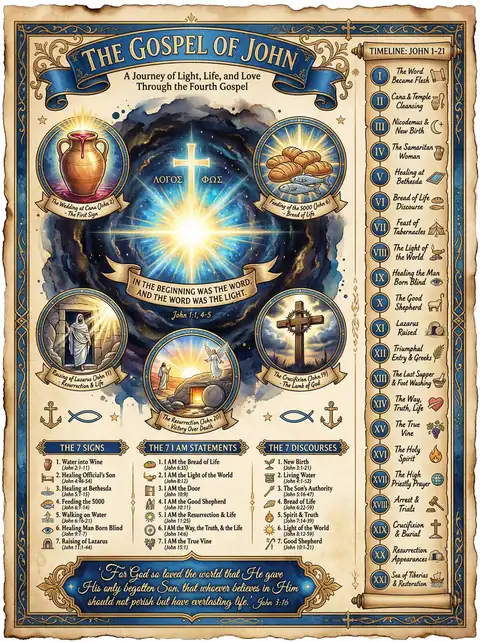
Full-page visual overview of The Gospel of John — key events, themes, and structure at a glance
How to Study the Gospel of John
To study the Gospel of John, begin with John 1:1–18, follow the seven signs and seven "I am" statements, and keep John 20:31 in view: John writes so that readers may believe Jesus is the Messiah, the Son of God, and have life in his name.
- 1 Begin with the Prologue (John 1:1–18): it is the theological lens for the entire Gospel.
- 2 Follow the seven signs: water to wine, healing the official's son, the pool of Bethesda, feeding the five thousand, walking on water, healing the blind man, raising Lazarus.
- 3 Pay attention to the seven "I am" statements: Bread of Life, Light of the World, Gate, Good Shepherd, Resurrection and Life, Way/Truth/Life, True Vine.
- 4 Notice the extended discourses — especially John 3 (new birth), John 6 (bread of life), and John 14–17 (the Upper Room Discourse).
- 5 Watch the responses to Jesus: belief, rejection, confusion, and growing faith.
- 6 Read the Passion narrative slowly (chapters 18–19): John emphasizes that Jesus goes to the cross as the sovereign king, not a helpless victim.
- 7 End with the resurrection appearances (chapters 20–21) and the invitation to believe.
John was written so that you may believe that Jesus is the Messiah, the Son of God, and that by believing you may have life in his name (John 20:31). Keep that purpose in view as you read — every passage is an invitation to faith.
John Chapter-by-Chapter Summary
The Gospel of John is traditionally associated with the apostle John and is often dated near the end of the first century. Unlike the Synoptic Gospels, John selects seven signs and seven "I am" declarations to make one central argument: Jesus is the eternal Son of God, and believing in him brings eternal life.
The Word Made Flesh — Early Ministry
- 1:1–18 The Prologue: "In the beginning was the Word." John identifies Jesus as the eternal Logos — the divine Word through whom all things were made — who became flesh and dwelt among us.
- 1:19–51 John the Baptist testifies: "Behold, the Lamb of God." The first disciples are called — Andrew, Peter, Philip, and Nathanael. Jesus is identified as the Son of God and King of Israel.
- 2:1–12 The Wedding at Cana — the first sign. Jesus turns water into wine, revealing His glory. The disciples believe in Him.
- 2:13–25 Jesus cleanses the Temple: "Destroy this temple, and in three days I will raise it up." He speaks of the temple of His body — pointing to the resurrection.
- 3:1–21 Nicodemus visits at night. Jesus declares: "You must be born again." The most famous verse in Scripture: "For God so loved the world..." (3:16).
- 4:1–42 The Samaritan Woman at the Well. Jesus offers "living water." She becomes the first evangelist, bringing her whole village to meet the Messiah.
The Book of Signs — Seven Miracles
- 5:1–47 Healing at Bethesda — the third sign. Jesus heals a man who had been ill for 38 years on the Sabbath, triggering the first serious conflict with Jewish leaders.
- 6:1–71 Feeding 5,000 (sign 4) and walking on water (sign 5). The Bread of Life Discourse: "I am the bread of life; whoever comes to me shall not hunger." Many disciples turn back.
- 8:12–59 "I am the light of the world." Conflict intensifies. Jesus declares: "Before Abraham was, I am" — a direct claim to divine identity. The leaders attempt to stone Him.
- 9:1–41 Healing the man born blind (sign 6). A masterful narrative of growing faith versus hardening unbelief. The healed man worships Jesus; the Pharisees expel him.
- 10:1–42 "I am the good shepherd; I know my sheep." Jesus claims unity with the Father. The Feast of Dedication. Another attempt to stone Him.
- 11:1–12:50 The Raising of Lazarus (sign 7) — the climactic miracle. "I am the resurrection and the life." The Triumphal Entry into Jerusalem. Greeks seek Jesus: "The hour has come for the Son of Man to be glorified."
The Upper Room — Final Teachings
- 13:1–38 The Last Supper. Jesus washes the disciples' feet — a radical act of servant leadership. He predicts His betrayal and Peter's denial. "A new commandment I give you: Love one another."
- 14:1–31 "I am the way, the truth, and the life." Jesus promises the Holy Spirit — the Paraclete (Advocate/Helper) — who will guide them into all truth. "Peace I leave with you; my peace I give you."
- 15:1–27 "I am the true vine." The call to abide in Christ. "Greater love has no one than this: to lay down one's life for one's friends." The world will hate those who follow Jesus.
- 16:1–33 The Spirit will convict the world of sin, righteousness, and judgment. "In this world you will have trouble. But take heart! I have overcome the world."
- 17:1–26 The High Priestly Prayer — the longest recorded prayer of Jesus. He prays for Himself (glory), His disciples (protection), and all future believers (unity): "that they may all be one."
- 17:20–26 "I in them and you in me — so that they may be brought to complete unity." The vision of the church: a community whose unity reflects the unity of the Trinity.
Passion, Resurrection & Commission
- 18:1–19:16 Arrest in Gethsemane. Peter's three denials. Jesus before Pilate: "My kingdom is not of this world." Pilate's verdict: "Pilate's declaration of innocence" The crowd chooses Barabbas.
- 19:17–42 The Crucifixion. "It is finished" (tetelestai — a commercial term meaning "paid in full"). Jesus entrusts His mother to John. Blood and water flow from His pierced side. Burial in a new tomb.
- 20:1–18 The Resurrection. Mary Magdalene finds the empty tomb. Peter and John run to see. Jesus appears to Mary: "Mary!" She recognizes Him and becomes the first witness to the risen Christ.
- 20:19–31 Jesus appears to the disciples. Thomas doubts, then confesses: "My Lord and my God!" — the climactic declaration of the Gospel. The purpose statement: "that you may believe" (20:31).
- 21:1–25 Epilogue: Breakfast on the beach. Jesus restores Peter with three questions mirroring three denials: "Do you love me?... Feed my sheep." The commission is renewed. The Gospel ends: the world could not contain the books.
- 21:15–19 "Simon son of John, do you love me?" — three times. Peter's restoration is complete. He is recommissioned to shepherd the flock, and Jesus predicts the manner of Peter's death.
Key Themes in John
The Gospel of John develops four interlocking theological themes that together answer the question Jesus himself poses throughout the narrative: Who do you say that I am?
Jesus as the Eternal Word (Logos)
John opens with the most theologically dense prologue in Scripture: "the Word's eternal divine identity" (1:1). By identifying Jesus as the Logos, John places Him at the center of creation, revelation, and redemption. The Incarnation — "the Word became flesh" (1:14) — is the hinge of human history: the eternal God entering time and space.
Read John 1:14 in your preferred translation.
John 1:14
Application: The Incarnation means God is not distant or indifferent. He entered our suffering, our limitations, our world — and that changes everything about how we relate to Him.
Belief and Eternal Life
John uses the word "believe" (pisteuo) 98 times — more than any other New Testament book. This is not intellectual assent but a living, trusting relationship with Jesus. The purpose of the Gospel is explicitly stated: "John's purpose: faith and life in Jesus" (20:31). Eternal life, in John, is not primarily future — it begins now.
Read John 3:16 in your preferred translation.
John 3:16
Application: John's Gospel is an extended invitation to believe. Every miracle, every discourse, every confrontation is designed to bring the reader to a decision: Who do you say Jesus is?
Light vs. Darkness
John structures his Gospel around the cosmic conflict between light and darkness. Jesus declares: "I am the light of the world" (8:12; 9:5). The darkness does not overcome the light (1:5), yet people love darkness rather than light because their deeds are evil (3:19). This is not merely metaphor — it describes the fundamental spiritual choice every person faces.
Read John 1:5 in your preferred translation.
John 1:5
Application: Living in the light means bringing our whole lives — including our failures and secrets — into the presence of Christ, trusting that His light heals rather than condemns.
The Holy Spirit as Paraclete
Unique to John's Gospel are the five Paraclete (Advocate/Helper) passages in the Upper Room Discourse (John 14–16). Jesus promises that the Spirit will teach, remind, testify, convict, and guide believers into all truth. The Spirit is not a consolation prize for Jesus's absence — Jesus says it is better that He goes, so the Spirit can come (16:7).
Read John 14:26 in your preferred translation.
John 14:26
Application: The Holy Spirit is the living presence of Christ in every believer. Prayer, Scripture reading, and community are not just disciplines — they are the means by which the Spirit guides us into truth.
John Symbols and Imagery
Living Water
Historical Context
Jesus spoke of 'living water' to the Samaritan woman at Jacob's Well (John 4:10–14) — a well with deep historical significance for both Jews and Samaritans. In the ancient Near East, running (living) water was prized over stagnant cistern water for its purity and life-giving properties.
Theological Meaning
Living water is a symbol of the Holy Spirit (John 7:37–39) and eternal life. Jesus offers what no physical water can provide: a spring 'welling up to eternal life.' The image connects to Ezekiel's river of life (Ezekiel 47) and the river of the water of life in Revelation 22.
The Bread of Life
Historical Context
After feeding 5,000 people with five loaves and two fish (John 6:1–15), Jesus used the crowd's hunger for more bread as a teaching moment. The manna in the wilderness (Exodus 16) provided the backdrop for His claim to be the true bread from heaven.
Theological Meaning
Jesus is not merely a provider of bread — He is the bread. 'Jesus as the true source of life' (6:35). The Eucharist (communion) echoes this symbolism: bread and wine as the body and blood of Christ.
Light of the World
Historical Context
In John 8:12, Jesus speaks during the Feast of Tabernacles, when four massive golden menorahs illuminated the Temple courts — a celebration of the pillar of fire that guided Israel in the wilderness.
Theological Meaning
Light is the first creation of God (Genesis 1:3) and the defining characteristic of God's nature (1 John 1:5). Jesus as the Light of the World means He reveals truth, exposes sin, and guides the path of life. In Revelation 21:23, the New Jerusalem needs no sun because 'the Lamb is its lamp.'
The Good Shepherd
Historical Context
Shepherding was central to Israelite life and identity. The great leaders — Abraham, Moses, David — were all shepherds. Psalm 23 and Ezekiel 34 established the 'shepherd' as the primary image of God's care for His people. Jesus's audience would have immediately understood the weight of His claim.
Theological Meaning
In John 10:11, Jesus identifies himself as the Good Shepherd, an image that anticipates his sacrificial death. Unlike hired hands who flee, the Good Shepherd knows each sheep by name. This image of intimate, sacrificial care defines the nature of Christ's relationship with His followers.
The True Vine
Historical Context
The vine was a central symbol of Israel in the Old Testament (Psalm 80:8–16; Isaiah 5:1–7; Ezekiel 15). Israel was God's vine, planted and tended by Him — yet repeatedly failing to bear fruit. In John 15:1, Jesus presents himself as the fulfillment of what Israel was called to be.
Theological Meaning
Abiding in the vine is the key to fruitfulness. Branches that do not abide wither; those that do bear 'much fruit' (15:5). The image describes the Christian life as one of organic connection to Christ — not striving, but remaining. Love is the fruit; the Father is glorified when disciples bear much fruit.
John Bible Study Journal and Reflection Questions
A printable journal template designed for verse-by-verse reflection, prayer, and personal response to Scripture.
John Bible Small Group Discussion Guide
These 8 questions are designed for a 60–90 minute small group session. Begin with the icebreaker, then work through observation, interpretation, and application questions. Close with the prayer prompt.
If you could have a one-on-one conversation with Jesus — like Nicodemus at night or the Samaritan woman at the well — what is the one question you would ask Him?
Read John 1:1–14 aloud. John calls Jesus the "Word" (Logos). What does it mean that God communicated Himself through a person rather than just words or laws? What does this tell us about God's character?
The Logos concept would have resonated with both Jewish readers (the creative Word of God in Genesis) and Greek readers (the rational principle ordering the universe). John claims Jesus is both.
John records seven "I AM" statements of Jesus (6:35; 8:12; 10:9; 10:11; 11:25; 14:6; 15:1). Choose one that resonates with you most. Why does that particular image of Jesus speak to your current season of life?
In John 11, Jesus weeps at Lazarus’s tomb — even though He knows He is about to raise him. Why do you think Jesus wept? What does this tell us about how God relates to human suffering?
This is the shortest verse in the Bible (John 11:35) and one of the most theologically significant. Jesus does not weep because He is helpless — He weeps because He is present. God is not unmoved by our grief.
Jesus prays in John 17 that His followers would be "one" as He and the Father are one. What kind of unity is He describing? How does the disunity in the church today affect its witness to the world?
John 15:4 contains one of the most repeated commands in John's Gospel. What does it practically look like to "abide" in Christ in your daily life? What habits or practices help you stay connected to the vine?
Peter is restored in John 21 through three questions — mirroring his three denials. Is there an area of your life where you need to receive Christ's restoration rather than carrying guilt? What would it look like to accept that restoration this week?
Close by reading John 3:16 together slowly. Have each person replace "the world" with their own name: "God's personal love in Christ" Sit in silence for 30 seconds, then share one word that captures how that truth makes you feel. Close in prayer, thanking God for the specific, personal nature of His love.
John Bible Study Questions and Answers
Deeper questions, richer answers — exploring the historical, theological, and personal dimensions of John.
Day 95 · In the Beginning Was the Word
Why does John open with ‘In the beginning was the Word’ — what is he claiming about Jesus?
John's prologue is one of the most theologically dense passages in all of Scripture. The Greek word Logos (Word) carried enormous weight in both Jewish and Greek thought. For Greek philosophers, the Logos was the rational principle ordering the cosmos. For Jewish readers, it echoed the creative speech of God in Genesis 1. By opening with “In the beginning” — the exact words that open Genesis — John is making a staggering claim: Jesus is not a new figure in history, but the eternal agent of creation itself. The Word did not begin to exist; he “was” — a continuous state of being before time. John 1:14 then delivers the shock: this eternal Word “became flesh and dwelt among us.” The incarnation is not God visiting from a distance; it is God taking up permanent residence in human form.
Read John 1:1 in your preferred translation.
Nicodemus came to Jesus at night — why does that detail matter, and what does it say about spiritual seeking?
John 3 introduces Nicodemus, a Pharisee and member of the Sanhedrin, who comes to Jesus “by night.” This is not a throwaway detail. In John's Gospel, light and darkness are loaded symbols — light represents truth, life, and revelation; darkness represents concealment, fear, and spiritual blindness. Nicodemus comes at night because he is not yet ready to be seen. He is curious but cautious, intellectually drawn but socially constrained. Jesus meets him exactly where he is — not with condemnation, but with the most famous verse in Scripture: “For God so loved the world...” Many people begin their spiritual journey in the dark, asking questions they are afraid to ask publicly. John's Gospel says: that is still a beginning.
Read John 3:1–2 in your preferred translation.
How does BibleLum help beginners see the deeper structure of John's Gospel?
John's Gospel is structured around seven signs and seven “I Am” declarations — a deliberate literary architecture that most readers never notice because they read the Gospel linearly rather than structurally. BibleLum helps beginners see how each sign corresponds to an “I Am” statement, building a cumulative case for Jesus's identity. The turning of water into wine (sign 1) connects to “I am the true vine” (I Am 7). The feeding of five thousand (sign 5) connects to “I am the bread of life” (I Am 2). Reading John with this architecture in mind transforms it from a biography into a carefully constructed theological argument — one that John himself states explicitly in John 20:31.
Read John 20:31 in your preferred translation.
Day 107 · I Am the Bread of Life
When Jesus says ‘I am the bread of life,’ what Old Testament memory is he deliberately invoking?
The feeding of the five thousand in John 6 immediately triggers a crowd comparison to Moses and the manna in the wilderness (Exodus 16). The crowd asks: “What sign do you do? Our fathers ate manna in the wilderness.” They are testing Jesus against the greatest miracle worker in Jewish memory. Jesus reframes the entire comparison. Moses did not give the bread from heaven — God did. And now God is giving a new bread: not physical sustenance that lasts a day, but living bread that sustains eternally. The “I Am” formula here (Greek: egō eimi) echoes the divine name revealed to Moses at the burning bush (Exodus 3:14). Jesus is not just claiming to be greater than Moses; he is claiming to be the same God who fed Israel in the desert.
Read John 6:35 in your preferred translation.
Many disciples walked away after the ‘bread of life’ discourse — what does their departure reveal about costly faith?
John 6:66 records one of the most sobering verses in the Gospels: “After this many of his disciples turned back and no longer walked with him.” This was not the religious authorities rejecting Jesus — these were people who had already been following him. The bread of life discourse is deliberately difficult. Jesus speaks of eating his flesh and drinking his blood — language that was offensive, even scandalous, to a Jewish audience. He does not soften it or explain it away. When the crowd thins, Jesus turns to the Twelve and asks: “Do you want to go away as well?” Peter's answer is one of the most honest confessions in Scripture: “Lord, to whom shall we go? You have the words of eternal life.” Faith is not always comfortable certainty; sometimes it is staying when you do not fully understand, because there is nowhere else to go.
Read John 6:68–69 in your preferred translation.
How does John 1–5 establish the pattern of ‘sign → misunderstanding → deeper teaching’ that shapes the whole Gospel?
BibleLum helps readers notice a recurring three-part pattern throughout John's Gospel: Jesus performs a sign or makes a statement; the audience misunderstands it literally; Jesus then uses the misunderstanding as a doorway to deeper spiritual truth. Nicodemus hears “born again” and asks about re-entering the womb (John 3). The Samaritan woman hears “living water” and asks about a well (John 4). The crowd hears “bread from heaven” and thinks about food (John 6). In each case, the literal misunderstanding is not a failure — it is John's literary device to invite the reader to make the same journey from surface to depth. The question John poses to every reader is: will you stay at the literal level, or will you follow Jesus into what he actually means?
Read John 3:8 in your preferred translation.
Day 108 · I Am the Good Shepherd
What does ‘I am the good shepherd’ mean against the backdrop of Ezekiel 34 and Israel's failed leaders?
The shepherd metaphor in John 10 is not a gentle pastoral image — it is a political indictment. In Ezekiel 34, God pronounces devastating judgment on the “shepherds of Israel” — the kings and priests who exploited the flock rather than protecting it. God declares: “I myself will search for my sheep.” When Jesus says “I am the good shepherd,” he is claiming to be the fulfillment of Ezekiel's prophecy — the divine shepherd who comes personally to rescue what the human leaders failed to protect. The contrast is explicit: the hired hand flees when the wolf comes; the good shepherd lays down his life. This is not a metaphor for gentle leadership. It is a claim to be the God of Israel, arriving in person to do what no human king ever could.
Read John 10:11 in your preferred translation.
Jesus says ‘my sheep hear my voice’ — what does it practically mean to hear and recognize Jesus's voice today?
John 10:27 is one of the most intimate verses in the Gospel: “My sheep hear my voice, and I know them, and they follow me.” The Greek word for “know” here (ginōskō) implies relational, experiential knowledge — not mere intellectual awareness. In the ancient Near East, a shepherd's voice was distinctive — sheep learned to distinguish their shepherd's call from all others. Jesus is describing a relationship built over time through consistent exposure. Practically, this means that hearing Jesus's voice is not usually a dramatic auditory experience; it is the accumulated familiarity that comes from sustained engagement with Scripture, prayer, and community. The sheep who follow are not those who hear perfectly, but those who keep orienting themselves toward the voice they have learned to trust.
Read John 10:27 in your preferred translation.
How do the seven “I Am” statements in John form a complete portrait of Jesus's identity?
BibleLum helps beginners see how all seven “I Am” declarations in John's Gospel and reveals that they are not random self-descriptions — they form a deliberate theological portrait addressing every dimension of human need. The seven declarations are: Bread of Life (sustenance), Light of the World (guidance), Gate of the Sheep (access and protection), Good Shepherd (care and sacrifice), Resurrection and the Life (victory over death), Way, Truth, and Life (direction and reality), and True Vine (belonging and fruitfulness). Together they answer the deepest questions of human existence: What will sustain me? What will guide me? Who will protect me? What happens when I die? How do I find purpose? Each “I Am” is Jesus's answer to a specific human hunger.
Read John 14:6 in your preferred translation.
Day 109 · Lazarus and the Upper Room Discourse
Why does Jesus weep at Lazarus's tomb if he already knows he will raise him?
John 11:35 — “Jesus wept” — is the shortest verse in the Bible and one of the most theologically significant. The Greek verb used is edakrysen, a quiet, personal weeping, distinct from the loud wailing of the mourners around him. Jesus is not performing grief; he is experiencing it. The text also says Jesus was “deeply moved in his spirit and greatly troubled” (v.33) — the Greek word embrimaomai suggests something closer to indignation or anguish than mere sadness. Jesus is not weeping because he has lost hope; he is weeping because death itself is wrong. It is an intrusion into the world God made for life. His tears are not a contradiction of his power — they are a revelation of his character. The one who has power over death is also the one who grieves most deeply over its existence.
Read John 11:35 in your preferred translation.
In the Upper Room, Jesus washes his disciples' feet — what is he teaching about power and service?
Foot-washing in the first century was the task of the lowest household slave — so menial that Jewish law specified it was beneath the dignity of a Jewish servant. When Jesus takes off his outer garment and wraps a towel around his waist, every person in the room understands the social statement he is making. Peter's protest — “You shall never wash my feet” — is not stubbornness; it is the natural response of someone whose entire understanding of honor and hierarchy is being overturned. Jesus's response is equally radical: “If I do not wash you, you have no share with me.” The act is not just a lesson in humility; it is a picture of the cross. The one with all authority empties himself of status to cleanse those who cannot cleanse themselves. John 13 is the enacted parable of what John 3:16 declares in words.
Read John 13:14 in your preferred translation.
What is the “new commandment” Jesus gives in John 13, and why is it actually new?
Jesus calls his command to love one another a “new commandment” (John 13:34) — but love was already commanded in Leviticus 19:18. What makes it new? BibleLum points out three dimensions of newness. First, the standard is new: “as I have loved you” — not as you love yourself (Leviticus), but as Christ loved, which means sacrificially and without condition. Second, the scope is new: the community of disciples is to be a visible sign to the watching world, not just an internal ethic. Third, the power source is new: the Holy Spirit, promised in John 14–16, will be the agent of this love, making possible what human willpower cannot sustain. The commandment is new because the covenant it belongs to is new.
Read John 13:34 in your preferred translation.
Day 110 · The Cross and Resurrection Appearances
John's crucifixion account differs from the other Gospels — what is he uniquely emphasizing?
John's passion narrative is the most theologically interpreted of the four Gospels. Where Mark emphasizes the abandonment and suffering, John presents Jesus as sovereignly in control throughout. Jesus carries his own cross (no Simon of Cyrene in John). His final words are not a cry of dereliction but a declaration: “It is finished” (tetelestai). The Greek word tetelestai was used in commercial contexts to mean “paid in full” — stamped on a receipt to indicate a debt completely settled. John frames the crucifixion not as a tragedy that happened to Jesus, but as a mission Jesus accomplished. The timing is also significant: John places the crucifixion at the hour when the Passover lambs were being slaughtered in the Temple. The Lamb of God dies at the exact moment the sacrificial system he fulfills is being enacted a few hundred meters away.
Read John 19:30 in your preferred translation.
Mary Magdalene mistakes the risen Jesus for a gardener — what does this moment reveal about how we recognize the risen Christ?
John 20 contains one of the most tender scenes in all of Scripture. Mary stands weeping outside the empty tomb. She turns and sees Jesus but does not recognize him — she thinks he is the gardener. Recognition comes only when he speaks her name: “Mary.” This is a deliberate echo of John 10:3 — “the sheep hear his voice, and he calls his own sheep by name.” The risen Christ is recognized not through visual proof but through personal address. Mary's experience suggests that encountering the risen Jesus is rarely a dramatic vision; it is more often the moment when, in the middle of grief or confusion, something speaks your name with a familiarity that can only come from one who truly knows you. The resurrection is not primarily an argument to be won; it is a name to be heard.
Read John 20:16 in your preferred translation.
Why does John end his Gospel with the story of Peter's restoration — and what does it mean for those who have failed?
John 21 is often called the “epilogue” of the Gospel, and its centerpiece is Jesus's threefold restoration of Peter. Peter had denied Jesus three times around a charcoal fire (John 18). Now, around another charcoal fire, Jesus asks him three times: “Do you love me?” BibleLum helps readers notice that the Greek text uses two different words for love in this exchange — agapaō (unconditional, self-giving love) and phileō (warm, affectionate love) — and that Jesus ultimately meets Peter where he is, accepting the lesser word Peter offers. The restoration is not conditional on Peter achieving a higher standard of love; it is offered in the midst of his limitation. The Gospel ends not with the most faithful disciple, but with the one who failed most publicly — and was restored most personally. John's final message is that the risen Christ specializes in restoring those who thought they had disqualified themselves.
Read John 21:15 in your preferred translation.
Day 157 · The Upper Room Discourse — Deep Dive
Who is the “Helper” (Paraclete) Jesus promises in John 14–16, and why is his coming better than Jesus staying?
The Greek word Paraclete (translated “Helper,” “Advocate,” or “Comforter”) appears five times in John 14–16 and nowhere else in the Gospels. It literally means “one called alongside” — a legal advocate, a counselor, a companion in difficulty. Jesus makes a startling claim in John 16:7: “It is to your advantage that I go away, for if I do not go away, the Helper will not come to you.” How could the departure of Jesus be advantageous? Because the incarnate Jesus was physically limited — present in one place at one time. The Spirit is not. The Spirit's indwelling means that every believer in every century has the same access to divine presence that the twelve disciples had in Galilee. The Helper does not replace Jesus; he makes Jesus universally and permanently accessible.
Read John 14:26 in your preferred translation.
“In the world you will have tribulation” — how does Jesus's promise of peace coexist with the reality of suffering?
John 16:33 contains both the most honest acknowledgment of suffering in the Gospels and the most confident declaration of victory: “In the world you will have tribulation. But take heart; I have overcome the world.” The peace Jesus promises in John 14:27 is explicitly “not as the world gives” — it is not the absence of conflict or the resolution of circumstances. It is a settled confidence rooted in a completed reality. Jesus speaks in the perfect tense: “I have overcome” — not “I will overcome” or “I am overcoming.” The victory is already accomplished; the disciples are living in its aftermath. This means that suffering does not contradict the promise of peace; it is the arena in which the peace that “surpasses understanding” becomes visible and credible to a watching world.
Read John 16:33 in your preferred translation.
What does Jesus's High Priestly Prayer (John 17) reveal about his deepest concern for his followers?
John 17 is the longest recorded prayer of Jesus in the Gospels — sometimes called the High Priestly Prayer because Jesus intercedes for his people before his death, just as the High Priest interceded for Israel on the Day of Atonement. BibleLum helps readers see three concentric circles of concern in the prayer: Jesus prays first for himself (v.1–5), then for the eleven disciples (v.6–19), then for all future believers (v.20–26). The dominant theme throughout is unity: “that they may all be one, just as you, Father, are in me, and I in you.” Jesus's deepest concern on the night of his arrest is not his own safety — it is the relational coherence of the community he is leaving behind. The prayer reveals that Christian unity is not a secondary organizational preference; it is the primary apologetic for the truth of the Gospel.
Read John 17:20–21 in your preferred translation.
Day 216 · The Word Became Flesh
John 1:14 says the Word ‘dwelt among us’ — what does the Greek word for ‘dwelt’ reveal about the incarnation?
The Greek word translated “dwelt” in John 1:14 is eskēnōsen — literally, “pitched his tent” or “tabernacled.” This is a direct allusion to the Tabernacle of Exodus, the portable sanctuary where God's glory (the Shekinah) dwelt among Israel in the wilderness. John is making a precise theological claim: the incarnation is the new and final Tabernacle. What the tent in the desert was temporarily — a dwelling place of divine glory among the people — Jesus is permanently and personally. John 1:14 continues: “and we have seen his glory, glory as of the only Son from the Father.” The disciples who walked with Jesus were not merely watching a great teacher; they were witnessing the glory of God in human form, the fulfillment of every Temple and every sacrifice that preceded him.
Read John 1:14 in your preferred translation.
John says Jesus came to his own people and ‘his own people did not receive him’ — what does rejection by the familiar teach us?
John 1:11 is one of the most poignant verses in the prologue: “He came to his own, and his own people did not receive him.” The word “own” (idia) refers to his own possession, his own home — Israel, the covenant people who had been waiting for exactly this moment. The tragedy is not that strangers rejected Jesus; it is that those most prepared to recognize him were the ones who missed him. Familiarity with the forms of religion can become the greatest barrier to encountering its substance. The Pharisees knew the Scriptures better than anyone — and used that knowledge to condemn the one the Scriptures pointed to. John's prologue warns that proximity to truth is not the same as receiving truth. The question John poses to every reader is not “Do you know about Jesus?” but “Have you received him?”
Read John 1:12 in your preferred translation.
How does John 1 function as a ‘lens’ that shapes how we read everything that follows in the Gospel?
BibleLum describes John's prologue as a “theological overture” — like the opening of a symphony that introduces every major theme before the full development begins. Every major concept in the Gospel is seeded in John 1:1–18. Light and darkness (v.4–5) will structure the entire narrative. Life (v.4) will be the central gift Jesus offers. Witness and testimony (v.7–8) will be the mechanism by which truth spreads. Grace and truth (v.14) will characterize every encounter Jesus has. Receiving versus rejecting (v.11–12) will be the fundamental choice every character faces. Reading John with the prologue as a lens transforms the Gospel from a sequence of events into a unified argument — each story an illustration of what the prologue has already declared.
Read John 1:4 in your preferred translation.
Day 218 · The Crucifixion
Why does John record that a soldier pierced Jesus's side, and what is the theological significance of the blood and water?
John 19:34 records a detail absent from the other Gospels: after Jesus died, a soldier pierced his side with a spear, and “at once there came out blood and water.” John emphasizes this with unusual insistence: “He who saw it has borne witness — his testimony is true, and he knows that he is telling the truth” (v.35). The medical explanation is that the blood and water came from the pericardial sac around the heart — evidence that Jesus had already died from cardiac rupture, confirming the reality of his death against later claims that he merely fainted. But John's theological intent runs deeper. Throughout his Gospel, water symbolizes the Spirit (John 7:37–39) and blood symbolizes the sacrificial life poured out. The pierced side of Christ becomes the source from which the church is born — an echo of Eve formed from Adam's side, and a foreshadowing of the sacraments that would sustain the community he was founding.
Read John 19:34 in your preferred translation.
Jesus entrusts his mother to the Beloved Disciple from the cross — what does this act of care reveal about his priorities in dying?
John 19:26–27 records that even in the extremity of crucifixion, Jesus notices his mother Mary standing at the foot of the cross and entrusts her care to the Beloved Disciple. “Woman, behold your son.” “Behold, your mother.” And from that hour the disciple took her to his own home. This is not a sentimental detail. In a culture where a widow's security depended entirely on male family members, Jesus is ensuring his mother will be provided for after his death. He is dying — and he is doing practical family care. This moment reveals something essential about the character of Jesus: his cosmic mission does not make him indifferent to the particular, immediate needs of the people he loves. The one who is reconciling the world to God is simultaneously making sure his mother has a home. Faithfulness to the large does not excuse neglect of the near.
Read John 19:26 in your preferred translation.
How does John's crucifixion account fulfill the Passover typology established at the beginning of his Gospel?
When John the Baptist first sees Jesus in John 1:29, he declares: “Behold, the Lamb of God, who takes away the sin of the world!” This guide traces how John's entire Gospel is structured to fulfill this identification. John places the crucifixion on the Day of Preparation for Passover (John 19:14) — the day the Passover lambs were slaughtered in the Temple. The soldiers do not break Jesus's legs (John 19:33), fulfilling the Passover requirement that no bone of the lamb be broken (Exodus 12:46). The hyssop branch used to offer Jesus sour wine (John 19:29) is the same plant used to apply the Passover blood to the doorposts in Egypt. John has constructed a meticulous typological argument: Jesus is not merely dying at Passover time; he is the Passover, the final and definitive sacrifice that all previous Passovers were pointing toward.
Read John 19:36 in your preferred translation.
Day 248 · The Son of God — Signs and Belief
John selects only seven signs from Jesus's ministry — what is the principle behind his selection?
John explicitly states in John 20:30–31 that Jesus performed “many other signs” not recorded in the Gospel. His selection of seven is deliberate — seven being the number of completeness in Hebrew thought, signaling that these signs form a complete and sufficient testimony. BibleLum helps readers see how the seven signs correspond to the “I Am” declarations, each chosen to demonstrate a specific dimension of Jesus's identity and mission: water to wine (abundance and new creation), healing the official's son (life over death at a distance), healing the paralytic (authority over law and sin), feeding five thousand (provision and the bread of life), walking on water (divine sovereignty over chaos), healing the blind man (light of the world), raising Lazarus (resurrection and life). Together they constitute a cumulative, escalating argument for the Gospel's thesis: Jesus is the Son of God.
Read John 20:30–31 in your preferred translation.
The blind man in John 9 is healed and then interrogated — what does his progression from ‘a man called Jesus’ to ‘Lord’ teach about growing faith?
John 9 traces one of the most remarkable faith journeys in the Gospel. When first asked about his healer, the man born blind says simply: “The man called Jesus.” When pressed by the Pharisees, he says: “He is a prophet.” When thrown out of the synagogue and met by Jesus again, he says: “Lord, I believe” — and worships him. The progression is not accidental. The man begins with what he knows from experience (a man healed me), moves to theological inference (a prophet did this), and arrives at personal commitment (Lord, I believe) only after he has been cast out by the religious establishment and met Jesus face to face a second time. John seems to suggest that genuine faith often develops through stages, and that the willingness to hold what you know while remaining open to more is itself a form of faithfulness. The Pharisees, who claim to see, remain blind; the man who was blind, comes to see.
Read John 9:38 in your preferred translation.
How does the structure of John 1–12 (“The Book of Signs”) differ from John 13–21 (“The Book of Glory”)?
Scholars have long recognized that John's Gospel divides into two major sections, sometimes called the “Book of Signs” (chapters 1–12) and the “Book of Glory” (chapters 13–21). BibleLum helps readers trace the structural and thematic shift between them. In the Book of Signs, Jesus is largely public — performing miracles, engaging crowds, debating religious leaders. The audience is broad and the response is mixed. In the Book of Glory, Jesus withdraws entirely to his inner circle — the Upper Room discourse (chapters 13–17) is addressed only to the Twelve, and the passion narrative is intimate and focused. The shift marks a transition from demonstration to formation: Jesus has shown who he is; now he is preparing those who will carry that identity into the world after his departure. The signs were for the crowd; the glory is for the community.
Read John 13:1 in your preferred translation.
Day 298 · For God So Loved the World
John 3:16 is the most quoted verse in the Bible — but what does ‘the world’ (kosmos) actually mean in John's theology?
The Greek word kosmos appears 78 times in John's Gospel — more than in any other New Testament book. It is one of John's most complex and layered terms, carrying at least three distinct meanings. First, kosmos means the created order — the physical universe God made and declared good. Second, it means humanity in its totality — every person regardless of ethnicity, status, or religious background. Third, and most distinctively in John, kosmos refers to the human system organized in opposition to God — the world of darkness, unbelief, and hostility to the light. John 3:16 uses kosmos in the second sense: God's love extends to every human being without exception. But the same Gospel that declares this universal love also warns that “the world” in the third sense will hate those who follow Jesus (John 15:18–19). The love is universal; the reception is not.
Read John 3:16 in your preferred translation.
John 3:16 says God ‘gave’ his Son — what does the language of gift reveal about the nature of salvation?
The verb “gave” (edōken) in John 3:16 is in the aorist tense — a completed, decisive action. God did not loan, lend, or temporarily deploy his Son; he gave. The language of gift is significant because a gift, by definition, cannot be earned, deserved, or repaid. John 3:16 is often quoted as a statement about human belief, but its grammatical center of gravity is divine action: God loved, God gave. The human response (“whoever believes”) is the condition for receiving the gift, not the cause of the giving. This distinction matters enormously for how people relate to God. If salvation were earned, it would produce pride in the successful and despair in the failing. Because it is given, it produces gratitude in everyone who receives it — and an awareness that the ground at the foot of the cross is perfectly level.
Read Ephesians 2:8 in your preferred translation.
How does John 3:16 function as a summary of the entire Gospel — and why does John place it in a conversation rather than a sermon?
BibleLum points out that John 3:16 appears not in a public sermon or formal teaching, but in a private midnight conversation with a single inquirer — Nicodemus, a religious leader who came to Jesus in secret. This placement is theologically intentional. The most universal statement in Scripture (“God so loved the world”) is spoken to one person, in the dark, who is not yet ready to believe publicly. John seems to be saying that the cosmic scope of God's love does not bypass the individual; it arrives through personal encounter. The Gospel is not primarily a public announcement to be broadcast; it is a word spoken to a particular person in their particular darkness. Every reader of John 3:16 is invited to receive it the way Nicodemus did — not as a theological proposition to be debated, but as a word addressed personally, in the night, to them.
Read John 3:17 in your preferred translation.
John Bible Study Key Characters
Meet the people whose faith, failure, and faithfulness shaped the story.
Jesus Christ
The eternal Word of God made flesh — the central figure whose divine identity John systematically reveals.
John the Baptist
The forerunner who prepared the way for Jesus, declaring Him the Lamb of God.
Mary Magdalene
The first witness to the resurrection, who encountered the risen Jesus in the garden.
Nicodemus
A Pharisee who came to Jesus by night and heard the famous words about being "born again."
John Bible Study Practical Application
Ancient wisdom, lived out today — practical steps rooted in Scripture.
Abide in Christ
The vine and branches metaphor calls believers to maintain a daily, dependent relationship with Jesus.
Love Is the Proof
Jesus says the world will know His disciples by their love for one another — love is the church's greatest witness.
Doubt Is Welcome
Thomas's honest doubt and Jesus's patient response show that questioning faith is part of the journey to deeper belief.
Related Study Packs
Common Questions About Studying the Gospel of John
How do I study the Gospel of John?
To study the Gospel of John, begin with the Prologue (John 1:1–18), which frames the entire Gospel. Then follow the seven signs — from water to wine to the raising of Lazarus — and the seven "I am" statements. Keep John 20:31 in view throughout: John writes so that readers may believe Jesus is the Messiah, the Son of God, and have life in his name.
What is the main message of the Gospel of John?
The main message of John is stated directly in John 20:31: "These are written so that you may believe that Jesus is the Messiah, the Son of God, and that by believing you may have life in his name." John presents Jesus as the eternal Word made flesh — the one who reveals the Father, offers eternal life, and calls people to faith.
What are the seven signs in the Gospel of John?
The seven signs in John are: (1) turning water into wine at Cana (John 2), (2) healing the royal official's son (John 4), (3) healing the paralyzed man at Bethesda (John 5), (4) feeding the five thousand (John 6), (5) walking on water (John 6), (6) healing the man born blind (John 9), and (7) raising Lazarus from the dead (John 11). Each sign is a public demonstration of Jesus' identity and glory.
What are the seven I AM statements in John?
The seven "I am" statements in John are: I am the Bread of Life (John 6:35), I am the Light of the World (John 8:12), I am the Gate (John 10:9), I am the Good Shepherd (John 10:11), I am the Resurrection and the Life (John 11:25), I am the Way, the Truth, and the Life (John 14:6), and I am the True Vine (John 15:1). These statements echo the divine name revealed to Moses in Exodus 3:14.
The Gospel of John
"Jesus performed many other signs in the presence of his disciples, which are not recorded in this book. But these are written that you may believe that Jesus is the Messiah, the Son of God, and that by believing you may have life in his name."
John 20:30–31
Start the 300-Day Bible Study Journey →