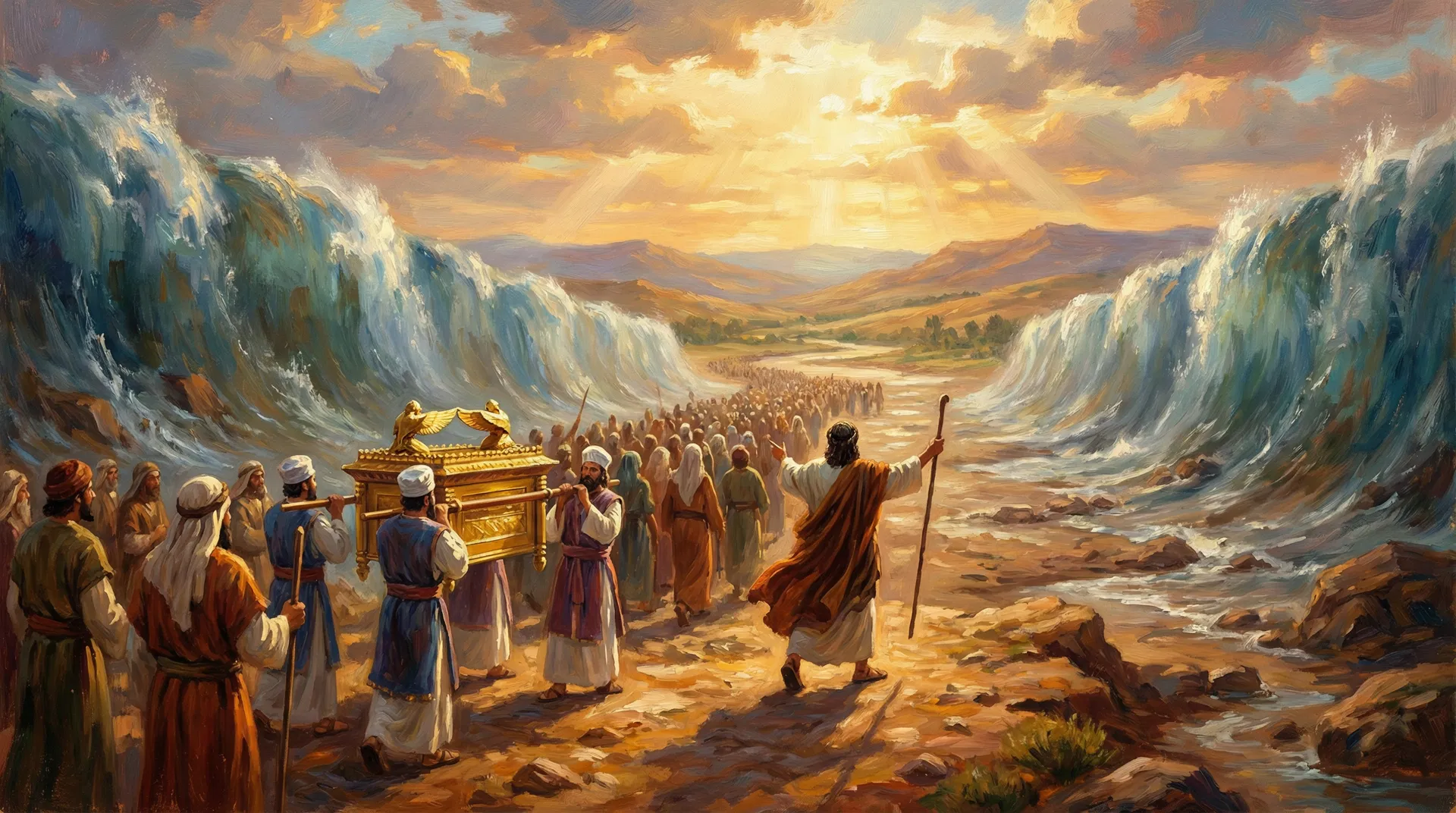
Joshua Bible Study Guide Overview
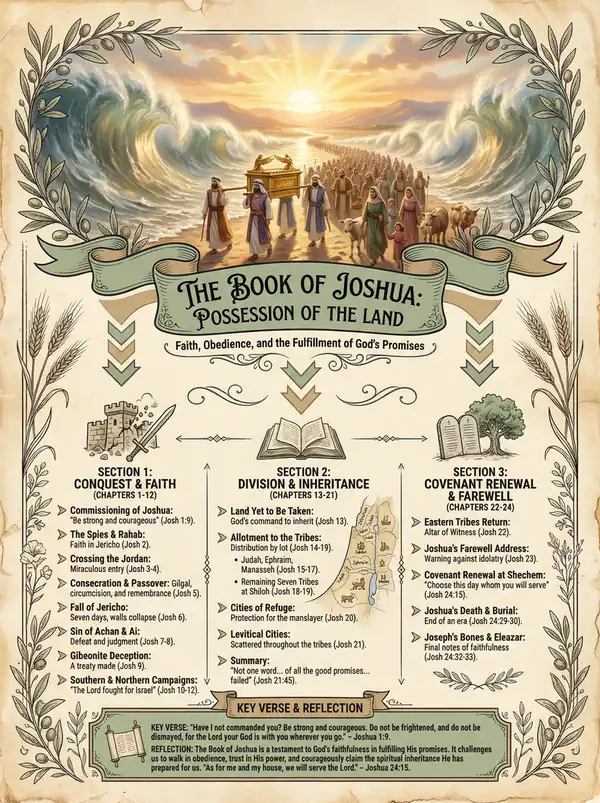
Full-page visual overview of The Book of Joshua — key events, themes, and structure at a glance
How to Study the Book of Joshua
To study Joshua, read it as the story of God keeping his promises, not simply as a record of ancient battles. Watch how the book moves from preparation, to conquest, to inheritance, to covenant renewal. Joshua is about courage, obedience, judgment, mercy, and the faithfulness of God across generations.
- 1 Start with God's promise to Abraham and Israel's journey from Egypt.
- 2 Notice the repeated command: "Be strong and courageous."
- 3 Watch how obedience and disobedience shape Israel's experience.
- 4 Pay attention to Rahab, Jericho, Achan, Caleb, and the land allotments.
- 5 Read the conquest narratives with both judgment and mercy in view.
- 6 End with Joshua 24: "Choose this day whom you will serve."
Joshua also raises difficult questions about violence, judgment, and the conquest of Canaan. A good study should not skip those questions, but read them within the larger story of covenant, idolatry, justice, and God's patience.
Joshua Chapter-by-Chapter Summary
Traditionally associated with Joshua and Israel's entrance into Canaan, the book records the fulfillment of God's promise to give the land to the Israelites. It is a story of faith, obedience, military conquest, and covenant renewal.
Preparation to Enter the Promised Land
- 1:1–9 God commissions Joshua: "Be strong and courageous." The divine charge sets the tone for the entire book.
- 1:10–18 Joshua prepares the people. The eastern tribes pledge loyalty and support.
- 2:1–24 Two spies are sent to Jericho. Rahab hides them and receives a promise of protection — a scarlet cord in her window.
- 3:1–17 The Jordan River parts as the priests carry the Ark of the Covenant. A miraculous crossing echoes the Red Sea.
- 4:1–24 Twelve stones are set up as a memorial at Gilgal — "so that all the peoples of the earth may know that the hand of the Lord is mighty."
- 5:1–15 Circumcision renewed at Gilgal. The Passover is celebrated. The manna ceases. Joshua meets the Commander of the Lord's army.
The Conquest of Canaan
- 6:1–27 The Fall of Jericho — seven days, seven priests, seven trumpets. The walls collapse. Rahab and her family are saved.
- 7:1–26 Achan's sin causes defeat at Ai. The lesson: one person's disobedience affects the whole community.
- 8:1–35 Ai is conquered by ambush. Joshua renews the covenant at Mount Ebal and Gerizim.
- 9:1–27 The Gibeonite deception — they trick Israel into a peace treaty. Joshua honors the oath despite the deception.
- 10:1–43 The sun stands still during the battle of Gibeon. Southern campaign victories.
- 11:1–12:24 Northern campaign. Summary of all conquered kings — 31 in total.
Division of the Land
- 13:1–7 "There remains yet very much land to be possessed." God's reminder that the task is ongoing.
- 14:1–15 Caleb's inheritance at Hebron — at 85 years old, he still claims his mountain: "Give me this hill country."
- 15–19 Allotments to the twelve tribes. Detailed boundary descriptions establish each tribe's inheritance.
- 20:1–9 Six Cities of Refuge established — places of safety for those who cause accidental death.
- 21:1–45 Levitical cities distributed. The section closes by emphasizing that every promise God made to Israel proved reliable.
- 22:1–34 The eastern tribes return home. A misunderstanding about an altar is resolved peacefully.
Farewell and Covenant Renewal
- 23:1–16 Joshua's first farewell address — warnings against intermarriage and idolatry. "Be very careful to love the Lord your God."
- 24:1–28 The Covenant at Shechem. Joshua recounts God's faithfulness from Abraham to the present. The people choose: "As for me and my house, we will serve the Lord."
- 24:29–33 Joshua dies at 110. Joseph's bones are buried. Eleazar the priest dies. An era ends.
Key Themes in Joshua
The Book of Joshua is built around four interlocking theological themes that speak powerfully to modern believers navigating their own "promised lands."
God's Faithfulness
The central message of Joshua is that God keeps every promise He makes. After 400 years in Egypt and 40 years in the wilderness, the Israelites finally enter the land God promised to Abraham (Genesis 12:7). The closing summary in Joshua 21:45 is definitive: "God's promises proved reliable"
Read Joshua 21:45 in your preferred translation.
Joshua 21:45
Application: When circumstances make God's promises seem distant or impossible, Joshua's testimony calls us to trust in God's perfect timing and unwavering faithfulness.
Obedience and Victory
Success in Joshua is consistently tied to obedience. When Israel follows God's unusual battle plans (marching around Jericho for seven days), they win. When Achan disobeys by taking forbidden plunder, the entire nation suffers defeat at Ai. The pattern is unmistakable: obedience leads to blessing; disobedience leads to defeat.
Read Joshua 1:7 in your preferred translation.
Joshua 1:7
Application: Spiritual growth often requires trusting God's methods even when they seem counterintuitive — the 'walls' in our lives fall through faithful obedience, not clever strategy.
Courage in the Face of Fear
The command "Be strong and courageous" appears four times in chapter 1 alone (1:6, 7, 9, 18). This repetition is intentional — God knew Joshua and the Israelites would face terrifying opposition. Courage in Joshua is not the absence of fear, but the choice to act in faith despite overwhelming odds.
Read Joshua 1:9 in your preferred translation.
Joshua 1:9
Application: God's call to courage is not a demand for fearlessness but an invitation to trust that His presence makes the impossible possible.
Judgment and Mercy Together
Joshua presents both the severity of God's judgment (the destruction of Canaanite cities) and the breadth of His mercy (Rahab, a Canaanite prostitute, is saved and becomes an ancestor of Jesus — Matthew 1:5). These two realities exist side by side, showing that God's justice never eliminates His capacity for redemptive mercy.
Read Joshua 6:25 in your preferred translation.
Joshua 6:25
Application: The story of Rahab reminds us that no background, past, or nationality places anyone beyond the reach of God's saving grace.
Joshua Symbols and Imagery
The Jordan River
Historical Context
The Jordan marked the boundary between the wilderness and the Promised Land. Crossing it required a miraculous act of God — the priests stepped into the water before it parted, requiring faith before sight.
Theological Meaning
The Jordan represents the transition from a life of wandering to a life of purpose and inheritance. In the New Testament, baptism in the Jordan (Jesus's baptism) echoes this theme of crossing into a new identity and calling.
The Walls of Jericho
Historical Context
Jericho was a heavily fortified city — the first and most formidable obstacle in Canaan. God's battle plan (march and shout) was humanly absurd, ensuring the victory would be unmistakably attributed to God alone.
Theological Meaning
The walls represent human systems of power and opposition that appear impenetrable. Their collapse through worship and obedience (not military might) teaches that spiritual battles are won through faithfulness, not force.
The Promised Land
Historical Context
The land of Canaan was the fulfillment of a 400-year-old promise made to Abraham (Genesis 12:7). Its conquest was not merely territorial — it was the vindication of God's covenant faithfulness across generations.
Theological Meaning
In the New Testament (Hebrews 4), the Promised Land becomes a type of the 'rest' that believers enter through faith in Christ. The land points forward to the ultimate inheritance — the new creation of Revelation 21–22.
Rahab's Scarlet Cord
Historical Context
Rahab hung a scarlet cord from her window as the agreed signal that would protect her household when Israel attacked Jericho (Joshua 2:18–21). It was a mark of identification and covenant protection.
Theological Meaning
The scarlet cord is widely understood as a type of the blood of Christ — a visible sign of salvation that protects those who trust in God's promise. Rahab's story also foreshadows the inclusion of Gentiles in God's redemptive plan.
The Memorial Stones
Historical Context
After crossing the Jordan, Joshua commanded twelve men to take twelve stones from the riverbed and set them up at Gilgal as a permanent memorial (Joshua 4:1–9).
Theological Meaning
The stones represent the importance of intentional remembrance. God's people are called to create 'memorials' — practices, stories, and rituals — that transmit faith to the next generation. 'When your children ask... tell them.'
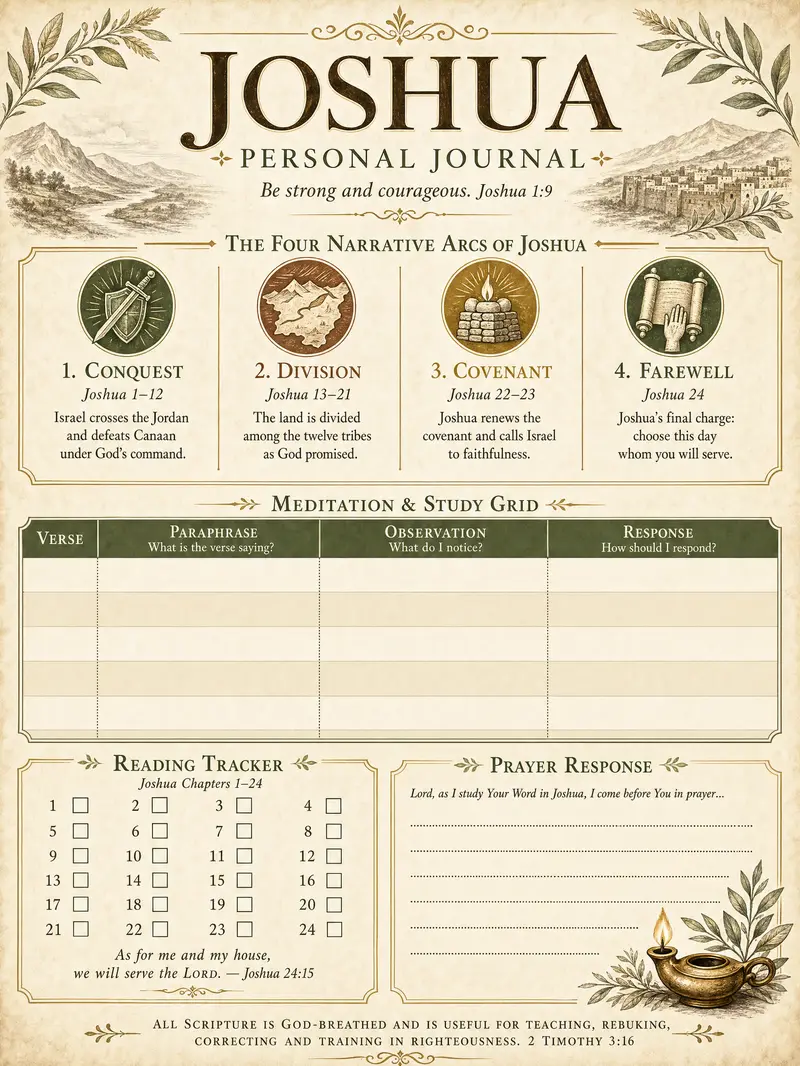
Joshua Bible Study Journal and Reflection Questions
A printable journal template designed for verse-by-verse reflection, prayer, and personal response to Scripture.
Joshua Bible Small Group Discussion Guide
These 8 questions are designed for a 60–90 minute small group session. Begin with the icebreaker, then work through observation, interpretation, and application questions. Close with the prayer prompt.
Have you ever faced a situation where you had to take a leap of faith before you could see the outcome — like the priests stepping into the Jordan? What happened?
Read Joshua 1:1–9 aloud. How many times does God tell Joshua to "be strong and courageous"? Why do you think God repeated this command so many times?
The repetition (4 times in 9 verses) suggests Joshua — and the people — genuinely needed this reassurance. Fear is not a sign of weak faith.
Compare Rahab's story (Joshua 2) with Achan's story (Joshua 7). What do these two contrasting characters reveal about how God responds to faith versus disobedience?
Joshua 21:45 concludes that God's promises to Israel proved reliable. What does this tell us about God's character? How does this promise apply to believers today?
The battle of Jericho required Israel to march silently for six days and then shout on the seventh. How does this unusual strategy challenge our tendency to rely on our own methods and wisdom?
Deeper question: What 'walls' in your life might require a strategy that looks foolish by worldly standards?
Joshua 24:15 presents a clear choice: "Choose this day whom you will serve." In what areas of your life are you currently facing a similar choice between serving God and serving other priorities?
Caleb, at 85 years old, still claimed his inheritance with full confidence (Joshua 14:12). What "hill country" — a dream, calling, or promise — have you been waiting to claim? What is holding you back?
Close by reading Joshua 1:9 together: "courage grounded in God's presence" Have each person share one area where they need courage this week, then pray for one another.
Joshua Bible Study Questions and Answers
Deeper questions, richer answers — exploring the historical, theological, and personal dimensions of Joshua.
Day 27 · Crossing the Jordan — Joshua 1–6
God commands Joshua to be strong and courageous four times in Joshua 1. Why does the text repeat this command, and what was Joshua actually afraid of?
The fourfold repetition of be strong and courageous (Joshua 1:6, 7, 9, 18) is not motivational rhetoric — it is a theological diagnosis. Joshua was facing the impossible: leading 2 million people across the Jordan River in flood stage, then conquering fortified Canaanite cities. His fear was legitimate. But God's command is grounded in a promise: I will be with you (v. 5). Courage in Joshua is not the absence of fear but the choice to act on God's word despite fear. The same phrase be strong and courageous appears in Deuteronomy 31 when Moses commissioned Joshua. The repetition in Joshua 1 is a literary echo — God is confirming that the same commission given through Moses is now directly given by God himself.
Read Joshua 1:9 in your preferred translation.
Rahab, a Canaanite prostitute, hid the Israelite spies and was saved because of her faith. What does her story tell us about who God includes in his story?
Rahab is one of the most surprising figures in the Bible. She is a Canaanite (the enemy), a prostitute (socially marginalized), and a woman in a patriarchal world — and yet she becomes the hero of Joshua 2. Her confession is one of the most complete statements of faith in the entire Old Testament. God's inclusion of Rahab is a deliberate subversion of ethnic and moral boundaries. Rahab appears in Matthew 1:5 in the genealogy of Jesus, and in Hebrews 11:31 and James 2:25 as a model of faith. Her story is not a footnote — it is a theological statement about grace: God saves people the world has written off.
Read Joshua 2:11 in your preferred translation.
The Jordan River crossing in Joshua 3 mirrors the Red Sea crossing in Exodus. What is the theological significance of this parallel?
The Jordan crossing is deliberately constructed as a second Exodus. The priests carry the ark into the water; the waters stop; the people cross on dry ground — exactly as at the Red Sea. God tells Joshua: I will exalt you in the eyes of all Israel, so they may know that I am with you as I was with Moses (3:7). The parallel is intentional: a new generation needed a new Exodus experience to confirm that the same God was still acting. BibleLum's pattern recognition engine traces the Exodus typology throughout the Old Testament: the Jordan crossing, Elijah parting the Jordan (2 Kings 2), and ultimately Jesus's baptism in the Jordan — each a new crossing that inaugurates a new phase of God's redemptive work.
Read Joshua 3:7 in your preferred translation.
Day 28 · The Conquest Begins — Joshua 7–12
Achan's sin in Joshua 7 caused Israel's defeat at Ai. How did ancient Israel understand the concept of corporate sin and collective consequences?
Ancient Israel operated with a corporate solidarity that modern Western individualism struggles to grasp. When Achan took devoted things (herem), the entire community was affected — Israel has sinned (7:11), not just Achan. This is not unfair collective punishment in the modern sense; it reflects the biblical understanding that communities are organically connected. One member's sin weakens the whole body. The New Testament carries this principle into the church: If one part suffers, every part suffers with it (1 Corinthians 12:26). Paul's instruction to deal with sin in the Corinthian church (1 Corinthians 5) echoes the Joshua 7 principle: unaddressed sin in the community affects everyone.
Read Joshua 7:11 in your preferred translation.
The Gibeonites deceived Joshua into making a peace treaty (Joshua 9). Joshua honored the treaty even when he discovered the deception. What does this teach about integrity and covenant-keeping?
Joshua's decision to honor the Gibeonite treaty despite the deception is remarkable. The leaders did not inquire of the Lord (9:14) — they made the treaty without prayer. Yet when the deception was discovered, Joshua kept his word. This reflects the biblical conviction that covenant integrity matters more than being right. Breaking an oath, even one obtained by fraud, would have made Israel like the nations they were displacing. Centuries later, Saul broke this treaty by attacking the Gibeonites (2 Samuel 21), and Israel suffered a famine as a result. The long-term consequences of covenant-breaking — even a treaty made under false pretenses — underscore the seriousness with which God views sworn commitments.
Read Joshua 9:19 in your preferred translation.
Joshua 10 describes the sun standing still. How have scholars interpreted this passage, and what is its theological purpose in the narrative?
Joshua 10:12-14 describes Joshua asking God to stop the sun and moon, and God complying. Interpretations range from a literal astronomical miracle to a poetic description of a prolonged day. The text itself quotes from the Book of Jashar — an ancient Israelite poetry collection — suggesting the account may be using poetic language to describe a historical event. The theological point is clear regardless of mechanism: God controls creation and fights for his people. The theological significance is that YHWH is not merely a national deity — he commands the cosmos itself. The sun and moon, worshiped as gods by Israel's neighbors, obey Israel's God. This is a direct polemic against Canaanite religion.
Read Joshua 10:12 in your preferred translation.
Day 29 · Dividing the Land — Joshua 13–24
Joshua 13-21 contains detailed land allotments that seem tedious to modern readers. Why are these chapters in the Bible, and what do they communicate theologically?
The land allotments are not bureaucratic filler — they are covenant fulfillment documentation. God promised Abraham specific land (Genesis 15:18-21), and now each tribe receives its portion by name. The detailed geography is theological: God keeps his promises with specificity, not vagueness. Every city name, every boundary marker is evidence that the God who promised is the God who delivers. Caleb's request for Hebron (Joshua 14:6-15) is embedded in the land allotments as a model of faith: I am still as strong today as the day Moses sent me out (v. 11). At 85, Caleb claims his inheritance. The land chapters are not just geography — they are a gallery of faithfulness.
Read Joshua 11:23 in your preferred translation.
Joshua's farewell speech (Joshua 23-24) ends with Choose this day whom you will serve. What does this challenge mean for us today?
Joshua's challenge at Shechem is one of the most dramatic moments in the Old Testament. He places before Israel a genuine choice: serve the gods of Mesopotamia, the gods of Canaan, or YHWH. His own declaration — as for me and my household, we will serve the Lord — is not coercion; it is personal witness that invites response. The choice is real, the stakes are ultimate, and the decision belongs to each person and household. The Shechem covenant renewal echoes the Sinai covenant (Exodus 19-24) and anticipates the New Covenant. Each generation must personally appropriate the covenant — faith cannot be inherited passively. Joshua's challenge is the Old Testament version of Jesus's Follow me.
Read Joshua 24:15 in your preferred translation.
The book of Joshua ends with three burials: Joshua, Joseph's bones, and Eleazar. What is the literary and theological significance of this ending?
The three burials at the end of Joshua are a narrative closure of the entire Exodus-Conquest story. Joseph's bones, carried from Egypt (Genesis 50:25, Exodus 13:19), are finally buried in the promised land — the Exodus is complete. Joshua's burial closes the era of Moses's successor. Eleazar's burial closes the Aaronic priestly line of the wilderness generation. Three generations of faith are laid to rest in the land God promised. BibleLum traces the bones of Joseph thread from Genesis 50 through Exodus 13 to Joshua 24 — a 400-year journey. This kind of canonical thread-tracing reveals the Bible's long memory and the faithfulness of God across generations.
Read Joshua 24:32 in your preferred translation.
Day 196 · The Promised Land Revisited — Joshua Review
Looking back at Joshua from the perspective of the later prophets, how did Israel's incomplete conquest of Canaan shape the rest of the Old Testament story?
Joshua 13:1 notes that there are still very large areas of land to be taken over. The incomplete conquest — leaving Canaanite enclaves throughout the land — became the seed of Israel's later apostasy. Judges opens immediately with Israel's failure to drive out the remaining peoples, and the book of Judges traces the consequences: intermarriage, idol worship, and the cycle of sin-oppression-crying out-deliverance. The incomplete obedience of Joshua's generation shaped the next five centuries. The prophets (Isaiah, Jeremiah, Ezekiel) repeatedly call Israel back to the covenant of Sinai and the promise of the land. The exile is framed as the ultimate consequence of the incomplete obedience that began in Joshua's time. The land promise is not abandoned — it is deferred to a new covenant and a new creation.
Read Joshua 13:1 in your preferred translation.
Joshua's life spans the entire Exodus-Conquest story. What does his example teach us about finishing well — about faithfulness over a lifetime?
Joshua appears first as a young military commander (Exodus 17), then as one of twelve spies (Numbers 13), then as Moses's successor (Deuteronomy 31), and finally as an old man giving his farewell speech (Joshua 23-24). His life is a study in long obedience in the same direction. He was faithful when the other ten spies gave a fearful report. He was faithful when Moses died. He was faithful when the conquest was incomplete. He finished well. The phrase servant of the Lord — used of Moses throughout Deuteronomy — is applied to Joshua only at the end of his life (Joshua 24:29). The title is earned over a lifetime. Faithfulness is not a moment; it is a trajectory.
Read Joshua 24:29 in your preferred translation.
How does the book of Joshua point forward to Jesus — and why is the name Joshua significant in the New Testament?
The Hebrew name Yehoshua (Joshua) and the Greek name Iesous (Jesus) are the same name — both mean YHWH saves or the Lord is salvation. This is not coincidence. Hebrews 4:8 makes the connection explicit: For if Joshua had given them rest, God would not have spoken later about another day. Joshua brought Israel into the earthly promised land; Jesus brings his people into the true rest — the eternal Sabbath rest of God. BibleLum helps beginners see how Joshua points forward to Jesus, the greater deliverer who brings God's people into true rest.
Read Hebrews 4:8-9 in your preferred translation.
Joshua Bible Study Key Characters
Meet the people whose faith, failure, and faithfulness shaped the story.
Joshua
The leader of the Israelites after Moses, tasked with leading the people into the Promised Land.
Rahab
The Canaanite woman who hid Israelite spies and became part of God's people.
The Israelites
The people of Israel, following Joshua in the conquest of Canaan.
Joshua Bible Study Practical Application
Ancient wisdom, lived out today — practical steps rooted in Scripture.
Trust in God's Promises
Joshua's story encourages believers to trust that God will fulfill His promises, no matter how daunting the obstacles.
Courage and Obedience
In times of challenge or uncertainty, God's call to be strong and courageous, and to obey His guidance, remains relevant.
Commitment to God
Joshua's declaration to serve the Lord challenges believers to make a conscious, active commitment to follow God in all aspects of life.
Related Study Packs
Common Questions About Studying the Book of Joshua
How do I study the Book of Joshua?
To study the Book of Joshua, begin with Joshua 1:1–9, where God commissions Joshua with the command to be strong and courageous. Then follow the three main movements: the crossing of the Jordan and entry into the land (Joshua 1–5), the conquest and battles (Joshua 6–12), and the division of the land among the tribes (Joshua 13–22). Keep Joshua 21:43–45 in view throughout: every promise God made to Israel was fulfilled. Reading with a guide that explains the historical background, the geography of Canaan, and the theological significance of the conquest will help you move from surface reading to genuine understanding.
What is the main message of the Book of Joshua?
The main message of Joshua is the faithfulness of God to his covenant promises. God promised Abraham land, and Joshua records how that promise was fulfilled. The book also teaches that obedience to God brings blessing, while compromise and disobedience bring defeat — as seen in the contrast between Achan (Joshua 7) and Rahab (Joshua 2). Joshua is ultimately a book about what it looks like when God leads his people into the inheritance he has prepared for them.
What are the key themes in the Book of Joshua?
The key themes in Joshua include: the faithfulness of God to his covenant promises, the importance of obedience and wholehearted devotion to God, the reality of spiritual warfare and the need for divine strength, the inclusion of outsiders like Rahab within the people of God, and the proper distribution and stewardship of the land as a gift from God. The book also foreshadows the greater rest and inheritance that the New Testament describes through Jesus Christ.
How does the Book of Joshua connect to the rest of the Bible?
Joshua continues the story begun in Genesis and Exodus. God promised Abraham a land, a people, and a blessing (Genesis 12:1–3), and Joshua records the fulfillment of the land promise. The book also looks forward: the rest Joshua gave Israel was incomplete (Hebrews 4:8), pointing to a greater rest in Christ. The conquest of Canaan raises difficult questions about divine judgment, which are best understood in the context of the full biblical narrative of sin, judgment, and redemption.
The Book of Joshua
"As for me and my house, we will serve the Lord."
Joshua 24:15
Start the 300-Day Bible Study Journey →