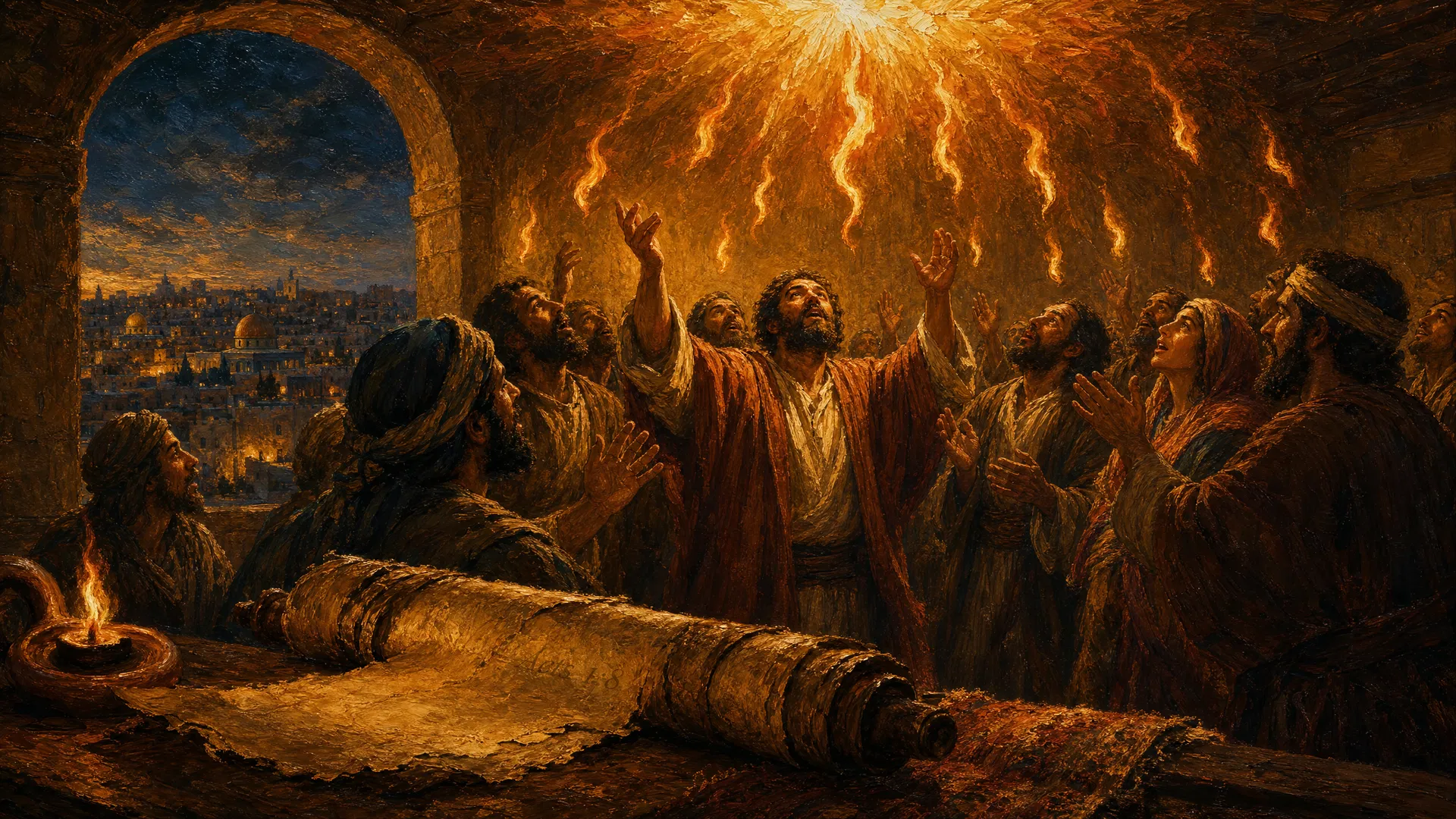
Acts Bible Study Guide Overview
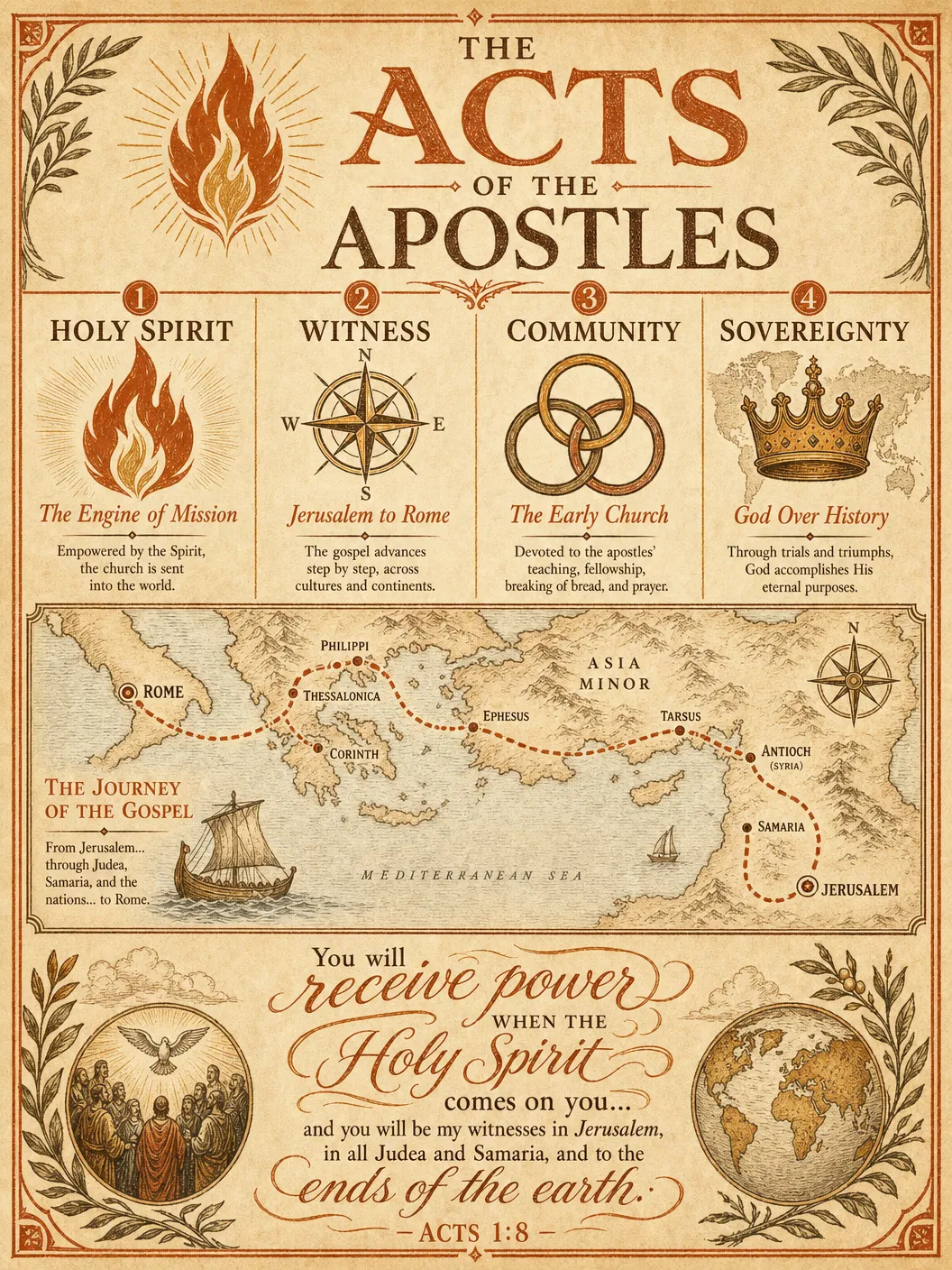
Full-page visual overview of The Acts of the Apostles — key events, themes, and structure at a glance
How to Study the Acts of the Apostles
To study Acts, read it as a narrative — a story with a driving momentum, not a theological treatise. Luke is showing you something in motion: the gospel moving outward from Jerusalem to Judea to Samaria to the ends of the earth (Acts 1:8). That verse is the outline of the whole book. Keep it in view as you read.
- 1 Read Acts alongside the Gospel of Luke: Acts is volume two of a two-part work. Luke ends where Acts begins — with the risen Jesus and the promise of the Spirit. Reading them together reveals Luke's full theological vision.
- 2 Notice the role of the Holy Spirit: the Spirit is the main character driving every advance. Mark every time the Spirit acts, speaks, or empowers. Acts is the story of the Spirit-driven church.
- 3 Follow the geographic movement: Jerusalem (ch. 1–7) → Judea and Samaria (ch. 8–12) → the ends of the earth (ch. 13–28). Each section opens with new obstacles and shows how the gospel overcomes them.
- 4 Study Paul's three missionary journeys (ch. 13–21): trace them on a map. Notice the pattern: Paul enters a city, preaches in the synagogue, faces opposition, establishes a church, and moves on.
- 5 Pay attention to the speeches: Acts contains more than two dozen speeches — by Peter, Stephen, Paul, and others. Each one is a window into early Christian proclamation and theology.
- 6 Read Acts 15 carefully: the Jerusalem Council is the theological hinge of the book. The decision made there — that Gentiles are full members of God's people by faith — shapes everything that follows.
Acts ends abruptly — Paul is in Rome, under house arrest, still preaching. Luke does not resolve the story because the story is not over. The reader is left with the question: what happens next? The answer is: you do. Acts is an invitation to continue the mission.
Acts Chapter-by-Chapter Summary
Traditionally associated with Luke and often dated to the early 60s AD, the Acts of the Apostles is the only narrative account of the early church in the New Testament. It traces the gospel's unstoppable expansion from a small upper room in Jerusalem to the imperial capital of Rome — driven not by human strategy but by the Holy Spirit. Acts is simultaneously a history of the church, a theology of mission, and an invitation to join the story.
The Promise Fulfilled — Pentecost and the Birth of the Church
- 1:1–11 Luke opens with the risen Jesus commissioning his disciples: "You will be my witnesses in Jerusalem, Judea, Samaria, and to the ends of the earth." He ascends into heaven as they watch, and two angels promise his return.
- 1:12–26 The 120 disciples gather in the upper room in prayer. They choose Matthias to replace Judas, restoring the twelve apostles — a symbolic act signaling continuity with Israel's twelve tribes.
- 2:1–13 Pentecost: the Holy Spirit descends as tongues of fire. The disciples speak in the languages of every nation represented in Jerusalem. Crowds are amazed; some mock. The promised Spirit has arrived.
- 2:14–47 Peter's first sermon: quoting Joel 2 and Psalm 16, he proclaims Jesus as Lord and Messiah. Three thousand are baptized. The first church community forms — devoted to teaching, fellowship, breaking of bread, and prayer.
Jerusalem — Signs, Persecution, and the First Martyr
- 3:1–4:31 Peter heals a lame man at the temple gate. The Sanhedrin arrests Peter and John, who boldly declare: "Salvation is found in no one else, for there is no other name under heaven given to mankind by which we must be saved." The church prays for boldness — and receives it.
- 4:32–5:42 The Jerusalem church shares possessions. Ananias and Sapphira lie about their gift and die — a sobering reminder of God's holiness. The apostles are arrested again, miraculously freed, and flogged. They leave rejoicing.
- 6:1–7 Seven deacons are appointed to serve the Greek-speaking widows, freeing the apostles for prayer and the Word. The church multiplies rapidly — including many priests.
- 6:8–7:60 Stephen, full of grace and power, is arrested and delivers the longest speech in Acts — a sweeping retelling of Israel's history ending with the accusation that the leaders have always resisted the Holy Spirit. He is stoned, becoming the first Christian martyr, as Saul watches approvingly.
Judea and Samaria — The Gospel Breaks Boundaries
- 8:1–40 Persecution scatters the Jerusalem church — and the gospel spreads. Philip evangelizes Samaria (breaking Jewish-Samaritan barriers) and leads an Ethiopian eunuch to faith on a desert road. The gospel is already crossing ethnic and social boundaries.
- 9:1–31 Saul of Tarsus, on his way to arrest Christians in Damascus, is blinded by a light and hears the voice of Jesus. His conversion is the pivot point of Acts. Ananias baptizes him; Saul immediately begins preaching that Jesus is the Son of God.
- 9:32–11:18 Peter heals Aeneas and raises Tabitha. Then the defining moment: God gives Peter a vision of unclean animals and commands him to eat — a symbol that Gentiles are no longer unclean. Cornelius, a Roman centurion, receives the Spirit before baptism. The Gentile mission is officially authorized.
- 11:19–12:25 The Antioch church is founded — the first predominantly Gentile congregation, where followers of Jesus are first called "Christians." Barnabas recruits Saul. Herod kills James and imprisons Peter, who is miraculously freed by an angel.
To the Ends of the Earth — Paul's Three Missionary Journeys
- 13:1–14:28 First journey: The Holy Spirit sets apart Barnabas and Saul. They travel through Cyprus and Asia Minor, planting churches in Pisidian Antioch, Iconium, Lystra, and Derbe. Paul's pattern: synagogue first, then Gentiles. Severe opposition follows everywhere.
- 15:1–35 The Jerusalem Council: the defining theological debate of the early church. Must Gentiles be circumcised? Peter, Paul, Barnabas, and James all speak. The verdict: Gentiles are saved by grace through faith, not by observing the law of Moses. A letter is sent to the Gentile churches.
- 15:36–18:22 Second journey: Paul and Silas travel through Macedonia and Greece. In Philippi, Lydia is converted and Paul and Silas are jailed and miraculously freed. In Athens, Paul preaches at the Areopagus. In Corinth, he stays 18 months — the longest stay of any journey.
- 18:23–20:38 Third journey: Paul spends three years in Ephesus — his longest ministry base. Extraordinary miracles occur. A riot breaks out over the goddess Artemis. Paul bids farewell to the Ephesian elders with one of the most moving speeches in Acts, knowing he will not see them again.
Jerusalem to Rome — Paul in Chains
- 21:1–23:35 Paul arrives in Jerusalem despite warnings. He is arrested in the temple, nearly killed by a mob, and rescued by Roman soldiers. He delivers his defense speech in Aramaic, then invokes his Roman citizenship. A plot to kill him is foiled; he is transferred to Caesarea.
- 24:1–26:32 Paul stands before Felix, Festus, and King Agrippa. His defense before Agrippa is a masterpiece of rhetoric — ending with Agrippa's famous response: "Do you think that in such a short time you can persuade me to be a Christian?" Agrippa concludes Paul is innocent but has already appealed to Caesar.
- 27:1–28:16 The sea voyage to Rome: a dramatic storm, shipwreck on Malta, and miraculous survival. Paul heals the island's sick. After three months, they sail again and arrive in Rome — where believers come out to meet Paul on the road.
- 28:17–31 Paul in Rome under house arrest for two years — free to receive all who come to him. He meets with Jewish leaders, some believe, most do not. Luke closes with Paul "proclaiming the kingdom of God and teaching about the Lord Jesus Christ — with all boldness and without hindrance."
Key Themes in Acts
Acts develops four interlocking themes — the Holy Spirit, witness, the expansion of the church, and the sovereignty of God over history — that together show how the gospel moves from a single room to the ends of the earth.
The Holy Spirit as the Engine of Mission
The Holy Spirit is mentioned over 50 times in Acts — more than in any other New Testament book. He is not a background presence but the active director of the entire mission: he descends at Pentecost, guides Philip to the Ethiopian eunuch, stops Paul from entering Bithynia, calls Barnabas and Saul for the first missionary journey, and leads the Jerusalem Council to its verdict. Acts is not the Acts of the Apostles but the Acts of the Holy Spirit through the apostles.
Read Acts 1:8 in your preferred translation.
Acts 1:8
Application: The early church did not strategize their way to global impact — they were sent and sustained by the Spirit. What would it look like to approach your own calling with the same dependence on the Spirit's leading rather than human planning?
The Unstoppable Expansion of the Gospel
Acts traces a deliberate geographic expansion following the pattern of Acts 1:8: Jerusalem (chapters 1–7) → Judea and Samaria (8–12) → the ends of the earth (13–28). Every attempt to stop the gospel — imprisonment, flogging, stoning, shipwreck — accelerates rather than halts it. Luke punctuates the narrative with growth summaries: "the word of God spread" (6:7; 12:24; 19:20). The book ends not with Paul's death but with the gospel still advancing.
Read Acts 12:24 in your preferred translation.
Acts 12:24
Application: The book of Acts is an unfinished story — it ends mid-sentence, with Paul still preaching. This is intentional: the reader is meant to understand that the story continues in their own generation. Where is the gospel advancing in your context, and what role are you playing?
The Breaking of Ethnic and Social Barriers
Acts systematically dismantles the barriers that divided the ancient world. The gospel crosses the Jewish-Samaritan divide (Acts 8), the Jewish-Gentile divide (Acts 10–11), the slave-free divide (Acts 16), and the educated-uneducated divide (Acts 17). The Jerusalem Council (Acts 15) is the theological ratification of what the Spirit had already been doing: creating one new humanity in Christ. Luke highlights women, foreigners, slaves, and social outcasts as key recipients and agents of the gospel.
Read Acts 10:34–35 in your preferred translation.
Acts 10:34–35
Application: The early church's diversity was not a social program but a theological statement about the nature of the gospel. What barriers — ethnic, economic, generational — exist in your church or community that the gospel should be crossing?
Suffering as the Path of Witness
In Acts, suffering is not an obstacle to mission — it is the means of it. Stephen's martyrdom scatters the church and plants the gospel in new regions (8:1–4). Paul's imprisonments give him access to governors, kings, and Caesar's household. The apostles leave the Sanhedrin "joy amid suffering for Jesus" (5:41). This pattern echoes Jesus's own path: the cross before the resurrection, suffering before glory.
Read Acts 5:41 in your preferred translation.
Acts 5:41
Application: Western Christianity often treats suffering as a sign that something has gone wrong. Acts presents it as a sign that something has gone right — that the witness is real enough to provoke opposition. How does this reframe your own experience of difficulty or opposition?
Acts Symbols and Imagery
Tongues of Fire (Pentecost)
Historical Context
On the day of Pentecost (the Jewish Feast of Weeks, 50 days after Passover), a sound like a rushing wind filled the house and what appeared to be tongues of fire rested on each of the 120 disciples. They spoke in the languages of the diaspora Jews gathered in Jerusalem from every nation under heaven.
Theological Meaning
Fire in the Old Testament symbolizes God's presence (the burning bush, the pillar of fire, the fire on Sinai). The tongues of fire at Pentecost signal that God's presence has now come to dwell in his people rather than in a building. The reversal of Babel (Genesis 11) is also in view: where Babel scattered humanity through language confusion, Pentecost gathers humanity through language understanding.
Baptism
Historical Context
Jewish baptism (mikveh) was a ritual of purification. John's baptism was a baptism of repentance. Christian baptism in Acts is consistently linked to repentance, forgiveness of sins, and receiving the Holy Spirit (Acts 2:38). It is performed in the name of Jesus and marks entry into the community of believers.
Theological Meaning
Baptism in Acts is the outward sign of an inward transformation. It is not the cause of salvation but its public declaration. The Ethiopian eunuch's baptism (Acts 8) is particularly striking: he is a foreigner, a eunuch (excluded from the temple assembly by Deuteronomy 23:1), and yet immediately baptized. The gospel breaks every barrier.
The Areopagus (Mars Hill)
Historical Context
The Areopagus was a rocky hill in Athens where the city's governing council met to discuss philosophy, law, and religion. It was the intellectual center of the ancient world. Epicurean and Stoic philosophers debated there daily. When Paul was brought before the Areopagus (Acts 17:19), he was entering the most prestigious intellectual forum of his era.
Theological Meaning
Paul's Areopagus speech is a masterclass in contextual evangelism. He begins with what his audience already knows (the altar to the unknown god, their own poets), then moves to what they do not know (the resurrection). He does not quote Scripture to a non-Jewish audience but uses their own cultural touchstones to point to Christ. This models the principle of finding common ground before presenting the gospel.
The Shipwreck on Malta
Historical Context
Paul's sea voyage to Rome (Acts 27–28) is one of the most detailed ancient sea voyage narratives in existence. The ship carried 276 people and was caught in a northeaster (Euroclydon) for 14 days before wrecking on the island of Malta. Paul had warned the captain not to sail; the warning was ignored.
Theological Meaning
The shipwreck narrative is a parable of the entire book of Acts: God's purposes cannot be sunk. An angel had told Paul he must stand before Caesar, and no storm could prevent it. Paul's calm authority during the crisis — distributing bread, encouraging the crew — models the witness of a Spirit-filled believer in extremity. Malta becomes an unexpected mission field: Paul heals the sick and the whole island is transformed.
Acts Bible Study Journal and Reflection Questions
A printable journal template designed for verse-by-verse reflection, prayer, and personal response to Scripture.
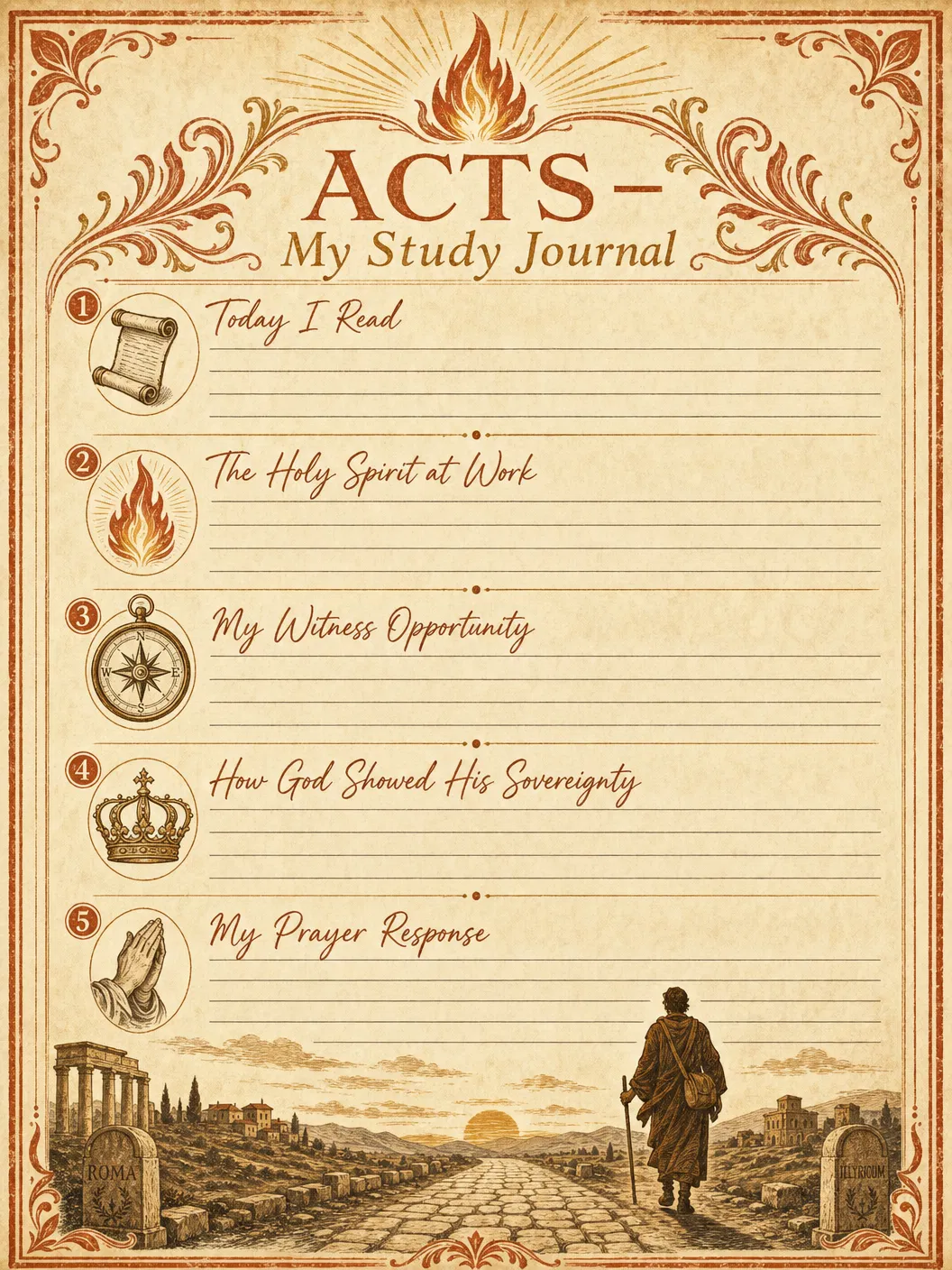
Acts Bible Small Group Discussion Guide
These 8 questions are designed for a 60–90 minute small group session. Begin with the icebreaker, then work through observation, interpretation, and application questions. Close with the prayer prompt.
If you could have witnessed any single moment in the book of Acts — Pentecost, Paul's conversion, the Jerusalem Council, the Areopagus speech, the Malta shipwreck — which would you choose and why?
Read Acts 2:42–47. List the five practices of the early Jerusalem church. Which of these is most present in your church community today? Which is most absent? What would it take to strengthen the weakest area?
The five practices: apostles' teaching, fellowship (koinonia), breaking of bread, prayer, and sharing possessions. The passage also notes that the Lord added to their number daily — growth was a byproduct of community, not a program.
Acts 1:8 gives a geographic outline of the entire book: Jerusalem → Judea and Samaria → ends of the earth. Trace how this pattern unfolds through the book. What specific events mark each transition? What caused the gospel to move from one stage to the next?
The transitions are often forced by persecution (8:1–4 scatters the Jerusalem church) or divine initiative (10:1–11:18 opens the Gentile mission). The church did not always choose to expand — sometimes it was pushed.
In Acts 15, the Jerusalem Council debates whether Gentiles must be circumcised. Peter, Paul, Barnabas, and James all speak. What arguments does each one make? How does the council reach its decision? What does this process tell us about how the early church handled theological disagreement?
The council uses three sources: Peter's experience (God gave the Spirit to Gentiles without circumcision), Paul and Barnabas' testimony (signs and wonders among Gentiles), and James' appeal to Scripture (Amos 9:11–12). The decision is made by consensus, not by a single authority.
Paul's Areopagus speech (Acts 17:22–31) is addressed to a non-Jewish, philosophically sophisticated audience. How does his approach differ from his synagogue sermons? What does this tell us about how to communicate the gospel in different cultural contexts?
In synagogues, Paul argues from Scripture. At the Areopagus, he argues from creation, human experience, and their own poets. He finds common ground before presenting the distinctive claims of the gospel. This is not compromise — it is translation.
The Holy Spirit is mentioned over 50 times in Acts — guiding, empowering, and sometimes redirecting the apostles. Think of a time when you felt a clear sense of the Spirit's leading. How did you respond? What would it look like to cultivate greater sensitivity to the Spirit's direction in your daily decisions?
Acts ends with Paul under house arrest, still preaching "with all boldness and without hindrance." The book is deliberately unfinished. In what sense is your own life a continuation of the story of Acts? What chapter are you currently writing?
Close by reading Acts 1:8 together: "Spirit-empowered witness to every people" Have each person identify their own "Jerusalem" — the immediate sphere of witness God has placed them in. Then pray for one another, asking the Spirit to empower each person for the witness they are called to.
Acts Bible Study Questions and Answers
Deeper questions, richer answers — exploring the historical, theological, and personal dimensions of Acts.
Day 48 · Pentecost — The Spirit Arrives and the Church Is Born
What exactly happened at Pentecost, and why was it the defining moment in history?
Pentecost (from the Greek for "fiftieth") was a Jewish harvest festival held 50 days after Passover. On this day, approximately AD 30, something unprecedented occurred: the Holy Spirit descended on the 120 disciples gathered in Jerusalem, accompanied by a sound like rushing wind and what appeared to be tongues of fire. The disciples immediately began speaking in the languages of the diaspora Jews gathered in Jerusalem from every nation. Three thousand people were baptized that day. Pentecost is the fulfillment of Joel's prophecy (Joel 2:28–32) and Jesus's promise (Acts 1:8). It marks the transition from the age of the law to the age of the Spirit — God's presence no longer confined to a temple building but now dwelling in his people. The church was not organized into existence; it was born by the Spirit.
Read Acts 2:1 in your preferred translation.
How do I experience the Holy Spirit today? Is what happened at Pentecost still available to believers now?
Peter's Pentecost sermon answers this directly: "Repent and be baptized, every one of you, in the name of Jesus Christ for the forgiveness of your sins. And you will receive the gift of the Holy Spirit. The promise is for you and your children and for all who are far off" (Acts 2:38–39). The gift of the Spirit is not limited to the first century — it is for all who are far off, which includes every generation since. The specific manifestations at Pentecost (tongues, wind, fire) were signs marking a unique historical moment — the inauguration of the new covenant age. But the Spirit himself — as guide, comforter, empowerer, and sanctifier — is the ongoing inheritance of every believer. The question is not whether the Spirit is available but whether we are attentive to his presence and responsive to his leading.
Read Acts 2:39 in your preferred translation.
Why does Acts begin with the ascension rather than the resurrection, and what does this tell us about Luke's purpose?
Luke's Gospel ends with the ascension; Acts begins with it. This is not repetition but theological framing. The ascension is the hinge between the two volumes: Jesus's earthly ministry is complete; now his heavenly ministry begins through the Spirit and the church. Luke's purpose in Acts is to show that the gospel's spread from Jerusalem to Rome is not accidental but divinely orchestrated. By opening with the ascension and the commission of Acts 1:8, Luke establishes the entire book as the fulfillment of Jesus's final command. The church does not act on its own initiative — it is sent, sustained, and directed by the risen and ascended Lord through his Spirit.
Read Acts 1:9 in your preferred translation.
Day 49 · Paul's Missionary Journeys — Conversion, Expansion, and the Gentile Mission
What made Paul's conversion so significant, and why does Luke tell it three times in Acts?
Saul of Tarsus was not a passive bystander to Stephen's stoning — he was its approving witness (Acts 7:58; 8:1). He then launched a systematic campaign to destroy the church, entering houses and dragging men and women to prison (8:3). His conversion on the Damascus road is therefore not just a personal transformation but a theological statement: if the gospel can reach Saul, it can reach anyone. Luke tells Paul's conversion three times (Acts 9, 22, 26) — each retelling emphasizing a different audience and theological point. This repetition signals its central importance to the book's argument. Paul himself later describes his conversion as evidence that Jesus is truly risen: "He appeared to me also, as to one abnormally born" (1 Corinthians 15:8). The persecutor becomes the apostle; the destroyer becomes the builder.
Read Acts 9:4 in your preferred translation.
Peter's vision in Acts 10 told him that nothing God has made is unclean. How does this apply to how I view people who are different from me?
Peter's vision (Acts 10:9–16) uses food laws as a symbol for something much larger: the barrier between Jew and Gentile has been abolished in Christ. When Peter arrives at Cornelius's house, he says: "I now realize how true it is that God does not show favoritism but accepts from every nation the one who fears him" (10:34–35). The vision is not primarily about dietary laws — it is about people. The principle is radical: no person is to be called common or unclean (10:28). This has direct implications for how believers relate to people of different ethnicities, social classes, and backgrounds. The gospel creates a community where the normal human categories of clean/unclean, insider/outsider, worthy/unworthy are overturned.
Read Acts 10:15 in your preferred translation.
The Jerusalem Council (Acts 15) is sometimes called the first church council. What was at stake, and why does its decision still matter today?
The question before the Jerusalem Council was existential: must Gentiles become Jews (through circumcision and Torah observance) in order to be saved? If yes, Christianity is a sect of Judaism. If no, it is a universal faith accessible to all humanity without ethnic or cultural preconditions. The council's decision — that Gentiles are saved by grace through faith, not by observing the law — is the theological foundation of Paul's letters to the Romans and Galatians. It established that the gospel is not a cultural package but a message that can be received by people of every nation without requiring them to adopt a foreign culture. This decision still matters because it defines the nature of the gospel itself: it is for everyone, as they are, where they are.
Read Acts 15:11 in your preferred translation.
Day 50 · Paul in Chains — From Athens to Rome
Paul's Areopagus speech is often called the greatest example of contextual evangelism. What made it so effective?
When Paul arrived in Athens, he did not begin with Scripture (his audience had none) or with Jewish history (irrelevant to Greeks). Instead, he began with what they already knew and valued: their own religious instincts (the altar to the unknown god), their own philosophers (Epimenides and Aratus), and their own experience of being human. Paul's strategy was to find the point of genuine contact between the gospel and his audience's existing framework, then use that contact point to introduce what they did not know: the resurrection. He did not compromise the message — he translated it. The result was mixed (some mocked, some believed, some wanted to hear more) but the approach was masterful. It models a principle that remains essential: effective witness requires genuine understanding of the person you are speaking to.
Read Acts 17:28 in your preferred translation.
Acts ends with Paul under house arrest, still preaching. How do I maintain purpose and witness when my circumstances are severely limited?
Paul's final two years in Rome are described in two verses (28:30–31), but those verses contain one of the most powerful phrases in the book: "with all boldness and without hindrance." Under house arrest, chained to guards, awaiting trial before Caesar, Paul received everyone who came to him and proclaimed the kingdom of God. The key insight is that Paul did not wait for his circumstances to improve before he began his witness. He worked within his constraints rather than against them. The guards became his congregation; his visitors became his audience. This models a principle that appears throughout Acts: the gospel advances not despite limitations but through them. Constraints define the shape of the witness, not its possibility.
Read Acts 28:31 in your preferred translation.
Why does Acts end so abruptly, without telling us what happened to Paul? Is this a literary flaw or intentional?
Luke almost certainly knew the outcome of Paul's trial when he wrote Acts — yet he chose not to include it. This is deliberate literary strategy, not oversight. The book ends not with Paul's fate but with the gospel's advance: "with all boldness and without hindrance." The abrupt ending serves Luke's theological purpose: Acts is not a biography of Paul but a history of the gospel's unstoppable expansion. By ending mid-story, Luke signals that the story is not finished — it continues in every generation of believers. The reader is invited to ask: what is my chapter in this story? Where is the gospel advancing through my witness? The open ending is an open invitation.
Read Acts 28:31 in your preferred translation.
Day 174 · Pentecost — Deep Dive into Acts 2
What is the theological significance of the 3,000 baptisms on Pentecost day?
The number 3,000 is not incidental. At Mount Sinai, when Israel worshipped the golden calf, approximately 3,000 people died under the judgment of the law (Exodus 32:28). On Pentecost, 3,000 people were added to the church through the gift of the Spirit. Luke’s audience, steeped in Scripture, would have recognized this as a deliberate reversal. The law at Sinai brought death; the Spirit at Pentecost brings life. This is precisely Paul’s argument in 2 Corinthians 3: the old covenant was a ministry of death written on stone, but the new covenant is a ministry of the Spirit that gives life. Pentecost is not just the birthday of the church — it is the inauguration of the new covenant age, the fulfillment of Jeremiah’s promise that God would write his law on hearts rather than stone (Jeremiah 31:33).
Read Acts 2:41 in your preferred translation.
The early church devoted themselves to four things (Acts 2:42). What would it look like to apply this pattern in a modern church or small group?
Acts 2:42 describes the early church’s four core practices: the apostles’ teaching, fellowship, breaking of bread, and prayer. These are not programs — they are the organic rhythms of a community shaped by the Spirit. Apostles’ teaching: serious, ongoing engagement with Scripture, not just inspirational messages. Fellowship (koinŏnia): shared life, not just attendance at the same event. Breaking of bread: regular communion that remembers Christ’s death and anticipates his return. Prayer: corporate dependence on God, not just private devotion. A modern small group that practices all four — studying Scripture together, sharing real life, eating together, and praying together — is closer to the New Testament pattern than most church programs.
Read Acts 2:42 in your preferred translation.
Why did Peter quote Joel 2 at Pentecost, and what does “the last days” mean in that context?
Peter’s opening words are striking: “This is what was spoken by the prophet Joel: ‘In the last days, God says, I will pour out my Spirit on all people.’” The phrase “the last days” does not mean “the end of the world is near.” It means the final era of redemptive history has begun — the age inaugurated by Christ’s death, resurrection, and the gift of the Spirit. The New Testament consistently uses “last days” to describe the present age between Christ’s first and second coming (Hebrews 1:2; 1 Peter 1:20; 1 John 2:18). Peter is saying: the age Joel prophesied has arrived. The Spirit is no longer given selectively to kings, priests, and prophets — he is poured out on all flesh, on sons and daughters, on young and old, on servants. The democratization of the Spirit is the defining mark of the new covenant age.
Read Acts 2:17 in your preferred translation.
Day 175 · Paul in Athens — The Areopagus and Contextual Witness
What was the Areopagus, and why was it the most challenging venue Paul ever preached in?
The Areopagus (Mars Hill) was Athens’ ancient council of philosophers and civic leaders — the intellectual center of the Greco-Roman world. Paul was not invited to preach; he was summoned to explain his “foreign ideas.” His audience included Epicurean and Stoic philosophers who had no knowledge of the Hebrew Scriptures and no framework for a bodily resurrection. The Epicureans believed the gods were indifferent to human affairs and that death was simply the end. The Stoics believed in an impersonal divine reason (logos) that permeated the universe. Paul had to build a theological bridge from their worldview to the gospel without the scaffolding of Jewish Scripture. He did this by starting with creation (God made the world), moving to providence (God governs history), and arriving at the resurrection (God raised Jesus as judge). It is the most sophisticated piece of apologetics in the New Testament.
Read Acts 17:28 in your preferred translation.
Paul used Greek poetry to make his point. Is it legitimate to use secular culture, art, or philosophy to share the gospel?
Paul quotes two Greek poets — Epimenides (“in him we live and move and have our being”) and Aratus (“we are his offspring”) — not to endorse their theology but to find points of genuine contact between the gospel and his audience’s existing beliefs. This is not compromise; it is translation. The principle is this: all truth is God’s truth. When a secular philosopher, novelist, or filmmaker captures something genuinely true about the human condition — longing, guilt, love, death, meaning — that truth can serve as a bridge to the gospel. Paul’s approach legitimizes engaging seriously with culture rather than retreating from it. The test is not whether the source is secular but whether the truth being cited is genuinely true and whether it points toward rather than away from Christ.
Read Acts 17:28 in your preferred translation.
The Areopagus sermon ended with mixed results — some mocked, some believed, some wanted to hear more. Is this a model for success or failure?
By any modern metrics of ministry success, the Areopagus sermon was a mixed result: a few converts, no church planted, no follow-up mentioned. Yet Luke includes it as a model of apostolic witness, not a cautionary tale. This tells us something important about how the New Testament measures success. The apostolic model is faithful proclamation, not guaranteed results. Paul did not adjust his message when the crowd mocked the resurrection — he did not soften it or remove the offense. The three responses (mockery, openness, belief) are the three responses the gospel always produces. Luke’s point is not that Paul failed in Athens but that the gospel was faithfully proclaimed in the intellectual capital of the ancient world. The seed was planted; the harvest belongs to God.
Read Acts 17:32 in your preferred translation.
Day 225 · The Church Is Born — Acts 1–4 Revisited
Acts 1:8 is often called the “outline verse” of the entire book. How does the rest of Acts fulfill this single sentence?
Jesus’ final commission — “You will be my witnesses in Jerusalem, and in all Judea and Samaria, and to the ends of the earth” — functions as the structural outline of Acts. Chapters 1–7 cover Jerusalem; chapters 8–12 cover Judea and Samaria; chapters 13–28 trace the gospel’s advance to the ends of the earth, culminating in Rome. This is not accidental literary structure — it is theological architecture. Luke is showing that the church’s expansion is not the result of human planning or ambition but the fulfillment of a divine commission. Every missionary journey, every persecution, every shipwreck, every imprisonment advances the gospel according to the pattern Jesus established before his ascension. The book of Acts is the story of Acts 1:8 being fulfilled.
Read Acts 1:8 in your preferred translation.
The early church held everything in common (Acts 2:44–45; 4:32–35). Is this a model for Christian community today?
The Jerusalem community’s practice of sharing possessions is one of the most discussed and debated passages in Acts. It is important to note that this was voluntary, not compulsory (Acts 5:4 makes clear that Ananias was not required to sell his property). It was also a response to a specific historical situation: many pilgrims had stayed in Jerusalem after Pentecost and needed support. The principle behind the practice — that the community of believers takes responsibility for one another’s needs — is clearly normative (see 2 Corinthians 8–9; Galatians 6:2). The specific form (communal property) is not mandated. What is mandated is a generosity so radical that “there were no needy persons among them” (Acts 4:34). This echoes Deuteronomy 15:4: “there need be no poor people among you.” The church is called to embody the economic ethics of the kingdom.
Read Acts 4:32 in your preferred translation.
Stephen’s speech in Acts 7 is the longest speech in the book. Why does Luke give so much space to a speech that ends in martyrdom?
Stephen’s speech is a comprehensive retelling of Israel’s history, culminating in the accusation that Israel has always resisted the Holy Spirit and killed the prophets. It is not a defense speech — it is a prosecution. Stephen is not trying to escape; he is delivering a verdict. Luke gives Stephen’s speech such prominence because it is the theological turning point of Acts. After Stephen’s martyrdom, the Jerusalem church is scattered (8:1), and the gospel begins its expansion to Samaria and beyond. Stephen’s death is not a setback — it is the catalyst for the mission. Luke also introduces Saul at this moment (7:58; 8:1), planting the seed for the most dramatic conversion in the book. Stephen’s martyrdom is the hinge on which the entire narrative turns.
Read Acts 7:60 in your preferred translation.
Day 227 · The First Missionary Journey — Acts 13–15
How did the church at Antioch become the launching pad for world mission, and what made it different from Jerusalem?
Antioch was the third-largest city in the Roman Empire and the first truly multiethnic church. It was here that believers were first called Christians (Acts 11:26) — a name given by outsiders who noticed that this community was defined by its allegiance to Christ rather than by ethnicity or social class. The Antioch church was also the first to commission and fund missionaries (Acts 13:1–3). The Jerusalem church had been the center of the movement, but Antioch became the base for the Gentile mission. This shift is significant: the gospel was no longer moving from Jerusalem outward as a Jewish movement but from Antioch outward as a universal one. The Holy Spirit’s instruction — “Set apart for me Barnabas and Saul for the work to which I have called them” — marks the beginning of intentional cross-cultural mission.
Read Acts 13:2 in your preferred translation.
Paul and Barnabas had a sharp disagreement over John Mark (Acts 15:36–41). How should Christians handle conflict within ministry partnerships?
The conflict between Paul and Barnabas is one of the most honest moments in Acts. Luke does not sanitize it: “They had such a sharp disagreement that they parted company” (15:39). Both men had legitimate points. Barnabas wanted to give John Mark a second chance; Paul was unwilling to risk the mission on someone who had previously deserted them (13:13). The outcome is instructive: the disagreement resulted in two missionary teams instead of one, doubling the reach of the mission. God’s sovereignty worked through human conflict. The story also has a redemptive arc: Paul later writes warmly of Mark (“Get Mark and bring him with you, because he is helpful to me in my ministry” — 2 Timothy 4:11), suggesting that reconciliation eventually occurred. The lesson is not that conflict is good but that God can use even our failures and disagreements to advance his purposes.
Read Acts 15:39 in your preferred translation.
Paul’s sermon in Pisidian Antioch (Acts 13:16–41) is his first recorded sermon. How does it compare to Peter’s Pentecost sermon, and what does the difference reveal?
Both sermons follow the same basic structure: a retelling of Israel’s history, a proclamation of Jesus’ death and resurrection, and a call to repentance. But the audiences differ, and the emphases shift accordingly. Peter speaks to Jerusalem Jews who witnessed the crucifixion; Paul speaks to diaspora Jews and God-fearers in Asia Minor who know the Scriptures but are more distant from the events. Peter’s sermon emphasizes the guilt of Jerusalem (“you, with the help of wicked men, put him to death” — 2:23) and calls for repentance. Paul’s sermon emphasizes the fulfillment of Scripture and the offer of forgiveness: “through him everyone who believes is set free from every sin” (13:39). Both sermons are anchored in the resurrection, but Paul’s is more explicitly forensic — it uses the language of justification that will dominate his letters. Acts 13 is the bridge between the Gospels and the Pauline epistles.
Read Acts 13:39 in your preferred translation.
Acts Bible Study Key Characters
Meet the people whose faith, failure, and faithfulness shaped the story.
Peter
The lead apostle in the first half of Acts, whose Pentecost sermon launches the church and whose vision in Acts 10 opens the Gentile mission.
Paul (Saul)
The persecutor-turned-apostle whose dramatic conversion and three missionary journeys drive the second half of Acts, culminating in Rome.
Stephen
The first Christian martyr, whose Spirit-filled defense before the Sanhedrin and death by stoning triggers the scattering that spreads the gospel.
Barnabas
Paul's early mentor and missionary partner, whose generosity and encouragement model the koinonia (fellowship) of the early church.
Cornelius
The Roman centurion whose conversion through Peter marks the decisive opening of the gospel to the Gentile world.
Acts Bible Study Practical Application
Ancient wisdom, lived out today — practical steps rooted in Scripture.
Be Filled with the Spirit
The disciples were commanded to wait for the Spirit before they acted. Effective witness flows from Spirit-empowerment, not human strategy or eloquence.
Find Your Jerusalem
Acts 1:8 starts with Jerusalem — the immediate, local sphere of witness. Before thinking globally, ask: who in my immediate world needs to hear the gospel?
Work Within Your Constraints
Paul preached from prison, from house arrest, from chains. Your limitations do not disqualify you from witness — they define the shape of it.
Related Study Packs
Common Questions About Studying the Acts of the Apostles
How do I study the Acts of the Apostles?
For beginners, the best way to study Acts is to follow the spread of the gospel through the power of the Holy Spirit, using Acts 1:8 as the outline of the book. To study Acts, read it as a narrative with a driving momentum. Keep Acts 1:8 in view as the outline: Jerusalem → Judea and Samaria → the ends of the earth. Read it alongside the Gospel of Luke, since Acts is volume two of a two-part work. Track the role of the Holy Spirit, follow the geographic expansion, study the missionary journeys on a map, and pay close attention to the speeches by Peter, Stephen, and Paul, which are windows into early Christian proclamation.
What is the main message of the Acts of the Apostles?
The main message of Acts is that the gospel of Jesus Christ is unstoppable. Despite persecution, imprisonment, shipwreck, and opposition from both Jewish and Roman authorities, the word of God continues to spread and prevail (Acts 19:20). Luke shows that this advance is not driven by human strategy but by the Holy Spirit. Acts is simultaneously a history of the early church, a theology of mission, and an invitation to join the story that is still unfolding.
What is the role of the Holy Spirit in Acts?
The Holy Spirit is the central character of Acts. The book begins with the promise of the Spirit (Acts 1:8) and the outpouring at Pentecost (Acts 2). Throughout the narrative, the Spirit initiates mission (Acts 13:2), guides decisions (Acts 16:6–7), empowers preaching (Acts 4:8), and crosses ethnic and cultural boundaries (Acts 10). Every major advance of the gospel in Acts is Spirit-driven. To study Acts is to study the Spirit's work in the world.
How does the Acts of the Apostles connect to the rest of the Bible?
Acts is the bridge between the Gospels and the Epistles. It shows how the resurrection of Jesus and the gift of the Spirit launched the mission that Paul's letters address from the inside. Acts fulfills the Great Commission of Matthew 28 and the promise of Isaiah that the nations would come to the light. The Jerusalem Council in Acts 15 resolves the question of Gentile inclusion that Genesis 12 first raised. Reading Acts alongside Luke, Romans, and Galatians reveals the full arc of God's redemptive plan.
The Acts of the Apostles
"He proclaimed the kingdom of God and taught about the Lord Jesus Christ — with all boldness and without hindrance!"
Acts 28:31
Start the 300-Day Bible Study Journey →