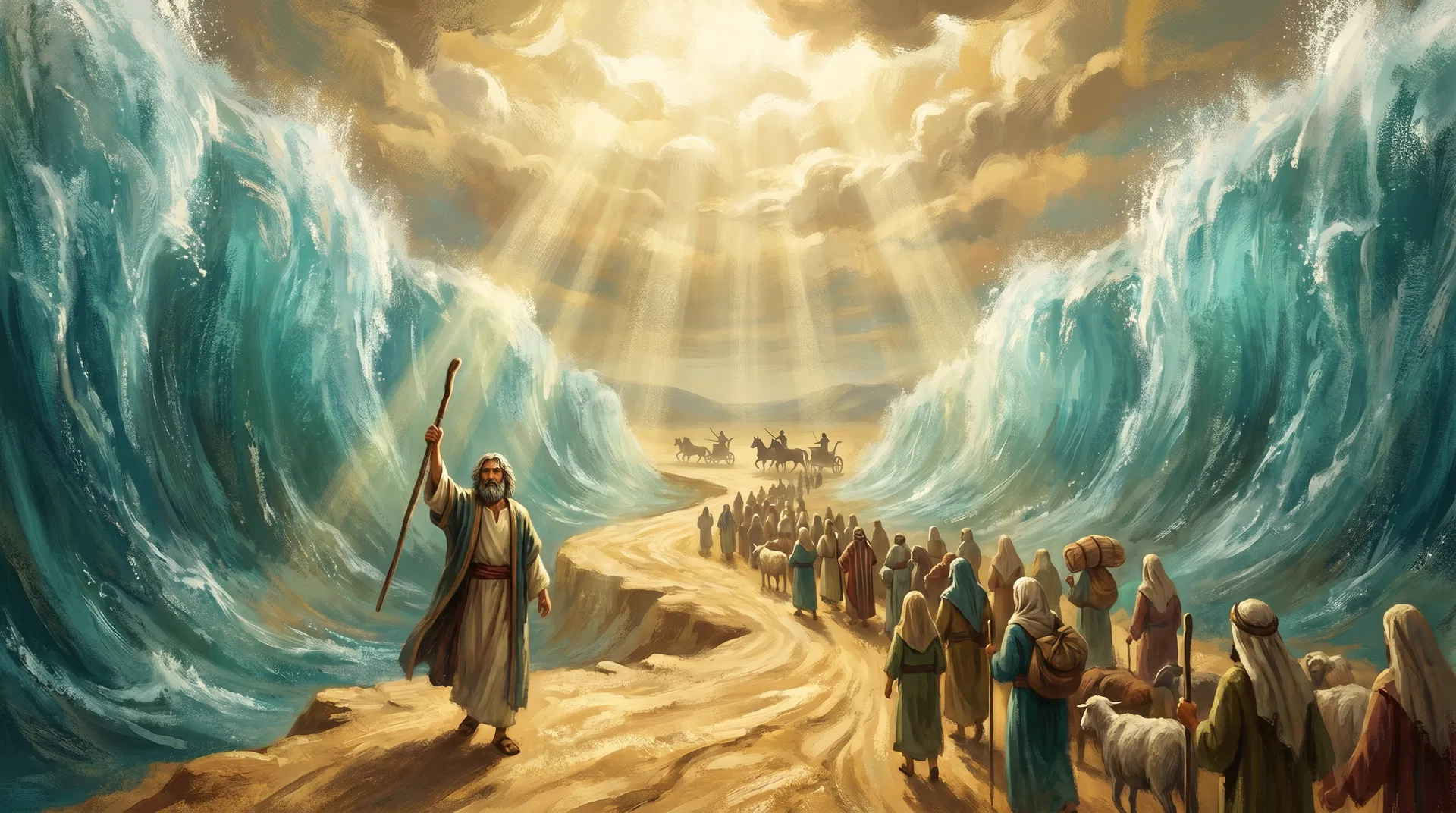
Exodus Bible Study Guide Overview
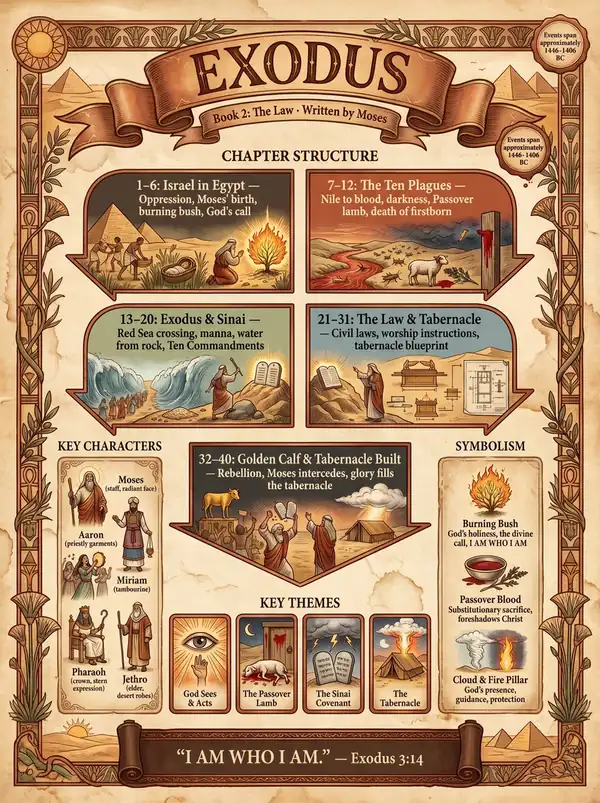
Full-page visual overview of The Book of Exodus — key events, themes, and structure at a glance
How to Study the Book of Exodus
To study Exodus, read it as the story of God creating a people for himself — not just rescuing slaves, but forming a nation through covenant, law, and presence. Exodus is not primarily about Moses. It is about who God is: the God who hears, acts, delivers, and dwells.
- 1 Start with Israel in Egypt: understand the context of slavery and the silence of God before Moses.
- 2 Follow the ten plagues as a confrontation between the God of Israel and the gods of Egypt.
- 3 Read the Passover carefully — it is the interpretive key to the entire book, and to the New Testament.
- 4 Receive the Ten Commandments not as a burden but as a covenant charter for a redeemed people.
- 5 Pay attention to the Tabernacle (chapters 25–40): God's goal is not just to free Israel, but to dwell among them.
- 6 Ask how each section answers the question: What kind of God is this?
Exodus also raises difficult questions about hardening hearts, judgment on Egypt, and divine deliverance. A good study holds those questions honestly while reading within the larger arc of redemption, covenant, and the coming of Christ — the true Passover Lamb.
Exodus Chapter-by-Chapter Summary
Traditionally associated with Moses, Exodus records Israel's liberation from slavery, the covenant at Sinai, and the construction of the tabernacle — the portable dwelling place of God among his people.
Oppression, Call, and Commission
- 1:1–22 A new pharaoh arises who does not know Joseph. Israel multiplies and is enslaved. Midwives Shiphrah and Puah defy Pharaoh’s infanticide order — the first act of civil disobedience in the Bible.
- 2:1–10 Moses is born, hidden in a basket on the Nile, and discovered by Pharaoh’s daughter. His mother becomes his nurse. The deliverer grows up in the very house of the oppressor.
- 2:11–3:1 Moses kills an Egyptian taskmaster, flees to Midian, marries Zipporah, and tends sheep for forty years. God is silent — but not absent.
- 3:1–22 The burning bush: fire that does not consume. God reveals His name — I AM WHO I AM (YHWH) — and commissions Moses to confront Pharaoh and lead Israel out of Egypt.
- 4:1–31 Moses’ objections and God’s responses. Aaron is appointed as spokesman. Moses returns to Egypt. The elders of Israel bow in worship when they hear God has seen their misery.
- 5:1–6:30 First confrontation with Pharaoh fails — workloads increase. Moses cries out to God. God reaffirms the covenant and His name: “I am the Lord.”
The Ten Plagues and the Passover
- 7:1–25 Plague 1: Water turned to blood. Pharaoh’s heart is hardened. The Nile — Egypt’s life source and the river where Hebrew babies were drowned — becomes death.
- 8:1–9:12 Plagues 2–6: Frogs, gnats, flies, livestock disease, boils. Each plague targets an Egyptian deity, demonstrating YHWH’s supremacy over Egypt’s gods.
- 9:13–10:29 Plagues 7–9: Hail, locusts, darkness. The darkness is so thick it can be felt — three days of night over Egypt while Israel has light in Goshen.
- 11:1–10 The announcement of the final plague: the death of every firstborn in Egypt. Pharaoh is warned but refuses. The distinction between Israel and Egypt is absolute.
- 12:1–28 The Passover institution: a lamb without blemish, blood on the doorposts, unleavened bread, bitter herbs. “When I see the blood, I will pass over you.” A meal that becomes the central liturgy of Israel’s faith.
- 12:29–51 The Exodus begins at midnight. 430 years of slavery end. Israel leaves Egypt “with a high hand” — not as fugitives but as a liberated people.
Through the Sea to Sinai
- 13:1–22 Consecration of the firstborn. The pillar of cloud by day and fire by night — God’s visible presence leading the way.
- 14:1–31 The Red Sea crossing. Pharaoh’s army pursues; Israel is trapped. Moses stretches out his hand; the sea parts. Israel walks through on dry ground. Egypt’s army is drowned. “The Lord is a warrior.”
- 15:1–27 The Song of Moses: the first great hymn of Scripture. Miriam leads the women in dance. Then the waters of Marah are bitter — and God sweetens them. The pattern of deliverance followed by testing begins.
- 16:1–36 Manna from heaven and quail in the evening. God provides daily bread — enough for each day, double on the sixth. The Sabbath rhythm is embedded in the wilderness experience.
- 17:1–18:27 Water from the rock at Massah and Meribah. Victory over Amalek as long as Moses’ arms are raised. Jethro’s wisdom: delegate leadership to capable men.
- 19:1–20:21 Israel arrives at Sinai. God descends in fire and smoke. The Ten Commandments are spoken directly by God — the foundation of the covenant relationship.
The Covenant Laws and the Tabernacle Blueprint
- 21:1–23:33 The Book of the Covenant: laws governing servants, violence, property, social justice, and worship. Justice for the vulnerable — the widow, orphan, and foreigner — is central.
- 24:1–18 The covenant ratification ceremony: blood sprinkled on the altar and the people. Moses, Aaron, and the elders see God and eat and drink in His presence. Moses ascends into the cloud for forty days.
- 25:1–27:21 The Tabernacle blueprint: ark of the covenant, table of showbread, golden lampstand, curtains, altar. God’s dwelling is to be built exactly as He commands.
- 28:1–29:46 The priestly garments and ordination ceremony. Aaron and his sons are set apart. The goal: “I will dwell among the Israelites and be their God.”
- 30:1–31:18 Altar of incense, bronze basin, anointing oil, incense formula. Bezalel and Oholiab are filled with the Spirit of God for craftsmanship. The Sabbath is reaffirmed as a sign of the covenant.
The Golden Calf and the Tabernacle Completed
- 32:1–35 The golden calf: while Moses is on the mountain, Israel makes an idol. Aaron’s complicity. Moses’ intercession saves the nation. The Levites execute judgment. Moses shatters the tablets.
- 33:1–23 Moses’ intimate conversation with God: “If your Presence does not go with us, do not send us up from here.” God agrees. Moses asks to see God’s glory; God reveals His goodness and proclaims His name.
- 34:1–35 The covenant is renewed. God proclaims His character: “The Lord, the Lord, the compassionate and gracious God, slow to anger, abounding in love and faithfulness.” Moses’ face shines.
- 35:1–39:43 The Tabernacle is built exactly as God commanded. Bezalel and Oholiab lead the craftsmen. The people give so generously that Moses has to tell them to stop.
- 40:1–38 The Tabernacle is erected and consecrated. The cloud of glory fills it — so thick that Moses cannot enter. God has come to dwell with His people. The Exodus is complete.
Key Themes in Exodus
Exodus establishes four foundational theological themes that shape Israel's identity and anticipate the redemption accomplished in Christ.
The God Who Sees and Acts
Exodus opens with God hearing the groaning of His people and remembering His covenant (2:24–25). The divine name YHWH — I AM WHO I AM — reveals a God who is not distant or passive but actively present in history. He sees the affliction of His people, comes down to deliver them, and goes before them as a pillar of cloud and fire. The Exodus is the defining demonstration in the Old Testament that God is a God who acts.
Read Exodus 3:7 in your preferred translation.
Exodus 3:7
Application: When you are in a season of waiting or suffering, Exodus invites you to remember: God sees. He has not forgotten. His timing is not indifference — it is preparation. What situation in your life do you need to bring before the God who sees?
Liberation and the Passover Lamb
The Passover is the theological heart of Exodus. An unblemished lamb is sacrificed; its blood is applied to the doorposts; death passes over the households marked by blood. This is not magic — it is substitution. The lamb dies so the firstborn lives. The New Testament identifies Jesus as the Passover Lamb (1 Corinthians 5:7; John 1:29), and the Last Supper is a Passover meal. Every communion service is a remembrance of the greater Exodus — liberation from sin and death through the blood of the Lamb.
Read Exodus 12:13 in your preferred translation.
Exodus 12:13
Application: The Passover was not just a historical event but a meal to be repeated and remembered. How does the practice of communion (or regular reflection on Christ’s sacrifice) shape your daily sense of freedom and gratitude?
Covenant at Sinai
The Ten Commandments are not a ladder to climb to God but a charter for a people already redeemed. God does not say, “obedience as the price of rescue” He says, “rescue before faithful living” The law is a gift to a liberated people, not a burden imposed on slaves. It defines the character of the community that bears God’s name.
Read Exodus 20:2 in your preferred translation.
Exodus 20:2
Application: The order matters: redemption before law. We do not obey to earn God’s love; we obey because we have already received it. How does understanding the Ten Commandments as a response to grace (rather than a means of earning it) change how you relate to God’s commands?
The Tabernacle — God Dwelling with His People
The second half of Exodus (chapters 25–40) is almost entirely devoted to the Tabernacle — its design, construction, and consecration. This is not architectural detail for its own sake. The Tabernacle is the answer to the deepest question of Exodus: can a holy God dwell with a sinful people? The answer is yes — through sacrifice, priesthood, and the specific structures God provides. When the cloud of glory fills the completed Tabernacle, the Exodus reaches its climax: God has come to live among His people.
Read Exodus 25:8 in your preferred translation.
Exodus 25:8
Application: The Tabernacle points forward to the Incarnation (John 1:14 — “God's presence in Jesus”) and ultimately to the New Jerusalem (Revelation 21:3 — “God dwelling with humanity”). What does it mean to you that God’s deepest desire is not just to forgive you but to dwell with you?
Exodus Symbols and Imagery
The Burning Bush
Historical Context
Moses encountered a bush that burned but was not consumed on Mount Horeb (Exodus 3:1–6). This was the site of his divine commission. The burning bush was not a common phenomenon — its uncanny persistence is what drew Moses to look.
Theological Meaning
The burning bush symbolizes the presence of God — holy, consuming, yet sustaining. It also foreshadows Israel’s experience: a people in the fire of affliction who are not destroyed. In the New Testament, Stephen cites the burning bush as the moment God revealed Himself as the God of the living (Acts 7:30–33). The fire that does not consume is the fire of God’s love.
The Ten Plagues
Historical Context
Each of the ten plagues targeted a specific Egyptian deity: the Nile (Hapi), frogs (Heqet), the sun (Ra). The plagues were not random disasters but a systematic dismantling of Egypt’s religious worldview, demonstrating that YHWH is supreme over every so-called god.
Theological Meaning
The plagues are a cosmic trial: YHWH vs. the gods of Egypt. The verdict is unambiguous. This pattern — God’s judgment exposing the emptiness of idols — runs throughout Scripture. Every idol eventually fails its worshippers. The plagues invite us to examine what we are trusting in besides God.
The Passover Lamb
Historical Context
The Passover lamb had to be without blemish, male, one year old (Exodus 12:5). Its blood was applied to the doorposts with hyssop. The family ate the lamb in haste, dressed for travel. This meal was to be repeated annually as a perpetual ordinance.
Theological Meaning
Paul identifies Christ with the Passover sacrifice in 1 Corinthians 5:7, and John the Baptist presents Jesus in sacrificial terms in John 1:29. The Passover is an interpretive key to the cross: substitution, protection through blood, and liberation from bondage.
The Pillar of Cloud and Fire
Historical Context
God led Israel through the wilderness as a pillar of cloud by day (providing shade and direction) and a pillar of fire by night (providing light and warmth). The pillar moved when Israel was to move and stopped when they were to camp (Exodus 13:21–22).
Theological Meaning
The pillar is the visible manifestation of God’s presence and guidance. It anticipates the Holy Spirit, who guides believers into all truth (John 16:13). The pillar also connects to the Shekinah glory that fills the Tabernacle and Temple, and ultimately to the glory of God that fills the New Jerusalem (Revelation 21:23).
The Tabernacle
Historical Context
The Tabernacle (mishkan, meaning "dwelling place") was a portable sanctuary built according to exact divine specifications. It contained the Ark of the Covenant in the Most Holy Place, separated from the Holy Place by a thick curtain. Only the High Priest could enter the Most Holy Place, once a year on Yom Kippur.
Theological Meaning
John 1:14 says the Word "tabernacled among us" (the Greek word is skenō, the same root as the Hebrew mishkan). Jesus is the true Tabernacle — God's dwelling among humanity. When Jesus dies, the Temple curtain tears in two (Matthew 27:51), opening access to God's presence for all. The Tabernacle points to the cross, and the cross points to the New Jerusalem.
Exodus Bible Study Journal and Reflection Questions
A printable journal template designed for verse-by-verse reflection, prayer, and personal response to Scripture.
Exodus Bible Small Group Discussion Guide
These 8 questions are designed for a 60–90 minute small group session. Begin with the icebreaker, then work through observation, interpretation, and application questions. Close with the prayer prompt.
Have you ever felt “called” to do something that felt far beyond your ability or comfort zone? What happened? How did you respond?
Read Exodus 3:1–14. Moses gives five objections to God's call (3:11, 3:13, 4:1, 4:10, 4:13). How does God respond to each one? What does this pattern tell us about how God handles our doubts and fears?
God never dismisses Moses' fears — He addresses each one with a specific promise or provision. The pattern suggests that honest objection is not the opposite of faith; it is often the beginning of it.
Compare Exodus 14:10–12 (Israel's fear at the Red Sea) with Exodus 15:1–2 (Israel's song after crossing). What changed between these two moments? What does this rapid shift from fear to praise tell us about human nature and faith?
Exodus 20:2 begins the Ten Commandments with a statement of identity and history: “God's rescue of Israel” Why does God introduce the commandments this way? How does this change how we understand the nature of the law?
The commandments are not a means of earning God's favor — they are a response to grace already given. The order of redemption before law is foundational to understanding the entire Bible's message.
In Exodus 32–33, Moses intercedes for Israel after the golden calf incident. He argues that God's reputation is at stake: “What will the Egyptians say?” (32:12). Then he makes the most audacious request in the book: “Show me your glory” (33:18). What does Moses' boldness in prayer reveal about his relationship with God? What does it invite us to?
Moses' intercession is one of the most powerful examples of prayer in Scripture. He argues with God — and God listens. This models a kind of prayer that is honest, persistent, and grounded in God's own character and promises.
The Israelites grumbled repeatedly in the wilderness despite witnessing extraordinary miracles. Where do you see a similar pattern in your own life — forgetting past deliverances when facing new challenges? What practices help you remember what God has done?
Exodus 25:8 says God's purpose in the Tabernacle is “that I may dwell among them.” The New Testament says believers are now the temple of the Holy Spirit (1 Corinthians 6:19). What does it mean for your daily life that God desires to dwell with you — not just visit you?
Close by reading Exodus 33:14 together: "God's accompanying presence and rest" Have each person share one "wilderness" they are currently walking through — a place of uncertainty, waiting, or hardship. Then pray together, asking God for the assurance of His presence in that specific place.
Exodus Bible Study Questions and Answers
Deeper questions, richer answers — exploring the historical, theological, and personal dimensions of Exodus.
Day 8 · Moses and the Burning Bush — Exodus 1–6
Who was Moses in the Bible, and why is he considered the most important figure in the Old Testament?
Moses is the central figure of the Pentateuch (the first five books of the Bible) and arguably the most important human figure in the entire Old Testament. Born a Hebrew slave, raised in Pharaoh's palace, exiled to Midian, and called by God at a burning bush, Moses's life spans the entire Exodus narrative. He is simultaneously lawgiver, prophet, mediator, and deliverer — the one through whom God gives the Torah, leads Israel out of Egypt, and establishes the covenant at Sinai. Jesus himself is presented in the New Testament as a new Moses: a deliverer who gives a new law (the Sermon on the Mount) and leads his people to a greater promised land. Moses's name in Hebrew (Moshe) means 'drawn out' — because Pharaoh's daughter drew him out of the water (Exodus 2:10). The irony is layered: the one drawn out of the Nile will later part the Red Sea. Moses is the only person in Scripture described as one whom the Lord knew face to face (Deuteronomy 34:10). His 40 years in Egypt, 40 years in Midian, and 40 years leading Israel form a life of three perfect acts.
Read Exodus 3:1 in your preferred translation.
God said 'I AM WHO I AM' at the burning bush. What does this name mean, and why does it matter?
When Moses asks God's name at the burning bush, God replies: I AM WHO I AM (Exodus 3:14) — in Hebrew, Ehyeh Asher Ehyeh. This is the origin of the divine name YHWH (Yahweh), the personal name of the God of Israel. The name means 'I am the one who is' or 'I will be what I will be' — pointing to God's self-existence, eternal presence, and sovereign freedom. This is not a philosophical abstraction; it is a personal name given to a specific people in a specific moment of crisis. The God who calls Moses is not a distant deity but the self-existent one who chooses to be present with his people. Jesus's seven 'I Am' statements in John's Gospel (I am the bread of life; I am the light of the world; etc.) deliberately echo Exodus 3:14. When Jesus says 'Before Abraham was, I am' (John 8:58), he is claiming the divine name — which is why the religious leaders immediately tried to stone him for blasphemy. The burning bush is the theological foundation for understanding both the Old Testament God and the New Testament Christ.
Read Exodus 3:14 in your preferred translation.
Why did God harden Pharaoh's heart? Does this mean God controls people against their will?
The hardening of Pharaoh's heart is one of the most theologically challenging passages in the Bible. Exodus alternates between Pharaoh hardening his own heart (8:15, 8:32, 9:34) and God hardening it (9:12, 10:1, 10:20). Paul addresses this directly in Romans 9:17-18, using Pharaoh as an example of God's sovereign purpose. The key is that Pharaoh first hardened his own heart; God's hardening confirmed and accelerated what Pharaoh had already chosen. This is not arbitrary divine control but the judicial consequence of persistent, willful rebellion. The purpose of the hardening is explicitly stated: so that I may multiply my signs and wonders in Egypt (Exodus 7:3) and so that the Egyptians will know that I am the Lord (7:5). The plagues are not merely punishments — they are a systematic dismantling of Egyptian theology. Each plague targets a specific Egyptian deity: the Nile (Hapi), frogs (Heqet), sun (Ra). The God of Israel is demonstrating his supremacy over every god Egypt worships.
Read Exodus 7:3-4 in your preferred translation.
Day 9 · The Ten Plagues and Passover — Exodus 7–12
What were the ten plagues of Egypt, and is there historical or archaeological evidence for them?
The ten plagues of Egypt (Exodus 7-12) are: blood, frogs, gnats/lice, flies, livestock disease, boils, hail, locusts, darkness, and death of the firstborn. Each plague escalates in severity and targets a specific domain of Egyptian life and religion. Archaeological evidence is debated: the Ipuwer Papyrus (Egyptian document describing national catastrophe) has been linked to the plagues by some scholars, though its dating is contested. The Thera volcanic eruption (c. 1600 BC) has been proposed as a natural trigger for a cascade of ecological disasters matching the plague sequence. Most scholars acknowledge the plagues are historically rooted events, even if the precise mechanisms and dating remain uncertain. The plagues follow a pattern of three triads plus a climax. The first plague of each triad is announced in advance; the second is warned; the third comes without warning. The Israelites are progressively exempted from the plagues (from the fourth plague onward), demonstrating that the God of Israel is targeting Egypt specifically, not unleashing random natural disaster. The plagues are a theological confrontation, not merely a meteorological event.
Read Exodus 12:12 in your preferred translation.
What is Passover in the Bible, and how does it connect to Jesus and the Last Supper?
The Passover (Exodus 12) is the night God struck down the firstborn of Egypt while 'passing over' the houses marked with the blood of a lamb on the doorposts. A lamb without defect was slaughtered, its blood applied to the doorframe, and its flesh eaten in haste — ready to leave. The connection to Jesus is explicit in the New Testament: John the Baptist calls Jesus 'the Lamb of God, who takes away the sin of the world' (John 1:29). Jesus's Last Supper was a Passover meal. Paul writes: 'Christ, our Passover lamb, has been sacrificed' (1 Corinthians 5:7). The Exodus Passover is the interpretive key to understanding the cross. The Passover lamb requirements (Exodus 12:5-7) are remarkably specific: a year-old male without defect, slaughtered at twilight, blood applied to doorposts, no bones broken. John's Gospel notes that the soldiers did not break Jesus's legs (John 19:33, 36) — fulfilling the Passover requirement. The detail is not accidental; it is John's way of saying: this is the true Passover, the final and ultimate sacrifice.
Read Exodus 12:13 in your preferred translation.
Why did God kill the firstborn of Egypt? How do we reconcile this with a God of love?
The death of the firstborn (Exodus 12:29-30) is one of the most morally challenging events in Scripture. Several theological frameworks help: First, it is the climax of a long escalation — Pharaoh had already ordered the death of all Hebrew male infants (Exodus 1:22). The tenth plague mirrors Pharaoh's own decree. Second, the death of the firstborn is explicitly connected to Israel being God's firstborn son (Exodus 4:22-23): 'Let my son go, so he may worship me. But you refused to let him go; so I will kill your firstborn son.' The judgment is proportional and retributive. Third, the Passover lamb provides a way of escape — even for Egyptians who chose to apply the blood (Exodus 12:38 mentions a 'mixed multitude' who left with Israel). BibleLum's approach to difficult Old Testament passages: read them in their canonical context, not in isolation. The God who sends the tenth plague is the same God who provided the Passover lamb as a way of escape. Judgment and mercy are not opposites in Exodus — they are simultaneous. The cross is the ultimate expression of this pattern: God's judgment falls on the Lamb so that it passes over those who shelter in his blood.
Read Exodus 12:29 in your preferred translation.
Day 10 · Crossing the Sea and the Ten Commandments — Exodus 13–20
Did Moses really part the Red Sea? Is there historical evidence for the Exodus?
The parting of the Red Sea (or 'Sea of Reeds' — yam suph in Hebrew) is one of the most debated miracles in the Bible. The Hebrew term yam suph may refer to a marshy lake in the Nile Delta region rather than the Red Sea proper, which has led some scholars to propose natural explanations (wind setdown, seismic activity). However, the biblical text describes a wall of water on both sides and dry ground beneath (Exodus 14:22) — a description that resists purely naturalistic explanation. The broader question of Exodus historicity is actively debated: no direct Egyptian records of the Exodus survive, but this is not unusual (Egyptian records rarely documented military defeats). The Merneptah Stele (c. 1208 BC) is the earliest extrabiblical reference to Israel as a people in Canaan. The crossing of the sea is the defining event of the Old Testament — referenced more than any other single event in the Hebrew Scriptures. It is Israel's founding miracle, the basis for their identity as a redeemed people, and the model for every subsequent act of divine deliverance. Isaiah 43:16-17 uses the Exodus as a template for a future, greater deliverance. Revelation 15:3 depicts the redeemed singing the 'song of Moses' after their own sea-crossing.
Read Exodus 14:21 in your preferred translation.
What are the Ten Commandments, and are they still relevant for Christians today?
The Ten Commandments (Exodus 20:1-17; Deuteronomy 5:6-21) are the foundational moral law given to Israel at Mount Sinai. They divide into two tables: the first four concern the relationship with God (no other gods, no idols, do not misuse God's name, keep the Sabbath); the last six concern relationships with people (honor parents, do not murder, do not commit adultery, do not steal, do not give false testimony, do not covet). For Christians, the Ten Commandments remain morally binding as expressions of God's unchanging character, though the ceremonial and civil aspects of Mosaic law are fulfilled in Christ. Jesus summarized them as love God and love your neighbor (Matthew 22:37-40). The Ten Commandments begin with a declaration of identity, not a command: 'I am the Lord your God, who brought you out of Egypt, out of the land of slavery' (Exodus 20:2). The commandments are given to a people already redeemed — they are not the means of salvation but the shape of life for the saved. This order (redemption first, then law) is crucial: Israel does not obey to earn freedom; they obey because they are already free.
Read Exodus 20:2-3 in your preferred translation.
What happened at Mount Sinai, and why is the covenant at Sinai the most important event in the Old Testament?
Mount Sinai (also called Horeb) is the location of the most significant theological event in the Old Testament: God's formal covenant with Israel. At Sinai, God descends in fire, thunder, and cloud; the people tremble at the base of the mountain; Moses ascends to receive the Torah. The Sinai covenant follows the structure of ancient Near Eastern suzerainty treaties — agreements between a great king and his vassals. The structure is: preamble (I am the Lord your God), historical prologue (who brought you out of Egypt), stipulations (the commandments), blessings and curses, and witnesses. God is presenting himself as the great king who has already delivered Israel, now formalizing the relationship. BibleLum traces the covenant theme from Noah (Genesis 9) through Abraham (Genesis 15, 17) through Moses (Exodus 19-24) through David (2 Samuel 7) to the New Covenant (Jeremiah 31:31-34; Luke 22:20). Each covenant builds on the previous one, expanding the scope of God's redemptive purpose. The Sinai covenant is the constitutional moment of Israel's national existence — the moment a family (Abraham's descendants) becomes a nation under God.
Read Exodus 19:5 in your preferred translation.
Day 11 · The Law and the Tabernacle Blueprint — Exodus 21–31
What was the Tabernacle in the Bible, and what was its theological purpose?
The Tabernacle (Exodus 25-31, 35-40) was a portable sanctuary — a tent-temple — that served as God's dwelling place among Israel during their wilderness journey. Its design was given by God in precise detail: an outer court, a Holy Place, and the Most Holy Place (Holy of Holies) containing the Ark of the Covenant. The Tabernacle answers the central question of Exodus: can a holy God dwell with a sinful people? The answer is yes — but only through the sacrificial system, the priesthood, and the specific structures God provides. When the cloud of glory fills the completed Tabernacle (Exodus 40:34-35), the Exodus reaches its climax: God has come to live among his people. The Tabernacle's layout mirrors Eden: the Most Holy Place (God's presence) is like the inner garden; the Holy Place is like the outer garden; the outer court is like the land beyond Eden. The cherubim on the Ark's cover (Exodus 25:18-20) echo the cherubim guarding Eden's entrance (Genesis 3:24). The Tabernacle is a portable Eden — a place where God and humans meet. The New Testament presents Jesus as the true Tabernacle: 'The Word became flesh and tabernacled among us' (John 1:14).
Read Exodus 25:8 in your preferred translation.
Why does Exodus spend so many chapters on the Tabernacle's construction details? What can we learn from this?
Exodus devotes 13 chapters (25-31, 35-40) to the Tabernacle — more space than the creation of the world (2 chapters) or the ten plagues (5 chapters). This proportion is intentional. The Tabernacle is not a footnote; it is the destination of the Exodus. The detailed instructions communicate that approaching a holy God requires careful, specific, costly preparation. The materials (gold, silver, bronze, fine linen, acacia wood) represent the best of what Israel had. The craftsmanship required Spirit-given skill (Exodus 31:3). Worship is not casual or improvised — it is ordered, intentional, and costly. The Tabernacle chapters also contain a profound spiritual principle: the instructions (Exodus 25-31) and the execution (Exodus 35-40) are described in nearly identical language. What God commands, Israel does — exactly. This is the pattern of obedient faith: not creativity in worship, but faithful execution of God's design. The contrast with the Golden Calf (Exodus 32) — where Israel improvised their own worship — is stark.
Read Exodus 40:16 in your preferred translation.
How does the Tabernacle connect to the Temple, to Jesus, and to the New Jerusalem in Revelation?
The Tabernacle is the first in a series of divine dwelling places that form one of the Bible's great theological threads. Tabernacle (Exodus 40) → Solomon's Temple (1 Kings 8) → Ezekiel's visionary Temple (Ezekiel 40-48) → Jesus as the true Temple ('Destroy this temple and I will raise it in three days' — John 2:19) → the church as God's temple (1 Corinthians 3:16) → the New Jerusalem where 'the Lord God Almighty and the Lamb are its temple' (Revelation 21:22). The trajectory is from a tent to a city — from a portable sanctuary for one nation to a cosmic dwelling for all nations. The Tabernacle is the seed; the New Jerusalem is the full-grown tree. BibleLum helps beginners trace how the New Testament, especially Hebrews 8–10, interprets the Tabernacle theme. The author of Hebrews argues that the Tabernacle was a 'copy and shadow' of the heavenly reality (Hebrews 8:5), and that Jesus is the true high priest who entered the true Most Holy Place — heaven itself — with his own blood (Hebrews 9:11-12).
Read John 1:14 in your preferred translation.
Day 12 · The Golden Calf and the Tabernacle Built — Exodus 32–40
Why did Israel worship the golden calf, and what does this event reveal about human nature and idolatry?
The golden calf (Exodus 32) is one of the most shocking events in the Bible: Israel worships an idol just 40 days after hearing God's voice at Sinai and receiving the commandment 'You shall have no other gods before me.' Aaron makes the calf from the people's gold earrings and declares: 'These are your gods, Israel, who brought you up out of Egypt.' The event reveals the human tendency to replace the invisible God with a visible, controllable substitute. The calf was not a rejection of Yahweh — it was an attempt to worship Yahweh through a visible image, combining Egyptian bull worship with Israelite faith. This is the essence of idolatry: not atheism, but the domestication of God. Moses's intercession after the golden calf (Exodus 32:11-14, 30-32) is one of the most remarkable prayers in Scripture. He argues with God on the basis of God's own reputation and promises, and offers to be blotted out of God's book in place of the people. This is a foreshadowing of Christ's substitutionary intercession. The golden calf episode also explains why the Levites are chosen as priests (32:26-29) — they stood with Moses when everyone else had compromised.
Read Exodus 32:1 in your preferred translation.
Exodus 34:6-7 is called the 'divine character declaration.' What does it reveal about who God is?
After the golden calf catastrophe, Moses asks to see God's glory. God responds by proclaiming his name: 'The Lord, the Lord, the compassionate and gracious God, slow to anger, abounding in love and faithfulness, maintaining love to thousands, and forgiving wickedness, rebellion and sin. Yet he does not leave the guilty unpunished.' This passage — Exodus 34:6-7 — is the most quoted passage in the Old Testament by the Old Testament itself. It is referenced or echoed in Numbers, Nehemiah, Psalms, Joel, Jonah, Nahum, and more. It is the theological center of the Hebrew Bible: God is simultaneously merciful and just, patient and holy. The tension in Exodus 34:6-7 — forgiving wickedness yet not leaving the guilty unpunished — is the central theological problem of the entire Bible. How can a just God forgive sin without compromising justice? The New Testament's answer is the cross: in Christ, God is both just and the justifier (Romans 3:26). The cross is where Exodus 34:6-7 is fully resolved — mercy and justice meet at Calvary.
Read Exodus 34:6-7 in your preferred translation.
Exodus ends with the cloud of glory filling the Tabernacle. What is the theological significance of this ending?
Exodus 40:34-38 describes the cloud of glory (the Shekinah) descending to fill the completed Tabernacle — so powerfully that even Moses cannot enter. This is the climax of the entire book. The Exodus began with God hearing Israel's cry of slavery; it ends with God taking up permanent residence among his people. The cloud by day and fire by night that guided Israel through the wilderness is now concentrated in the Tabernacle. This ending directly parallels the dedication of Solomon's Temple (1 Kings 8:10-11) and anticipates Revelation 21:3: 'God's dwelling place is now among the people, and he will dwell with them.' BibleLum traces the glory-cloud from its first appearance in Exodus 13:21 (pillar of cloud and fire) through the Tabernacle (Exodus 40:34) through the Temple (1 Kings 8:10) through Ezekiel's vision of the glory departing (Ezekiel 10) and returning (Ezekiel 43) to the Transfiguration (Matthew 17:5 — a bright cloud overshadowed them) to Revelation 21:23 (the glory of God gives light to the New Jerusalem). The cloud is the visible signature of God's presence throughout Scripture.
Read Exodus 40:34 in your preferred translation.
Day 192 · Passover and the Exodus — Review
What is the significance of the Exodus event for the entire Bible — Old Testament and New Testament?
The Exodus is the central redemptive event of the Old Testament, referenced more than any other single event in the Hebrew Scriptures. It establishes the pattern that shapes all subsequent acts of divine salvation: God hears the cry of the oppressed, intervenes with mighty acts, defeats the oppressor, leads his people through water, and brings them to a new land. The New Testament presents Jesus's death and resurrection as a new and greater Exodus. Luke 9:31 describes Jesus's death as his 'exodus' (departure). 1 Corinthians 10:1-4 identifies the cloud, the sea, the manna, and the water from the rock as types of baptism, the Lord's Supper, and Christ himself. The Exodus pattern recurs throughout Scripture: Noah's flood (water judgment, new beginning), Abraham leaving Ur, Jacob returning from Laban, Joseph in Egypt, Israel's return from Babylon (Isaiah calls it a 'new Exodus'), and ultimately Jesus's death and resurrection. Each is a variation on the same theme: God delivers his people from bondage through water and into a new life. The Exodus is not one story among many — it is the story that all other stories are telling.
Read Hebrews 11:28 in your preferred translation.
How does the Exodus story speak to people experiencing oppression, injustice, or suffering today?
The Exodus begins with a cry: 'The Israelites groaned in their slavery and cried out, and their cry for help because of their slavery went up to God. God heard their groaning' (Exodus 2:23-24). The first thing God does in the Exodus is hear the cry of the oppressed. This is not a passive hearing — it triggers a chain of divine action: God remembered his covenant, God looked on the Israelites, God was concerned about them (2:24-25). The Exodus is the foundational text for liberation theology, the civil rights movement, and every tradition that reads the Bible as God's solidarity with the suffering. Martin Luther King Jr. drew extensively on the Exodus narrative in his civil rights preaching. His final speech — 'I've Been to the Mountaintop' — explicitly invokes Moses on Mount Nebo, seeing the Promised Land but not entering it. The Exodus story has been the primary biblical resource for oppressed communities throughout history — from enslaved Africans in America to South African anti-apartheid Christians — because it presents a God who takes sides with the powerless against the powerful.
Read Exodus 2:24-25 in your preferred translation.
How does the Passover meal connect to the Jewish Seder and to Christian Communion (the Eucharist)?
The Passover Seder (Hebrew for 'order') is the annual Jewish ritual meal commemorating the Exodus, celebrated on the eve of Passover (Nisan 14-15). The Seder includes the Haggadah (telling of the Exodus story), symbolic foods (bitter herbs for slavery, matzah for haste, lamb for the sacrifice), four cups of wine, and the singing of Hallel psalms (Psalms 113-118). Jesus's Last Supper was a Passover Seder — the cup of blessing he took was likely the third cup, the 'cup of redemption'. When he said 'This is my blood of the covenant' (Matthew 26:28), he was reinterpreting the Passover through his own death — the Passover lamb is now himself. BibleLum traces the Passover from its institution in Exodus 12 through its celebration in Deuteronomy 16, through Hezekiah's great Passover (2 Chronicles 30), through Jesus's Last Supper (Matthew 26; Mark 14; Luke 22; John 13-17) to Paul's interpretation (1 Corinthians 5:7; 11:23-26) to Revelation's 'marriage supper of the Lamb' (Revelation 19:9). The Passover is not a Jewish ritual that Christians have replaced — it is the root from which Christian Communion grows.
Read 1 Corinthians 5:7-8 in your preferred translation.
Day 205 · The Tabernacle Blueprint — Exodus 25–31
What was the Ark of the Covenant, and what happened to it?
The Ark of the Covenant (Exodus 25:10-22) was a gold-covered acacia wood chest containing the stone tablets of the Ten Commandments, Aaron's rod that budded, and a jar of manna (Hebrews 9:4). Its lid — the 'mercy seat' or 'atonement cover' — was flanked by two golden cherubim and was the place where God's presence dwelled and where the high priest sprinkled blood on the Day of Atonement. The Ark was the physical symbol of God's covenant presence with Israel. It disappeared from history after the Babylonian destruction of Jerusalem in 586 BC. Its current location is unknown — theories range from Ethiopia (the Ethiopian Orthodox Church claims to possess it) to a cave near the Dead Sea. The Ark's power in the Old Testament narrative is striking: the Jordan River parts when the Ark enters it (Joshua 3:15-16); the walls of Jericho fall as the Ark is carried around them (Joshua 6); the Philistines who capture the Ark suffer plagues (1 Samuel 5-6); Uzzah dies when he touches it to steady it (2 Samuel 6:6-7). The Ark is not a magical object — it is the site of God's holy presence, and approaching it carelessly is approaching God carelessly.
Read Exodus 25:22 in your preferred translation.
What is the Day of Atonement (Yom Kippur), and how does it connect to Jesus's death?
The Day of Atonement (Leviticus 16; the Tabernacle's sacrificial system is established in Exodus) was the holiest day of the Jewish calendar — the one day per year when the high priest entered the Most Holy Place to sprinkle blood on the mercy seat, making atonement for Israel's sins. Two goats were used: one was sacrificed, the other (the 'scapegoat') had the people's sins symbolically transferred to it and was sent into the wilderness. The book of Hebrews interprets Jesus's death as the ultimate Day of Atonement — once for all, not annually (Hebrews 9:11-12). Jesus is simultaneously the high priest and the sacrifice. When Jesus died, the temple curtain separating the Holy Place from the Most Holy Place was torn in two from top to bottom (Matthew 27:51). This is the theological climax of the Tabernacle/Temple system: the barrier between God and humanity is removed. The tearing from top to bottom indicates divine action — God himself opened the way. Access to God's presence, once restricted to one man on one day per year, is now available to all who come through Christ.
Read Hebrews 9:7 in your preferred translation.
How does the Tabernacle's design reflect the structure of creation and the Garden of Eden?
The parallels between the Tabernacle and creation are extensive and deliberate. Both are completed in seven stages (Exodus 39-40 uses the phrase 'as the Lord commanded Moses' seven times, echoing the seven days of creation). Both conclude with God's presence filling the completed work (Genesis 2:1-3; Exodus 40:34-35). The Tabernacle's three zones (outer court, Holy Place, Most Holy Place) mirror the three zones of creation (earth, sky, heaven — or land, sea, cosmos). The menorah (lampstand) with seven branches represents the tree of life; the cherubim on the Ark echo the cherubim guarding Eden. The Tabernacle is a microcosm of creation — a portable cosmos where God and humanity meet. BibleLum's structural analysis maps 23 specific parallels between the Tabernacle construction narrative (Exodus 25-40) and the creation narrative (Genesis 1-2). The most striking: both end with a divine inspection and blessing. Genesis 1:31: 'God saw all that he had made, and it was very good.' Exodus 39:43: 'Moses inspected the work and saw that they had done it just as the Lord had commanded. So Moses blessed them.' The Tabernacle is a new creation — the world as it was meant to be.
Read Exodus 40:17 in your preferred translation.
Day 207 · The Passover Lamb — Exodus 12
What does it mean that Jesus is the 'Lamb of God'? How does this title connect Exodus to the New Testament?
When John the Baptist sees Jesus and declares 'Look, the Lamb of God, who takes away the sin of the world!' (John 1:29), he is invoking the entire sacrificial system of the Old Testament — and specifically the Passover lamb of Exodus 12. The Passover lamb was slaughtered, its blood applied to doorposts, and its death caused the angel of death to 'pass over' the household. Jesus's death is presented as the ultimate Passover — his blood applied to the doorposts of the heart, causing God's judgment to pass over those who shelter in him. The title 'Lamb of God' is not sentimental — it is a precise theological claim connecting Jesus's death to the entire sacrificial theology of the Old Testament. The lamb imagery in the New Testament is concentrated in two books: John's Gospel and Revelation. In John, Jesus is the Passover Lamb (John 1:29; 19:14, 36). In Revelation, the Lamb appears 28 times — more than any other title for Jesus. The Lamb who was slain is also the Lamb on the throne (Revelation 5:6). The vulnerability of the cross and the sovereignty of the throne are united in a single image. This is the New Testament's answer to the problem of suffering: the one who suffered most is the one who reigns.
Read John 1:29 in your preferred translation.
Exodus 12:26-27 commands parents to explain the Passover to their children. What does this teach about faith transmission across generations?
The Passover is designed to be a teaching moment: 'And when your children ask you, What does this ceremony mean to you? then tell them, It is the Passover sacrifice to the Lord, who passed over the houses of the Israelites in Egypt' (Exodus 12:26-27). Faith transmission is not accidental — it is built into the ritual structure of Passover. The Seder's youngest child asks the four questions; the adults answer with the story. The ceremony is designed so that children ask, and parents explain. This is the biblical model for faith formation: not classroom instruction alone, but embodied ritual that generates questions and creates space for story. Deuteronomy 6:4-9 (the Shema) extends this principle: 'These commandments that I give you today are to be on your hearts. Impress them on your children. Talk about them when you sit at home and when you walk along the road, when you lie down and when you get up.' Faith is transmitted through conversation, ritual, and daily life — not primarily through formal religious education. The Passover is the model: create a memorable experience, then explain its meaning.
Read Exodus 12:26-27 in your preferred translation.
How does the blood of the Passover lamb connect to the concept of atonement throughout the Bible?
The Passover blood on the doorposts is the first instance of blood providing protection from divine judgment in the Bible. The principle — that life is in the blood, and blood makes atonement (Leviticus 17:11) — runs through the entire sacrificial system of the Old Testament. The logic is substitutionary: the lamb dies so that the firstborn lives. This substitutionary pattern reaches its climax in Isaiah 53 (the Suffering Servant who bears the sins of many) and in the New Testament's interpretation of the cross. Hebrews 9:22 states the principle explicitly: 'Without the shedding of blood there is no forgiveness.' BibleLum traces the blood-atonement theme from Abel's sacrifice (Genesis 4:4) through the Passover (Exodus 12) through the Day of Atonement (Leviticus 16) through the Suffering Servant (Isaiah 53) to the Last Supper ('This is my blood of the covenant, which is poured out for many for the forgiveness of sins' — Matthew 26:28) to Revelation 7:14 ('They have washed their robes and made them white in the blood of the Lamb'). The blood of the Passover lamb is the first chapter of a story that ends at the cross.
Read Leviticus 17:11 in your preferred translation.
Exodus Bible Study Key Characters
Meet the people whose faith, failure, and faithfulness shaped the story.
Moses
A Hebrew raised in Pharaoh's palace, called by God to lead his people out of slavery and receive the law on Mount Sinai.
Pharaoh
The king of Egypt whose hardened heart leads to ten devastating plagues and the destruction of his army.
Aaron
Moses' brother and spokesman, appointed as the first High Priest of Israel.
Miriam
Moses' sister, a prophetess who leads the women of Israel in worship after crossing the Red Sea.
Exodus Bible Study Practical Application
Ancient wisdom, lived out today — practical steps rooted in Scripture.
God Sees and Hears You
'I have seen their misery and heard their crying.' Whatever you're going through, you are not invisible to God.
Obedience Precedes the Miracle
Israel had to walk forward with the sea before them and Egypt behind them. Faith often obeys before the way feels clear.
Intercession Changes Things
Moses' prayer after the golden calf shows that prayer is not passive — it is one of the most powerful forces in the universe.
Related Study Packs
Common Questions About Studying the Book of Exodus
How do I study the Book of Exodus?
For beginners, the best way to study Exodus is to read it as the story of God redeeming his people and coming to dwell with them. To study Exodus, read it in two halves. Chapters 1–18 are narrative: the oppression in Egypt, the call of Moses, the ten plagues, the Passover, and the journey to Sinai. Chapters 19–40 are legal and liturgical: the Ten Commandments, the covenant law, the tabernacle instructions, the golden calf, and the restoration of the covenant. Keep the big question in view throughout: who is God, and how does he dwell with his people? The tabernacle at the end answers the question the burning bush raised at the beginning.
What is the main message of the Book of Exodus?
The main message of Exodus is that God redeems his people in order to dwell with them. The book moves from slavery to salvation to covenant to sanctuary. God hears the cry of his people (ch. 2–3), acts in power to deliver them (ch. 4–18), enters into covenant with them at Sinai (ch. 19–24), and gives detailed instructions for how he will live among them in the tabernacle (ch. 25–40). The final verse — the glory of God filling the tabernacle — is the climax the whole book has been building toward.
What are the Ten Commandments in Exodus?
The Ten Commandments (Exodus 20:1–17) are the foundational terms of the covenant between God and Israel at Sinai. They are divided into two tables: the first four concern the relationship with God (no other gods, no idols, no misuse of God's name, Sabbath rest), and the last six concern relationships with others (honor parents, no murder, no adultery, no theft, no false witness, no coveting). Jesus summarizes both tables in Matthew 22:37–40: love God and love your neighbor. The commandments are not the basis of salvation but the shape of covenant life.
How does the Book of Exodus connect to the rest of the Bible?
Exodus is the foundational redemption story of the Old Testament, and the New Testament interprets Jesus through its lens. The Passover lamb (Exodus 12) is the type fulfilled by Jesus, the Lamb of God (John 1:29; 1 Corinthians 5:7). The manna in the wilderness (Exodus 16) points to Jesus as the bread of life (John 6). The tabernacle (Exodus 25–40) anticipates the incarnation — John 1:14 says the Word "tabernacled" among us. Paul describes the exodus as a pattern for Christian experience in 1 Corinthians 10. Revelation draws heavily on exodus imagery to describe the final redemption.
The Book of Exodus
"So the cloud of the Lord was over the tabernacle by day, and fire was in the cloud by night, in the sight of all the Israelites during all their travels."
Exodus 40:38
Start the 300-Day Bible Study Journey →