
Genesis Bible Study Guide Overview
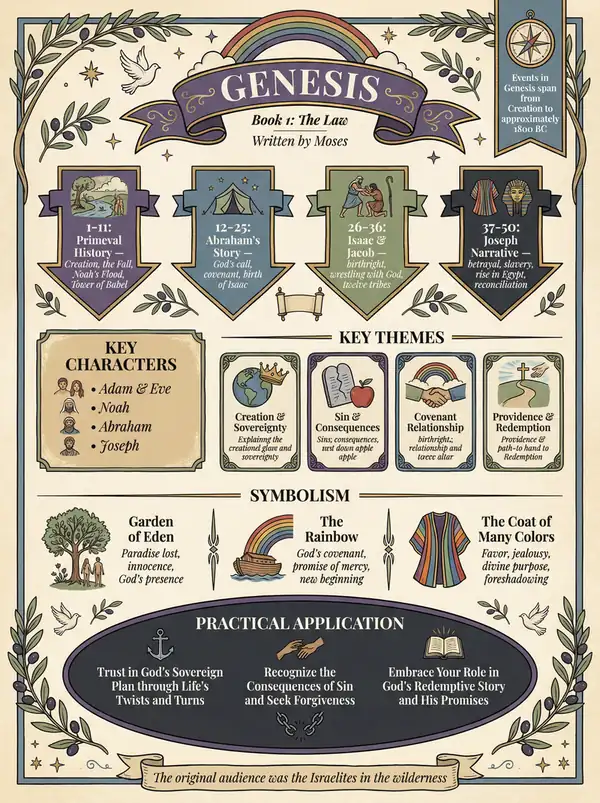
Full-page visual overview of The Book of Genesis — key events, themes, and structure at a glance
How to Study the Book of Genesis
To study Genesis, read it as the foundation of the entire biblical story — not just a collection of ancient narratives, but the opening act of a drama that runs all the way to Revelation. Genesis answers the most fundamental questions: Who made the world? What went wrong? How does God respond to human failure? And who are the people through whom he will work?
- 1 Read chapters 1–11 as primeval history: creation, the fall, Cain and Abel, the flood, and Babel.
- 2 Notice the pattern: creation → rebellion → consequence → grace.
- 3 Follow the covenant thread: God calls Abraham and makes specific, unconditional promises.
- 4 Trace the family line: Abraham → Isaac → Jacob → Joseph.
- 5 Watch how God works through flawed people — deception, jealousy, failure, and restoration.
- 6 Ask how each story anticipates the rest of Scripture, especially the coming of Christ.
Genesis is not primarily a science textbook or a political document — it is a theological declaration about who God is, who we are, and why the world needs redemption. Read it with those questions in view.
Genesis Chapter-by-Chapter Summary
The Book of Genesis spans from the creation of the cosmos to the death of Joseph in Egypt — covering thousands of years of primeval and patriarchal history. It is the foundation upon which the entire biblical narrative is built.
Primeval History — Creation to Babel
- 1:1–2:3 The six days of creation. God speaks the cosmos into existence. The seventh day is sanctified as Sabbath rest.
- 2:4–25 The Garden of Eden. Adam is formed from dust; Eve from Adam's rib. Humanity is placed in the garden to 'work and keep' it.
- 3:1–24 The Fall. The serpent deceives Eve; Adam follows. God pronounces judgment — but also the first gospel promise (3:15): a seed who will crush the serpent.
- 4:1–5:32 Cain kills Abel. Sin spreads. But a line of faithful descendants continues through Seth — 'At that time people began to call on the name of the Lord' (4:26).
- 6:1–9:29 Noah and the Flood. God's grief over human wickedness. The ark, the flood, the rainbow covenant: 'Never again will I destroy all living creatures' (8:21).
- 10:1–11:32 The Table of Nations and the Tower of Babel. Humanity scattered across the earth — setting the stage for God's call of one man to bless all nations.
Abraham — Father of Faith
- 12:1–9 The Call of Abram. God commands: "Go." Three promises: land, descendants, blessing to all nations. Abram obeys without knowing the destination (Hebrews 11:8).
- 15:1–21 The Covenant of the Pieces. God alone passes between the animals — making an unconditional promise. 'Abram believed the Lord, and he credited it to him as righteousness' (15:6).
- 17:1–27 The covenant of circumcision. Abram becomes Abraham. Sarai becomes Sarah. God promises a son within a year — 'Is anything too hard for the Lord?' (18:14).
- 18:1–19:38 Three visitors announce Isaac's birth. Abraham intercedes for Sodom. Lot is rescued from Sodom's destruction.
- 21:1–7 Isaac is born. Sarah laughs with joy: 'God has brought me laughter, and everyone who hears about this will laugh with me.'
- 22:1–19 The Binding of Isaac (Akedah). Abraham's supreme test of faith. God provides a ram. 'On the mountain of the Lord it will be provided' — pointing forward to Calvary.
Isaac and Jacob — The Covenant Continues
- 25:19–34 Jacob and Esau are born. Esau sells his birthright for a bowl of stew — a vivid picture of trading eternal inheritance for immediate gratification.
- 27:1–45 Jacob deceives Isaac and steals Esau's blessing. The family is torn apart. Yet God's purposes are not thwarted by human failure.
- 28:10–22 Jacob's Ladder at Bethel. God appears in a dream: 'I am with you and will watch over you wherever you go.' Jacob names the place 'House of God.'
- 29:1–30:43 Jacob serves Laban for Rachel. He is deceived in turn — reaping what he sowed. Twelve sons are born, the future tribes of Israel.
- 32:22–32 Jacob wrestles with God at Peniel. He is renamed Israel — 'one who struggles with God.' He walks away limping but blessed.
- 35:1–29 Return to Bethel. God reaffirms the covenant. Rachel dies giving birth to Benjamin. Isaac dies. The patriarchal era closes.
Joseph — Providence in Suffering
- 37:1–36 Joseph's coat of many colors. His brothers' jealousy. Sold into slavery in Egypt for 20 pieces of silver — a foreshadowing of Christ's betrayal.
- 39:1–41:57 Joseph in Potiphar's house. Falsely accused. Imprisoned. Yet 'the Lord was with Joseph.' Pharaoh's dreams interpreted. Joseph elevated to second-in-command of Egypt.
- 42:1–45:28 The brothers come to Egypt for grain. Joseph tests them. Benjamin is brought. Joseph reveals himself weeping: 'I am Joseph! Is my father still living?'
- 46:1–47:31 Jacob's family — 70 people — relocates to Egypt. Jacob blesses Pharaoh. The family settles in Goshen.
- 48:1–49:33 Jacob blesses his sons. The twelve tribes receive prophetic blessings. Judah is singled out: 'The scepter will not depart from Judah' — pointing to the Messiah.
- 50:1–26 Jacob is buried in Canaan. Joseph forgives his brothers: 'You intended to harm me, but God intended it for good.' Joseph dies at 110, confident in God's promise to bring Israel back to the land.
Key Themes in Genesis
Genesis establishes four foundational theological themes that run through the entire Bible — from creation to new creation.
God as Creator and Sovereign
Genesis opens with the conviction that God creates all that exists. Everything — matter, time, life, and meaning — originates in God. He does not merely shape pre-existing chaos; He speaks reality into being. This foundational truth shapes every subsequent story: God is not a distant observer but the active, sovereign author of all creation.
Read Genesis 1:1 in your preferred translation.
Genesis 1:1
Application: When life feels chaotic or meaningless, Genesis grounds us in the truth that the universe has a Creator who called it 'very good' — and who is still working to restore that goodness.
The Reality and Reach of Sin
Genesis 3 is the hinge of human history. The serpent's lie — 'You will be like God' — captures the essence of every sin: the desire to be autonomous, to define good and evil for ourselves. The consequences cascade: shame, blame, broken relationships, exile from Eden, and ultimately death. By Genesis 6, God grieves that 'the depth of humanity's bent toward evil'
Read Genesis 3:15 in your preferred translation.
Genesis 3:15
Application: Understanding the depth of the Fall helps us stop being surprised by the brokenness in ourselves and the world — and deepens our appreciation for the grace that Genesis also promises.
God's Covenant Faithfulness
Despite human failure at every turn — the Fall, Cain's murder, the Flood, Babel, and the patriarchs' repeated deceptions — God keeps initiating covenant relationships. He promises Noah (never to destroy the earth again), Abraham (land, descendants, and blessing to all nations), and Jacob (the same covenant renewed). These covenants are not earned; they are given by grace.
Read Genesis 17:7 in your preferred translation.
Genesis 17:7
Application: God's covenants in Genesis reveal that His commitment to humanity does not depend on human performance. His faithfulness is the anchor when ours fails.
Providence — God's Hidden Hand
The Joseph narrative (chapters 37–50) is the supreme illustration of divine providence in Genesis. Joseph is betrayed, enslaved, falsely accused, and imprisoned — yet at every point, 'the Lord was with Joseph.' What his brothers intended for evil, God intended for good: the preservation of the covenant family and the salvation of Egypt. Providence does not eliminate suffering; it redeems it.
Read Genesis 50:20 in your preferred translation.
Genesis 50:20
Application: Joseph's story invites us to trust that God is working in our darkest chapters — not just despite them, but through them — toward purposes we cannot yet see.
Genesis Symbols and Imagery
The Rainbow
Historical Context
After the Flood, God placed a rainbow in the sky as a sign of His covenant with Noah and all living creatures (Genesis 9:12–17). In the ancient Near East, the bow was a weapon of war; God 'hanging up' His bow signaled the end of divine judgment.
Theological Meaning
The rainbow is a visible, recurring reminder of God's grace and restraint. In Revelation 4:3, a rainbow surrounds God's throne — suggesting that even in the context of final judgment, God's covenant mercy frames everything He does.
The Tree of Life
Historical Context
The Tree of Life stood at the center of the Garden of Eden (Genesis 2:9). After the Fall, God placed cherubim and a flaming sword to guard it, preventing humanity from eating its fruit and living forever in a state of sin.
Theological Meaning
The Tree of Life bookends the entire Bible — it appears first in Eden (Genesis 2) and last in the New Jerusalem (Revelation 22:2), where its leaves are 'for the healing of the nations.' The cross of Christ is the bridge between these two trees.
The Ram at Moriah
Historical Context
When Abraham was about to sacrifice Isaac on Mount Moriah, God provided a ram caught in a thicket as a substitute (Genesis 22:13). Abraham named the place 'The Lord Will Provide' (Yahweh-Jireh).
Theological Meaning
The ram is one of the most powerful types of Christ in the Old Testament — an innocent substitute taking the place of the condemned. Mount Moriah is traditionally identified with the Temple Mount in Jerusalem, where centuries later the ultimate sacrifice would take place.
Joseph's Coat
Historical Context
Jacob gave Joseph a distinctive robe (often translated 'coat of many colors'), marking him as the favored son. His brothers' jealousy over this garment was the catalyst for selling him into slavery.
Theological Meaning
The coat that marked Joseph for suffering also marked him for glory. It foreshadows how the 'beloved Son' who is rejected and 'sold' becomes the savior of those who rejected him — a pattern fulfilled perfectly in Jesus.
Pharaoh's Seven Years
Historical Context
Pharaoh dreamed of seven fat cows devoured by seven thin cows, and seven full heads of grain swallowed by seven withered ones (Genesis 41). Joseph interpreted this as seven years of abundance followed by seven years of famine.
Theological Meaning
The dream and its interpretation reveal that God governs history — including the rise and fall of empires — to accomplish His redemptive purposes. Joseph's wisdom in preparation mirrors the biblical call to stewardship: using times of abundance to prepare for times of scarcity.
Genesis Bible Study Journal and Reflection Questions
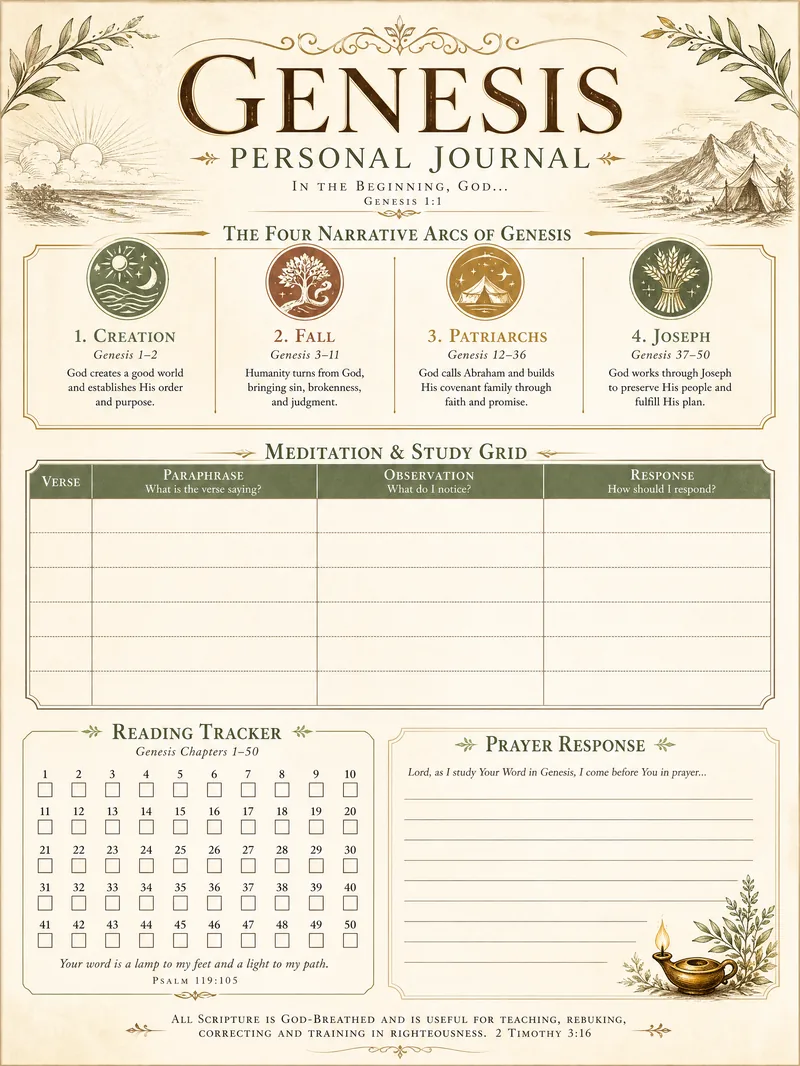
A printable journal template designed for verse-by-verse reflection, prayer, and personal response to Scripture.
Genesis Bible Small Group Discussion Guide
These 8 questions are designed for a 60–90 minute small group session. Begin with the icebreaker, then work through observation, interpretation, and application questions. Close with the prayer prompt.
If you could ask God one question about the creation story, what would it be? What draws you to that question?
Read Genesis 3:1–13. Notice how the serpent's question subtly distorts God's words (compare 2:16–17 with 3:1). What tactics does the serpent use? Where do you see similar distortions of God's truth today?
The serpent changes 'any tree' to 'every tree,' and adds 'you will surely die' as a question — casting doubt on both God's generosity and His judgment.
In Genesis 12:1–3, God makes three promises to Abraham. List them. Then trace how each promise unfolds through the rest of Genesis. Which promise do you find most surprising?
Genesis 15:6 says Abram 'trust received as righteousness' This verse is quoted three times in the New Testament (Romans 4, Galatians 3, James 2). What does it mean to be 'credited' with righteousness? How does this challenge a works-based view of faith?
This is the first explicit statement of justification by faith in the Bible — a theological cornerstone that Paul builds his entire argument in Romans upon.
Joseph says to his brothers: 'You intended to harm me, but God intended it for good' (50:20). How does the Joseph narrative redefine what 'good' means? Can you think of a time when something painful in your life was later revealed to have a redemptive purpose?
Genesis shows a pattern: God calls ordinary, flawed people — Abraham lies twice about his wife, Jacob deceives his father, Joseph is arrogant in his youth. What does this pattern tell us about how God works? How does it challenge our tendency to disqualify ourselves from God's calling?
The Sabbath is established in Genesis 2:1–3 before the Fall — it is part of God's original design, not a religious rule. What would it look like to practice genuine rest in your life this week? What makes rest difficult for you?
Close by reading Genesis 50:20 together. Have each person share one area of their life where they are struggling to see God's hand — a situation that feels like 'harm' rather than 'good.' Pray together that God would grant the eyes to see His hidden purposes, even in the hardest chapters.
Genesis Bible Study Questions and Answers
Deeper questions, richer answers — exploring the historical, theological, and personal dimensions of Genesis.
Day 1 · Creation — In the Beginning
Why does Genesis describe creation in six days — is this literal history or something deeper?
The creation week in Genesis 1 has fascinated scholars for millennia. The Hebrew word yom (day) can mean a literal 24-hour period, an era, or an undefined span of time. What Genesis insists on is not the clock speed of creation, but its Author. The rhythmic structure — evening and morning, God speaking and it being so — is a liturgical poem declaring that the cosmos is ordered, purposeful, and good.
Read Genesis 1:1 in your preferred translation.
The world feels chaotic and broken — how can I trust that God is still in control, like he was in Genesis?
Genesis does not shy away from chaos. The Hebrew word tohu wabohu — "formless and void" — describes the earth before creation. God did not begin with perfect materials; he brought order out of disorder. When your world feels like Genesis 1:2 — dark, shapeless, without form — the text invites you to notice what comes next: "And the Spirit of God was hovering over the face of the waters." The same Spirit who hovered over primordial chaos is present in yours.
Read Genesis 1:2 in your preferred translation.
How does BibleLum help connect this Genesis passage to the larger Bible story?
Traditional Bible study gives you the text. BibleLum gives you the connective tissue — the threads that run from Genesis all the way to Revelation. Beyond cross-references, BibleLum surfaces the cultural and historical context that makes the text come alive: what a first-century Jewish reader would have understood by "image of God," why the serpent was not just a snake, and how Genesis mirrors the structure of the entire Bible.
Read Genesis 3:15 in your preferred translation.
Day 2 · The Fall, the Flood, and Babel
What is the Tower of Babel really about — pride, language, or something deeper?
The Tower of Babel (Genesis 11) is often reduced to a story about human pride, but the text reveals something more theologically precise: humanity's attempt to build a name for themselves — to secure identity and significance apart from God. The irony is devastating: they built a tower to reach the heavens, but God had to "come down" to see it (Genesis 11:5). The reversal at Pentecost (Acts 2) is deliberate — where Babel scattered and confused, the Spirit gathered and unified, reversing the curse through the gospel.
Read Genesis 11:4 in your preferred translation.
Noah waited 120 years building an ark no one believed in — how do I keep faith when my obedience looks foolish to everyone around me?
Noah's obedience is described in one of the most striking phrases in Genesis: "Noah did everything just as God commanded him" (Genesis 6:22). This was not a weekend project — it was a lifetime of faithful action in the face of universal skepticism. Hebrews 11:7 says Noah "in holy fear built an ark to save his family. By his faith he condemned the world and became heir of the righteousness that is in keeping with faith." Faithful obedience in the face of ridicule is itself a form of testimony — it declares that you believe God's word more than you fear human opinion.
Read Hebrews 11:7 in your preferred translation.
How does BibleLum help trace the flood narrative as a pattern for baptism, judgment, and new creation throughout the Bible?
BibleLum helps beginners trace the flood as a narrative archetype that recurs throughout Scripture: water as both judgment and salvation, death and resurrection, old world ending and new world beginning. The exodus through the Red Sea, Israel's crossing of the Jordan, and Christian baptism all echo the flood's structure. Peter explicitly connects them (1 Peter 3:20–21). BibleLum helps beginners see how these connections fit into the larger Bible story, showing how one story illuminates all the others.
Read not the removal of dirt from the body but the pledge of a clear conscience toward God." — 1 Peter 3:21 in your preferred translation.
Day 3 · The Call of Abraham
Why did God choose Abraham specifically — and what does the covenant actually mean?
The call of Abraham in Genesis 12 is one of the most pivotal moments in Scripture. God's choice of Abraham was not based on Abraham's merit but on divine initiative — a pattern that runs through the entire Bible. The covenant God made with Abraham was unconditional — God alone passed between the divided animals (Genesis 15), taking the oath upon himself. This is the foundation of grace: God binds himself to his promises regardless of human performance.
Read Genesis 12:2 in your preferred translation.
Abraham left everything without knowing where he was going — how do I take a step of faith when I cannot see the destination?
Hebrews 11:8 tells us Abraham "obeyed and went, even though he did not know where he was going." This is the anatomy of biblical faith — not certainty about the path, but certainty about the One who calls. Abraham's faith was not blind optimism. He had heard God's voice. Faith in Scripture is always a response to revelation — you trust the character of the One who has spoken. The question is not "Can I see the destination?" but "Do I trust the Guide?"
Read Hebrews 11:8 in your preferred translation.
How does BibleLum connect Abraham's covenant to the rest of the Bible's story?
BibleLum helps beginners trace the Abrahamic covenant as the spine of the entire biblical narrative — from Genesis 12 through Galatians 3 to Revelation 7. Paul's argument in Galatians is that the gospel was preached in advance to Abraham (Galatians 3:8). BibleLum maps how every subsequent covenant — Mosaic, Davidic, New — is an elaboration of what God promised to Abraham, culminating in Christ as the seed in whom all nations are blessed.
Read Galatians 3:8 in your preferred translation.
Day 4 · Abraham and Isaac
How could a loving God command Abraham to sacrifice his son — what is really happening in Genesis 22?
Genesis 22 is one of the most disturbing and theologically dense passages in the Bible. God commands Abraham to offer Isaac as a burnt offering — the very son through whom all of God's promises were to be fulfilled. The key is in Hebrews 11:19: Abraham "reasoned that God could even raise the dead." He trusted that God's promise was more certain than his son's death. The story is not about God wanting child sacrifice — it is about God providing a substitute (the ram) and revealing his own plan to provide the ultimate substitute on the same mountain range where Christ was crucified.
Read Genesis 22:14 in your preferred translation.
Abraham said 'God himself will provide the lamb' before he knew how — what does it look like to speak faith before you see the outcome?
When Isaac asked "Where is the lamb for the burnt offering?" Abraham answered: "God himself will provide the lamb." This was not a comfortable platitude — it was a declaration of faith spoken in the middle of the most agonizing moment of his life. Speaking faith before you see the outcome is not denial — it is declaration. It is choosing to articulate what you believe about God's character even when circumstances contradict it. Abraham's words became prophecy: God did provide — first the ram, then ultimately his own Son.
Read Genesis 22:8 in your preferred translation.
How does BibleLum help beginners see the Moriah sacrifice pointing forward to Calvary — and what details in Genesis 22 only make sense in light of the cross?
BibleLum helps beginners notice the extraordinary typological precision of Genesis 22: Isaac carries the wood for his own sacrifice up the mountain, just as Jesus carried his cross. The ram caught in a thicket by its horns is the substitute. The location — Moriah — is the same mountain range as Golgotha. John 8:56 records Jesus saying "Your father Abraham rejoiced at the thought of seeing my day; he saw it and was glad." Abraham's experience on Moriah gave him a glimpse of what God himself would do — provide his own Son as the substitute, the Lamb of God who takes away the sin of the world.
Read Romans 8:32 in your preferred translation.
Day 5 · Jacob and Esau
Why did God choose Jacob over Esau before either was born — and what does this reveal about how God works?
Genesis 25 records one of the most theologically charged statements in the Bible: before the twins were born, God declared "the older will serve the younger" (Genesis 25:23). Paul returns to this in Romans 9 as the clearest example of divine election — God's choice based not on human merit but on his own sovereign purpose. This is not a story about God being arbitrary or unfair — it is a story about God's freedom to work through unexpected people. The entire biblical pattern runs this way: the younger over the older, the weak over the strong, the unlikely over the obvious. Grace, by definition, is not earned.
Read in order that God's purpose in election might stand — she was told, 'The older will serve the younger.'" — Romans 9:11–12 in your preferred translation.
Jacob wrestled with God all night and refused to let go until he received a blessing — what does this teach about persistent, desperate prayer?
The wrestling match at Peniel (Genesis 32) is one of the strangest and most profound passages in Scripture. Jacob wrestles with a divine figure through the night — and when the figure cannot overpower him, he dislocates Jacob's hip. Yet Jacob refuses to release his grip. The paradox is that God could have ended the match at any moment — the hip dislocation proves it. But he allowed Jacob to persist. This is the theology of prayer: God invites us to wrestle, to press in, to refuse to let go until we receive what we need. The wound and the blessing come together.
Read Genesis 32:28 in your preferred translation.
How does BibleLum help beginners understand Jacob's transformation from 'deceiver' to 'one who strives with God'?
BibleLum helps beginners trace Jacob's entire arc as a study in divine character formation — twenty years of being deceived by Laban mirror the years he spent deceiving others, until the night at Peniel where his identity is fundamentally rewritten. The name change from Jacob ("heel-grabber, supplanter") to Israel ("one who strives with God") is not just personal — it becomes the name of an entire nation. BibleLum helps beginners see how Jacob's transformation prefigures Israel's larger story: wrestling with God, being wounded, and ultimately being blessed.
Read Genesis 32:30 in your preferred translation.
Day 6 · Joseph's Rise
Joseph was sold into slavery by his own brothers — how does Genesis explain God's providence working through human evil?
Joseph's betrayal (Genesis 37) is one of the most psychologically raw scenes in the Bible. His brothers' jealousy escalates from resentment to murder plot to slave sale. Yet the narrator never suggests God was absent — the hidden providence of God is the theological spine of the entire Joseph narrative. Genesis 50:20 is the interpretive key: "You intended to harm me, but God intended it for good." This is not a naive claim that evil doesn't matter — it is a profound declaration that God's purposes are not derailed by human sin. Joseph's story is the clearest Old Testament portrait of how God works through suffering, not around it.
Read Genesis 50:20 in your preferred translation.
Joseph was betrayed by his own brothers — how do I trust God when the people closest to me cause the deepest wounds?
Joseph's story is the most psychologically detailed narrative in Genesis. His brothers' betrayal was not a minor setback — it was a catastrophic rupture of family, identity, and future. What sustains Joseph is not stoic resilience but a quiet confidence that God's purposes are not derailed by human evil. Genesis 39:2 repeats a phrase like a refrain: "The Lord was with Joseph." Not that everything was fine — but that God was present in the pit, the slave market, and the prison.
Read Genesis 39:2 in your preferred translation.
How does BibleLum help beginners see Joseph's story as a pattern of the suffering servant throughout Scripture?
BibleLum helps beginners see Joseph as the most fully developed type of Christ in the Old Testament — beloved son, rejected, sold for silver, falsely accused, exalted to the right hand of power, and becoming the savior of those who betrayed him. The parallels are not coincidental — they are part of a deliberate typological pattern that Scripture itself invites us to trace. Isaiah 53's suffering servant, Psalm 22's forsaken one, and ultimately Jesus all echo the Joseph narrative. BibleLum helps beginners see how these connections fit into the larger Bible story.
Read Genesis 50:20 in your preferred translation.
Day 7 · Joseph Restores His Family
How does the coat of many colors and Joseph's dreams function as literary and theological foreshadowing in Genesis?
The coat (or "robe of many colors") and Joseph's dreams are not incidental details — they are narrative signals that alert the reader to Joseph's special status and the conflict that will drive the story. In the ancient Near East, a special garment signified honor and authority. Jacob's gift marked Joseph as the heir of the covenant blessing — which his brothers understood and resented. The dreams (sheaves bowing, stars bowing) are divine confirmation of what the coat symbolized. Together they set up the central theological question: will God's purposes survive human jealousy?
Read Genesis 37:4 in your preferred translation.
Joseph was sold by his brothers, falsely accused, and thrown in prison — how do I hold onto hope when injustice keeps compounding?
Joseph's descent is relentless: betrayed by family, sold into slavery, falsely accused by Potiphar's wife, forgotten by the cupbearer. Each chapter seems to close off another avenue of escape. Yet the narrator keeps inserting the same phrase: "the Lord was with Joseph". Hope in Scripture is not optimism about circumstances — it is confidence in the character of God. Joseph could not see how the pit, the prison, and the forgotten promise would resolve. But the reader can see what Joseph could not: that each apparent setback was a step in a larger plan. The same is true of your story.
Read Genesis 39:20–21 in your preferred translation.
How does BibleLum help beginners see the hidden parallels between Joseph's descent into Egypt and Israel's later exodus from Egypt?
BibleLum helps beginners notice the structural narrative parallels between Joseph's story and the Exodus: both involve descent into Egypt, slavery, divine deliverance, and ascent to freedom — with Joseph's story functioning as a miniature preview of the national story. Genesis ends with Jacob's family in Egypt — which sets up Exodus's opening. But BibleLum shows how Joseph himself is a type of Moses: both are deliverers who save their people through wisdom and divine power, both are rejected before being accepted. The Bible is a story that keeps echoing itself.
Read Genesis 50:24 in your preferred translation.
Day 191 · Creation and Fall — Review
Why does the 300-day journey return to Genesis 1–3 at Day 191 — what does revisiting the beginning reveal that we missed the first time?
The BibleLum journey is designed as a spiral, not a straight line. Returning to Genesis 1–3 at Day 191 — after reading the Law, the Psalms, and the Prophets — means encountering creation with completely different eyes. The "image of God" in Genesis 1:27 now resonates with Ezekiel's vision of the divine throne. The Fall now echoes in Isaiah's lament over Babylon. Ancient Jewish readers practiced this same spiral reading — the Torah was read annually, but each year's reading was illuminated by everything learned in between. The second reading of Genesis 1–3 is not repetition; it is revelation. You are not the same reader you were at Day 1, and the text will not be the same text.
Read Genesis 1:27 in your preferred translation.
After reading 190 days of Scripture, how does the story of the Fall in Genesis 3 hit differently — and what does it mean for how we understand our own failures?
At Day 1, Genesis 3 reads as an origin story. At Day 191, it reads as a mirror. Having walked through Israel's repeated cycles of faithfulness and failure, the reader recognizes the universal pattern: the temptation to be "like God," the hiding after failure, the blame-shifting, the exile from presence. The Fall is not a story about two people in a garden — it is the story of every human heart. But Day 191 also brings the promise of Genesis 3:15 into sharper focus: the seed of the woman who will crush the serpent's head. After 190 days of watching God pursue his people through every failure, that promise feels less like a footnote and more like the entire point.
Read Genesis 3:15 in your preferred translation.
How does BibleLum use the Day 191 return to Genesis to show the "bookend" structure of the entire Bible — from garden to garden?
BibleLum points out one of the Bible's most elegant structural features: the garden-to-garden arc. Genesis begins in a garden where God walks with humanity; Revelation ends in a garden-city where God dwells with his people forever. The tree of life appears in both. At Day 191, you are roughly two-thirds through the journey — positioned between the beginning and the end. BibleLum uses this moment to surface the architectural beauty of Scripture: every book you have read, every prophet's cry, every psalm of longing is part of the movement from Genesis 3 (exile from the garden) to Revelation 22 (restoration to the garden). You are not reading disconnected texts — you are reading one story.
Read Revelation 22:1–2 in your preferred translation.
Day 201 · In the Beginning — Creation
Day 201 brings Genesis 1–3 back a third time — in the context of the New Testament. How does reading creation through the lens of John 1 and Colossians 1 transform its meaning?
John 1:1 deliberately echoes Genesis 1:1: "In the beginning was the Word." The creation account is being re-read through a Christological lens — the same Word who said "Let there be light" is the Word who became flesh. Colossians 1:16 makes it explicit: "all things were created through him and for him." At Day 201, you have read the Gospels and Paul's letters. The creation account now functions as a prologue not just to Genesis but to the entire Christ-story. The "image of God" that was marred in the Fall is being restored in the "image of the invisible God" (Colossians 1:15). Creation is not background — it is the first chapter of the redemption story.
Read Colossians 1:15–16 in your preferred translation.
Reading Genesis 1–3 for the third time at Day 201 — what does it mean to live as an "image-bearer" in a world that has forgotten what the image is?
The Hebrew phrase tselem Elohim — image of God — was a royal designation in the ancient Near East. Kings placed their images throughout their territory to represent their authority. Genesis democratizes this: every human being is a royal image-bearer, placed in creation to represent God's character and care. In a culture that defines human worth by productivity, appearance, or social status, the Genesis declaration is radical: your dignity is not earned — it is given at creation. To live as an image-bearer means to reflect God's justice, creativity, and love into the spaces you inhabit. It is not a status to achieve but a calling to embody.
Read Genesis 1:27 in your preferred translation.
How does BibleLum help beginners see that the New Testament writers were doing a "creative re-reading" of Genesis — and why does this matter for how we interpret Scripture?
BibleLum helps beginners trace a practice called inner-biblical interpretation — where later biblical authors deliberately reread and reapply earlier texts. Paul's "last Adam" language in Romans 5 and 1 Corinthians 15 is a conscious re-reading of Genesis 2–3. Jesus' wilderness temptation (Matthew 4) reverses Adam's garden temptation. This is not proof-texting — it is the Bible reading itself. The New Testament writers were saturated in Genesis and saw Christ as its fulfillment. BibleLum surfaces these connections in real time, showing how the same text can carry multiple layers of meaning across centuries. Scripture is not a flat document — it is a living conversation across time.
Read 1 Corinthians 15:22 in your preferred translation.
Day 203 · The Abrahamic Covenant
At Day 203, reading the Abrahamic Covenant after Paul's letters — how does Galatians 3 reframe what God promised Abraham in Genesis 12 and 15?
Paul's argument in Galatians 3 is stunning: the promise to Abraham ("all nations will be blessed through you," Genesis 12:3) was always about faith, not law. The covenant came 430 years before the Mosaic Law — which means the Law cannot nullify or supersede the promise. Abraham was justified by faith before circumcision, before Sinai, before any religious system. Reading Genesis 12 and 15 at Day 203 — after Romans, Galatians, and Hebrews — reveals that the Abrahamic Covenant is the theological spine of the entire Bible. Every subsequent covenant (Mosaic, Davidic, New) is an elaboration or fulfillment of what God promised one man under a starlit sky. "Your offspring will be as numerous as the stars" was always pointing to Christ and his global family.
Read if indeed you can count them.' Then he said to him, 'So shall your offspring be.'" — Genesis 15:5 in your preferred translation.
Abraham left everything for a land he had never seen — what does his obedience at Day 203 teach us about faith in the middle of the journey, not just at the beginning?
At Day 203 of 300, you are in the middle of a long journey — just as Abraham was in the middle of his. He had left Ur, but had not yet received the land. He had the promise, but not the fulfillment. Hebrews 11:8 says he "obeyed and went, even though he did not know where he was going." This is middle-of-the-journey faith — the hardest kind. The temptation in the middle is to measure progress by what you can see. Abraham had a tent, not a palace. He had a promise, not a possession. But Hebrews 11:10 says "he was looking forward to the city with foundations, whose architect and builder is God." Day 203 is an invitation to ask: what am I looking forward to that I cannot yet see?
Read Hebrews 11:8 in your preferred translation.
How does BibleLum help connect the covenant ceremony of Genesis 15 — where God alone walks between the pieces — to the cross?
Genesis 15 contains one of the most dramatic covenant rituals in the ancient world: animals are cut in half, and the parties walk between the pieces, symbolizing "may I be cut like these animals if I break this covenant." But in Genesis 15:17, only God passes through the pieces — as a smoking firepot and blazing torch. Abraham is asleep. BibleLum helps beginners notice the theological weight of this moment: God takes the covenant oath alone, binding himself to the promise regardless of Abraham's faithfulness. This is not a bilateral contract — it is a unilateral commitment. When Israel broke the covenant, God did not walk away. Instead, at the cross, God himself bore the covenant curse ("cut off" in death) to keep the promise. The smoking firepot of Genesis 15 finds its fulfillment in the darkness of Golgotha.
Read Genesis 15:17 in your preferred translation.
Genesis Bible Study Key Characters
Meet the people whose faith, failure, and faithfulness shaped the story.
Adam & Eve
The first humans, created in God's image, whose disobedience brought sin into the world.
Noah
A righteous man chosen by God to build the ark and preserve life through the great flood.
Abraham
The father of faith, called by God to leave his homeland and become the father of a great nation.
Joseph
Son of Jacob, sold into slavery by his brothers, who rose to become ruler of Egypt and saved his family.
Genesis Bible Study Practical Application
Ancient wisdom, lived out today — practical steps rooted in Scripture.
You Are Made in God's Image
Every person carries inherent dignity and worth as a bearer of the image of God (Imago Dei).
God Redeems Broken Stories
Joseph's life shows that God can take the worst circumstances and use them for a greater purpose.
Faith Requires Stepping Out
Abraham's journey challenges us to trust God even when the destination is unknown.
Related Study Packs
Common Questions About Studying the Book of Genesis
How do I study the Book of Genesis?
To study the Book of Genesis, begin with the four foundational narratives that structure the book: creation (Genesis 1–2), the fall (Genesis 3), the flood (Genesis 6–9), and the tower of Babel (Genesis 11). Then follow the four patriarchal stories: Abraham (Genesis 12–25), Isaac (Genesis 21–26), Jacob (Genesis 25–36), and Joseph (Genesis 37–50). Keep Genesis 12:1–3 in view throughout — God's promise to Abraham of land, descendants, and blessing is the thread that ties the whole book together and runs through the entire Bible.
What is the main message of the Book of Genesis?
The main message of Genesis is that the God who created all things is the God who redeems. Genesis establishes the problem — sin, death, and separation from God — and introduces the solution: a covenant of grace. God's promise to Abraham in Genesis 12:1–3 sets the trajectory for the rest of Scripture. Genesis answers the most fundamental human questions: Where did we come from? What went wrong? And is there any hope? The answer to all three is found in the character and purposes of God.
What are the key themes in the Book of Genesis?
The key themes in Genesis include: creation and the goodness of the physical world, the nature and consequences of sin, the faithfulness of God to his covenant promises, the pattern of election — God choosing the younger, the weaker, the unexpected, the tension between human failure and divine grace, and the foreshadowing of redemption through figures like Abel, Isaac, and Joseph. Genesis also introduces the themes of land, seed, and blessing that will run through the entire Old Testament.
How does the Book of Genesis connect to the rest of the Bible?
Genesis is the seed of the entire Bible. Every major theme of Scripture — creation, fall, redemption, covenant, sacrifice, election, and new creation — is introduced here. The promise to Abraham (Genesis 12:1–3) is the backbone of the Old Testament and is fulfilled in Jesus Christ (Galatians 3:16). The garden of Eden points forward to the new Jerusalem in Revelation 22. Joseph's story of suffering, rejection, and exaltation foreshadows the pattern of Christ. Reading Genesis carefully is the foundation for reading the rest of the Bible well.
The Book of Genesis
"You intended to harm me, but God intended it for good to accomplish what is now being done, the saving of many lives."
Genesis 50:20
Start the 300-Day Bible Study Journey →