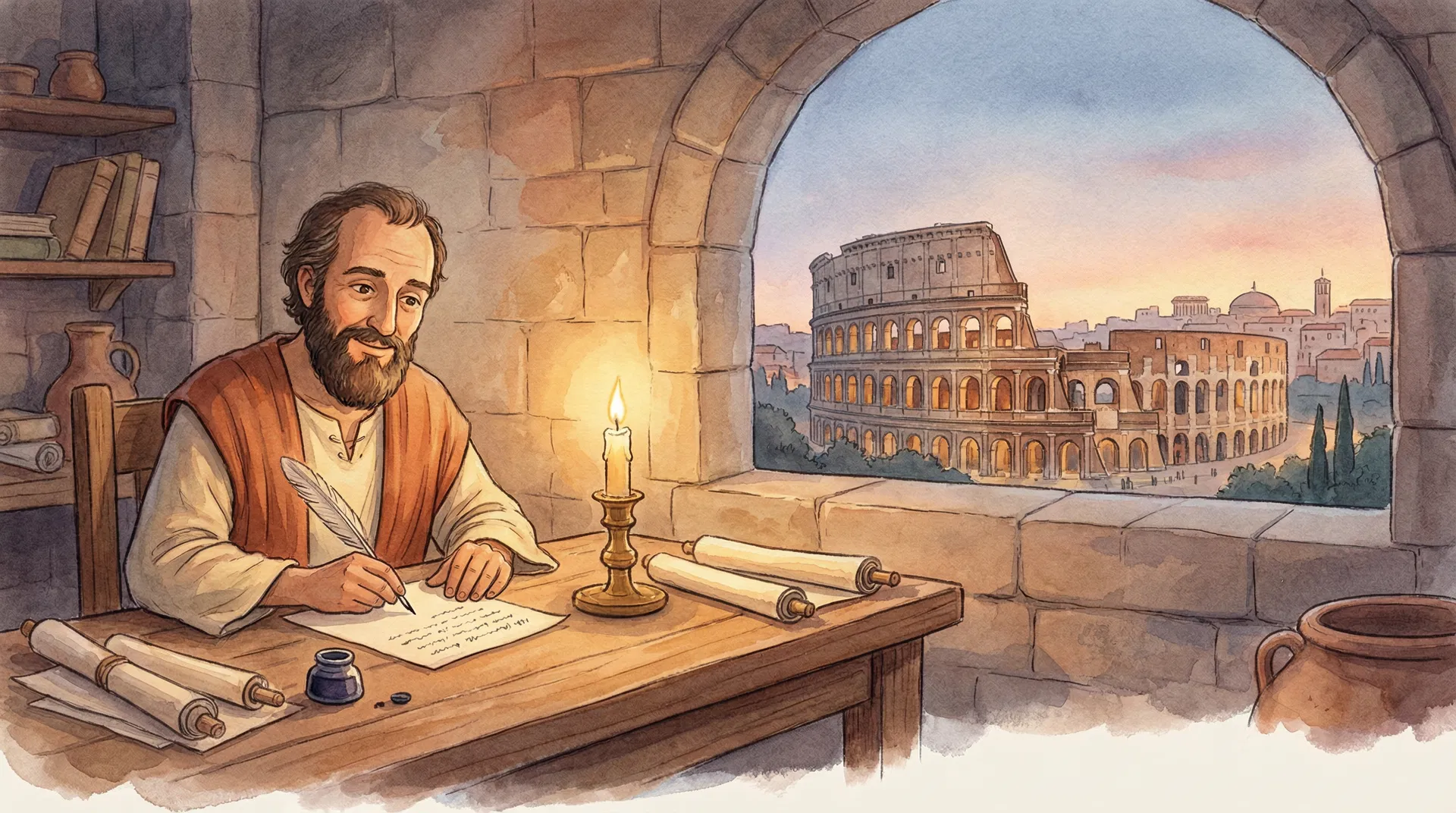
Romans Bible Study Guide Overview
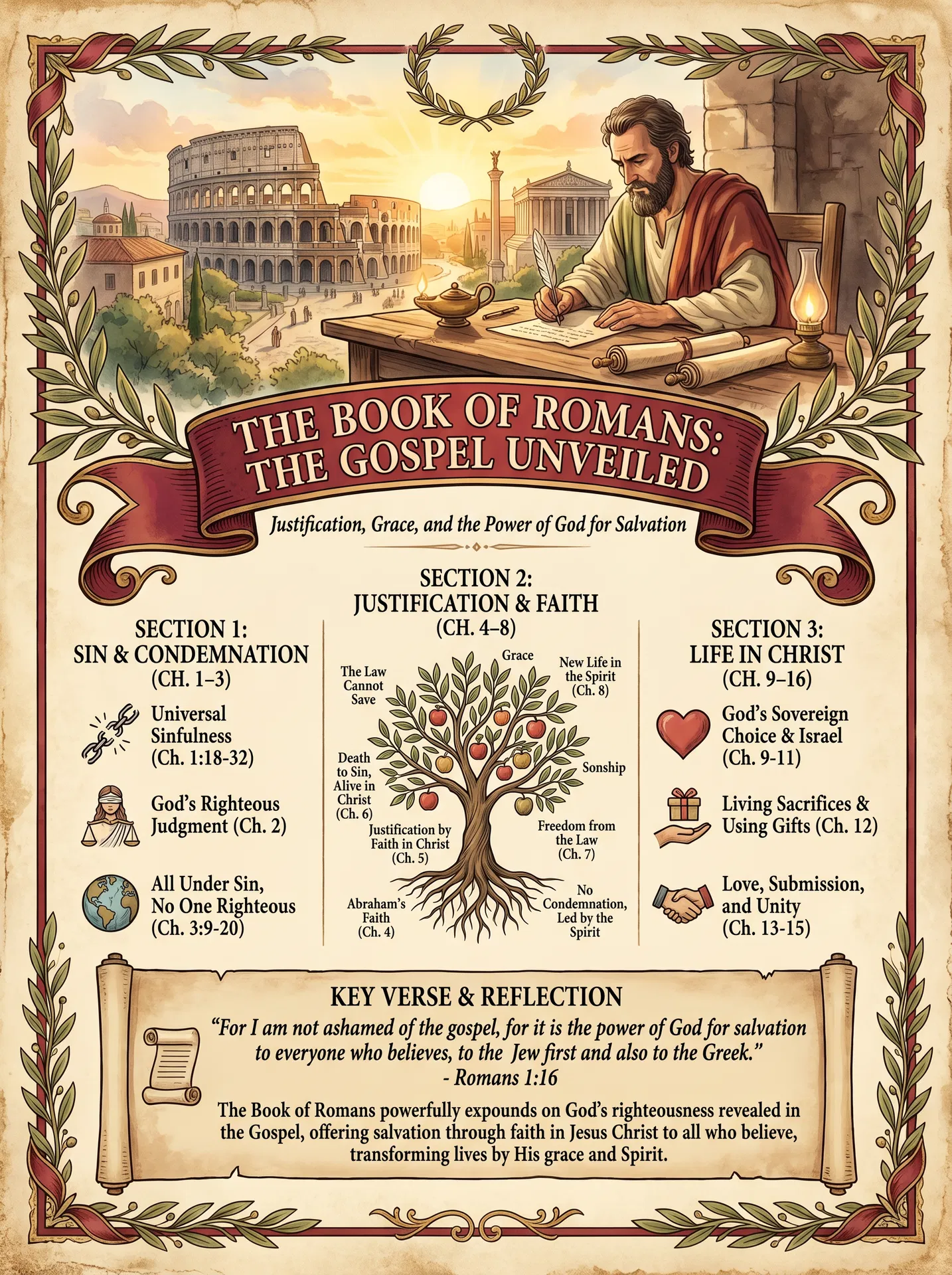
Full-page visual overview of The Letter to the Romans — key events, themes, and structure at a glance
How to Study the Letter to the Romans
To study Romans, read it as a single sustained argument — not a collection of quotable verses. Paul is building a case from beginning to end: all humanity stands guilty before God, but God has acted in Christ to justify the ungodly by faith. Keep the logical flow in view as you read each chapter.
- 1 Start with Romans 1:16–17: these two verses are the thesis of the entire letter — the gospel is the power of God for salvation, and in it the righteousness of God is revealed.
- 2 Read chapters 1–3 as the diagnosis: Gentiles, moral people, and Jews are all under sin. No one is righteous.
- 3 Study chapters 3–5 carefully: justification by faith, the meaning of the cross, and peace with God through Christ.
- 4 Follow chapters 6–8: the logic of sanctification — dead to sin, alive to God, walking by the Spirit.
- 5 Wrestle with chapters 9–11: the mystery of Israel, election, and the faithfulness of God to his promises.
- 6 Apply chapters 12–16: the practical shape of a life transformed by the gospel — love, community, conscience, and mission.
- 7 Ask throughout: What does this reveal about God? What does it demand of me?
Romans rewards slow, careful reading. It is not easy — Peter himself said Paul's letters contain things that are hard to understand (2 Peter 3:16). But the effort is worth it: no book in the Bible has shaped Christian theology, mission, and personal faith more profoundly.
Romans Chapter-by-Chapter Summary
The Letter to the Romans, written by Paul around AD 57, is the most systematic exposition of the gospel in the New Testament. Addressing a divided church in the capital of the empire, Paul lays out the full arc of salvation — from universal human guilt to justification by faith, sanctification, and the mystery of Israel's redemption.
The Universal Problem — All Have Sinned
- 1:1–17 Paul's introduction: the gospel is the power of God for salvation. His famous thesis: "The righteous shall live by faith" (1:17, quoting Habakkuk 2:4). This single verse launched the Protestant Reformation.
- 1:18–2:16 The Gentile's guilt: humanity suppressed the truth about God revealed in creation. The downward spiral of idolatry and moral corruption. God's judgment is just because He judges according to truth.
- 2:17–3:8 The Jew's guilt: possessing the law does not exempt from judgment. Circumcision is a matter of the heart. "God's name is blasphemed among the Gentiles because of you" (2:24).
- 3:9–31 "There is no one righteous, not even one" (3:10). The entire human race stands condemned. But then: "But now apart from the law the righteousness of God has been made known" — through faith in Jesus Christ.
The Divine Solution — Justified by Faith
- 4:1–25 Abraham: the great example of justification by faith. He was declared righteous before circumcision, before the law — proving that faith, not works, is the basis of right standing with God.
- 5:1–21 "Therefore, since we have been justified through faith, we have peace with God." The five benefits of justification. Adam and Christ contrasted: through one man sin entered; through one man grace abounds.
- 6:1–23 "Shall we go on sinning so that grace may increase? By no means!" Baptism as union with Christ's death and resurrection. We are dead to sin and alive to God. "The wages of sin is death, but the gift of God is eternal life."
- 7:1–8:39 The struggle with sin (ch. 7) and the Spirit-filled life (ch. 8). Romans 8 is the summit of the letter: no condemnation, adoption as children, intercession of the Spirit, and the unbreakable love of God.
The Mystery of Israel — God's Sovereign Plan
- 9:1–29 Paul's anguish for Israel. God's sovereign election: "Jacob I loved, but Esau I hated." The potter and the clay. God's freedom in mercy does not contradict His justice — it reveals His glory.
- 9:30–10:21 Israel stumbled over the stumbling stone (Christ) by pursuing righteousness through works rather than faith. "If you declare with your mouth, 'Jesus is Lord,' and believe in your heart... you will be saved" (10:9).
- 11:1–36 Has God rejected Israel? By no means! A remnant remains. The olive tree: Gentiles grafted in, Israel to be restored. "Oh, the depth of the riches of the wisdom and knowledge of God!" The doxology of Romans 11.
The Transformed Life — Living the Gospel
- 12:1–2 "Offer your bodies as a living sacrifice" — the great transition from doctrine to duty. "Do not conform to the pattern of this world, but be transformed by the renewing of your mind." The hinge verse of Romans.
- 12:3–21 Practical ethics: humility, spiritual gifts, love without hypocrisy, blessing persecutors, living at peace. "Do not be overcome by evil, but overcome evil with good" (12:21).
- 13:1–14:23 Submission to governing authorities. Love as the fulfillment of the law. The strong and the weak: do not cause a brother to stumble. "The kingdom of God is not a matter of eating and drinking, but of righteousness, peace and joy."
- 15:1–16:27 Paul's missionary vision: from Jerusalem to Spain. Personal greetings to 26 named individuals — a window into the early church. The closing doxology: "To him who is able to establish you... to the only wise God be glory forever!"
Key Themes in Romans
Romans unfolds four great theological movements that together present the most complete account of the gospel found anywhere in Scripture.
Justification by Faith
The central thesis of Romans is that sinful human beings can be declared righteous before a holy God — not by keeping the law, but through faith in Jesus Christ. Paul uses the Greek word dikaioo (justify) to describe a legal declaration: God pronounces the guilty party "not guilty" on the basis of Christ's righteousness credited to them. This is not earned; it is received as a gift.
"For we maintain that a person is justified by faith apart from the works of the law."
Romans 3:28
Application: Justification by faith means your standing before God is not based on your performance. On your worst day, you are fully accepted in Christ. On your best day, you add nothing to that standing.
The Power of the Gospel
Paul opens Romans with a bold declaration: "I am not ashamed of the gospel, because it is the power of God that brings salvation to everyone who believes" (1:16). The Greek word for "power" is dunamis — from which we get "dynamite." The gospel is not merely good advice or a moral system; it is the explosive, transformative power of God at work in human lives.
"For I am not ashamed of the gospel, because it is the power of God that brings salvation."
Romans 1:16
Application: If the gospel feels like old news, Romans invites you to see it again with fresh eyes. The same power that raised Jesus from the dead is at work in every believer (Romans 8:11).
Life in the Spirit (Romans 8)
Romans 8 is widely considered the greatest chapter in the Bible. It opens with "no condemnation" and closes with "nothing can separate us from the love of God." In between, Paul describes the Spirit-filled life: freedom from sin's power, adoption as God's children, the Spirit's intercession, the certainty of glory, and the unbreakable love of God. It is the summit of Paul's theology.
"There is therefore now no condemnation for those who are in Christ Jesus."
Romans 8:1
Application: Romans 8 is medicine for the soul. When guilt, fear, or suffering threaten to overwhelm, this chapter anchors us in the unshakeable realities of who we are in Christ.
The Transformed Mind
Romans 12:1–2 is the great hinge of the letter, transitioning from doctrine to practice. Paul's appeal is "by the mercies of God" — the entire argument of chapters 1–11 is the basis for the ethical appeal of chapters 12–16. The transformation Paul describes is not behavior modification but a renewal of the mind — a fundamentally different way of seeing reality that produces fundamentally different behavior.
"Do not conform to the pattern of this world, but be transformed by the renewing of your mind."
Romans 12:2
Application: "Do not conform to the pattern of this world" is not a list of rules but an invitation to a different way of seeing. What would it look like to evaluate your choices this week by the renewed mind Paul describes?
Romans Symbols and Imagery
The Courtroom
Historical Context
Paul was a trained Pharisee who knew Roman law. He uses the language of the Roman courtroom throughout Romans: justified (declared righteous), condemned, verdict, acquitted. Roman courts were the most sophisticated legal system in the ancient world, and Paul's audience in Rome would have understood every legal term immediately.
Theological Meaning
The courtroom imagery reveals the seriousness of sin (it requires a verdict) and the miracle of grace (the verdict is "not guilty" for those in Christ). God is both the just Judge who cannot ignore sin and the gracious Father who provides the payment Himself through Christ.
The Olive Tree
Historical Context
The olive tree was the most economically and symbolically important tree in the ancient Mediterranean world. Olive oil was used for food, light, medicine, and religious ceremony. Israel had long been described as God's olive tree (Jeremiah 11:16; Hosea 14:6). Wild olive branches were sometimes grafted onto cultivated trees to improve yield.
Theological Meaning
In Romans 11:17–24, Paul uses the olive tree to explain the relationship between Israel and the Gentiles in God's redemptive plan. Gentile believers are wild branches grafted into the cultivated tree of Israel's covenant history. This image warns against Gentile arrogance and affirms God's ongoing faithfulness to Israel.
Slavery and Freedom
Historical Context
Slavery was ubiquitous in the Roman Empire — estimates suggest 30–40% of the population of Rome were slaves. Paul's audience would have included both slaves and slave owners. The language of manumission (the legal freeing of a slave) was immediately understood as a picture of liberation.
Theological Meaning
Paul uses slavery as a theological category in Romans 6: before Christ, we were slaves to sin; after Christ, we are slaves to righteousness. The paradox is that true freedom is found in willing submission to God. "You have been set free from sin and have become slaves to righteousness" (6:18).
Adoption
Historical Context
Roman adoption was a serious legal act that gave the adopted child full rights as a natural-born son — including inheritance rights and the father's name. A Roman adoption could not be reversed. Paul's audience would have understood that adoption created a permanent, legally binding relationship.
Theological Meaning
Romans 8:15–17 describes believers as adopted children of God who cry "Abba, Father" — the intimate Aramaic term Jesus used. This adoption is permanent (nothing can separate us from God's love, 8:38–39), gives us full inheritance rights (co-heirs with Christ), and transforms our identity from slaves to sons and daughters.
Romans Bible Study Journal and Reflection Questions
A printable journal template designed for verse-by-verse reflection, prayer, and personal response to Scripture.
Romans Bible Small Group Discussion Guide
These 8 questions are designed for a 60–90 minute small group session. Begin with the icebreaker, then work through observation, interpretation, and application questions. Close with the prayer prompt.
Paul says he is "not ashamed of the gospel" (Romans 1:16) — implying it was something people could be ashamed of. Have you ever felt hesitant to share your faith? What made it feel risky?
Read Romans 3:21–26 carefully. Paul uses five different metaphors for salvation in these six verses: justification (courtroom), redemption (slave market), propitiation (temple sacrifice), righteousness (moral standing), and faith. What does the density of these images tell us about the richness of what Christ accomplished?
This is the theological heart of Romans — sometimes called the "most important paragraph ever written." Each metaphor addresses a different dimension of the human problem: guilt, bondage, wrath, moral failure, and separation.
Romans 5:3–5 says we rejoice in our sufferings because they produce perseverance, character, and hope. Compare this with Romans 8:18: "our present sufferings are not worth comparing with the glory that will be revealed." How do these two passages together shape a Christian theology of suffering?
Romans 7:15–19 describes a painful inner conflict: "I do not do what I want, but I do the very thing I hate." Is Paul describing his experience before or after conversion? What does this passage tell us about the ongoing struggle with sin in the Christian life?
Scholars have debated this for centuries. The key insight is that the struggle itself — the hatred of sin, the desire for good — is a sign of the Spirit's work. A person without the Spirit does not grieve their sin.
Romans 9:20–21 uses the image of the potter and the clay. How do you respond to Paul's argument for God's sovereignty? Does it comfort you or trouble you? What questions does it raise for you?
This is one of the most challenging passages in the New Testament. The goal is not to resolve the tension but to sit with it honestly — and to notice that Paul's response to God's sovereignty is doxology (11:33–36), not despair.
Romans 12:2 calls us to be "transformed by the renewing of your mind." What specific thought patterns, beliefs, or assumptions in your life most need to be renewed by the gospel? What would it look like to actively work on one of them this week?
Romans 8:38–39 lists ten things that cannot separate us from God's love. Which of these ten threats feels most real to you right now — death, life, angels, demons, present, future, powers, height, depth, or anything else in creation? How does Paul's declaration speak to that specific fear?
Close by reading Romans 8:1 and 8:38–39 together. Have each person share one thing they have been carrying that they need to release to God — guilt, fear, uncertainty, or grief. Then pray together, declaring over each person: "Nothing can separate you from the love of God in Christ Jesus."
Romans Bible Study Questions and Answers
Deeper questions, richer answers — exploring the historical, theological, and personal dimensions of Romans.
Day 96 · Nothing Can Separate Us from God's Love — Romans 8
What does Romans 8:28 mean — does God really work all things for good?
Romans 8:28 is one of the most quoted and most misunderstood verses in the Bible. Paul writes: And we know that in all things God works for the good of those who love him. The key word is all things — not 'good things.' Paul is writing from prison, under persecution, having experienced shipwreck and beatings. He is not promising comfort; he is asserting that God's sovereign purpose cannot be derailed even by suffering, betrayal, or death. The 'good' is defined in verse 29: being conformed to the image of his Son. Paul's argument in Romans 8 moves from present suffering (v. 18) to future glory (v. 19-25) to the Spirit's intercession (v. 26-27) to God's sovereign purpose (v. 28-30). The famous chain — foreknew, predestined, called, justified, glorified — is Paul's answer to the question: can anything undo what God has started?
And we know that in all things God works for the good of those who love him, who have been called according to his purpose. — Romans 8:28 (NIV)
Romans 8:38-39 says nothing can separate us from God's love. Why do so many Christians still feel separated from God?
Paul's declaration — neither death nor life, neither angels nor demons, neither the present nor the future, nor any powers, neither height nor depth, nor anything else in all creation — is an exhaustive list designed to close every loophole. The feeling of separation is real, but Paul distinguishes between experiential distance and ontological reality. We may feel far from God during grief, sin, or doubt. But feeling separated is not the same as being separated. The love of God is not a feeling — it is a fact secured by the death and resurrection of Jesus (v. 34). The context of Romans 8:38-39 is suffering and persecution (v. 35-37). Paul asks: Can hardship, or persecution, or famine, or nakedness, or danger, or sword separate us? His answer is No — in all these things we are more than conquerors. The love of God is most visible not in the absence of suffering but in the presence of God within it.
For I am convinced that neither death nor life... will be able to separate us from the love of God that is in Christ Jesus our Lord. — Romans 8:38-39 (NIV)
Romans 8 mentions the Holy Spirit 19 times. How does Paul's pneumatology (theology of the Spirit) in Romans 8 differ from popular Christian ideas about the Spirit?
Popular Christianity often associates the Holy Spirit primarily with dramatic experiences — tongues, healings, emotional encounters. Romans 8 presents a different portrait. The Spirit's primary work is transformative indwelling: setting the mind on what the Spirit desires (v. 5), giving life to mortal bodies (v. 11), putting to death the misdeeds of the body (v. 13), confirming our adoption as children of God (v. 15-16), and interceding for us with groans that words cannot express (v. 26). This is not spectacular but deeply personal and continuous. BibleLum traces the Spirit's role from Genesis 1:2 (hovering over the waters) through Ezekiel 37 (breathing life into dry bones) to Romans 8 (indwelling believers). The Spirit is consistently the agent of new creation — wherever the Spirit moves, death gives way to life.
The Spirit himself testifies with our spirit that we are God's children. — Romans 8:16 (NIV)
Day 116 · All Have Sinned — Justified by Faith — Romans 1–4
What does 'justified by faith' mean in Romans 3-4, and why did this doctrine spark the Protestant Reformation?
Justification is a legal term: to be declared righteous before God's court. Paul's argument in Romans 3:21-26 is that God justifies sinners not on the basis of their moral performance but through faith in Jesus Christ. This was explosive in the 16th century because the medieval church taught that justification was a process involving both faith and works of penance. Martin Luther, reading Romans 1:17 — the righteous will live by faith — experienced what he called a 'tower experience': the realization that God's righteousness is not a demand but a gift received through faith alone. Paul's proof text in Romans 4 is Abraham: What does Scripture say? Abraham believed God, and it was credited to him as righteousness (4:3, quoting Genesis 15:6). Abraham was justified before circumcision (4:10) and before the Law (4:13). Paul's argument is historical: the faith-righteousness pattern predates every religious system.
For we maintain that a person is justified by faith apart from the works of the law. — Romans 3:28 (NIV)
Romans 1:16 says Paul is not ashamed of the gospel. Why would someone be ashamed of it, and what does unashamed faith look like today?
In Paul's world, the gospel was socially embarrassing: it proclaimed that a crucified criminal was Lord of the universe. Crucifixion was the most shameful death in Roman culture — reserved for slaves and rebels. To claim that this executed man was the Son of God was intellectual and social suicide in educated Roman circles. Paul's declaration — I am not ashamed — is not triumphalism; it is a deliberate counter-cultural stance. He has calculated the cost and chosen the gospel anyway. The shame dynamic is still operative today. In secular academic contexts, claiming that Jesus is the only way to God sounds exclusive and intolerant. In pluralistic social contexts, it sounds arrogant. Paul's antidote is not argument but conviction: it is the power of God that brings salvation (1:16). The gospel's power is not diminished by cultural disapproval.
For I am not ashamed of the gospel, because it is the power of God that brings salvation to everyone who believes. — Romans 1:16 (NIV)
Romans 3:23 says 'all have sinned and fall short of the glory of God.' What does 'fall short of the glory' mean — is it just moral failure?
The phrase fall short of the glory of God carries more weight than a simple moral failure. In Jewish theology, the glory (kabod) of God was the radiant presence that filled the tabernacle and temple. Humans were created to image and reflect that glory (Genesis 1:26-27). Sin is not merely rule-breaking; it is the failure to be what humans were designed to be — bearers of divine glory. Paul's gospel is not just forgiveness of sins but restoration of the glory-bearing vocation. Romans 5:2 says we rejoice in the hope of the glory of God — the glory we lost is the glory we are being restored to. Romans 8:30 says those God justified, he also glorified. The arc of Romans is from glory lost (3:23) to glory restored (8:30) — a complete redemptive narrative.
For all have sinned and fall short of the glory of God, and all are justified freely by his grace. — Romans 3:23-24 (NIV)
Day 117 · Peace with God — Life in the Spirit — Romans 5–8
Romans 5:12-21 compares Adam and Christ as two 'federal heads' of humanity. What does this mean and why does it matter for understanding original sin?
Paul draws a parallel between Adam and Christ that has shaped Christian theology for two millennia. Adam's one act of disobedience brought condemnation to all; Christ's one act of obedience brings justification to all who believe. This is the doctrine of federal headship: just as a nation's treaty made by its representative is binding on all citizens, Adam's choice in the garden affected all his descendants. The good news is that the same logic works in reverse: union with Christ reverses what union with Adam brought. The Adam-Christ parallel is not just theological abstraction — it explains why the gospel is universal. Sin entered through one man (5:12), so righteousness can enter through one man (5:17). Paul's logic requires a historical Adam for the parallel to work. This is why the historicity of Adam has been a significant debate in contemporary theology.
For just as through the disobedience of the one man the many were made sinners, so also through the obedience of the one man the many will be made righteous. — Romans 5:19 (NIV)
Romans 7:15 says 'I do not do what I want to do, but what I hate I do.' Is Paul describing the Christian life, and how do we escape this internal war?
Romans 7:14-25 is one of the most debated passages in Paul's letters. Is Paul describing his pre-conversion experience, his post-conversion struggle, or a rhetorical device? The internal war — wanting to do good but doing evil — resonates with every honest believer. Paul's answer is not "try harder" but transfer of allegiance: Who will rescue me from this body of death? Thanks be to God, who delivers me through Jesus Christ our Lord (7:24-25). The rescue comes not from moral effort but from union with Christ and the indwelling Spirit (Romans 8:1-4). The transition from Romans 7 to Romans 8 is one of the most dramatic in all of Scripture. Romans 7 ends in despair: What a wretched man I am! Romans 8 opens with triumph: There is now no condemnation for those who are in Christ Jesus. The solution to the war within is not willpower but the Spirit of life (8:2).
Therefore, there is now no condemnation for those who are in Christ Jesus, because through Christ Jesus the law of the Spirit who gives life has set you free. — Romans 8:1-2 (NIV)
Romans 5:3-5 says suffering produces perseverance, character, and hope. How does Paul's theology of suffering differ from modern prosperity gospel?
The prosperity gospel teaches that faith produces health, wealth, and freedom from suffering. Paul's theology in Romans 5 is the direct opposite: we also glory in our sufferings (5:3). This is not masochism — it is a developmental theology of suffering. Suffering → perseverance (hypomone: staying under the weight) → proven character (dokime: tested and approved) → hope. The chain is sequential: you cannot shortcut to hope without passing through suffering and perseverance. Paul's own biography validates his theology. He lists his sufferings in 2 Corinthians 11:23-28: imprisonments, floggings, shipwrecks, hunger, danger. Yet he writes in Philippians 4:11: I have learned, in whatever state I am, to be content. The contentment is not natural — it is learned through suffering.
We also glory in our sufferings, because we know that suffering produces perseverance; perseverance, character; and character, hope. — Romans 5:3-4 (NIV)
Day 118 · Israel and the Gentiles — Romans 9–11
Romans 9 teaches divine election and predestination. Does this mean God arbitrarily chooses who is saved and who is not?
Romans 9 is the most contested chapter in Paul's letters. Paul's argument — Jacob I loved, but Esau I hated (9:13); God has mercy on whom he wants to have mercy (9:18) — has been interpreted as unconditional individual election by Calvinists and as corporate/national election by Arminians. The context is crucial: Paul is addressing why Israel, God's chosen people, has largely rejected the Messiah. His answer is that God's election has always been selective within Israel (Isaac not Ishmael, Jacob not Esau) — election was never based on ethnic descent. The potter-and-clay image (9:20-21) is drawn from Isaiah 29 and Jeremiah 18. In both contexts, the potter reshapes the clay — the image is about God's sovereign right to redirect his purposes, not about arbitrary damnation. Romans 9-11 ends not with fatalism but with doxology: Oh, the depth of the riches of the wisdom and knowledge of God! (11:33).
It does not, therefore, depend on human desire or effort, but on God's mercy. — Romans 9:16 (NIV)
Romans 10:9 says 'if you declare with your mouth that Jesus is Lord and believe in your heart that God raised him from the dead, you will be saved.' Is salvation really this simple?
Romans 10:9 is the clearest statement of the gospel's simplicity in the New Testament. But the simplicity is deceptive: confessing Jesus as Lord in the Roman Empire was a political act of treason. Caesar was Lord (Kyrios) — the title was his exclusive claim. To say Jesus is Lord was to say Caesar is not. Paul's simple formula carried enormous social and political weight. The 'heart belief' is not mere intellectual assent — it is the conviction that the resurrection actually happened, which changes everything. Romans 10:13 — Everyone who calls on the name of the Lord will be saved — is a quote from Joel 2:32, where the Lord is YHWH. Paul applies it to Jesus, making an implicit claim about Jesus's divine identity. The simplicity of the gospel (call on the name) is grounded in the profundity of who Jesus is.
If you declare with your mouth, 'Jesus is Lord,' and believe in your heart that God raised him from the dead, you will be saved. — Romans 10:9 (NIV)
Romans 11:25-26 says 'all Israel will be saved.' Does this mean every Jewish person will eventually be saved, and what does it mean for Jewish-Christian relations?
Romans 11:25-26 is one of the most debated eschatological texts in the New Testament. Paul speaks of a mystery: Israel has experienced a hardening in part until the full number of the Gentiles has come in, and in this way all Israel will be saved. Interpretations range from a future mass conversion of ethnic Jews to a spiritual fulfillment through the church (the 'true Israel'). The context suggests Paul expects a future turning of Israel to the Messiah. Paul's pastoral concern in Romans 9-11 is deeply personal: I could wish that I myself were cursed and cut off from Christ for the sake of my people (9:3). His theology of Israel's future is not cold doctrine — it is the anguish of a Jewish man who loves his people and believes God has not abandoned them. Romans 11:29 is his anchor: God's gifts and his call are irrevocable.
And in this way all Israel will be saved, as it is written: The deliverer will come from Zion; he will turn godlessness away from Jacob. — Romans 11:26 (NIV)
Day 119 · Living Sacrifices — Love One Another — Romans 12–16
What does it mean to be a 'living sacrifice' in Romans 12:1, and how does this concept transform the meaning of worship?
Romans 12:1 is the hinge of the entire letter: Therefore, I urge you, brothers and sisters, in view of God's mercy, to offer your bodies as a living sacrifice, holy and pleasing to God — this is your true and proper worship. The word "therefore" connects everything Paul has argued in Romans 1-11 to the practical life of Romans 12-16. The word latreia (worship/service) was used for priestly temple service. Paul is saying: your entire embodied life is now the temple, and living it for God is the sacrifice. The contrast between dead sacrifices (animals killed on an altar) and a living sacrifice (a person who continues to live but is wholly given to God) is striking. A dead sacrifice is offered once; a living sacrifice must choose daily to remain on the altar. This is why Paul says do not conform to the pattern of this world (12:2) — the world constantly pulls the living sacrifice off the altar.
Therefore, I urge you, brothers and sisters, in view of God's mercy, to offer your bodies as a living sacrifice, holy and pleasing to God — this is your true and proper worship. — Romans 12:1 (NIV)
Romans 12:2 says 'be transformed by the renewing of your mind.' How does mind renewal actually work in practice?
The word transformed (metamorphousthe) is the same root as transfiguration — it describes a change in outward form that reflects an inward reality. The passive voice is significant: be transformed, not transform yourself. The agent of transformation is the renewing of your mind — a process, not an event. In practice, mind renewal involves replacing the world's categories (success, status, security) with God's categories (sacrifice, service, suffering for others). This happens through Scripture, prayer, community, and the Spirit's work. Romans 12:3-8 immediately applies the renewed mind to self-assessment: Do not think of yourself more highly than you ought. The first test of a renewed mind is humility about one's own gifts and limitations. Paul's practical ethics in Romans 12-15 are the fruit of the theological roots in Romans 1-11.
Do not conform to the pattern of this world, but be transformed by the renewing of your mind. — Romans 12:2 (NIV)
Romans 13:1-7 commands submission to governing authorities. How should Christians apply this passage under unjust governments?
Romans 13:1-7 has been used to justify both Christian obedience to tyranny and Christian resistance to injustice. The historical context matters: Paul is writing to Christians in Rome under Nero — not yet the persecuting Nero, but a Roman emperor nonetheless. Paul's command to submit is not absolute or unconditional. Acts 5:29 establishes the limit: we must obey God rather than human beings. Romans 13 describes government's legitimate function (punishing evil, rewarding good); when government inverts this function, the basis for submission is undermined. The same Paul who wrote Romans 13 was executed by the Roman government. He appealed to Caesar (Acts 25:11) — using the legal system — but ultimately refused to renounce Christ. The early church's martyrs were not anarchists; they submitted to Roman law in everything except the demand to worship Caesar. That boundary — God over Caesar — is the hermeneutical key to Romans 13.
Let everyone be subject to the governing authorities, for there is no authority except that which God has established. — Romans 13:1 (NIV)
Day 158 · The Gospel of God — Deep Dive — Romans 1–8
Why did Paul write the letter to the Romans, and what was the specific situation in the Roman church he was addressing?
Romans is unique among Paul's letters: he is writing to a church he did not found and has never visited. The Roman church was likely founded by Jewish Christians who returned to Rome after Pentecost. In AD 49, Emperor Claudius expelled all Jews from Rome (Acts 18:2). When they returned after Claudius's death in AD 54, the church had become predominantly Gentile. Paul is addressing a Jewish-Gentile tension in the Roman church — the strong (Gentile) looking down on the weak (Jewish Christians with food and calendar scruples), and the weak judging the strong. Romans 14-15 addresses this tension directly: Accept the one whose faith is weak, without quarreling over disputable matters (14:1). Paul's grand theological argument in Romans 1-11 is the foundation for the practical unity he calls for in Romans 14-15. The theology is not abstract — it is written to heal a divided church.
I am obligated both to Greeks and non-Greeks, both to the wise and the foolish. That is why I am so eager to preach the gospel also to you who are in Rome. — Romans 1:14-15 (NIV)
Romans 8:1 says 'there is now no condemnation for those in Christ Jesus.' How do Christians who struggle with guilt and shame apply this verse?
No condemnation is a legal verdict, not a feeling. Paul is not saying you will never feel guilty — he is saying the court has issued its final ruling and you have been acquitted. The struggle with guilt after justification is real, but Paul distinguishes between conviction (from the Spirit) and condemnation (from the accuser). Conviction leads to repentance and restoration; condemnation leads to despair and paralysis. The Spirit convicts to restore; the accuser condemns to destroy. Revelation 12:10 calls Satan the accuser of our brothers and sisters, who accuses them before our God day and night. Romans 8:33-34 is Paul's direct answer to the accuser: Who will bring any charge against those whom God has chosen? It is God who justifies. Who then is the one who condemns? No one. The verdict is final.
Therefore, there is now no condemnation for those who are in Christ Jesus. — Romans 8:1 (NIV)
The phrase 'righteousness of God' appears 8 times in Romans. What does it mean — is it God's attribute or a gift he gives?
The righteousness of God (dikaiosyne theou) is the interpretive key to Romans. Luther initially read it as God's punishing justice — the righteous God who condemns sinners — and it terrified him. His breakthrough was realizing it is both God's attribute and his gift. God is righteous (he keeps his covenant promises), and he gives righteousness to those who believe (1:17; 3:21-22). The gospel reveals a righteousness that is from God and through faith — not earned but received. This double meaning is what makes Romans 1:17 the thesis of the entire letter. BibleLum traces the righteousness theme from Genesis 15:6 (Abraham's faith credited as righteousness) through Isaiah 53:11 (the servant will justify many) to Romans 3:21-26 (the righteousness of God through faith in Jesus Christ). The thread is unbroken: God has always justified by faith, not by works.
For in the gospel the righteousness of God is revealed — a righteousness that is by faith from first to last, just as it is written: The righteous will live by faith. — Romans 1:17 (NIV)
Day 212 · Who Will Rescue Me? — Life in the Spirit — Romans 7–8
What is the role of the Mosaic Law in Paul's theology in Romans 7? Did God give a law that was designed to fail?
Paul's treatment of the Law in Romans 7 is subtle and often misread. He is not saying the Law is bad — the Law is holy, righteous, and good (7:12). But the Law has a diagnostic function, not a curative one. It reveals sin (7:7: I would not have known what sin was had it not been for the law) but cannot cure it. Giving a sick patient an accurate diagnosis is not the same as healing them. The Law was never designed to save — it was designed to reveal the need for a Savior. Galatians 3:24 calls the Law a guardian (paidagogos) that led us to Christ. Romans 7 explains why: the Law arouses sin (7:5), exposes the depth of human rebellion (7:8-11), and leaves us crying out for rescue (7:24). The Law's apparent failure is actually its success — it drives us to Christ.
So then, the law is holy, and the commandment is holy, righteous and good. — Romans 7:12 (NIV)
Romans 8:26 says the Spirit intercedes for us with 'groans that words cannot express.' What does this mean for prayer when we don't know what to pray?
Romans 8:26 is one of the most pastoral verses in the New Testament. Paul acknowledges that we do not know what we ought to pray for. This is not a failure of faith — it is the honest condition of finite creatures facing infinite complexity. The Spirit's response is not to give us better words but to pray within us beyond words. The groans are the Spirit's, not ours — the Spirit takes our inarticulate longings and presents them to the Father in a language that transcends human speech. The context is cosmic: the whole creation groans (8:22), we groan (8:23), and the Spirit groans (8:26). Paul is describing a universe in labor — longing for the new creation. Our wordless prayers are not isolated — they are part of the Spirit's intercession that encompasses all of creation's longing for redemption.
The Spirit himself intercedes for us through wordless groans. — Romans 8:26 (NIV)
Romans 8:19-22 speaks of creation waiting in eager expectation. What is Paul's theology of the natural world and its future?
Romans 8:19-22 is one of the most ecologically significant passages in the New Testament. Paul says creation was subjected to frustration (8:20) — not by its own choice, but by God, in hope. The natural world is not merely a backdrop for human salvation; it is a participant in the redemptive story. Creation will be liberated from its bondage to decay and brought into the freedom and glory of the children of God (8:21). The new creation is not the destruction of the old but its transformation. This passage has significant implications for Christian environmental ethics. If creation is waiting for redemption — not annihilation — then caring for the natural world is not optional for Christians. BibleLum traces the creation-redemption theme from Genesis 1-2 (good creation) through Genesis 3 (cursed creation) to Romans 8 (creation redeemed) to Revelation 21-22 (new creation).
The creation waits in eager expectation for the children of God to be revealed. — Romans 8:19 (NIV)
Day 292 · Love Must Be Sincere — Romans 12
Romans 12:9-21 contains one of the densest ethical passages in the New Testament. How does Paul's ethics differ from both rule-based morality and situational ethics?
Romans 12:9-21 is a rapid-fire series of imperatives: love sincerely, hate evil, cling to good, be devoted to one another, honor others above yourselves, never lack zeal, keep your spiritual fervor, be joyful in hope, patient in affliction, faithful in prayer. This is not a rule book — it is a portrait of a transformed character. Paul's ethics are virtue ethics: the goal is not compliance with rules but the formation of a person who naturally loves, serves, and forgives. The imperatives describe what a Spirit-renewed person looks like, not a checklist to achieve righteousness. The command Do not repay anyone evil for evil (12:17) and If your enemy is hungry, feed him (12:20) are direct applications of Jesus's Sermon on the Mount teaching (Matthew 5:38-48). Paul's ethics are not independent of Jesus's teaching — they are the practical outworking of the gospel he has been explaining since Romans 1.
Love must be sincere. Hate what is evil; cling to what is good. — Romans 12:9 (NIV)
Romans 12:19-20 says to leave vengeance to God and feed your enemies. How do we practically forgive people who have genuinely wronged us?
Romans 12:19 quotes Deuteronomy 32:35: It is mine to avenge; I will repay, says the Lord. Paul's instruction to leave vengeance to God is not passive acceptance of injustice — it is the transfer of the burden of justice to God. Forgiveness does not mean pretending the wrong did not happen or that consequences should not follow. It means releasing the demand that you personally exact the payment. This is possible only when you trust that God is a just judge who will settle all accounts. The burning coals image (12:20, from Proverbs 25:21-22) has been interpreted as either shaming the enemy into repentance or as a metaphor for the discomfort of undeserved kindness. Either way, the practical instruction is the same: meet hostility with generosity. This is not weakness — Paul calls it overcoming evil with good (12:21).
Do not be overcome by evil, but overcome evil with good. — Romans 12:21 (NIV)
Romans 12:4-8 describes the church as a body with different gifts. How does Paul's theology of spiritual gifts in Romans differ from the Corinthian approach?
In 1 Corinthians 12-14, Paul addresses a church where spiritual gifts have become a source of pride and division — particularly the gift of tongues. In Romans 12, Paul presents gifts in a functional, service-oriented framework: prophecy, serving, teaching, encouraging, giving, leading, showing mercy. The emphasis is not on the spectacular but on the useful. Each gift is given for the common good (1 Corinthians 12:7), and the context of Romans 12 is humble service: honor others above yourselves (12:10). BibleLum helps beginners connect Romans 12:4-8, 1 Corinthians 12, Ephesians 4:11-16, and 1 Peter 4:10-11 to map the New Testament's theology of spiritual gifts. The consistent theme: gifts are given for others, not for self-display. The measure of a gift's value is its contribution to the body's health, not its impressiveness.
We have different gifts, according to the grace given to each of us. — Romans 12:6 (NIV)
Romans Bible Study Key Characters
Meet the people whose faith, failure, and faithfulness shaped the story.
Paul
The apostle to the Gentiles, who wrote this theological masterpiece while in Corinth.
Abraham
Used as the prime example of justification by faith apart from works.
Adam
Contrasted with Christ — Adam brought sin and death; Christ brings righteousness and life.
Romans Bible Study Practical Application
Ancient wisdom, lived out today — practical steps rooted in Scripture.
Renew Your Mind
Romans 12:2 calls believers to transformation through the renewing of the mind — not conforming to the world's patterns.
Nothing Can Separate You
Romans 8:38-39 offers the most comprehensive assurance in Scripture — nothing in all creation can separate us from God's love.
Live at Peace
Paul's practical instructions in Romans 12-15 provide a blueprint for loving community life.
Related Study Packs
Common Questions About Studying the Letter to the Romans
How do I study the Letter to the Romans?
To study Romans, read it as a single sustained theological argument rather than a collection of isolated verses. Paul builds his case in stages: the universal problem of sin (chapters 1–3), the solution of justification by faith (chapters 3–5), the life of sanctification (chapters 6–8), the mystery of Israel (chapters 9–11), and the practical shape of gospel living (chapters 12–16). Start with Romans 1:16–17 as the thesis, then follow the logic chapter by chapter. A study guide or commentary will help you navigate the dense theological reasoning.
What is the main message of the Letter to the Romans?
The main message of Romans is that the gospel — the good news of Jesus Christ — is the power of God for the salvation of everyone who believes (Romans 1:16). Paul demonstrates that all humanity, both Jew and Gentile, stands guilty before God, but that God has provided a way of righteousness through faith in Jesus Christ. Justification is by faith alone, not by works of the law. This righteousness transforms not only individual lives but also the community of God's people.
What does Romans teach about justification by faith?
Romans is the most complete biblical exposition of justification by faith. Paul argues that no one can be declared righteous before God by their own moral effort or religious observance (Romans 3:20). Instead, God himself provides righteousness as a gift through faith in Jesus Christ, whose death atones for sin and whose resurrection vindicates the justified (Romans 3:21–26; 4:25). Abraham is Paul's key example: he was declared righteous before circumcision, by faith alone (Romans 4). This doctrine became the cornerstone of the Protestant Reformation and remains central to Christian theology.
How does the Letter to the Romans connect to the rest of the Bible?
Romans is the theological spine of the New Testament. It draws extensively on the Old Testament — quoting Genesis, Psalms, Isaiah, and Habakkuk — to show that justification by faith is not a new idea but the fulfillment of what God always promised. Romans 9–11 addresses the relationship between Israel and the church, showing that God's covenant faithfulness has not failed. The letter also anticipates themes developed in Galatians, Ephesians, and Hebrews. Understanding Romans provides the theological framework for reading the entire New Testament.
The Letter to the Romans
"For I am convinced that neither death nor life, neither angels nor demons, neither the present nor the future, nor any powers, neither height nor depth, nor anything else in all creation, will be able to separate us from the love of God that is in Christ Jesus our Lord."
Romans 8:38–39
Start the 300-Day Bible Study Journey →