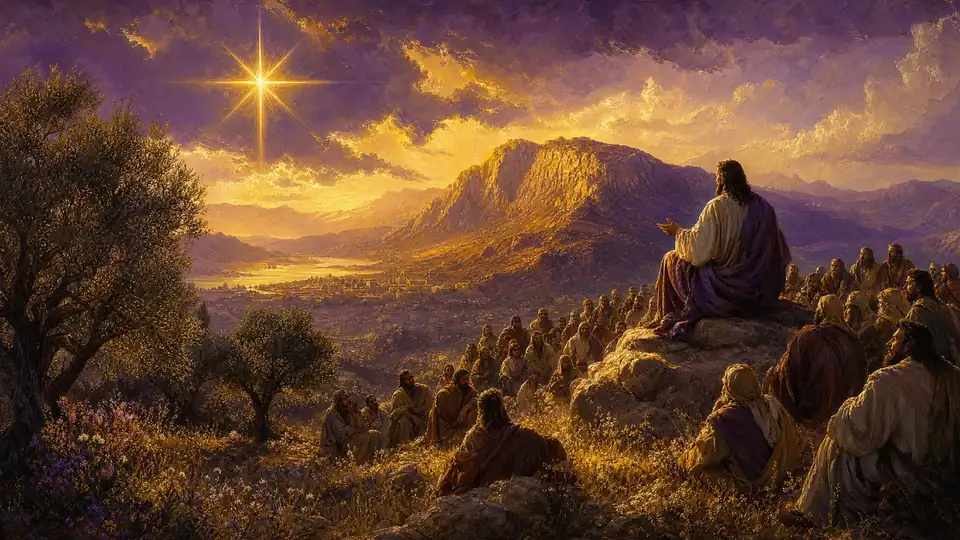
Matthew Bible Study Guide Overview
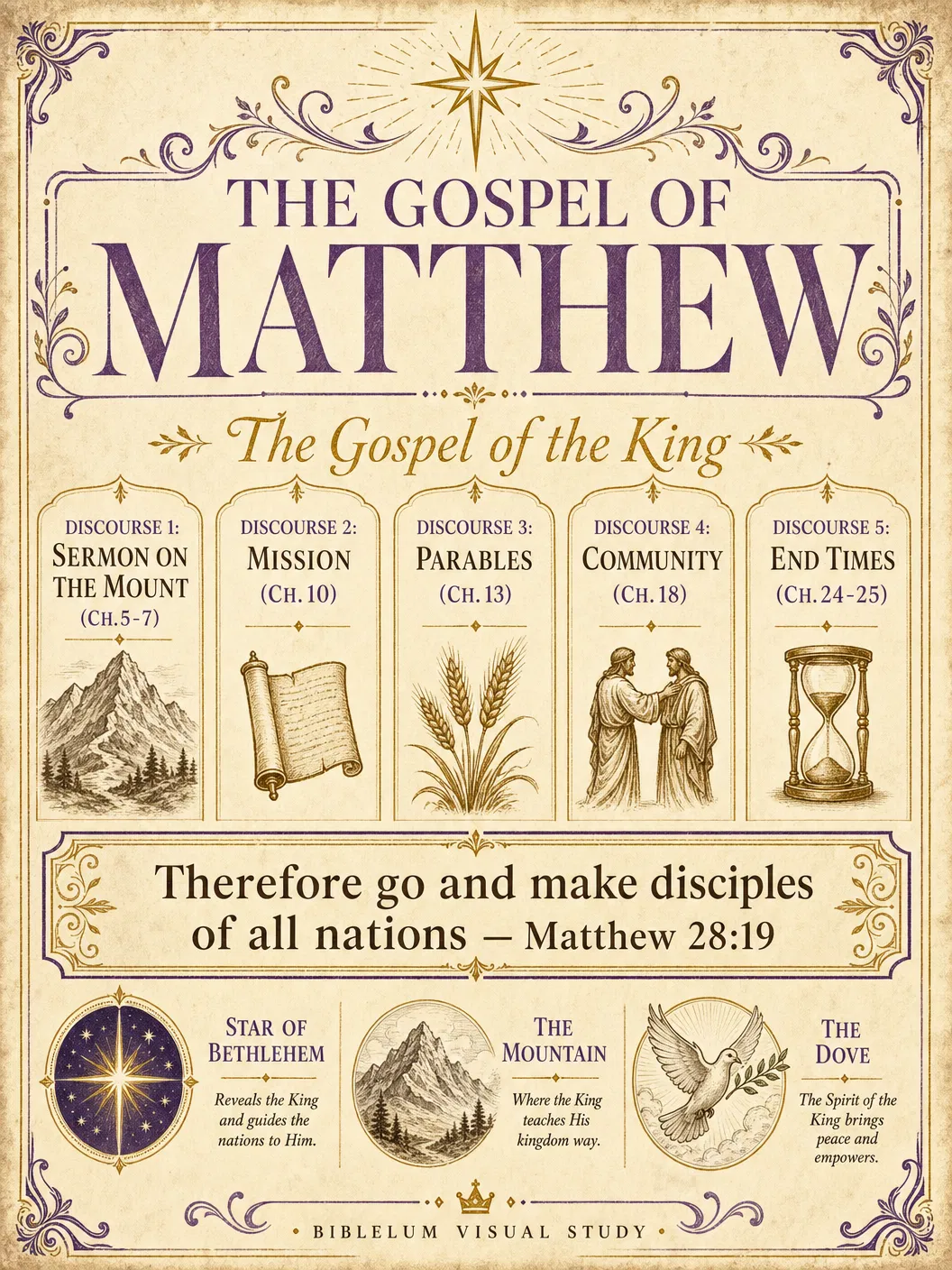
Full-page visual overview of The Gospel of Matthew — key events, themes, and structure at a glance
How to Study the Gospel of Matthew
For beginners, the best way to study Matthew is to read it as a Gospel about Jesus the Messiah, the fulfillment of the Old Testament, and the teacher of the kingdom of heaven. To study Matthew, pay attention to how Matthew presents Jesus as the Messiah, the fulfillment of the Old Testament, the teacher of the kingdom, and the true Son of David.
- 1 Watch how Matthew connects Jesus to the Old Testament.
- 2 Follow the five major teaching sections.
- 3 Notice the kingdom of heaven theme.
- 4 Compare Jesus' authority with the religious leaders.
- 5 Ask how each passage calls for discipleship.
Matthew Chapter-by-Chapter Summary
The Gospel of Matthew is traditionally associated with Matthew and is often dated to the late first century. Written with a strongly Jewish context in view, it presents Jesus as the long-awaited Messiah and the fulfillment of the entire Old Testament. Structured around five major discourses that mirror the five books of Moses, it is the most comprehensive account of Jesus' teaching in the New Testament — from the Sermon on the Mount to the Great Commission.
The King Arrives — Birth, Baptism, and the Sermon on the Mount
- 1:1–2:23 Matthew opens with a royal genealogy tracing Jesus from Abraham through David — establishing his Messianic credentials. The virgin birth fulfills Isaiah 7:14. Magi from the East worship the newborn king; Herod's slaughter of the innocents echoes Pharaoh's massacre in Exodus.
- 3:1–4:25 John the Baptist prepares the way. Jesus is baptized — the heavens open, the Spirit descends as a dove, and the Father speaks: "This is my Son, whom I love; with him I am well pleased." Jesus then faces forty days of temptation in the wilderness, echoing Israel's forty years.
- 5:1–7:29 The Sermon on the Mount: the Beatitudes, salt and light, the Lord's Prayer, the Golden Rule, and the Two Builders. Jesus teaches with authority unlike the scribes. "You have heard it said... but I say to you" — a radical reinterpretation of the law from the inside out.
The King's Power — Miracles, Mission, and Growing Opposition
- 8:1–9:38 A cascade of ten miracles: healing a leper, a centurion's servant, Peter's mother-in-law, the demon-possessed, a paralytic, a woman with bleeding, a dead girl, two blind men, and a mute man. The crowds marvel; the Pharisees accuse. Jesus calls Matthew the tax collector.
- 10:1–42 Jesus sends out the Twelve with authority over demons and disease. His mission discourse is sobering: expect rejection, persecution, and division — even within families. "Whoever acknowledges me before others, I will also acknowledge before my Father in heaven."
- 11:1–12:50 John the Baptist questions from prison; Jesus affirms him as the greatest prophet. Cities that witnessed miracles are condemned for unbelief. The Pharisees accuse Jesus of casting out demons by Beelzebul. Jesus declares the only unforgivable sin: blasphemy against the Holy Spirit.
- 13:1–15:39 Seven parables of the Kingdom: the Sower, the Weeds, the Mustard Seed, the Yeast, the Hidden Treasure, the Pearl, and the Net. John the Baptist is beheaded. Jesus feeds 5,000 and walks on water. He confronts the Pharisees' tradition of hand-washing — "What goes into someone's mouth does not defile them."
The King's Identity — Peter's Confession and the Road to Jerusalem
- 16:13–20 The turning point of Matthew: "Who do you say I am?" Peter's answer — "You are the Messiah, the Son of the living God" — is the rock on which Jesus says he will build his church. Jesus gives Peter the keys of the kingdom.
- 16:21–17:27 Jesus predicts his death and resurrection three times. Peter rebukes him; Jesus rebukes Peter: "Get behind me, Satan." The Transfiguration: Moses and Elijah appear; the Father again speaks from a cloud. A boy with seizures is healed — "this kind comes out only by prayer."
- 18:1–20:34 Community teaching: the greatest in the kingdom is like a child. The Parable of the Lost Sheep. Forgiveness seventy-seven times. The rich young ruler cannot give up his wealth. "It is easier for a camel to go through the eye of a needle than for someone who is rich to enter the kingdom of God." Two blind men healed near Jericho.
The King Confronts Jerusalem — Triumphal Entry and Olivet Discourse
- 21:1–22:46 The Triumphal Entry: Jesus rides into Jerusalem on a donkey, fulfilling Zechariah 9:9. He clears the temple. The Parable of the Tenants condemns the religious leaders. Four confrontations: taxes to Caesar, the resurrection, the greatest commandment, and whose son is the Christ.
- 23:1–39 Seven woes against the scribes and Pharisees: "Woe to you, teachers of the law and Pharisees, you hypocrites!" They clean the outside of the cup but inside are full of greed. Jerusalem has killed the prophets; her house is left desolate.
- 24:1–25:46 The Olivet Discourse: signs of the end — wars, famines, persecution, the abomination of desolation. "No one knows about that day or hour, not even the angels." Three parables of readiness: the Ten Virgins, the Talents, and the Sheep and Goats — judgment based on how we treated "the least of these."
The King's Sacrifice — Passion, Death, and Resurrection
- 26:1–75 The Last Supper: Jesus institutes the Eucharist — "This is my blood of the covenant, which is poured out for many for the forgiveness of sins." Gethsemane: "My Father, if it is possible, may this cup be taken from me. Yet not as I will, but as you will." Judas betrays; Peter denies.
- 27:1–66 The trial before Pilate: "Pilate's declaration of innocence" The crowd chooses Barabbas. Jesus is crucified at Golgotha. Darkness covers the land for three hours. The temple curtain tears from top to bottom. The centurion declares: "Surely he was the Son of God!"
- 28:1–20 The Resurrection: Mary Magdalene and the other Mary find the empty tomb. An angel announces: "He has risen, just as he said." The risen Jesus meets the women, then the eleven disciples on a mountain in Galilee. The Great Commission: "Go and make disciples of all nations... Christ's enduring presence with his people"
Key Themes in Matthew
Matthew develops four interlocking themes — Jesus as the new Moses, the kingdom of heaven, discipleship, and the inclusion of all nations — that together present the most complete portrait of Jesus' teaching in the New Testament.
Jesus as the Fulfillment of the Old Testament
Matthew contains more Old Testament quotations and allusions than any other Gospel — over 60 direct citations. His signature phrase "Matthew's fulfillment pattern" appears 14 times. Matthew presents Jesus not as a replacement for the Old Testament but as its completion: the new Moses who gives a new law from a new mountain, the new David who establishes an eternal kingdom, the new Israel who succeeds where the nation failed.
Read Matthew 5:17 in your preferred translation.
Matthew 5:17
Application: Reading the Old Testament through Matthew's lens transforms it from a history book into a promise book. What Old Testament promises or patterns do you see coming to completion in Jesus's life and ministry?
The Kingdom of Heaven
The phrase "kingdom of heaven" appears 32 times in Matthew — and nowhere else in the Gospels. It is the organizing theme of the entire book. Jesus announces it in the Beatitudes, illustrates it in seven parables (Matthew 13), and embodies it in his person. The kingdom is both present ("the kingdom of heaven is at hand") and future ("your kingdom come"). It is not a geographic territory but a reign — the rule of God breaking into human history through Jesus.
Read Matthew 6:33 in your preferred translation.
Matthew 6:33
Application: The Sermon on the Mount is the constitution of the kingdom. Which of its demands — loving enemies, forgiving seventy times, giving without recognition — most challenges the way you currently live?
Discipleship and the Great Commission
Matthew is the only Gospel to use the word "church" (ekklesia, 16:18; 18:17). From the calling of the first disciples (4:18–22) to the Great Commission (28:18–20), the entire Gospel is structured around the formation of a community of disciples. Jesus does not just teach crowds — he invests deeply in twelve. The Great Commission is the climax: "Go and make disciples of all nations" — the mission is global, the method is discipleship, and the promise is his perpetual presence.
Read Matthew 4:19 in your preferred translation.
Matthew 4:19
Application: Discipleship in Matthew is not a program but a relationship — following Jesus, learning from him, and becoming like him. Who are you discipling, and who is discipling you?
Judgment and Accountability
Matthew contains more teaching on judgment than any other Gospel. The Olivet Discourse (chapters 24–25) ends with three parables of accountability: the Ten Virgins (readiness), the Talents (faithfulness), and the Sheep and Goats (compassion). The final parable is stunning in its criteria: judgment is based not on theological correctness but on how we treated "the least of these" — the hungry, the stranger, the sick, the imprisoned. Orthodoxy without orthopraxy is insufficient.
Read Matthew 25:40 in your preferred translation.
Matthew 25:40
Application: The Sheep and Goats parable is uncomfortable precisely because it is so concrete. What specific acts of mercy toward vulnerable people does Jesus's teaching call you to?
Matthew Symbols and Imagery
The Star of Bethlehem
Historical Context
The Magi (magoi) were likely Zoroastrian astrologers from Persia or Babylon who studied celestial phenomena for prophetic significance. The star they followed has been variously identified as a conjunction of Jupiter and Saturn (7 BC), a comet, or a supernova. Whatever its astronomical nature, it served as a divine navigational sign pointing to the birthplace of the Messiah.
Theological Meaning
The star is the first sign in Matthew that the gospel is for all nations, not just Israel. Gentile astronomers from the East are the first to worship the newborn king — while the religious establishment in Jerusalem is indifferent or hostile. The star anticipates the Great Commission: the light of Christ is meant to guide all peoples to worship.
The Mountain
Historical Context
In the ancient Near East, mountains were considered the dwelling places of the gods — the meeting point between heaven and earth. Moses received the Law on Mount Sinai. Elijah heard God's voice on Mount Horeb. The Jerusalem Temple was built on Mount Zion. Mountains in the Bible are consistently places of divine encounter and revelation.
Theological Meaning
Matthew structures his Gospel around five major discourses, each delivered on or associated with a mountain (the Sermon on the Mount, the Mission Discourse, the Parables Discourse, the Community Discourse, the Olivet Discourse). Jesus is the new Moses giving a new law from a new mountain. The final scene of Matthew — the Great Commission — takes place on a mountain in Galilee. Mountains in Matthew signal that something definitive is being revealed.
Bread and the Feeding Miracles
Historical Context
Bread (artos) was the staple food of the ancient Mediterranean world — the difference between survival and starvation. The two feeding miracles in Matthew (5,000 in chapter 14; 4,000 in chapter 15) took place in the wilderness, evoking the manna God provided to Israel in the desert. The numbers are significant: 12 baskets (for Israel's 12 tribes) and 7 baskets (for the 7 nations of Canaan, symbolizing Gentile inclusion).
Theological Meaning
The feeding miracles are Eucharistic foreshadowings: Jesus takes bread, blesses it, breaks it, and gives it — the same four actions at the Last Supper. They also demonstrate that Jesus is the true bread from heaven (John 6:35). In the Lord's Prayer, Jesus teaches his disciples to pray for "daily bread" — a prayer that is simultaneously physical and spiritual, trusting God for both sustenance and salvation.
The Dove at Baptism
Historical Context
Doves were the most common sacrificial bird in ancient Israel — affordable even for the poor (Leviticus 12:8). They were also symbols of peace and new beginnings: after the Flood, a dove returned to Noah with an olive branch, signaling the end of judgment and the start of a new creation. In the Song of Solomon, the dove is a term of endearment.
Theological Meaning
The dove descending on Jesus at his baptism is the Holy Spirit visibly manifesting. This is the first explicit Trinitarian scene in Matthew: the Son is baptized, the Spirit descends, and the Father speaks. The dove connects Jesus to Noah (new creation after judgment), to the sacrificial system (he is the ultimate sacrifice), and to the Song of Solomon (the beloved Son). The Spirit's descent also marks Jesus as the anointed one — the Messiah — empowered for his mission.
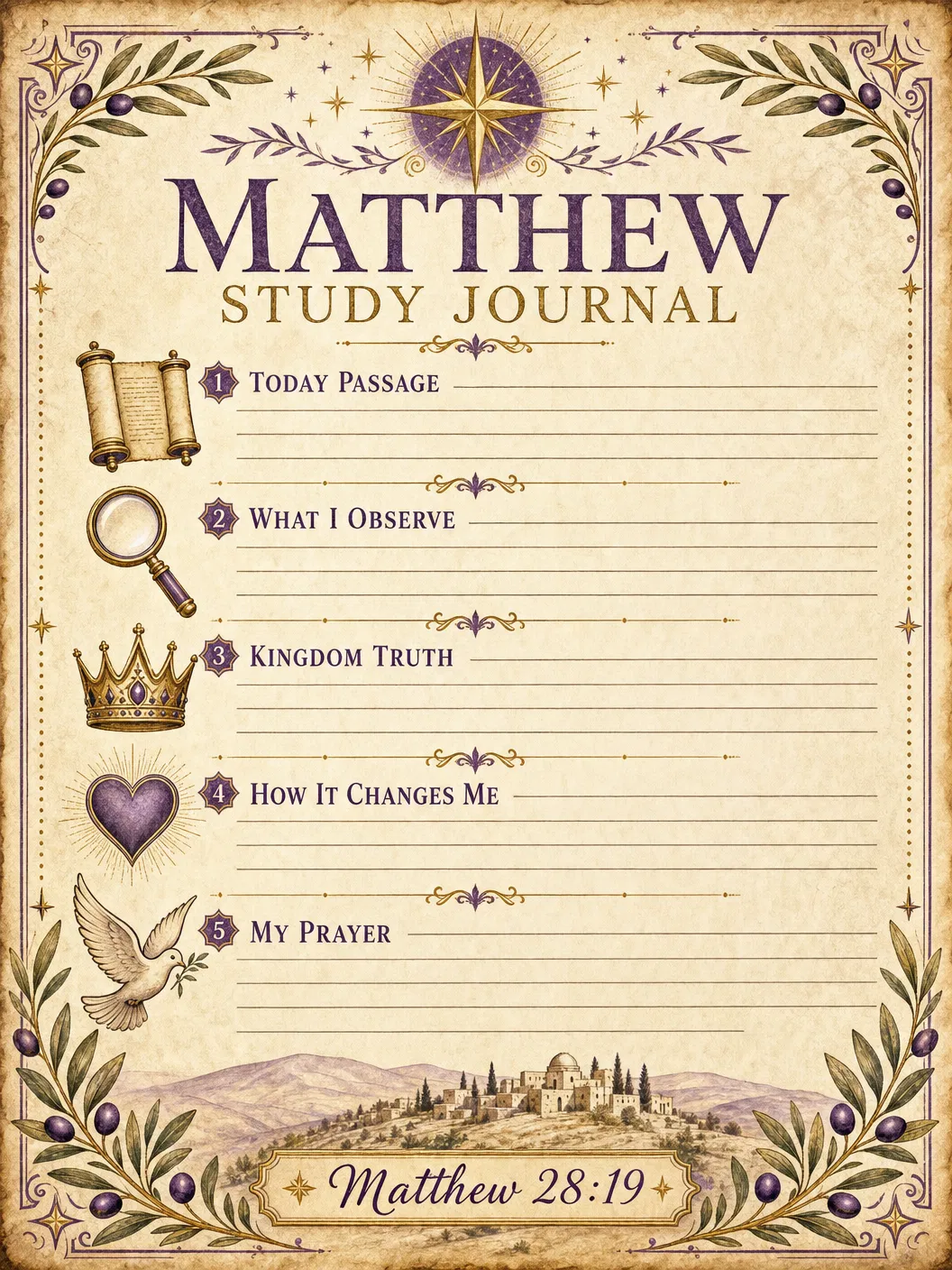
Matthew Bible Study Journal and Reflection Questions
A printable journal template designed for verse-by-verse reflection, prayer, and personal response to Scripture.
Matthew Bible Small Group Discussion Guide
These 8 questions are designed for a 60–90 minute small group session. Begin with the icebreaker, then work through observation, interpretation, and application questions. Close with the prayer prompt.
If you could have been present at one scene in Matthew's Gospel — the Sermon on the Mount, the Transfiguration, the feeding of the 5,000, or the empty tomb — which would you choose and why?
Read the Beatitudes (Matthew 5:3–12) aloud slowly. Which beatitude is most surprising or counterintuitive to you? Which one most describes where you are right now in life?
The Beatitudes do not describe eight types of Christians — they describe one person: the disciple of Jesus. Together they paint a portrait of the character formed by life in the kingdom.
Matthew records seven woes against the Pharisees in chapter 23. Compare these with the seven Beatitudes in chapter 5. What contrasts do you notice? What does this tell us about the difference between religious performance and genuine kingdom character?
The Pharisees are outwardly righteous but inwardly corrupt — the exact inverse of the Beatitudes. The woes are not primarily condemnation but warning: this is what religion looks like when it loses its heart.
In Matthew 16:18, Jesus says he will build his church on "this rock." What is the rock — Peter himself, Peter's faith, or Peter's confession? How does your answer shape your understanding of church authority and leadership?
This is one of the most debated verses in church history. The Catholic tradition reads it as Peter himself; the Protestant tradition reads it as Peter's confession of faith. Both agree that the church is built on the person and work of Jesus Christ.
The Parable of the Sheep and Goats (Matthew 25:31–46) suggests that judgment is based on how we treated "the least of these." Does this mean salvation is by works? How do you reconcile this with Matthew's emphasis on faith and grace?
The parable does not teach salvation by works but the fruit of genuine faith. Those who truly know the King will naturally serve his people — not to earn his favor but because they have received it. Works are the evidence of faith, not its substitute.
Jesus says in Matthew 6:24: "You cannot serve both God and money." In what specific ways does money compete with God for your primary loyalty? What one practical step could you take this week to loosen money's hold on your heart?
The Great Commission (Matthew 28:18–20) ends with a promise: "Christ's enduring presence with his people" How does the promise of Christ's presence change the way you approach the command to make disciples? Who in your life is God calling you to invest in?
Close by reading the Lord's Prayer (Matthew 6:9–13) together slowly, phrase by phrase. After each phrase, pause and ask: what would it look like for this to be genuinely true in my life this week? Then pray the prayer together as a group, meaning each word.
Matthew Bible Study Questions and Answers
Deeper questions, richer answers — exploring the historical, theological, and personal dimensions of Matthew.
Day 36 · The Sermon on the Mount — The Constitution of the Kingdom
What was the Sermon on the Mount actually about — a new law, an impossible ideal, or something else?
The Sermon on the Mount (Matthew 5–7) is the most famous extended teaching of Jesus, but it has been profoundly misunderstood throughout church history. Three major interpretations have dominated: (1) a new, stricter law that replaces Moses; (2) an impossible ideal designed to drive us to grace; (3) the actual character description of kingdom citizens transformed by the Spirit. The third interpretation best fits the context. Jesus opens with the Beatitudes — not commands but descriptions of the blessed person. He says he came not to abolish the Law but to fulfill it (5:17). His six antitheses ("You have heard... but I say") do not replace the Law but radicalize it — moving from external compliance to internal transformation. The Sermon is not a new legal code but a portrait of what human life looks like when the kingdom of God has taken root in the heart.
Read Matthew 5:3 in your preferred translation.
Jesus says "You are the salt of the earth" and "You are the light of the world." What does this mean for how I live Monday to Friday?
Salt and light are both transformative by nature — they do not need to announce themselves; they simply do what they are. Salt preserves and flavors; light illuminates and reveals. Jesus says his disciples already are these things — not that they should try to become them. The danger Jesus warns against is not failure to be salt and light, but losing the quality that makes you what you are — salt that has lost its saltiness is useless. In practice, this means that Christian witness is not primarily a program or an event but a quality of presence: the way you treat a difficult colleague, the honesty you bring to a business deal, the peace you carry into a anxious room. The light is not a performance — it is the natural overflow of a life hidden in God.
Read Matthew 5:14 in your preferred translation.
How does BibleLum connect Matthew's five discourses to the five books of Moses?
Matthew structures his Gospel around five major teaching blocks (chapters 5–7, 10, 13, 18, 24–25), each ending with the formula "When Jesus had finished saying these things." Most scholars believe this is a deliberate parallel to the five books of the Torah. BibleLum traces how Matthew consistently presents Jesus as the new Moses: born under a murderous king (like Moses under Pharaoh), called out of Egypt (2:15, quoting Hosea 11:1), passing through water (baptism, like the Red Sea crossing), tested in the wilderness for 40 days (like Israel's 40 years), and ascending a mountain to give the new law. This is not coincidence — it is Matthew's theological argument that Jesus is the fulfillment of everything Moses pointed toward.
Read Matthew 5:17 in your preferred translation.
Day 170 · The Sermon on the Mount — Deep Dive
What did Jesus mean by "Blessed are the meek, for they will inherit the earth" — isn't meekness weakness?
The Greek word praus (meek) was used in the ancient world to describe a trained warhorse — an animal of great power that had been disciplined to respond to the rider's direction. Meekness is not the absence of strength but strength under control. In the Old Testament, Moses is called the meekest man on earth (Numbers 12:3) — yet he confronted Pharaoh, led a nation, and interceded boldly before God. Jesus describes himself as "meek and lowly in heart" (Matthew 11:29) — yet he drove money-changers from the Temple and rebuked religious leaders publicly. Meekness in the biblical sense is the willingness to subordinate personal power to God's purposes — to be strong in the right direction, for the right reasons, at the right time.
Read Matthew 5:5 in your preferred translation.
Jesus says "Do not judge, or you too will be judged" (7:1). Does this mean Christians should never make moral judgments?
Matthew 7:1 is perhaps the most misquoted verse in the Bible — often used to shut down any moral evaluation. But the context makes clear that Jesus is not prohibiting discernment; he is prohibiting a specific kind of judgment: hypocritical, self-righteous condemnation. Three verses later, Jesus says "Do not give dogs what is sacred; do not throw your pearls to pigs" — which requires making a judgment about who is a dog and who is a pig. Later in the same chapter he warns about false prophets and says "by their fruit you will recognize them" — again requiring evaluation. The prohibition is against judging others by a standard you do not apply to yourself. The log-in-your-own-eye image is comic: a person with a plank in their eye offering to remove a speck from someone else's eye. The cure for bad judging is not no judging but honest self-examination first.
Read Matthew 7:1 in your preferred translation.
How does the Lord's Prayer function as a summary of the entire Sermon on the Mount?
The Lord's Prayer (Matthew 6:9–13) sits at the exact center of the Sermon on the Mount, and BibleLum argues it is not coincidental — it is the structural and theological heart of the entire discourse. Each petition of the prayer maps onto a theme of the Sermon: "Our Father in heaven" (the intimate relationship with God that makes the Beatitudes possible), "hallowed be your name" (the call to be salt and light), "your kingdom come" (the entire Sermon is a description of kingdom life), "give us daily bread" (the anti-anxiety teaching of 6:25–34), "forgive us our debts as we forgive our debtors" (the teaching on reconciliation in 5:23–26), "lead us not into temptation" (the narrow gate of 7:13–14). The prayer is not an isolated formula — it is a compressed version of everything Jesus teaches in chapters 5–7.
Read Matthew 6:9–10 in your preferred translation.
Day 245 · The King and His Kingdom — Parables and Power
Why did Jesus teach in parables — was he trying to make things clearer or more obscure?
Matthew 13:10–17 contains a startling answer to this question: Jesus says he speaks in parables so that some will not understand — quoting Isaiah 6:9–10 about hearts that have grown calloused. This seems to contradict the common assumption that parables are simple illustrations for simple people. The parables function as a kind of spiritual litmus test. For those who are genuinely seeking, the parable provokes curiosity and deeper inquiry — the disciples ask Jesus to explain, and he does. For those who are resistant, the parable allows them to dismiss the teaching without engaging its claim. The parable of the Sower (13:1–23) is itself a parable about how people receive parables: the same seed falls on different soils and produces radically different results. The variable is not the seed but the soil — the condition of the heart that receives the word.
Read Matthew 13:11 in your preferred translation.
Peter walked on water and then sank when he looked at the storm. What does this teach about faith and doubt?
Matthew 14:28–31 is the only Gospel account of Peter walking on water, and it is a study in the anatomy of faith. Peter does something the other disciples do not: he gets out of the boat. He walks on water — until he notices the wind and becomes afraid, at which point he begins to sink. Jesus' response is precise: "You of little faith, why did you doubt?" The Greek word for doubt (distazō) means to stand in two places at once — to be divided between trust and fear. Peter's failure is not that he looked at the storm; it is that looking at the storm caused him to shift his weight from Jesus to his own assessment of the situation. The lesson is not "ignore reality" but "keep your gaze on Jesus while reality rages." Significantly, Jesus immediately reaches out and catches Peter — the failure is real, but it is not final.
Read Matthew 14:31 in your preferred translation.
How does the Great Commission (Matthew 28:18–20) reframe everything that came before it in Matthew's Gospel?
The Great Commission is the final scene of Matthew's Gospel, and BibleLum argues it is the interpretive key to the entire book. Jesus opens with "All authority in heaven and on earth has been given to me" — a claim that would have been recognized as a direct echo of Daniel 7:14, where the Son of Man receives "authority, glory and sovereign power" from the Ancient of Days. The Commission has a specific structure: authority (the basis), command (make disciples of all nations), method (baptizing and teaching), and promise (I am with you always). The promise at the end echoes the name given to Jesus at the beginning of Matthew: Immanuel, "God with us" (1:23). The Gospel that opens with God-with-us closes with the same promise extended to the end of the age. BibleLum notes that the Commission is not primarily a guilt-inducing obligation but a confidence-building declaration: the one who sends us has all authority, and he goes with us.
Read Matthew 28:20 in your preferred translation.
Day 37 · Miracles and Parables — The Power and Mystery of the Kingdom
Why does Matthew cluster ten miracles together in chapters 8–9? What is he trying to show?
Matthew 8–9 is a carefully constructed gallery of ten miracles arranged in three groups of three, with two interruptions. This is not random reporting — it is a theological argument presented through narrative. The ten miracles echo the ten plagues of Exodus, but in reverse: where the plagues brought death and destruction, Jesus brings healing and restoration. Matthew is showing that Jesus is the new Moses who has come not to judge but to save. The range of people healed is also deliberate: a leper (ritually unclean), a Roman centurion's servant (a Gentile), Peter's mother-in-law (a woman), demoniacs, a paralytic, a tax collector's circle, a synagogue ruler's daughter, a hemorrhaging woman, two blind men, a mute man. Jesus crosses every social boundary of first-century Judaism. The miracles are not just power demonstrations — they are enacted parables of the kingdom's radical inclusivity.
Read Matthew 8:17 in your preferred translation.
The centurion says "just say the word, and my servant will be healed" (8:8). What made Jesus call this the greatest faith he had seen in Israel?
The centurion's statement reveals a profound understanding of authority and trust. He is a military man who understands chain of command: he gives orders and they are obeyed without question. He applies this same logic to Jesus — if Jesus has authority over sickness, he need only speak. What astonishes Jesus is not the centurion's knowledge of theology but the quality of his trust. He does not ask Jesus to come to his house (perhaps aware of the Jewish prohibition against entering a Gentile home). He does not demand a sign or a process. He simply trusts that Jesus's word is sufficient. Jesus says he has not found such faith in all of Israel — meaning that the religious insiders, with all their Scripture and tradition, have not grasped what this outsider instinctively understood: that Jesus speaks with the authority of God himself. Faith, Matthew shows us, is not primarily intellectual agreement but personal trust in the character and power of Jesus.
Read Matthew 8:10 in your preferred translation.
How does BibleLum read the Parable of the Sower as the key to understanding all of Jesus's parables?
Jesus himself signals the Parable of the Sower's foundational role when he says to the disciples, "Don't you understand this parable? How then will you understand any parable?" (Mark 4:13). BibleLum treats it as the master key to the parabolic method. The parable teaches that the same word of God produces radically different results depending on the condition of the heart that receives it. The four soils — hard path, rocky ground, thorny ground, good soil — are not four types of people but four responses that any person can give at different times and in different areas of life. BibleLum encourages readers to ask, for any passage they study: "What kind of soil am I being right now?" The parable also explains why Jesus teaches in parables at all: the parable is itself a seed. It penetrates defenses that a direct statement would trigger. Those who are genuinely hungry will press in for the meaning; those who are not will walk away entertained but unchanged.
Read a hundred, sixty or thirty times what was sown." — Matthew 13:8 in your preferred translation.
Day 38 · Peter's Confession and Jerusalem Entry — Who Is This King?
When Jesus asks "Who do you say I am?" at Caesarea Philippi, why does the location matter?
Caesarea Philippi was a city built by Philip the Tetrarch at the base of Mount Hermon, at the site of a massive rock cliff containing a cave dedicated to the god Pan — known locally as the Gates of Hades. It was one of the most pagan locations in the entire region. Jesus asks the identity question — "Who do you say I am?" — in the shadow of a shrine to a pagan deity, at a place literally called the Gates of Hades. When Peter answers "You are the Messiah, the Son of the living God," Jesus responds: "On this rock I will build my church, and the gates of Hades will not overcome it" (16:18). The location is the sermon. Jesus is declaring that his kingdom will advance even against the strongholds of the enemy — not by avoiding them but by confronting them directly. The church is not a defensive institution huddled against the darkness; it is an offensive force that the gates of hell cannot hold back.
Read Matthew 16:16 in your preferred translation.
Jesus says "Whoever wants to save their life will lose it, but whoever loses their life for me will find it" (16:25). What does this paradox mean practically?
This is one of the most counterintuitive statements in the Gospels — a direct contradiction of the self-preservation instinct that drives most human decision-making. Jesus says the very act of clinging to your life is what causes you to lose it. The Greek word for "life" here is psychē — soul, self, the core of personal identity. Jesus is not talking about physical death (though that is included) but about the fundamental orientation of a life. A life organized around self-protection, self-advancement, and self-fulfillment ultimately collapses inward — you spend all your energy maintaining and defending a self that was never meant to be the center of your universe. The paradox is that the self is only truly found when it is given away — when it is oriented toward God and others rather than toward itself. This is not a call to self-destruction but to self-transcendence: the discovery that the truest version of yourself emerges in the act of surrender.
Read Matthew 16:25 in your preferred translation.
How does the Transfiguration (Matthew 17) function as the theological center of the Gospel?
BibleLum identifies the Transfiguration as the mountain-top hinge of Matthew's Gospel — the moment where the veil between the human and divine is briefly lifted and the disciples see Jesus as he truly is. The scene is saturated with Old Testament imagery: the high mountain recalls Sinai; the shining face recalls Moses after meeting God (Exodus 34:29); the bright cloud and voice from heaven recall the Shekinah glory. Moses and Elijah appear — representing the Law and the Prophets — and then disappear, leaving only Jesus. The voice from the cloud says "This is my Son, whom I love; with him I am well pleased. Listen to him" — the same words spoken at the baptism, now amplified. The Transfiguration is Matthew's answer to Peter's confession: you said he is the Messiah — here is what that actually means. It also prepares the disciples for the cross: the glory they see on the mountain is the same glory that will be revealed, paradoxically, in the darkness of Golgotha.
Read Matthew 17:2 in your preferred translation.
Day 39 · The Great Commission — The End That Is a Beginning
What is the significance of the Olivet Discourse (Matthew 24–25) — is Jesus predicting the end of the world or the fall of Jerusalem?
Matthew 24–25 is one of the most debated passages in the New Testament. The disciples ask Jesus two questions: when will the Temple be destroyed, and what will be the sign of his coming and the end of the age? Most scholars believe Jesus answers both questions simultaneously, using the near event (Jerusalem's fall in AD 70) as a type and preview of the far event (the final return of Christ). The destruction of Jerusalem in AD 70 by the Roman general Titus was catastrophic — the Temple was burned, over a million Jews died, and the city was razed. Jesus's warning to "flee to the mountains" (24:16) was taken seriously by the early Christian community, who reportedly escaped to Pella before the siege. But Matthew 24:29–31 describes cosmic signs and the Son of Man coming on the clouds — language that goes beyond any historical event. The two-horizon structure is deliberate: the fall of Jerusalem is a historical anchor that prevents the prophecy from becoming purely speculative, while the cosmic language points to a final consummation that history itself cannot contain.
Read Matthew 24:35 in your preferred translation.
In the Parable of the Talents (25:14–30), the servant who buried his talent is condemned. Why is playing it safe so dangerous?
The third servant's logic seems reasonable: he was afraid of losing what he had been given, so he preserved it perfectly. He returns exactly what he received. But the master calls him wicked and lazy — the harshest verdict in any of the parables. The parable reveals that in the kingdom of God, neutrality is not an option. The talents (a unit of enormous monetary value) represent not just money but everything entrusted to us: gifts, opportunities, relationships, time, influence. The master's expectation is not perfection but engagement — the willingness to risk, to invest, to act. The third servant's real problem is revealed in his words: "I knew that you are a hard man" (25:24). His theology of God was wrong — he saw God as a demanding judge rather than a generous master who delights in his servants' flourishing. Fear-based theology produces paralysis. A true understanding of God's generosity produces courageous stewardship.
Read Matthew 25:21 in your preferred translation.
How does Matthew's account of the Passion (chapters 26–28) fulfill the five major Old Testament themes he has been building throughout the Gospel?
BibleLum traces how the Passion narrative is the convergence point of every major Old Testament theme Matthew has been weaving: the new Moses, the suffering servant, the Passover lamb, the rejected cornerstone, and the Son of Man receiving the kingdom. The Last Supper is a Passover meal — Jesus reinterprets the Exodus deliverance as pointing to his own blood "poured out for many for the forgiveness of sins" (26:28). The betrayal for thirty pieces of silver fulfills Zechariah 11:12–13. The darkness at the crucifixion echoes the ninth plague of Egypt. The tearing of the Temple curtain (27:51) signals that the barrier between God and humanity has been removed. The resurrection on the third day echoes Jonah's three days in the fish — a sign Jesus had promised to a generation seeking signs (12:40). Matthew's Gospel is not just a biography; it is a carefully constructed theological argument that Jesus is the fulfillment of Israel's entire story.
Read Matthew 26:28 in your preferred translation.
Day 171 · The Olivet Discourse — Watching and Waiting
What does Jesus mean by "this generation will certainly not pass away until all these things have happened" (24:34)?
Matthew 24:34 is one of the most contested verses in the New Testament. "This generation" (Greek: genea hautē) has been interpreted as: (1) the generation alive in AD 30, who would see Jerusalem's fall in AD 70; (2) the Jewish people as an ethnic group; (3) the generation alive when the end-time signs begin; or (4) the generation of unbelief that persists until Christ returns. The most historically grounded reading is the first: "all these things" in verses 4–33 refers primarily to the signs leading up to and including Jerusalem's destruction in AD 70, which did occur within that generation. The shift to cosmic language in verses 29–31 then moves to the final return of Christ, which is described as sudden and unmistakable — unlike the gradual escalation of the earlier signs. This two-horizon reading preserves both the historical specificity of Jesus's prophecy (which was remarkably accurate about AD 70) and the ongoing expectation of his final return.
Read Matthew 24:34 in your preferred translation.
The Parable of the Ten Virgins (25:1–13) ends with the door shut on five of them. What is the parable really warning against?
The five foolish virgins are not wicked — they are unprepared. They have lamps (outward profession of faith) but no oil (the inner reality that sustains it). When the bridegroom is delayed, their lamps go out — and they cannot borrow oil from others. The parable's warning is not about moral failure but about spiritual superficiality — the danger of a faith that looks real in normal conditions but has no reserves for the long wait. The oil in ancient Jewish interpretation often symbolized the Holy Spirit or the accumulated practice of righteousness. You cannot borrow a life of prayer, a history of trust, a pattern of obedience — these are built slowly over time and cannot be transferred at the last moment. The parable is a call to cultivate depth now, not to scramble for it later. The door that shuts is not arbitrary cruelty; it is the natural consequence of a relationship that was never truly formed.
Read Matthew 25:13 in your preferred translation.
How does the Parable of the Sheep and Goats (25:31–46) redefine where we encounter Jesus?
BibleLum calls Matthew 25:31–46 the most socially disruptive passage in the entire Gospel. The King tells the righteous that when they fed the hungry, welcomed the stranger, clothed the naked, and visited the prisoner, they were doing it to him — and they had no idea. The shock of the parable runs in both directions: the righteous are surprised to learn they served the King, and the unrighteous are surprised to learn they failed him. Neither group was conscious of the theological significance of their actions. This suggests that genuine kingdom living is not primarily about intentional religious performance but about a habitual orientation of the heart that sees and responds to human need. BibleLum notes that Jesus identifies himself with "the least of these brothers and sisters of mine" — the most vulnerable, marginalized, and forgotten members of society. The parable does not teach salvation by works; it reveals that genuine faith in the King produces a life that looks like the King.
Read Matthew 25:40 in your preferred translation.
Day 249 · The Passion and Great Commission — Death, Resurrection, and Mission
Why does Matthew include the story of Judas's remorse and suicide (27:3–10) — what is he trying to show?
Matthew is the only Gospel writer to include Judas's return of the thirty pieces of silver and his death. He frames it as a fulfillment of Zechariah 11:12–13 (attributed to Jeremiah in a complex citation), and he uses the incident to show a tragic contrast between remorse and repentance. Judas says "I have sinned, for I have betrayed innocent blood" (27:4) — a confession that is theologically accurate. But his response is despair and self-destruction rather than return to Jesus. Matthew places this scene immediately after Peter's denial and before the crucifixion, creating a deliberate contrast: Peter also betrayed Jesus, also wept bitterly, but ultimately returned and was restored. The difference is not the severity of the sin but the direction of the response. Judas turned inward and destroyed himself; Peter turned outward toward Jesus and was transformed. Matthew's inclusion of this story is a pastoral warning: guilt that leads to self-punishment is not the same as repentance that leads to restoration.
Read Matthew 27:4 in your preferred translation.
The soldiers mock Jesus as "King of the Jews" (27:29). How does Matthew turn this mockery into proclamation?
Throughout the Passion narrative, Matthew records a series of ironic proclamations by people who do not realize they are speaking truth. The soldiers' mockery — crown of thorns, purple robe, reed scepter, the taunt "Hail, King of the Jews!" — is meant to humiliate, but Matthew presents it as unwitting coronation. The inscription on the cross — "This is Jesus, the King of the Jews" (27:37) — was Pilate's attempt at political sarcasm, but Matthew presents it as the truest statement in the narrative. The chief priests who say "He saved others, but he can't save himself" (27:42) are accidentally correct in both directions: he did save others, and he could not save himself and save others simultaneously — the cross required the choice. Matthew's irony is theological: the moment of apparent defeat is the moment of ultimate victory. The one who is mocked as king is the one who will be worshipped as king by every nation. The resurrection vindicates what the cross seemed to deny.
Read Matthew 27:37 in your preferred translation.
How does the resurrection appearance in Matthew 28 differ from the other Gospels, and what unique theological point does Matthew make?
Matthew's resurrection account is the most cosmically charged of the four Gospels: an earthquake, an angel whose appearance is like lightning, guards who become like dead men, and a commission delivered on a mountain in Galilee — the region where Jesus began his ministry. Matthew's unique contribution is the Great Commission itself (28:18–20) and its grounding in the declaration of universal authority. The risen Jesus does not simply appear and comfort his disciples — he commissions them as agents of a global mission. The return to Galilee is significant: Matthew's Gospel opened with Jesus beginning his ministry in "Galilee of the Gentiles" (4:15), and it ends there too. The circle is complete, but the mission is just beginning. BibleLum notes that the final words of Matthew's Gospel — "I am with you always, to the very end of the age" — are the fulfillment of the name given to Jesus in chapter 1: Immanuel, God with us. The entire Gospel is bracketed by this promise.
Read Matthew 28:19 in your preferred translation.
Day 288 · The Greatest Commandment — Love as the Fulfillment of the Law
When Jesus summarizes the entire Law in two commandments (22:37–40), is he being original or quoting existing Jewish tradition?
Jesus's double commandment — love God (Deuteronomy 6:5) and love neighbor (Leviticus 19:18) — was not entirely novel. Some rabbis had already identified these as central to the Torah. What is distinctive is Jesus's claim that all the Law and the Prophets hang on these two — not that they summarize the Law but that they are the structural support from which everything else derives its meaning. The Pharisees' question was a test — they wanted to see if Jesus would prioritize one commandment over others in a way they could criticize. Jesus sidesteps the trap by going deeper: instead of ranking commandments, he identifies the root from which all commandments grow. Paul makes the same move in Romans 13:8–10: "Love is the fulfillment of the law." The implication is that any specific commandment is an application of love to a particular situation. This does not make the specific commandments unnecessary — it gives them their proper foundation. You cannot love God and neighbor in the abstract; the specific commandments show you what that love looks like in concrete situations.
Read Matthew 22:37 in your preferred translation.
Jesus condemns the Pharisees in Matthew 23 with seven "woes." What is the core failure he is diagnosing?
The seven woes of Matthew 23 are the most sustained and severe critique Jesus delivers in any of the Gospels. The core diagnosis is not immorality but performative religion — a faith that has become a system for managing reputation rather than a living relationship with God. Jesus identifies several specific symptoms: making converts who become "twice as much a child of hell" as their teachers (23:15); tithing mint and dill while neglecting justice, mercy, and faithfulness (23:23); cleaning the outside of the cup while the inside is full of greed and self-indulgence (23:25); building tombs for the prophets while being the spiritual descendants of those who killed them (23:29–31). The common thread is the gap between appearance and reality — a religion that has mastered the performance of godliness while remaining untransformed at the core. Jesus's remedy is not less religion but more reality: "First clean the inside of the cup and dish, and then the outside also will be clean" (23:26).
Read Matthew 23:13 in your preferred translation.
How does BibleLum connect the Greatest Commandment to the entire arc of Matthew's Gospel?
BibleLum reads the Greatest Commandment (22:37–40) as the interpretive lens for the whole Gospel of Matthew. Every major section of Matthew can be read as an exploration of what it means to love God and neighbor in a specific domain of life. The Sermon on the Mount (chapters 5–7) shows what love of God and neighbor looks like in the interior life and community relationships. The miracle chapters (8–9) show love enacted in healing and inclusion. The Mission Discourse (chapter 10) extends love beyond the immediate community to the lost sheep of Israel. The Parable Discourse (chapter 13) explores why love is received differently by different hearts. The Community Discourse (chapter 18) addresses love within the church — forgiveness, restoration, the lost sheep. The Olivet Discourse (chapters 24–25) shows love expressed in faithful watchfulness and care for the vulnerable. The Passion (chapters 26–28) is the ultimate demonstration of love: "Greater love has no one than this: to lay down one's life for one's friends" (John 15:13). Matthew's Gospel is, from beginning to end, a portrait of what love looks like when it takes human form.
Read Matthew 22:40 in your preferred translation.
Matthew Bible Study Key Characters
Meet the people whose faith, failure, and faithfulness shaped the story.
Jesus
Presented as the Son of David, Son of Abraham, and Son of God — the Messiah who fulfills all of Israel's hopes and commissions his followers to make disciples of all nations.
Joseph
The righteous man who obeys God's angel and protects the infant Jesus, modeling the faithful discipleship Matthew calls all readers to.
John the Baptist
The forerunner who prepares the way for Jesus, baptizes him, and whose imprisonment marks the transition to Jesus' public ministry.
Peter
The first disciple called, the one who confesses Jesus as Messiah, and the one who denies him — a portrait of both the heights and failures of discipleship.
Matthew Bible Study Practical Application
Ancient wisdom, lived out today — practical steps rooted in Scripture.
Live the Sermon on the Mount
The Beatitudes and the ethics of Matthew 5–7 are not ideals for a future age but the character of the kingdom now. Let them reshape your daily choices.
Pray the Lord's Prayer
Matthew 6:9–13 gives the church its model prayer. Use it not as a formula but as a framework for daily conversation with God.
Obey the Great Commission
Matthew 28:19–20 is not a command for missionaries only. Every disciple is called to make disciples — in their neighborhood, workplace, and family.
Related Study Packs
Common Questions About Studying the Gospel of Matthew
How do I study the Gospel of Matthew?
To study Matthew, read it as a carefully structured narrative written for a Jewish audience. Notice the five major teaching discourses — the Sermon on the Mount (ch. 5–7), the Mission Discourse (ch. 10), the Parable Discourse (ch. 13), the Community Discourse (ch. 18), and the Olivet Discourse (ch. 24–25) — which mirror the five books of Moses. Read each discourse in full before studying individual verses. Track the phrase 'the kingdom of heaven' throughout, as it is Matthew's central theme.
What is the main message of the Gospel of Matthew?
The main message of Matthew is that Jesus is the long-awaited Messiah of Israel — the fulfillment of the Law, the Prophets, and the Psalms. Matthew opens with a genealogy tracing Jesus to Abraham and David, and closes with the Great Commission sending his followers to all nations. The kingdom of heaven is the central theme: Jesus announces it, demonstrates it through miracles, teaches its values in the Sermon on the Mount, and inaugurates it through his death and resurrection.
What is the Sermon on the Mount in Matthew?
The Sermon on the Mount (Matthew 5–7) is the first and most famous of Jesus's five teaching discourses in Matthew. It opens with the Beatitudes — a portrait of the character of those who belong to the kingdom of heaven — and continues with teachings on anger, lust, oaths, retaliation, love for enemies, prayer (including the Lord's Prayer), fasting, money, and anxiety. It concludes with the parable of the two builders. The Sermon is not a new law but a description of life shaped by the kingdom.
How does the Gospel of Matthew connect to the rest of the Bible?
Matthew is the most explicitly Jewish of the four Gospels, written to show that Jesus fulfills the Hebrew Scriptures. The phrase 'this was to fulfill what was spoken by the prophet' appears more than a dozen times. Jesus is presented as the new Moses (five discourses mirroring the Torah), the new David (Son of David appears nine times), and the new Israel (recapitulating Israel's history in his own life). The Great Commission in Matthew 28:18–20 echoes Genesis 12 and Isaiah 49, extending the blessing of Abraham to all nations.
The Gospel of Matthew
"And surely I am with you always, to the very end of the age."
Matthew 28:20
Start the 300-Day Bible Study Journey →