
Philippians Bible Study Guide Overview
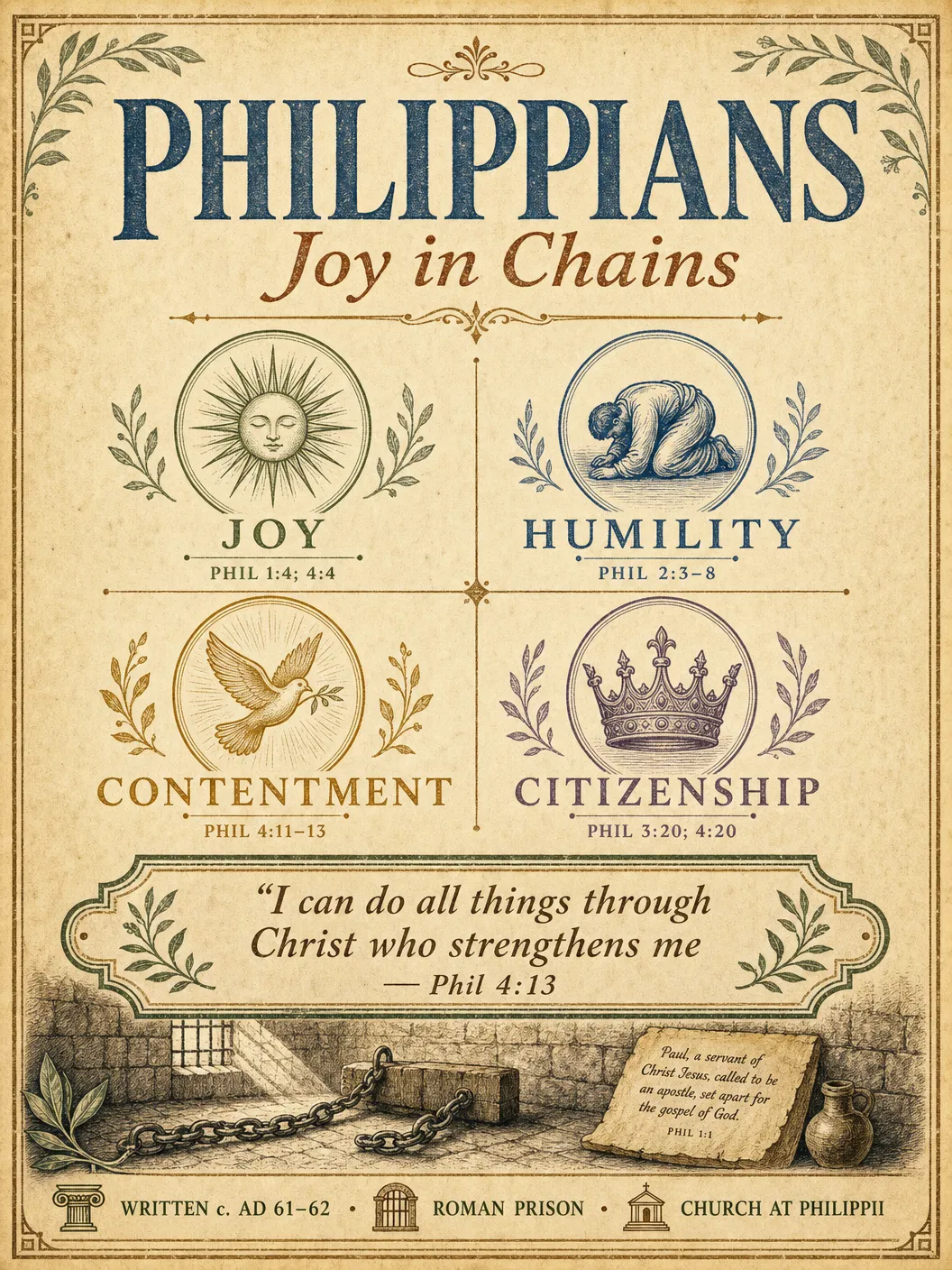
Full-page visual overview of The Letter to the Philippians — key events, themes, and structure at a glance
How to Study the Letter to the Philippians
To study Philippians, read it as a personal letter from a pastor to his most beloved congregation — not a systematic theology but an intimate conversation. Paul wrote from prison, yet joy runs through every paragraph. The key to the whole letter is Philippians 4:4: Rejoice in the Lord always. Read it in one sitting first to feel the warmth and flow of Paul's voice.
- 1 Read the whole letter in one sitting: Philippians is only four chapters. Before studying individual verses, feel the overall tone — gratitude, affection, and joy written from chains.
- 2 Notice the Christ-hymn in chapter 2:5–11: this is one of the most important passages in the New Testament. Paul quotes an early Christian hymn to ground his call to humility in the self-emptying of Christ.
- 3 Track the word "joy" and its variants through all four chapters: Paul uses it more than a dozen times. Ask what produces joy and what threatens it in each passage.
- 4 Read chapter 3 as Paul's personal testimony: his credentials, his loss, and his single-minded pursuit of knowing Christ. Philippians 3:8 is one of the most radical statements in all of Paul's letters.
- 5 Sit with Philippians 4:6–7 and 4:11–13: these are not motivational slogans but hard-won pastoral wisdom from a man who had learned contentment through suffering.
- 6 Ask throughout: What does it look like to live as a citizen of heaven (3:20) while living faithfully in a Roman colony? How does that question apply to your own context?
Philippians is a letter for hard seasons. Paul wrote it in chains, and its joy is not the joy of easy circumstances but of a man who had found something — someone — that no circumstance could take away. Read it slowly, and let it ask you the same question it asked the Philippians: where is your joy anchored?
Philippians Chapter-by-Chapter Summary
Traditionally attributed to Paul and often dated to his Roman imprisonment around AD 61–62, the Letter to the Philippians is the most joyful letter in the New Testament. Addressed to his most beloved congregation — the church he planted in the Roman colony of Philippi — it is a personal letter of friendship, gratitude, and pastoral encouragement. Its central argument: joy rooted in Christ is possible in any circumstance, even chains.
Joy in Chains — Partnership in the Gospel
- 1:1–11 Paul's greeting and thanksgiving. He expresses deep affection for the Philippians — his partners in the gospel from the first day. His prayer: that their love would abound more and more in knowledge and discernment.
- 1:12–18 Paul writes from prison. Rather than despair, he reports that his chains have advanced the gospel — the whole imperial guard knows he is imprisoned for Christ. Even those who preach from envy cannot stop the gospel.
- 1:19–26 The famous "to live is Christ, to die is gain" passage. Paul is torn between departing to be with Christ and remaining for the Philippians' sake. He chooses to stay — confident it is more necessary for them.
- 1:27–30 The call to live worthy of the gospel — standing firm together, not frightened by opponents. Suffering for Christ is a gift, just as believing in him is a gift.
The Mind of Christ — Humility and Exaltation
- 2:1–4 The appeal for unity grounded in the experience of Christ's love: "Do nothing out of selfish ambition or vain conceit. Rather, in humility value others above yourselves."
- 2:5–11 The Christ Hymn (Carmen Christi) — one of the most exalted passages in the New Testament. Christ, being in very nature God, did not grasp equality with God but Christ's self-giving humility He humbled himself to death — even death on a cross. Therefore God exalted him to the highest place.
- 2:12–18 "Work out your salvation with fear and trembling, for it is God who works in you." Shine as lights in a crooked generation. Paul rejoices even if poured out as a drink offering.
- 2:19–30 Timothy and Epaphroditus commended. Both are examples of the servant-minded Christ-likeness Paul has just described — genuinely caring for others, risking their lives for the work of Christ.
Knowing Christ — Pressing Toward the Goal
- 3:1–11 Paul warns against "dogs" — those who insist on circumcision. He lists his own impressive credentials (circumcised, tribe of Benjamin, Pharisee, blameless) and declares them all rubbish compared to knowing Christ. The surpassing worth of knowing Jesus.
- 3:12–16 The athlete metaphor: "Forgetting what is behind and straining toward what is ahead, I press on toward the goal to win the prize." Not yet perfect, but pressing forward.
- 3:17–21 Two contrasting citizenships: those whose god is their stomach (enemies of the cross) versus those whose citizenship is in heaven, from which they await the Savior who will transform their bodies.
The Peace That Passes Understanding
- 4:1–3 Paul urges Euodia and Syntyche — two women who have labored side by side with him — to agree in the Lord. He asks a "true companion" to help them reconcile.
- 4:4–7 The famous "Rejoice always" passage. "prayerful trust in place of anxiety And the peace of God, which transcends all understanding, will guard your hearts and your minds in Christ Jesus."
- 4:8–9 The mental discipline of Philippians: "Whatever is true, whatever is noble, whatever is right, whatever is pure, whatever is lovely, whatever is admirable — think about such things." The God of peace will be with you.
- 4:10–23 Paul's contentment secret: "I have learned, in whatever state I am, to be content." He can do all things through Christ who strengthens him. He thanks the Philippians for their generous partnership. Closing benediction: "The grace of the Lord Jesus Christ be with your spirit."
Key Themes in Philippians
Philippians develops four interlocking themes — joy, humility, contentment, and heavenly citizenship — that together show what it looks like to live as a follower of Christ in a world that does not share his values.
Joy in Every Circumstance
The word "joy" (chara) or "rejoice" (chairo) appears 16 times in Philippians — more per chapter than any other New Testament letter. Paul writes from prison, facing possible execution, yet the letter is saturated with joy. This is not circumstantial happiness but a settled orientation of the soul rooted in the reality of Christ. "joy rooted in the Lord" (4:4) is not a command to feel good but to orient toward what is eternally true.
Read Philippians 4:4 in your preferred translation.
Philippians 4:4
Application: Philippians challenges the assumption that joy depends on circumstances. Paul's joy in chains is not denial of difficulty but evidence that something deeper than circumstances is sustaining him. What would it look like to cultivate this kind of joy in your current season?
The Kenosis — Christ's Self-Emptying
The Christ Hymn of Philippians 2:5–11 is the theological summit of the letter. The Greek word kenosis (emptying) describes Christ's voluntary self-limitation: though equal with God, he did not grasp that equality but "Christ's self-giving humility" This is not a loss of divinity but a voluntary laying aside of divine prerogatives — the ultimate act of humility. The trajectory is downward (from heaven to earth, from glory to a cross) before it is upward (exalted to the highest place, every knee bowing).
Read Philippians 2:8 in your preferred translation.
Philippians 2:8
Application: The kenosis is not merely a doctrine to believe but a pattern to imitate. Paul introduces it as the basis for Christian humility: "Christ-shaped humility in community" (2:5). The path down is the path up.
Contentment as a Learned Art
Philippians 4:11 contains one of the most important words in the letter: "I have learned to be content." The Greek word autarkeia (contentment) was a Stoic virtue meaning self-sufficiency. Paul takes this concept and transforms it: his contentment is not self-sufficiency but Christ-sufficiency. "strength in Christ for every circumstance" (4:13). Contentment is not a personality trait but a discipline cultivated through practice and dependence on Christ.
Read Philippians 4:11 in your preferred translation.
Philippians 4:11
Application: Paul says he has "learned" contentment — which means it did not come naturally and it took time. What circumstances in your life are currently the most difficult to accept? What would it look like to begin learning contentment in that specific area?
Heavenly Citizenship
Philippi was a Roman colony — its citizens were immensely proud of their Roman citizenship, which brought legal privileges and a distinct identity. Paul uses this civic pride as a theological lever: "But our citizenship is in heaven" (3:20). This is not escapism but a reorientation of ultimate loyalty. Believers live as resident aliens in this world — fully engaged, but not ultimately defined by earthly categories of status, nationality, or achievement.
Read Philippians 3:20 in your preferred translation.
Philippians 3:20
Application: Heavenly citizenship does not mean disengagement from the world. It means engaging the world with a different set of ultimate commitments — not grasping for earthly status, not fearing earthly loss, because the most important things cannot be taken away.
Philippians Symbols and Imagery
Chains (Bonds)
Historical Context
Roman prisoners awaiting trial were often chained to a guard — a practice called custodia militaris. Paul was likely chained to a rotating series of Praetorian guards, the elite imperial soldiers stationed at the emperor's palace. This meant the gospel was literally being heard by the most powerful military force in the world, one guard at a time.
Theological Meaning
Paul transforms the symbol of chains from imprisonment to proclamation: "my chains have become well known throughout the whole palace guard" (1:13). What Rome intended as silencing, God used as amplification. The chains are not a contradiction of God's sovereignty — they are the instrument of it. This inverts every worldly understanding of power and weakness.
The Race / Athletic Contest
Historical Context
Athletic competition was central to Greco-Roman culture. The Isthmian Games (near Corinth) and the Olympic Games were major cultural events. Paul's audience would have immediately understood the imagery of straining toward the finish line, pressing forward, forgetting what is behind. Athletes in ancient races ran to win a perishable wreath (stephanos) — Paul runs for an imperishable prize.
Theological Meaning
The athletic metaphor in Philippians 3:12–14 describes the Christian life as one of active, disciplined pursuit — not passive waiting. "Forgetting what is behind" is not amnesia but the refusal to let past failures or past achievements define the present. The goal is not achievement but knowing Christ (3:10) — the prize is a person, not a performance.
Surpassing Worth (Skubalon)
Historical Context
In Philippians 3:8, Paul uses the Greek word skubalon — often translated "rubbish" or "garbage" but actually a much stronger term meaning refuse or dung. This was a shocking word for a letter to be read in a church gathering. Paul is describing his impressive religious credentials (Pharisee, blameless under the law) with the strongest possible term of worthlessness.
Theological Meaning
The skubalon passage is Paul's most personal statement of the gospel: everything he once counted as gain — his pedigree, his performance, his position — he now counts as loss compared to the surpassing worth of knowing Christ. The gospel does not add Christ to a life of achievement; it replaces the entire achievement framework.
The Peace of God
Historical Context
The Roman Empire promoted the Pax Romana — the "peace of Rome" enforced by military power. Coins bore the image of the emperor with inscriptions like "peace and security." Philippi was a Roman colony deeply invested in this imperial peace narrative.
Theological Meaning
Paul offers a radically different peace: "the peace of God, which transcends all understanding" (4:7). The Greek word phroureō (guard) is a military term — the peace of God stands sentinel over the believer's inner life. This peace is not achieved through circumstances but received through prayer and thanksgiving.
Philippians Bible Study Journal and Reflection Questions
A printable journal template designed for verse-by-verse reflection, prayer, and personal response to Scripture.
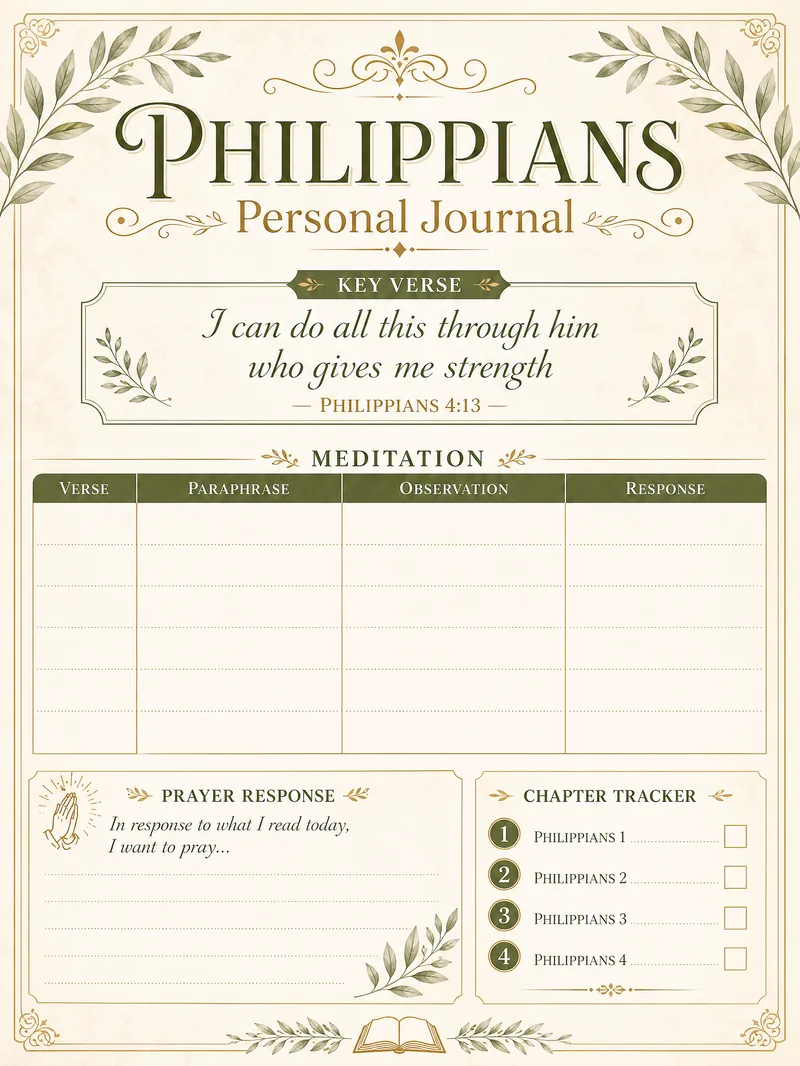
Philippians Bible Small Group Discussion Guide
These 8 questions are designed for a 60–90 minute small group session. Begin with the icebreaker, then work through observation, interpretation, and application questions. Close with the prayer prompt.
Paul writes this letter from prison with joy. Think of a time when someone you know maintained joy or peace in a genuinely difficult situation. What was it about them that struck you?
Read Philippians 2:5–11 aloud slowly. List every downward movement in the passage (what Christ gave up or became). Then list every upward movement (what God did in response). What does the shape of this passage tell us about how God responds to humility?
The downward movements: equality with God → servant form → human likeness → obedient → death → death on a cross. The upward: God exalted him → highest place → name above every name → every knee bows → every tongue confesses. The depth of the descent corresponds to the height of the exaltation.
Philippians 4:4–7 gives a specific sequence: rejoice → gentleness → prayer with thanksgiving → peace. How does each step in this sequence lead to the next? What happens if you skip a step?
Paul says in 3:8 that he counts everything as "skubalon" (rubbish/dung) compared to knowing Christ. He is referring to his own impressive religious credentials. Why is it harder to let go of our religious achievements than our obvious sins? What does this reveal about the nature of self-righteousness?
Religious achievement is harder to release than obvious sin because it feels virtuous. The Pharisee in Luke 18 cannot see his need precisely because his credentials are real. Paul's list in 3:4–6 is not fabricated — he genuinely was blameless under the law. The gospel requires releasing not just the bad but the impressive.
Paul says he has "learned" contentment (4:11). What does it mean that contentment is learned rather than given? What experiences do you think taught Paul this lesson? What experiences are teaching you?
Philippians 4:8 gives a list of things to think about: true, noble, right, pure, lovely, admirable, excellent, praiseworthy. Evaluate your typical mental diet this past week against this list. What fills most of your mental space? What would you need to change to align more closely with Paul's instruction?
"Our citizenship is in heaven" (3:20). In what specific areas of your life do you find yourself most attached to earthly status, security, or approval? What would it look like to hold those things more loosely this week?
Close by reading Philippians 4:6–7 together: "prayerful trust in place of anxiety" Have each person name one specific anxiety they are carrying. Then pray together, presenting each one to God with thanksgiving, and ask for the peace that transcends understanding to guard each person's heart and mind.
Philippians Bible Study Questions and Answers
Deeper questions, richer answers — exploring the historical, theological, and personal dimensions of Philippians.
Day 55 · Joy in Chains — The Paradox of Paul's Prison Letter
How could Paul write the most joyful letter in the New Testament from a Roman prison?
Philippians is often called the Epistle of Joy — yet it was written while Paul was under Roman custody, chained to guards, facing possible execution. The paradox is not accidental. Paul's joy is not circumstantial happiness but what he calls "the peace of God, which transcends all understanding" (4:7). He had learned — through shipwrecks, beatings, imprisonments, and betrayals — that joy rooted in Christ cannot be taken away by external circumstances. His chains had actually advanced the gospel (1:12–13): the entire Praetorian Guard had heard about Jesus. What Rome intended as silencing, God used as amplification.
Read Philippians 1:21 in your preferred translation.
I am going through a genuinely hard season — how do I "rejoice always" without feeling like I am lying to myself?
Paul's command to "rejoice always" (4:4) is not a command to pretend that everything is fine. Philippians itself contains real grief: Paul mourns Epaphroditus's near-death (2:27), acknowledges his own suffering (1:29–30), and warns with tears about enemies of the cross (3:18). The key is the phrase "in the Lord." Paul does not say "rejoice in your circumstances" but "rejoice in the Lord." Joy in Philippians is not an emotion to manufacture but an orientation toward what is eternally true about Christ — his resurrection, his sovereignty, his love — regardless of what is temporarily true about your situation. It is possible to grieve and rejoice simultaneously, just as Paul does throughout this letter.
Read Philippians 4:4 in your preferred translation.
Why is Philippians especially helpful for Christians in difficult seasons?
Philippians speaks directly to joy, anxiety, contentment, humility, and perseverance because Paul wrote it from prison, not from comfort. Unlike Romans (systematic theology) or Galatians (polemical defense), Philippians is deeply personal — a letter between friends written in chains. Paul uses the word "partnership" (koinonia) to describe his relationship with the Philippians, and the warmth is palpable throughout. Because Paul wrote from a place of genuine suffering, his words about joy and contentment carry weight that abstract theology cannot. He is not offering theory — he is sharing what he has lived. That is why Philippians addresses the exact pressure points of difficult seasons: anxiety (4:6), comparison (2:3–4), identity in achievement (3:4–9), and the challenge of maintaining joy in a hard world (4:4).
Read Philippians 1:3 in your preferred translation.
Day 181 · The Mind of Christ — Humility, Unity, and the Kenosis
What does the Christ Hymn (Philippians 2:5–11) actually teach about who Jesus is?
Philippians 2:5–11 is one of the earliest and most exalted Christological texts in the New Testament — scholars believe it may be an early Christian hymn that predates Paul's letter. It describes Christ's pre-existence ("being in very nature God"), his incarnation ("taking the very nature of a servant"), his death ("even death on a cross"), and his exaltation ("God exalted him to the highest place"). The theological term for Christ's self-emptying is kenosis (from the Greek kenoo, "to empty"). The text insists on the voluntary nature of the descent: Christ did not grasp (harpagmos) equality with God but chose to lay aside its expression. The same Jesus who was "in very nature God" became "obedient to death — even death on a cross." This is the most extreme possible contrast in the universe.
Read Philippians 2:6 in your preferred translation.
How do I actually practice the humility Paul describes — "valuing others above yourself" — without losing my sense of self?
Paul's call to humility in Philippians 2:3–4 is often misunderstood as self-erasure — pretending you have no needs, no opinions, no value. But the model Paul gives is Christ himself, who was fully God and fully confident in his identity — and precisely because of that security, he could serve without needing to protect his status. True humility in Philippians is not low self-esteem but freedom from the need to prove yourself. It is possible only when your identity is secured in Christ rather than in the approval of others or the achievement of status. Paul can "do all things through Christ who strengthens me" (4:13) — not because he has no needs, but because his deepest need is already met. From that place of security, serving others is not a threat but a gift.
Read Philippians 2:3 in your preferred translation.
How does BibleLum connect the Christ Hymn to the broader arc of the Bible?
BibleLum traces the kenosis pattern — descent before exaltation — as a thread running through the entire biblical narrative. Joseph is sold into slavery before becoming second in Egypt. Moses flees to the wilderness before leading the Exodus. David is anointed as a shepherd boy before becoming king. The pattern reaches its ultimate expression in Christ. The exaltation language of Philippians 2:9–11 ("every knee shall bow, every tongue confess") is a direct quotation of Isaiah 45:23 — a passage about the God of Israel. Paul applies it to Jesus, making one of the most explicit claims to Christ's divinity in the New Testament. BibleLum notes that this is not a late theological development — it is embedded in what scholars believe is one of the earliest Christian texts we possess.
Read Philippians 2:9 in your preferred translation.
Day 256 · Contentment and Citizenship — The Secret Paul Learned
What did Paul mean by "I can do all things through Christ who strengthens me" — and is it being misused today?
Philippians 4:13 is one of the most quoted — and most misquoted — verses in the Bible. In its original context, it is not a promise of unlimited achievement but a statement about contentment in all circumstances. The verse comes immediately after Paul says he has "learned the secret of being content whether well fed or hungry, whether living in plenty or in want" (4:12). The "all things" he can do through Christ are specifically: enduring abundance and enduring need. This is not a sports motivational poster — it is a testimony from a man who had been beaten, shipwrecked, imprisoned, and left for dead, and who had found Christ sufficient in all of it.
Read Philippians 4:13 in your preferred translation.
What does it practically mean that "our citizenship is in heaven" when I have to live in this world every day?
Philippians 3:20 uses the Greek word politeuma — commonwealth or colony — to describe the believer's true identity. Philippi was a Roman colony: its citizens were proud of their Roman identity, used Roman law, and modeled Roman culture even though they lived in Macedonia. Paul takes this civic identity and flips it: believers are a colony of heaven living in the world. Practically, heavenly citizenship means: (1) not finding ultimate security in earthly status or wealth; (2) not fearing earthly loss, because the most important things cannot be taken away; (3) treating every person as someone made in the image of the King whose subjects you are. It is not escapism — it is engagement with a different set of ultimate commitments.
Read Philippians 3:20 in your preferred translation.
How can Philippians help readers bring anxiety, contentment, and joy into honest conversation with Scripture?
Philippians 4:6–9 is one of the most pastorally practical passages in Scripture. Paul gives a four-step protocol for managing anxiety: (1) present your requests to God with thanksgiving; (2) receive the peace that transcends understanding; (3) actively direct your thoughts toward what is true, noble, right, pure, lovely, and admirable; (4) practice what you have learned. BibleLum notes that this is not a simplistic "just pray more" prescription. Paul is describing a whole-person practice that engages the will (prayer), the emotions (thanksgiving), the intellect (directed thinking), and the body (practice). Modern cognitive behavioral therapy (CBT) independently discovered that directing attention toward positive, accurate thoughts reduces anxiety — Paul was there 2,000 years earlier. The difference is that Paul's framework is relational: the peace comes not from a technique but from "the God of peace" himself (4:9).
Read Philippians 4:7 in your preferred translation.
Philippians Bible Study Key Characters
Meet the people whose faith, failure, and faithfulness shaped the story.
Paul
The apostle who writes from Roman imprisonment with remarkable joy, demonstrating that contentment is possible in any circumstance through Christ.
Timothy
Paul's trusted co-worker, commended as someone who genuinely cares for the Philippians' welfare — a rare quality Paul contrasts with self-seeking.
Epaphroditus
The Philippians' messenger who nearly died delivering their gift to Paul, described as a brother, co-worker, and fellow soldier.
Euodia & Syntyche
Two women leaders in the Philippian church whose conflict Paul addresses directly, urging them to agree in the Lord.
Philippians Bible Study Practical Application
Ancient wisdom, lived out today — practical steps rooted in Scripture.
Rejoice in the Lord Always
Joy is not a feeling to manufacture but an orientation toward what is eternally true about Christ — regardless of your current circumstances.
Think on These Things
Philippians 4:8 gives a specific mental diet: true, noble, right, pure, lovely, admirable. What you consistently think about shapes who you become.
Contentment Is Learned
Paul says he has "learned" contentment — it took time, suffering, and practice. You are not behind; you are in the school of Christ-sufficiency.
Related Study Packs
Common Questions About Studying the Letter to the Philippians
How do I study the Letter to the Philippians?
For beginners, the best way to study Philippians is to read it as a short prison letter about joy, humility, contentment, and life in Christ. To study Philippians, begin by reading the whole letter in one sitting — it is only four chapters and was meant to be heard as a single communication. Notice the tone: warm, personal, joyful, written from prison. Then study it section by section, paying special attention to the Christ-hymn in 2:5–11, Paul's personal testimony in chapter 3, and the famous passages on anxiety and contentment in chapter 4. Track the word "joy" throughout and ask what grounds it.
What is the main message of the Letter to the Philippians?
The main message of Philippians is that genuine, sustainable joy is possible in any circumstance — including chains — because it is rooted not in circumstances but in a person: Jesus Christ. Paul writes Rejoice in the Lord always (4:4) not as a command to feel happy but as an invitation to anchor joy in something unshakeable. The letter also calls believers to the humility of Christ (2:5–11), to single-minded pursuit of knowing him (3:8–10), and to the peace that surpasses understanding (4:7).
What is the Christ-hymn in Philippians 2:5–11?
Philippians 2:5–11 is one of the most important Christological passages in the New Testament. Paul quotes what many scholars believe is an early Christian hymn to illustrate the humility he is calling the Philippians to practice. The hymn describes Christ's self-emptying: though equal with God, he took on human flesh, became a servant, and was obedient to death on a cross. Because of this, God exalted him to the highest place and gave him the name above every name. The passage grounds Christian ethics in the story of Christ.
How does the Letter to the Philippians connect to the rest of the Bible?
Philippians sits within Paul's broader prison correspondence alongside Ephesians, Colossians, and Philemon. The Christ-hymn in 2:5–11 echoes Isaiah's Servant Songs and the creation narrative. Paul's language of citizenship (3:20) engages the Roman imperial context of Philippi, a Roman colony. His concept of joy in suffering connects to the Psalms of lament and to the teaching of Jesus in the Beatitudes. Philippians 4:13 — I can do all things through Christ who strengthens me — is one of the most quoted verses in the New Testament.
The Letter to the Philippians
"And the peace of God, which transcends all understanding, will guard your hearts and your minds in Christ Jesus."
Philippians 4:7
Start the 300-Day Bible Study Journey →