Proverbs Bible Study Guide Overview
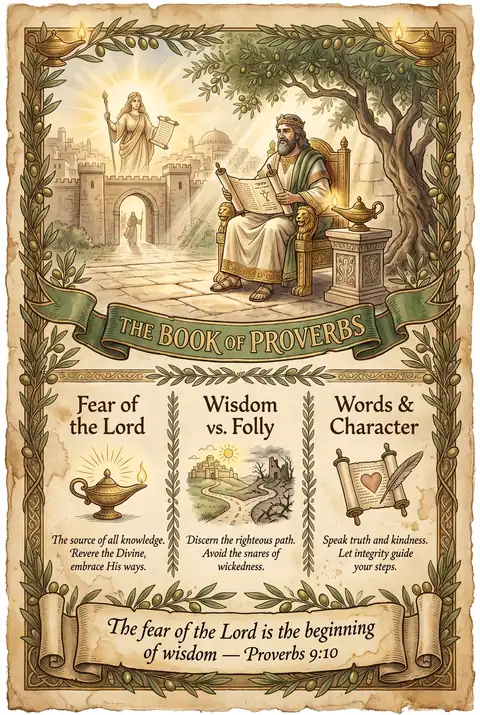
Full-page visual overview of The Book of Proverbs — key events, themes, and structure at a glance
How to Study the Book of Proverbs
For beginners, the best way to study Proverbs is to read it slowly as wisdom principles, not absolute promises. Start with Proverbs 1–9, then move through chapters 10–31 one or two sayings at a time.
- 1 Begin with chapters 1–9: these are extended poems addressed to a son, introducing the two paths — wisdom and folly — and personifying Wisdom as a woman who calls out in the streets.
- 2 Read chapters 10–22 as individual proverbs: each verse is a self-contained observation. Read slowly, one or two at a time, and let each one sit.
- 3 Notice the recurring themes: speech, work, money, friendship, pride, humility, the family, and the fear of the Lord.
- 4 Pay attention to the contrasts: the wise and the foolish, the righteous and the wicked, the diligent and the lazy.
- 5 Read Proverbs 31 carefully: the capable woman is a portrait of embodied wisdom — the book ends where it began, with wisdom made flesh in a real life.
- 6 Ask of each proverb: What does this reveal about God's order? Where do I see this pattern in my own life?
Proverbs is best read slowly and repeatedly over a lifetime. Many readers work through one chapter per day for a month. The goal is not information but formation — the gradual shaping of a mind and character that sees the world the way God sees it.
Proverbs Chapter-by-Chapter Summary
The Book of Proverbs is a collection of wisdom sayings compiled over centuries, attributed primarily to Solomon. It is not a book of promises but of principles — observations about how the world generally works when lived in alignment with God's created order. Its central thesis: the fear of the Lord is the beginning of wisdom.
Wisdom's Call — A Father's Instruction
- 1:1–7 "The fear of the Lord is the beginning of wisdom" — the thesis statement of the entire book. Wisdom is not merely intellectual; it begins with a right relationship to God.
- 1:20–33 Lady Wisdom cries out in the streets, at the city gates, in the public square. She is not hidden or esoteric — she is accessible to all who will listen. Those who reject her bear the consequences; those who heed her dwell secure.
- 3:1–12 "trusting God beyond self-reliance." The most beloved passage in Proverbs: total surrender to God's guidance rather than self-reliance. Discipline is a sign of God's love, not His anger.
- 8:1–36 Wisdom's great self-disclosure: she was present at creation, delighting in God's work. "Whoever finds me finds life and receives favor from the Lord." This passage points forward to Christ as the wisdom of God (1 Corinthians 1:24).
Solomon's Proverbs — Contrasts of Life
- 10:1–32 The main collection begins: antithetical proverbs contrasting the wise and the foolish, the righteous and the wicked. "A wise son brings joy to his father, but a foolish son brings grief to his mother" (10:1). Speech, work, integrity, and relationships are all addressed.
- 11:1–15:33 Honesty in business (11:1), the danger of pride (11:2), the power of words (12:18), the value of hard work (12:24), hope deferred (13:12), and the gentle answer that turns away wrath (15:1). These proverbs are not promises but patterns — observations about how life generally works.
- 16:1–22:16 "Pride goes before destruction, a haughty spirit before a fall" (16:18). "A cheerful heart is good medicine" (17:22). "The name of the Lord is a fortified tower; the righteous run to it and are safe" (18:10). The sovereignty of God over human plans (16:9; 19:21).
Self-Discipline, Justice, and Character
- 23:1–35 Warnings against gluttony, greed, and drunkenness. "Do not wear yourself out to get rich; do not trust your own cleverness" (23:4). The vivid portrait of the drunkard (23:29–35) is one of the most memorable passages in Proverbs.
- 24:1–34 Do not envy the wicked. "By wisdom a house is built, and through understanding it is established" (24:3). The sluggard's field: a portrait of what neglect produces. "A little sleep, a little slumber, a little folding of the hands to rest — and poverty will come on you like a thief."
- 25:1–29:27 More proverbs of Solomon, compiled by Hezekiah's men. "Like a city whose walls are broken through is a person who lacks self-control" (25:28). "As iron sharpens iron, so one person sharpens another" (27:17). The contrast between the righteous ruler and the wicked ruler (29:2).
Agur, Lemuel, and the Noble Woman
- 30:1–33 The words of Agur: a confession of ignorance before God's greatness. "Who has gone up to heaven and come down? Who has gathered up the wind in the hollow of his hands?" (30:4). Numerical sayings observe patterns in nature and human behavior.
- 31:1–9 The words of King Lemuel — taught to him by his mother. A queen mother's instruction to her royal son: avoid women who destroy kings, avoid wine, speak up for the poor and needy. Wisdom is not just personal virtue; it has public and political dimensions.
- 31:10–31 The Noble Woman (Eshet Chayil) — an acrostic poem in Hebrew, one letter per verse. She is industrious, generous, wise, strong, and God-fearing. She is the embodiment of all that Proverbs has taught. The book ends not with a rule but with a portrait — wisdom made flesh in a real human life.
Key Themes in Proverbs
Proverbs develops four major wisdom themes that together describe what it looks like to live skillfully in God's world — in work, relationships, speech, and character.
The Fear of the Lord
The thesis statement of Proverbs is "reverence as wisdom's beginning" (1:7; 9:10). This is not fear as terror but as reverent awe — a posture of humble trust and submission before a God who is infinitely greater and wiser than we are. Wisdom, in Proverbs, is not primarily intellectual achievement; it is a relational orientation toward God that shapes every area of life.
Read Proverbs 9:10 in your preferred translation.
Proverbs 9:10
Application: The fear of the Lord is the antidote to the self-sufficiency that Proverbs consistently warns against. "trusting God beyond self-reliance" (3:5). Where are you currently leaning on your own understanding rather than seeking God's wisdom?
Wisdom vs. Folly
Proverbs presents two paths with two destinations. Wisdom leads to life, flourishing, and the favor of God. Folly leads to ruin, shame, and death. These are not abstract categories — they are illustrated through dozens of concrete examples: the diligent worker and the sluggard, the honest merchant and the cheat, the faithful spouse and the adulterer, the humble person and the proud. Wisdom is practical: it shows up in how we work, speak, handle money, and treat others.
Read Proverbs 12:15 in your preferred translation.
Proverbs 12:15
Application: Proverbs invites a daily examination of choices. The wise person is not the one with the highest IQ but the one who consistently makes choices aligned with God's design for human flourishing. What is one area of your life where you are currently choosing the way of folly over the way of wisdom?
Words and Speech
No theme in Proverbs receives more attention than the power of words. The tongue can bring life or death (18:21), healing or destruction (12:18), peace or conflict (15:1). Proverbs is relentlessly practical: it addresses gossip, lying, flattery, harsh words, timely words, and the discipline of knowing when to speak and when to be silent. "the wisdom of restraint" (17:28).
Read Proverbs 18:21 in your preferred translation.
Proverbs 18:21
Application: Proverbs challenges us to audit our speech. What would change in your relationships if you applied Proverbs' wisdom about words for one week? Which specific area — gossip, criticism, encouragement, honesty — needs the most attention?
Diligence and Character
Proverbs is intensely practical about work, money, and character formation. The sluggard appears repeatedly as a cautionary figure — full of excuses, unwilling to act, heading toward poverty and shame. The diligent person, by contrast, works with skill and integrity and earns the trust of others. Proverbs does not promise that hard work always leads to wealth — but it consistently affirms that character matters and that God honors integrity.
Read Proverbs 12:24 in your preferred translation.
Proverbs 12:24
Application: Proverbs challenges the separation between "spiritual" and "practical" life. How we work, how we handle money, how we treat employees and employers — these are all spiritual issues. What would it look like to bring the wisdom of Proverbs into your workplace this week?
Proverbs Symbols and Imagery
The Tree of Life
Historical Context
The tree of life first appears in Genesis 2 as a literal tree in the Garden of Eden, access to which was blocked after the Fall (Genesis 3:24). In the ancient Near East, the tree of life was a common symbol of divine blessing and immortality. Proverbs uses it as a metaphor: wisdom is a tree of life (3:18), the fruit of the righteous is a tree of life (11:30), a longing fulfilled is a tree of life (13:12).
Theological Meaning
Proverbs' use of the tree of life imagery suggests that wisdom is the path back to Eden — to the life God originally intended. The New Jerusalem in Revelation 22 features the tree of life bearing fruit for the healing of the nations, suggesting that the wisdom journey of Proverbs points toward the ultimate restoration of all things.
Lady Wisdom and Dame Folly
Historical Context
In Proverbs 1–9, Wisdom and Folly are personified as two women calling out to young men in the city streets. This was a common literary device in ancient Near Eastern wisdom literature. The contrast between the two women would have been immediately recognizable to the original audience as a choice between two paths of life.
Theological Meaning
Lady Wisdom is not merely a literary device — she is the personification of God's own ordering of creation. In Proverbs 8, she was present at creation, delighting in God's work. The New Testament identifies Christ as the wisdom of God (1 Corinthians 1:24, 30; Colossians 2:3), suggesting that Lady Wisdom is a foreshadowing of Christ Himself.
The Craftsman / Artisan
Historical Context
Proverbs 8:30 describes Wisdom as an 'amon' — a Hebrew word that can mean craftsman, artisan, or master workman. The image is of Wisdom as a skilled craftsperson working alongside God in creation, delighting in the work and in the human beings being made.
Theological Meaning
The craftsman image suggests that wisdom is not just knowledge but skill — the ability to apply truth to the material of everyday life. Just as a craftsman shapes raw material into something beautiful and useful, wisdom shapes the raw material of our circumstances, relationships, and choices into a life that reflects God's design.
The Scroll / Written Word
Historical Context
Proverbs was written to be memorized and internalized — the repeated commands to "bind them on your heart" (3:3; 6:21; 7:3) reflect the ancient practice of wearing phylacteries (small scrolls of Scripture) as a physical reminder of God's commands. The written word was not just information; it was a formative presence.
Theological Meaning
The emphasis on writing wisdom on the heart anticipates the New Covenant promise of Jeremiah 31:33: "God's law reshaping the heart" Proverbs' goal is not external compliance but internal transformation — a heart so shaped by wisdom that righteous living flows naturally from the inside out.
Proverbs Bible Study Journal and Reflection Questions
A printable journal template designed for verse-by-verse reflection, prayer, and personal response to Scripture.
Proverbs Bible Small Group Discussion Guide
These 8 questions are designed for a 60–90 minute small group session. Begin with the icebreaker, then work through observation, interpretation, and application questions. Close with the prayer prompt.
What is the wisest piece of advice you have ever received? Who gave it to you, and what made it so memorable?
Read Proverbs 3:1–12 aloud. How many different commands does Solomon give in these 12 verses? What do they have in common? What does this passage reveal about the relationship between wisdom and trust?
There are at least 6 commands in 12 verses. The common thread is the surrender of self-reliance to God's guidance. Wisdom begins not with knowledge but with trust.
Compare Proverbs 26:4 ("the first half of Proverbs' tension") with Proverbs 26:5 ("Answer a fool according to his folly"). These two verses appear side by side. What does this apparent contradiction tell us about the nature of wisdom?
Wisdom is not a formula — it is the discernment to know which principle applies in which situation. This is why Proverbs cannot be reduced to a rulebook; it requires the cultivation of judgment.
Proverbs 8:22–31 describes Wisdom as present at creation, delighting in God's work. The New Testament identifies Christ as the wisdom of God (1 Corinthians 1:24). How does reading Proverbs 8 through the lens of Christ change how you understand both passages?
Lady Wisdom in Proverbs 8 is not simply a literary device — she is a foreshadowing of the incarnate Word. This gives Proverbs a Christological depth that is easy to miss.
Proverbs 31:10–31 ends the book with a portrait of the Noble Woman rather than a list of rules. Why do you think the book ends with a person rather than a principle? What does this tell us about the goal of wisdom?
Wisdom's goal is not compliance but character — a life so shaped by God's design that righteousness flows naturally. The Noble Woman is not a standard to achieve but a vision of what wisdom looks like embodied.
Proverbs 18:21 emphasizes that words can build or wound. Think about your conversations this past week. Were there moments when your words brought life? Were there moments when they brought something less than life? What would it look like to be more intentional about your speech?
Proverbs consistently warns against pride and commends humility. "Pride goes before destruction" (16:18). Where do you see pride operating in your own life — in your relationships, your work, your spiritual life? What would a humble response look like in that specific area?
Close by reading Proverbs 3:5–6 together: "trusting God rather than self-reliance" Have each person share one area of life where they are currently leaning on their own understanding. Then pray together, surrendering those areas to God's wisdom.
Proverbs Bible Study Questions and Answers
Deeper questions, richer answers — exploring the historical, theological, and personal dimensions of Proverbs.
Day 19 · Wisdom's Call — Do Not Forsake Her
What is the fear of the Lord and why does Proverbs call it the beginning of wisdom?
The Hebrew phrase yir'at YHWH (fear of the Lord) does not mean terror but rather a reverent, worshipful awe that recognizes God as the ultimate reality and standard of all things. Proverbs 1:7 declares it the very foundation of knowledge — not a preliminary step but the epistemological ground on which all true understanding is built. To fear the Lord is to see the world as it actually is: created, sustained, and judged by a personal God whose character defines what is good, true, and wise. Without this orientation, even brilliant human reasoning operates on a false premise. BibleLum connects this to the New Testament: Colossians 2:3 says that in Christ 'are hidden all the treasures of wisdom and knowledge.' The fear of the Lord in Proverbs points forward to the person of Jesus, who is himself described as the wisdom of God (1 Corinthians 1:24). True wisdom is not merely intellectual — it is relational and covenantal.
Read Proverbs 9:10 in your preferred translation.
Proverbs 3:5-6 says to trust God with all your heart and not lean on your own understanding — what does that look like practically?
Proverbs 3:5–6 is one of the most searched Bible verses on Google, and for good reason: it addresses the universal human tension between self-reliance and trust. 'Leaning on your own understanding' is not a condemnation of thinking — Proverbs itself is a book of careful observation and reasoning. Rather, it warns against autonomous reasoning that excludes God — making decisions as if God's character, commands, and purposes are irrelevant. Practically, trusting God means: (1) bringing decisions to God in prayer before acting; (2) consulting Scripture as a wisdom framework; (3) seeking counsel from wise, godly people; (4) holding your plans loosely, acknowledging that God's path may differ from your preferred route. BibleLum notes that the promise — 'He will make your paths straight' — is not a guarantee of ease but of direction. God's straight path may go through valleys (Psalm 23:4). The trust Proverbs calls for is not naive optimism but a deep confidence in God's character even when circumstances are confusing.
Read Proverbs 3:5–6 in your preferred translation.
Who is Lady Wisdom in Proverbs 8, and is she a divine being?
Proverbs 8 presents Wisdom as a woman who was present with God before creation, delighting in his work (8:22–31). Scholars debate whether she is a divine hypostasis (a distinct divine being), a literary personification of an attribute of God, or a poetic figure pointing to something greater. The most common evangelical interpretation is that she is a personification of God's own wisdom — a literary device that makes abstract wisdom vivid and personal. However, the New Testament picks up this imagery and applies it to Jesus (John 1:1–3; Colossians 1:15–17; 1 Corinthians 1:24), suggesting that Lady Wisdom is at minimum a prophetic foreshadowing of the pre-existent Christ, through whom all things were made. BibleLum traces the Wisdom Christology thread: Proverbs 8:22–31 (Wisdom present at creation) → John 1:1–3 (the Word/Logos present at creation) → Colossians 1:15–17 (Christ as the image of the invisible God, firstborn over all creation, through whom all things were created). The connection is not accidental — the New Testament authors deliberately echo Proverbs 8 to identify Jesus as the embodiment of divine wisdom.
Read Proverbs 8:27, 30 in your preferred translation.
Day 22 · Proverbs of Solomon — Contrasts of Life
Why does Proverbs seem to promise that the righteous will prosper — but that doesn't always happen in real life?
This is one of the most important questions in biblical theology. Proverbs operates primarily at the level of general principles, not absolute guarantees. The book describes how the world generally works under God's moral order: diligence tends to produce prosperity, integrity tends to build trust, wisdom tends to lead to flourishing. But Proverbs itself acknowledges exceptions (Proverbs 13:23; 16:8). The book of Job was written precisely to address the cases where the righteous suffer. Ecclesiastes wrestles with the same tension. Together, these three Wisdom books form a complete picture: Proverbs gives the general principles; Job shows what happens when they seem to fail; Ecclesiastes explores the limits of human wisdom in a fallen world. BibleLum places Proverbs within the full canon: the prosperity-righteousness connection is real but operates in a broken world where sin, injustice, and suffering distort outcomes. The ultimate resolution comes in the New Testament: the cross demonstrates that the most righteous person who ever lived suffered the most unjust death. Resurrection is God's final answer — righteousness will ultimately be vindicated, but not always in this life.
Read Proverbs 16:8 in your preferred translation.
What does Proverbs teach about the power of words and how we use our tongue?
Proverbs contains more teaching on speech than almost any other biblical book. The core insight is that words have the power of life and death (Proverbs 18:21). Specific teachings include: (1) The wise person speaks carefully and sparingly — 'When words are many, sin is not absent' (10:19); (2) Gentle words defuse anger — 'A gentle answer turns away wrath' (15:1); (3) Honest words, even painful ones, are more valuable than flattery — 'Wounds from a friend can be trusted' (27:6); (4) Gossip destroys relationships — 'A gossip betrays a confidence' (11:13); (5) Encouraging words are life-giving — 'Gracious words are a honeycomb, sweet to the soul and healing to the bones' (16:24). BibleLum connects this to James 3, which uses the same imagery as Proverbs: the tongue is like a small rudder that steers a great ship, or a small spark that sets a forest ablaze. James's teaching on the tongue is essentially Proverbs applied to the Christian community. The solution in both books is the same: wisdom from above, which is 'first of all pure; then peace-loving, considerate, submissive, full of mercy and good fruit' (James 3:17).
Read Proverbs 18:21 in your preferred translation.
What is the meaning of Proverbs 22:6 — 'Train up a child in the way he should go'?
Proverbs 22:6 is one of the most quoted parenting verses in the Bible, but it is also frequently misunderstood. The Hebrew phrase 'al-pi darko can mean 'according to his way' — which some scholars interpret as training a child according to their unique God-given bent or temperament, not forcing them into a one-size-fits-all mold. Others read it as 'in the way of wisdom' — the standard path of covenant faithfulness. Either way, the verse is a general principle of Proverbs, not an absolute promise: faithful parenting greatly increases the likelihood of a child embracing wisdom, but it does not guarantee it. Children are moral agents who make their own choices. BibleLum notes that this verse should be read alongside the rest of Proverbs' teaching on parenting: discipline is essential (13:24; 22:15; 29:17), but so is modeling — children learn wisdom by watching wise parents live it. The goal of Proverbs' parenting vision is not behavioral compliance but the formation of a child who loves wisdom, fears God, and can navigate life with discernment.
Read Proverbs 22:6 in your preferred translation.
Day 23 · Wise Living and the Noble Woman
Who is the Proverbs 31 woman and is she a real person or an ideal?
Proverbs 31:10–31 is an acrostic poem — each verse begins with a successive letter of the Hebrew alphabet — describing a woman of 'chayil' (valor, strength, excellence). She is almost certainly not a portrait of a specific historical woman but rather a literary ideal — the embodiment of wisdom applied to domestic, economic, and social life. Significantly, the Hebrew word 'chayil' is the same word used for mighty warriors and men of valor elsewhere in the Old Testament (Judges 11:1; Ruth 2:1). The Proverbs 31 woman is a warrior of wisdom. She is not primarily a domestic goddess but a person of remarkable competence, initiative, generosity, and character. BibleLum notes that Proverbs 31 forms a literary bookend with Proverbs 1–9: the book opens with a father urging his son to pursue Lady Wisdom, and it closes with a portrait of what that wisdom looks like embodied in a real human life. The Proverbs 31 woman is Lady Wisdom made flesh — she is what it looks like when someone actually lives by the principles of the book.
Read Proverbs 31:25–26 in your preferred translation.
Proverbs 4:23 says to guard your heart above all else — what does that mean?
In Hebrew thought, the heart (lev) is not primarily the seat of emotion but of the will, intellect, and moral character — the control center of the whole person. Proverbs 4:23 says "Guard your heart, for everything you do flows from it." This means: what you allow into your inner life — the thoughts you dwell on, the desires you cultivate, the beliefs you hold — will determine the direction of your entire life. Practically, guarding your heart means: (1) being selective about what you consume (media, relationships, ideas); (2) actively cultivating good desires through Scripture, prayer, and community; (3) addressing sin and bitterness before they take root; (4) regularly examining your motives and desires. BibleLum connects this to Jesus's teaching in Matthew 15:19: 'For out of the heart come evil thoughts — murder, adultery, sexual immorality, theft, false testimony, slander.' The heart is the source of behavior, which is why external rule-keeping without inner transformation is insufficient. The New Covenant promise (Ezekiel 36:26; Jeremiah 31:33) is precisely a heart transformation — God replacing the stone heart with a heart of flesh.
Read Proverbs 4:23 in your preferred translation.
What does Proverbs teach about money, wealth, and generosity?
Proverbs has a nuanced, non-prosperity-gospel view of wealth. On one hand, it acknowledges that diligence, integrity, and wisdom tend to produce material blessing (10:4; 13:11; 22:4). On the other hand, it consistently warns against making wealth the supreme goal. Key principles: (1) Wealth gained dishonestly will not last (10:2; 13:11); (2) A good name is worth more than great riches (22:1); (3) Generosity is itself a form of wisdom — 'One person gives freely, yet gains even more' (11:24); (4) The poor deserve justice and generosity (19:17; 22:9); (5) Contentment is better than anxious striving — 'Better a little with the fear of the Lord than great wealth with turmoil' (15:16). BibleLum notes that Proverbs 30:8–9 contains one of the most balanced prayers about money in the Bible: 'Give me neither poverty nor riches, but give me only my daily bread.' This prayer reflects the wisdom of knowing that both extremes carry spiritual dangers — it is the prayer of someone who has internalized Proverbs' teaching on wealth.
Read Proverbs 22:1 in your preferred translation.
Day 163 · Wisdom's Call — Review
What is the difference between wisdom and knowledge in Proverbs?
Proverbs distinguishes carefully between knowledge (da'at), understanding (binah), and wisdom (chokmah). Knowledge is the accumulation of facts and information. Understanding is the ability to discern connections and meaning — to see how things relate. Wisdom is the practical skill of applying knowledge and understanding to real-life situations in a way that produces flourishing. A person can have extensive knowledge (know many facts about relationships) without wisdom (consistently making destructive relational choices). Proverbs is primarily concerned with wisdom — the lived skill of navigating life well. BibleLum notes that this distinction maps onto the New Testament's contrast between the 'wisdom of this world' (sophisticated human reasoning that excludes God) and the 'wisdom of God' (1 Corinthians 1:18–25). The cross, which appears foolish by worldly standards, is the supreme demonstration of divine wisdom — God achieving redemption through apparent defeat.
Read Proverbs 2:6 in your preferred translation.
How does Proverbs address the temptation of sexual immorality?
Proverbs 5–7 contains extended warnings against adultery and sexual immorality. The approach is not merely rule-based but wisdom-based: the father explains the consequences that flow from sexual sin — the destruction of reputation, relationships, health, and future (5:9–14; 6:32–35). The alternative is not mere abstinence but the cultivation of deep, satisfying covenant love: 'May you rejoice in the wife of your youth... may her breasts satisfy you always' (5:18–19). Proverbs understands that sexual temptation is most effectively countered not by willpower alone but by the cultivation of genuine delight in what is good. BibleLum connects this to the New Testament's teaching on sexual ethics: Paul's instruction to 'flee sexual immorality' (1 Corinthians 6:18) echoes Proverbs' urgency. But Paul adds a theological foundation Proverbs only hints at: the body is a temple of the Holy Spirit (6:19), and sexual union creates a profound spiritual bond (6:16–17).
Read Proverbs 5:18–19 in your preferred translation.
Why does Proverbs use so much imagery from everyday life — farming, business, family — rather than theological language?
Proverbs is a book of embodied, practical theology — it insists that wisdom must be lived, not merely believed. By grounding its teaching in the observable patterns of everyday life (the ant's diligence, the sluggard's poverty, the merchant's scales, the farmer's harvest), Proverbs makes several important claims: (1) God's wisdom is woven into the fabric of creation itself — it can be observed and learned from; (2) There is no sacred/secular divide — the same wisdom that governs worship governs business and family life; (3) Wisdom is accessible to all people, not just the learned. BibleLum notes that Jesus's teaching style in the Gospels is deeply Proverbs-like: he constantly draws wisdom from everyday life (farming, fishing, baking, building, family relationships). This is not coincidental — Jesus is the wisdom of God (1 Corinthians 1:24), and his teaching method reflects the same conviction as Proverbs: that God's wisdom is embedded in creation and visible to those who have eyes to see it.
Read Proverbs 6:6 in your preferred translation.
Day 221 · Get Wisdom — Above All Else
What does it mean that wisdom was present with God at creation (Proverbs 8:22–31)?
Proverbs 8:22–31 describes Wisdom as God's 'craftsman' or 'master workman' present at creation, delighting in God's work and in humanity. This passage makes a remarkable claim: the wisdom that governs the universe is not an impersonal force but a personal, joyful presence. The theological implication is profound: the universe is not random or morally neutral — it was built according to a wisdom that has a character, a delight, and a purpose. This is why Proverbs can say that wisdom can be observed in creation: the patterns of cause and effect, the consequences of folly and virtue, the rhythms of nature — all reflect the wisdom that was present when the world was made. BibleLum traces the creation-wisdom connection through the canon: Genesis 1 (God creates by speaking — wisdom ordering chaos) → Proverbs 8 (Wisdom present at creation) → John 1:1–3 (the Word/Logos through whom all things were made) → Colossians 1:15–17 (Christ as the one in whom all things hold together). The wisdom of Proverbs is not merely practical advice — it is a window into the character of the Creator.
Read Proverbs 8:30–31 in your preferred translation.
Proverbs 4:7 says 'Get wisdom — though it cost all you have.' How do you actually acquire wisdom?
Proverbs identifies several concrete pathways to wisdom: (1) Fear of the Lord — the foundational orientation that makes all other wisdom possible (1:7; 9:10); (2) Listening to wise counsel — 'Plans fail for lack of counsel, but with many advisers they succeed' (15:22); (3) Learning from consequences — Proverbs frequently points to observable outcomes as teachers; (4) Humility — 'When pride comes, then comes disgrace, but with humility comes wisdom' (11:2); (5) Diligent study of Scripture — the Torah and wisdom literature were the curriculum of ancient Israelite education; (6) Time and experience — wisdom is accumulated, not downloaded. BibleLum notes that James 1:5 offers a New Testament promise that echoes Proverbs: 'If any of you lacks wisdom, you should ask God, who gives generously to all without finding fault, and it will be given to you.' This is not a promise of instant wisdom but of divine guidance in the process of acquiring it.
Read Proverbs 4:7 in your preferred translation.
How does Proverbs' view of wisdom compare to Greek philosophy's concept of wisdom?
Greek philosophy (particularly Socrates, Plato, and Aristotle) sought wisdom through rational inquiry and contemplation. Proverbs' wisdom is fundamentally different: it is relational and covenantal rather than purely intellectual. For Proverbs, wisdom begins with a right relationship with God (fear of the Lord), not with a right method of reasoning. Greek wisdom tends toward abstraction and theory; Proverbs' wisdom is intensely practical and embodied. This is why Paul in 1 Corinthians 1–2 contrasts the 'wisdom of this world' (Greek philosophical wisdom) with the 'wisdom of God' revealed in the cross — a wisdom that appears foolish by Greek standards. BibleLum notes that this contrast does not mean Proverbs is anti-intellectual. The book is deeply observational and rational — it pays careful attention to cause and effect, to human nature, to social dynamics. But it insists that reason alone, without the fear of the Lord, will ultimately lead to folly. The integration of faith and reason that Proverbs models became foundational for Christian intellectual tradition, from Augustine to Aquinas to C.S. Lewis.
Read Proverbs 2:6 in your preferred translation.
Day 223 · A Gentle Answer Turns Away Wrath
What does Proverbs 15:1 mean — 'A gentle answer turns away wrath'?
Proverbs 15:1 is one of the most practically powerful verses in the Bible for conflict resolution. The Hebrew word for "gentle" (rak) means soft, tender, or delicate — the opposite of harsh or cutting. The verse encodes a profound psychological and social insight: the emotional temperature of a conflict is largely determined by the response of the person who is addressed, not just the person who initiates. A harsh reply escalates; a gentle reply de-escalates. This is not weakness — it requires significant self-control and wisdom to respond gently when provoked. BibleLum connects this to Jesus's teaching on peacemaking (Matthew 5:9) and Paul's instruction to 'not repay evil with evil' (Romans 12:17–21). The gentle answer is not mere social strategy — it reflects the character of God, who is 'slow to anger and abounding in love' (Psalm 103:8). When we respond with gentleness, we are imaging God's own character into a conflict situation.
Read Proverbs 15:1 in your preferred translation.
What does Proverbs say about friendship and choosing the right relationships?
Proverbs has extensive teaching on friendship and relationships. Key principles: (1) Choose friends wisely — 'Walk with the wise and become wise, for a companion of fools suffers harm' (13:20); (2) True friendship involves honest rebuke — 'Wounds from a friend can be trusted, but an enemy multiplies kisses' (27:6); (3) Loyalty is the mark of a true friend — 'A friend loves at all times, and a brother is born for a time of adversity' (17:17); (4) Avoid quarrelsome people — 'Starting a quarrel is like breaching a dam; so drop the matter before a dispute breaks out' (17:14). BibleLum notes that Proverbs' teaching on friendship is intensely realistic — it acknowledges that relationships can be sources of great blessing or great harm, and that wisdom requires discernment about who to trust and how deeply. The New Testament adds a dimension Proverbs hints at: the community of believers is to be a family of genuine friendship, characterized by the same loyalty, honesty, and love that Proverbs describes as the ideal.
Read Proverbs 17:17 in your preferred translation.
What is the 'sluggard' in Proverbs and why does the book spend so much time on laziness?
The 'atsel (sluggard) appears in at least 14 verses in Proverbs and is one of the book's most vivid character types. The sluggard is not simply lazy — he is a person who has developed a systematic pattern of avoidance: he makes excuses ('There's a lion in the road!' — 26:13), he starts but doesn't finish, he sleeps when he should work (6:9–11), and he is wise in his own eyes (26:16). Proverbs spends so much time on this character because laziness is one of the most common and socially acceptable forms of folly — it rarely looks dramatic but slowly destroys a life. BibleLum notes that the antidote to the sluggard in Proverbs is not mere willpower but wisdom — specifically, the wisdom to see the future consequences of present choices. The ant (6:6–8) is the model: it works without being told, because it understands the seasons. The sluggard fails not primarily because he lacks energy but because he lacks the wisdom to see that 'a little sleep, a little slumber, a little folding of the hands to rest — and poverty will come on you like a thief' (6:10–11).
Read Proverbs 6:6 in your preferred translation.
Day 270 · The Way of Wisdom — Full Read
How does the book of Proverbs fit into the larger story of the Bible?
Proverbs occupies a unique place in the biblical canon as part of the Wisdom Literature (along with Job, Psalms, Ecclesiastes, and Song of Songs). While the narrative books tell the story of God's covenant with Israel, and the prophets interpret that story, Proverbs steps back and asks: 'Given that God created this world and governs it wisely, what does it look like to live skillfully within it?' It is theology applied to everyday life — not abstract doctrine but practical wisdom for navigating work, relationships, speech, money, and character. BibleLum traces Proverbs' place in the biblical story: Creation (Genesis 1–2) establishes that the world is ordered by God's wisdom → The Fall (Genesis 3) introduces folly and disorder → The Law provides covenant guidelines → Proverbs provides wisdom for living within that covenant framework → The Prophets call Israel back when they abandon it → Jesus embodies perfect wisdom (Matthew 12:42; 1 Corinthians 1:24) → The New Creation (Revelation 21–22) restores the original order.
Read Proverbs 3:19 in your preferred translation.
What are the most important Proverbs for daily life that everyone should memorize?
While all of Proverbs rewards careful reading, certain verses have proven especially formative across centuries of readers. Top verses for daily life: (1) Proverbs 3:5–6 — Trust in the Lord with all your heart; (2) Proverbs 4:23 — Guard your heart, for everything flows from it; (3) Proverbs 15:1 — A gentle answer turns away wrath; (4) Proverbs 18:21 — The tongue has the power of life and death; (5) Proverbs 22:6 — Train up a child in the way he should go; (6) Proverbs 27:17 — As iron sharpens iron, so one person sharpens another; (7) Proverbs 31:25 — She is clothed with strength and dignity; (8) Proverbs 1:7 — The fear of the Lord is the beginning of wisdom. BibleLum notes that memorizing Proverbs is itself a wisdom practice — the ancient Israelites were expected to internalize these sayings so that they would come to mind automatically in the moment of decision or temptation. This is why Proverbs 7:3 says to 'bind them on your fingers; write them on the tablet of your heart.' The goal is not merely to know the proverbs but to have them so deeply internalized that they shape instinctive responses.
Read Proverbs 7:3 in your preferred translation.
How does Proverbs connect to the New Testament and the teaching of Jesus?
The connections between Proverbs and the New Testament are extensive and deep. Jesus is explicitly identified as the wisdom of God (1 Corinthians 1:24, 30; Colossians 2:3), and his teaching style — using everyday observations, short memorable sayings, and concrete illustrations — is deeply Proverbs-like. Specific connections: (1) The Sermon on the Mount (Matthew 5–7) reads like an extended Proverbs commentary on the kingdom life; (2) James is sometimes called 'the Proverbs of the New Testament'; (3) Paul's ethical sections (Romans 12; Ephesians 4–6) draw heavily on Proverbs themes; (4) The 'two ways' motif in Proverbs appears throughout Jesus's teaching (Matthew 7:13–14; John 14:6). BibleLum's unique insight: Proverbs is not merely background to the New Testament — it is the lens through which the New Testament authors understood Jesus. When they called him 'the Word' (John 1:1), 'the wisdom of God' (1 Corinthians 1:24), and 'the one in whom all the treasures of wisdom and knowledge are hidden' (Colossians 2:3), they were making a claim that Jesus is the personal embodiment of everything Proverbs pointed toward.
Read Colossians 2:3 in your preferred translation.
Proverbs Bible Study Key Characters
Meet the people whose faith, failure, and faithfulness shaped the story.
Solomon
Israel's wisest king, who composed the majority of Proverbs as a guide for righteous and skillful living.
Lady Wisdom
A personification of divine wisdom who calls out in the streets, inviting all to choose understanding over folly.
The Noble Woman
The virtuous woman of Proverbs 31, whose strength, dignity, and wisdom embody the book's highest ideals.
Proverbs Bible Study Practical Application
Ancient wisdom, lived out today — practical steps rooted in Scripture.
Wisdom Begins with Humility
Proverbs teaches that the wise person is always learning, open to correction, and quick to listen.
Guard Your Words
Before speaking, Proverbs invites us to ask: Is it true? Is it kind? Is it necessary? Words shape reality.
Character Over Comfort
The book consistently values integrity, diligence, and generosity over wealth, status, or ease.
Related Study Packs
Common Questions About Studying the Book of Proverbs
How do I study the Book of Proverbs?
For beginners, the best way to study Proverbs is to read it slowly as wisdom principles, not absolute promises. Begin with chapters 1–9, which introduce the two paths of wisdom and folly, then read chapters 10–31 one or two proverbs at a time. Notice recurring themes: speech, work, money, friendship, and the fear of the Lord. Ask of each proverb what it reveals about God's created order and where you see that pattern in your own life. Many readers work through one chapter per day for a month.
What is the main message of the Book of Proverbs?
The main message of Proverbs is stated in Proverbs 1:7: the fear of the Lord is the beginning of wisdom. The book teaches that wisdom is not primarily intellectual ability but a way of living in right relationship with God and the world he made. Proverbs observes how the world generally works when lived in alignment with God's created order — in work, speech, relationships, and character. It is a lifelong invitation to choose the path of wisdom over the path of folly.
What does the fear of the Lord mean in Proverbs?
In Proverbs, the fear of the Lord does not mean terror or dread but reverent awe — a deep recognition of who God is and a life oriented around him. It is the foundational posture from which all wisdom flows. Proverbs 9:10 says the fear of the Lord is the beginning of wisdom, and knowledge of the Holy One is understanding. To fear the Lord is to take God seriously, to live as though he matters, and to align one's choices with his character and his order.
How does the Book of Proverbs connect to the rest of the Bible?
Proverbs belongs to the wisdom literature of the Old Testament alongside Job and Ecclesiastes. Its portrait of personified Wisdom in chapters 1–9 anticipates the New Testament's identification of Jesus as the wisdom of God (1 Corinthians 1:24; Colossians 2:3). The Sermon on the Mount echoes many Proverbs themes. James in the New Testament draws heavily on the wisdom tradition. Reading Proverbs alongside the Gospels and Epistles reveals how the wisdom of God is ultimately embodied in Christ.
The Book of Proverbs
"The fear of the Lord is the beginning of wisdom, and knowledge of the Holy One is understanding."
Proverbs 9:10
Start the 300-Day Bible Study Journey →