
Psalms Bible Study Guide Overview
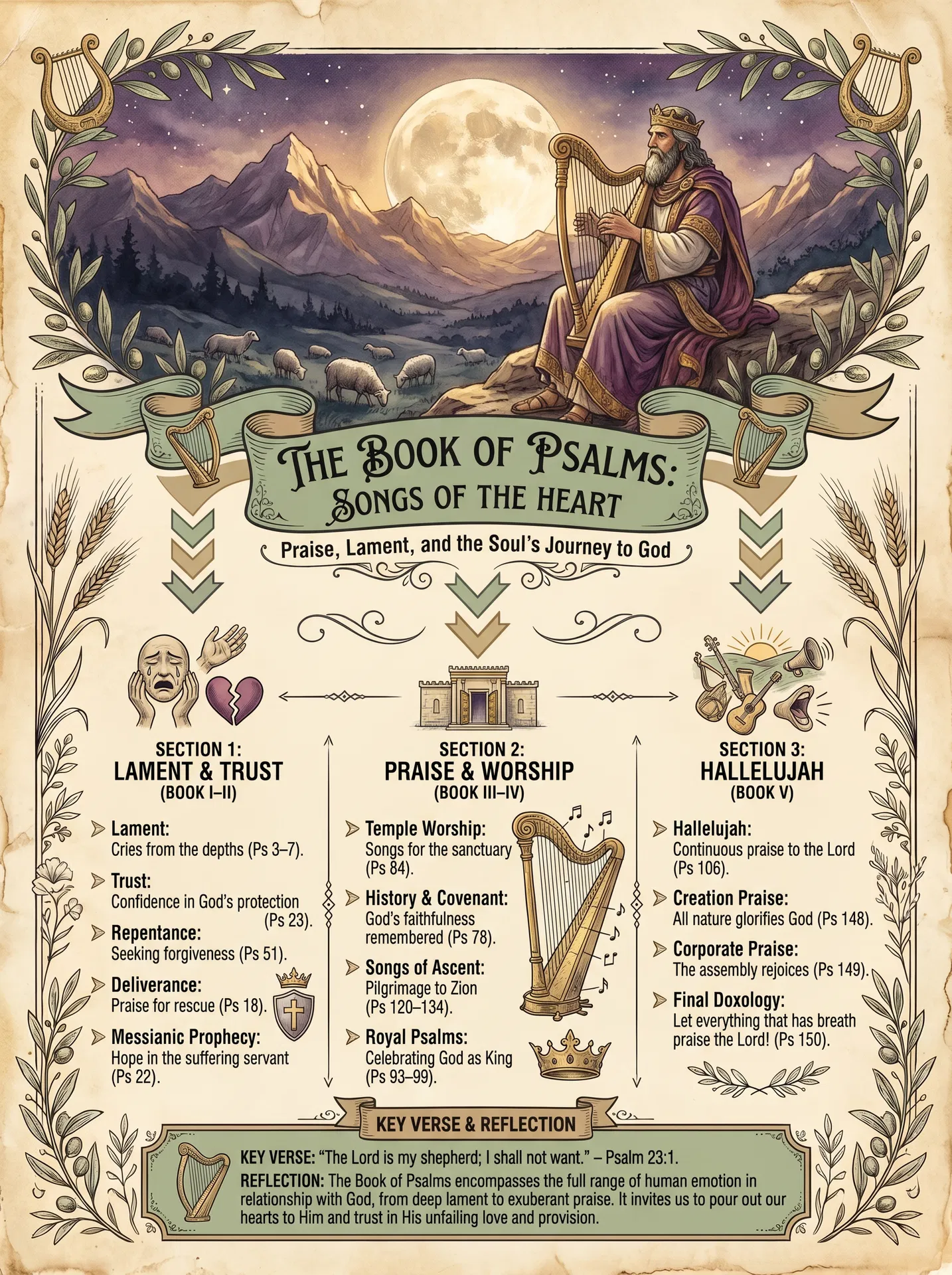
Full-page visual overview of The Book of Psalms — key events, themes, and structure at a glance
How to Study the Psalms
To study the Psalms, read them as prayers before you read them as isolated verses. Notice the type of psalm, the emotional movement, the image of God, and how the psalm teaches you to pray.
- 1 Identify the type of psalm: lament, praise, thanksgiving, wisdom, royal, or messianic.
- 2 Notice the emotional movement: many psalms move from fear to trust, grief to praise, or confusion to hope.
- 3 Look for repeated images: shepherd, refuge, fortress, deep waters, mountain, king.
- 4 Ask what the psalm teaches about God's character.
- 5 Turn the psalm into prayer or reflection.
Psalms Chapter-by-Chapter Summary
The Book of Psalms is a collection of 150 poems, prayers, and songs composed over nearly a thousand years — from Moses to the post-exilic period. Organized into five books mirroring the Pentateuch, it is Israel's hymnbook and the Bible's most intimate record of the human heart before God.
Book I — Prayers of David: Trust and Lament
- 1:1–6 The Two Ways — the blessed life of the one who meditates on God's law versus the way of the wicked. Psalm 1 serves as the gateway to the entire Psalter.
- 22:1–31 "the cry of abandonment" The great Psalm of abandonment and vindication — quoted by Jesus on the cross (Matthew 27:46). It moves from desolation to praise.
- 23:1–6 The Shepherd Psalm. Six verses that have comforted more people in more situations than perhaps any other passage in Scripture. "Even though I walk through the valley of the shadow of death, I will fear no evil."
- 32:1–11 The joy of forgiveness. David's confession after his sin with Bathsheba. "Blessed is the one whose transgressions are forgiven." Quoted by Paul in Romans 4:7–8 as evidence of justification by faith.
- 34:1–22 "Taste and see that the Lord is good." An acrostic psalm of thanksgiving. Every letter of the Hebrew alphabet is used to declare God's goodness and care for the righteous.
Books II–IV — Communal Worship and National Lament
- 42:1–11 "As the deer pants for streams of water, so my soul pants for you, my God." A psalm of spiritual thirst and depression — honest about the darkness while still choosing to hope.
- 51:1–19 The great penitential psalm. David's prayer after Nathan confronts him about Bathsheba. "Create in me a pure heart, O God." The deepest expression of repentance in Scripture.
- 84:1–12 "How lovely is your dwelling place, Lord Almighty!" A psalm of longing for God's presence. "Better is one day in your courts than a thousand elsewhere."
- 103:1–22 "Bless the Lord, O my soul." A comprehensive celebration of God's character: compassion, forgiveness, healing, redemption, love. "As far as the east is from the west, so far has he removed our transgressions from us."
- 119:1–176 The longest chapter in the Bible — 176 verses, each section beginning with a successive letter of the Hebrew alphabet. A sustained meditation on the beauty, power, and sufficiency of God's Word.
Book V — Praise, Ascent, and Hallelujah
- 120–134 The Songs of Ascent — 15 psalms sung by pilgrims traveling up to Jerusalem for the three annual festivals. They move from longing (120) to arrival (122) to trust (125) to blessing (134).
- 139:1–24 "You have searched me, Lord, and you know me." The most intimate psalm of God's omniscience and omnipresence. "Where can I go from your Spirit? Where can I flee from your presence?"
- 145:1–21 The only psalm explicitly titled "A Psalm of Praise." An acrostic celebration of God's greatness, goodness, and kingdom. "The Lord is gracious and compassionate, slow to anger and rich in love."
- 146–150 The Great Hallel — five consecutive Hallelujah psalms that close the entire Psalter. Each begins and ends with "Praise the Lord!" The final verse (150:6) is the Psalter's ultimate conclusion: "Let everything that has breath praise the Lord."
Key Themes in Psalms
The Psalms are organized around five enduring theological themes that together map the full range of human experience before God — from praise to lament, from doubt to trust.
Honest Prayer — Lament as Worship
More than a third of the Psalms are laments — raw, honest cries of pain, confusion, and abandonment. Psalm 22 begins "the cry of abandonment" Psalm 88 ends in darkness with no resolution. The Psalter gives us permission to bring our full emotional reality to God — not a sanitized version, but the actual weight of our suffering. This is not a lack of faith; it is the deepest form of faith.
Read Psalm 22:1 in your preferred translation.
Psalm 22:1
Application: If you have been told that honest doubt or grief is incompatible with faith, the Psalms disagree. Bring your actual situation to God — the anger, the confusion, the silence — and trust that He can handle it.
The Character of God
The Psalms are the richest single source in Scripture for understanding who God is. He is shepherd (23), fortress (46), judge (50), healer (103), creator (104), sustainer (121), and king (145). The Hebrew word hesed — often translated "steadfast love" or "lovingkindness" — appears over 120 times in the Psalms. It describes a covenant loyalty that is not earned and cannot be broken.
Read Psalm 103:8 in your preferred translation.
Psalm 103:8
Application: Reading the Psalms slowly is one of the most effective ways to reshape our understanding of God's character — moving from abstract theology to lived, felt knowledge of who He is.
Praise as a Discipline
The Psalms do not wait for circumstances to improve before praising God. Psalm 34 was written when David was pretending to be insane to escape an enemy — yet it opens with "continual praise in every season" Praise in the Psalms is often a choice made against the grain of current experience, a declaration of what is true about God regardless of what is happening.
Read Psalm 34:1 in your preferred translation.
Psalm 34:1
Application: Praise is not a feeling to wait for — it is a practice to cultivate. The Psalms train us to orient our hearts toward God's goodness even when circumstances pull us toward despair.
The Messianic Psalms
Several Psalms are explicitly quoted in the New Testament as prophecies fulfilled by Jesus. Psalm 22 describes the crucifixion in detail (pierced hands and feet, garments divided by lot) centuries before crucifixion was invented. Psalm 110 is the most quoted Old Testament passage in the New Testament: "the Messiah's exalted authority" Jesus himself uses this psalm to challenge the Pharisees' understanding of the Messiah (Matthew 22:44).
Read Psalm 110:1 in your preferred translation.
Psalm 110:1
Application: Reading the Psalms with New Testament eyes reveals that the entire Psalter is, in some sense, the prayer book of Jesus — He prayed these words, fulfilled these prophecies, and now intercedes for us as our great High Priest.
Psalms Symbols and Imagery
Musical Instruments
Historical Context
The Psalms were sung with a wide range of instruments: the harp (kinnor), lyre (nebel), tambourine, flute, trumpet, and cymbals. Psalm 150 lists six different instrument families. Temple worship was a full-sensory, musical experience — not a quiet, private affair.
Theological Meaning
The variety of instruments in the Psalms reflects the truth that all of creation is called to worship. Music is not merely decoration for worship — it is itself a form of prayer, a way of engaging the whole person (mind, emotion, body) in the presence of God.
Deep Waters
Historical Context
In the ancient Near East, the sea represented chaos, danger, and the power of death. Psalm 69 uses drowning as a metaphor for overwhelming distress: "Save me, O God, for the waters have come up to my neck." The image was immediately understood by ancient readers as a picture of existential crisis.
Theological Meaning
When the Psalms describe God as rescuing from deep waters (18:16; 144:7), they are claiming that God's power exceeds even the most terrifying forces of chaos and death. This imagery is fulfilled in Jesus calming the storm and ultimately in the resurrection — the ultimate rescue from the deepest waters.
The Mountain of God
Historical Context
Mount Zion (Jerusalem) was the location of the Temple — the place where heaven and earth met in Israelite theology. The Songs of Ascent (Psalms 120–134) were sung by pilgrims literally climbing the mountain to worship. The phrase "lifting up my eyes to the hills" (121:1) reflects this physical and spiritual journey.
Theological Meaning
The mountain represents the place of God's presence and rule. In the New Testament, this imagery is transformed: Hebrews 12:22 describes believers as drawing near to the heavenly Jerusalem, the community of God's people gathered around Christ, rather than to a physical mountain.
Shield and Fortress
Historical Context
Military imagery pervades the Psalms: God is described as shield (3:3; 28:7), fortress (18:2; 46:7), stronghold (9:9), and rock (18:2; 31:3). These were not abstract metaphors — David and the psalmists faced real military threats, and they expressed their trust in God using the language of physical protection.
Theological Meaning
The military imagery of the Psalms is ultimately about the nature of faith: trusting in God's protection rather than in human strength. 'Some trust in chariots and some in horses, but we trust in the name of the Lord our God' (20:7). This is not passivity but a reorientation of where ultimate security is found.
Psalms Bible Study Journal and Reflection Questions
A printable journal template designed for verse-by-verse reflection, prayer, and personal response to Scripture.
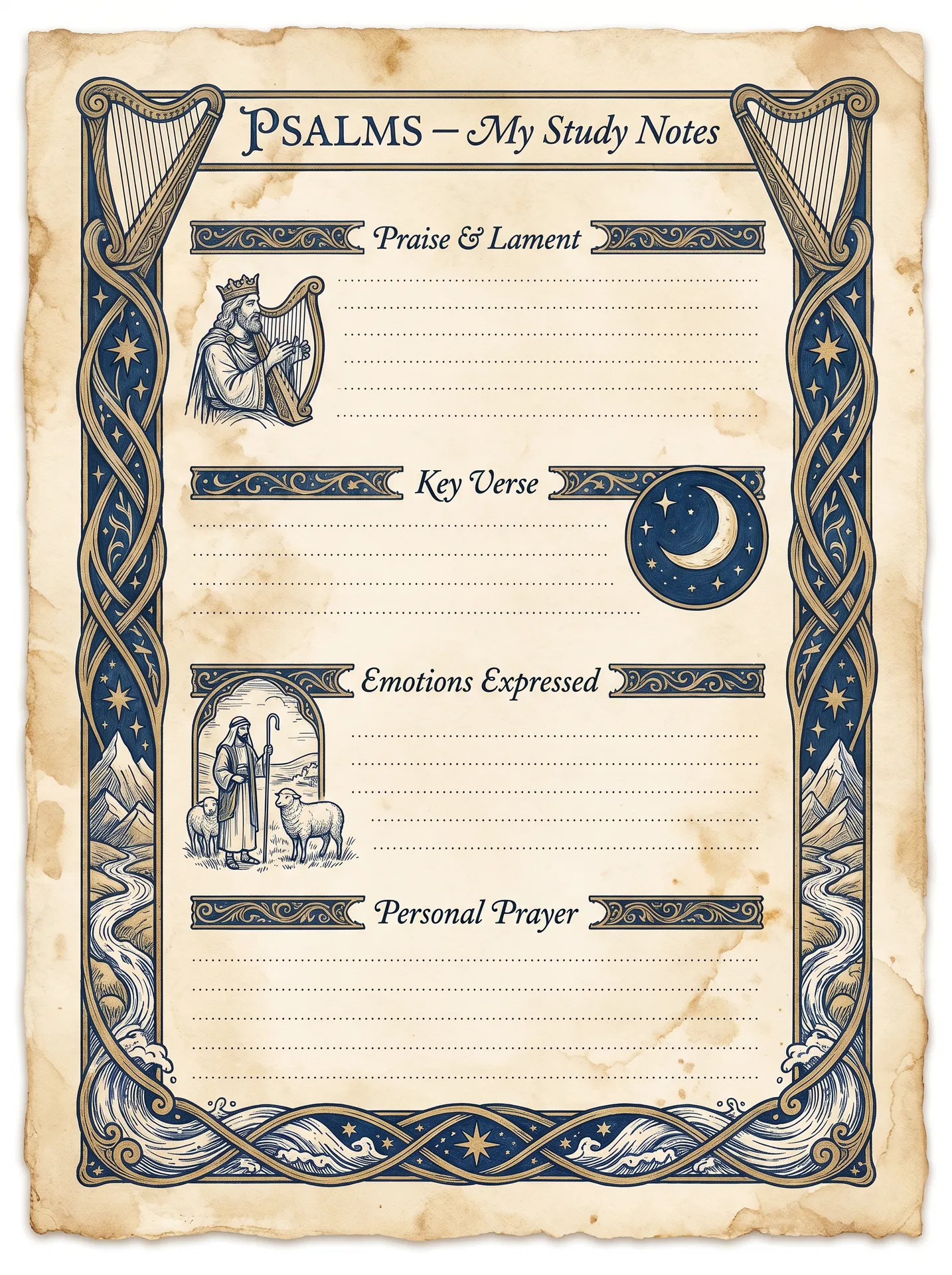
Psalms Bible Small Group Discussion Guide
These 8 questions are designed for a 60–90 minute small group session. Begin with the icebreaker, then work through observation, interpretation, and application questions. Close with the prayer prompt.
If you had to choose one Psalm that describes your current season of life, which would it be and why? (If you're not sure, consider Psalm 23, 42, or 139.)
Read Psalm 22:1–2 and then 22:24–31. How does the psalm move from abandonment to praise? What happens in the middle that enables this shift? What does this tell us about the nature of lament?
Psalm 22 is the most quoted psalm in the New Testament passion narratives. Jesus prays verse 1 from the cross — not as despair, but as the opening of a prayer He knew ended in vindication.
Compare Psalm 1 (the righteous person who meditates on God's law) with Psalm 73 (the psalmist who nearly lost faith watching the wicked prosper). How do these two psalms together give a more complete picture of the life of faith than either one alone?
Psalm 51:4 says "Against you, you only, have I sinned" — yet David sinned against Bathsheba and Uriah. What does David mean? What does this reveal about the ultimate nature of sin?
All sin is ultimately against God because He is the moral standard and the one whose image we bear. This does not minimize the harm done to others — it places it in its proper theological context.
The Psalms use over 20 different images for God: shepherd, rock, fortress, father, king, judge, healer, light. Which image resonates most with you right now? Which one is hardest for you to embrace? Why?
Psalm 46:10 says "stillness before God's sovereignty" In a culture of constant noise and activity, what would it practically look like for you to practice stillness before God this week? What obstacles would you face?
The Psalms model a full range of emotions brought honestly to God: joy, grief, anger, confusion, gratitude, fear. Is there an emotion you tend to hide from God? What would it look like to bring that emotion to Him in prayer this week, using one of the lament psalms as a guide?
Close by reading Psalm 23 together slowly, one verse at a time. After each verse, pause and ask: "Where do you most need this promise right now?" Let the psalm become a personal prayer. End with a moment of silence, then have each person speak one word of gratitude to God.
Psalms Bible Study Questions and Answers
Deeper questions, richer answers — exploring the historical, theological, and personal dimensions of Psalms.
Day 68 · Blessed Is the One — Psalms 1–8
Why does Psalm 1 open the entire Psalter with a contrast between the blessed person and the wicked? What does this framing reveal about the Psalter's purpose?
Psalm 1 functions as a deliberate editorial introduction to the entire Psalter, compiled in the post-exilic period. The Hebrew word ashrei (blessed/happy) opens with a beatitude defined negatively first: the blessed person does not walk, stand, or sit with the wicked — a threefold progression describing increasing entanglement with ungodly influence. The contrast sets up the Psalter's central tension: two ways of life, two destinies. The Psalter's five-book structure mirrors the Torah (Genesis through Deuteronomy), suggesting the compilers saw the Psalms as a second Torah — a response to God's word through prayer and praise.
Read Psalm 1:1-2 in your preferred translation.
Psalm 8 asks, What is mankind that you are mindful of him? Have you ever felt small or insignificant? How does this psalm reframe human dignity?
Psalm 8 holds two realities in tension: human smallness and human dignity. The psalmist looks at the night sky and feels the weight of smallness, but immediately receives the answer: God has crowned humanity with glory and honor. Your dignity is not earned by achievement — it is bestowed by the Creator's mindfulness. The Hebrew zakar (mindful) means to actively remember with care and intention. The New Testament applies Psalm 8:4-6 to Jesus in Hebrews 2:6-9, revealing that the full dignity of humanity is realized in the incarnate Son — what Adam failed to be, Christ fully became.
Read Psalm 8:4-5 in your preferred translation.
Psalms 2-8 include royal psalms, lament psalms, and creation psalms. What does this variety tell us about how ancient Israel understood prayer?
The opening cluster of Psalms is a deliberately curated anthology that models the full range of legitimate prayer. Psalm 2 is royal and messianic; Psalms 3-7 are personal laments; Psalm 8 is a creation hymn. Ancient Israel did not separate these categories — the king's throne, the individual's suffering, and the cosmos were all held within the same prayer space. Nothing is off-limits before God. BibleLum traces how each psalm type recurs throughout the Psalter, showing that the compilers intentionally wove together praise, lament, wisdom, and royal themes to create a complete school of prayer for God's people.
Read Psalm 9:7 in your preferred translation.
Day 69 · My God, My God — Psalms 9–17
Psalm 10 asks, Why, Lord, do you stand far off? How did Israel understand God's apparent silence in times of injustice?
Psalm 10 is a raw lament about the prosperity of the wicked and God's apparent inaction. In ancient Israel, this was not considered faithless — it was considered honest theology. The psalmist does not abandon God; he argues with God. The lament form assumes that God hears, cares, and will act — the complaint is addressed to God precisely because the psalmist believes God is just. The lament psalms make up the largest single category in the Psalter. Their preservation in Scripture is itself a theological statement: God welcomes honest complaint. Silence in prayer is not the same as absence.
Read Psalm 10:1 in your preferred translation.
When you feel like God is distant during suffering, what does Psalm 13's movement from lament to trust teach you about the shape of faith?
Psalm 13 moves in three stages: complaint (vv. 1-2), petition (vv. 3-4), and trust (vv. 5-6). Crucially, nothing changes in the psalmist's circumstances between verse 4 and verse 5 — the shift is entirely internal. This is the anatomy of faith: not waiting until circumstances improve to praise, but choosing to anchor in God's character even before the storm passes. Many Christians feel guilty for lamenting. Psalm 13 gives permission — and a model. The goal is not to suppress honest pain but to bring it to God and let it move toward trust, even when answers have not yet come.
Read Psalm 13:5 in your preferred translation.
Psalm 16 says you will not abandon me to the realm of the dead. How does Peter use this verse in Acts 2 to prove the resurrection?
In Acts 2:25-31, Peter quotes Psalm 16:10 and makes a stunning argument: David wrote this, but David died and his tomb is still with us. Therefore, David was speaking prophetically about the Messiah — the one whose body would not see decay. This is a first-century Jewish interpretive method called pesher, reading Scripture as pointing to a future fulfillment. BibleLum helps beginners trace this Psalm 16 to Acts 2 connection, showing how the New Testament authors read the Psalms as a messianic script — not by ignoring the original context, but by seeing it as a shadow of something greater.
Read Psalm 16:10 in your preferred translation.
Day 87 · The Lord Is My Shepherd — Psalms 23–31
Psalm 23 is the most memorized psalm in the world. What was its original meaning for David, and why has it resonated across 3,000 years?
David wrote Psalm 23 from the perspective of a sheep — a deliberate humility from a king. In the ancient Near East, kings were called shepherds of their people. By casting himself as the sheep and God as the shepherd, David inverted the power structure: the king is not the ultimate provider — God is. The valley of the shadow of death likely referred to the dark ravines where shepherds led flocks, where predators lurked. Jesus explicitly claims the shepherd imagery in John 10: I am the good shepherd. Psalm 23 is not just comfort literature — it is a messianic portrait of the king who lays down his life for his sheep.
Read Psalm 23:1-2 in your preferred translation.
Psalm 27 says The Lord is my light and my salvation — whom shall I fear? What does it look like to practice fearlessness in daily life?
Psalm 27 does not promise the absence of enemies or danger — David was surrounded by both. Biblical fearlessness is not the absence of threat but the presence of a greater reality. The Lord is my light — in a world of darkness, light is orientation. My salvation — in a world of danger, rescue is assured. Fearlessness grows not by eliminating risk but by deepening your awareness of who is with you. The psalm ends with a command: Wait for the Lord; be strong and take heart and wait for the Lord (v. 14). Fearlessness is not passive — it is active waiting, choosing to trust while circumstances remain unresolved.
Read whom shall I fear? The Lord is the stronghold of my life — of whom shall I be afraid? — Psalm 27:1 in your preferred translation.
Psalm 22 begins My God, my God, why have you forsaken me — the exact words Jesus cried from the cross. Was Jesus quoting Scripture, or was he simply in despair?
Jesus was doing both — and that is the point. By crying Psalm 22:1 from the cross, Jesus was not merely expressing despair; he was identifying his suffering with the entire lament tradition of Israel. First-century Jews who heard this would have known the full psalm — which ends not in abandonment but in vindication (vv. 24-31). Jesus was saying: I am living Psalm 22, and I trust its ending. Psalm 22 contains details that match the crucifixion with striking precision: garments divided by lot (v. 18), bones out of joint (v. 14), hands and feet pierced (v. 16). Written 1,000 years before crucifixion was invented as a method of execution.
Read Psalm 22:1 in your preferred translation.
Day 88 · Taste and See — Psalms 32–41
Psalm 32 is a psalm of confession. What did confession mean in ancient Israel, and why did David say silence made his bones waste away?
In the ancient world, sin was understood as a relational rupture — a broken covenant with God that had physical, social, and spiritual consequences. David's description of unconfessed sin (my bones wasted away, my strength was sapped) reflects the psychosomatic reality of guilt. Ancient Israel had no separation between spiritual and physical health — the whole person was affected by the state of the covenant relationship. Paul quotes Psalm 32:1-2 in Romans 4:7-8 as the definition of justification by faith: Blessed is the one whose sin the Lord does not count against them. David's confession psalm becomes Paul's proof text for grace.
Read Psalm 32:1 in your preferred translation.
Psalm 34 says Taste and see that the Lord is good. What does it mean to taste God — and how do you cultivate that kind of experiential faith?
The invitation to taste is deliberately sensory — it is not think and conclude or argue and prove. Experiential faith grows through practice, not just proposition. Psalm 34 was written when David was in desperate circumstances (feigning madness before Abimelech, 1 Samuel 21). His taste of God's goodness came not in comfort but in crisis — God delivered him, and the memory became a testimony. The psalm is an acrostic — each verse begins with a successive letter of the Hebrew alphabet. This literary structure suggests the psalmist is saying: from A to Z, in every possible way, God is good. Experiential faith is built through collected testimonies of God's faithfulness.
Read Psalm 34:8 in your preferred translation.
Psalm 41 ends Book I of the Psalter with a doxology. Why is the Psalter divided into five books, and what does each book emphasize?
The Psalter's five-book structure (Psalms 1-41, 42-72, 73-89, 90-106, 107-150) mirrors the five books of Moses. Each book ends with a doxology. Book I focuses on David's personal life; Book II on the monarchy; Book III on the exile; Book IV on God's eternal kingship; Book V on return and restoration. The Psalter tells Israel's whole story. BibleLum's structure analysis shows that the placement of individual psalms within each book is not random — editorial decisions shaped the Psalter as a theological narrative, not just a hymnal. Reading psalms in sequence reveals intentional theological progression.
Read Psalm 41:13 in your preferred translation.
Day 90 · As the Deer Pants — Psalms 42–51
Psalm 42 opens Book II with As the deer pants for streams of water, so my soul pants for you, my God. What was the historical context, and why is this longing so universal?
The Sons of Korah wrote Psalm 42 from exile — cut off from the temple, unable to worship in Jerusalem. The deer panting for water is an image of desperate, survival-level thirst. The psalmist is not describing a mild spiritual preference but an existential need. My tears have been my food day and night (v. 3) — this is raw spiritual depression. The refrain Why, my soul, are you downcast? (vv. 5, 11) is the psalmist preaching to himself — a practice of self-counsel that modern psychology calls cognitive reappraisal. Ancient Israel knew that feelings must be addressed, not suppressed.
Read Psalm 42:1 in your preferred translation.
Psalm 51 is David's confession after his sin with Bathsheba. What does create in me a pure heart teach us about the nature of genuine repentance?
The Hebrew word for create in Psalm 51:10 is bara — the same word used in Genesis 1:1 for God's act of creation from nothing. David is not asking for a renovation; he is asking for a new creation. This is the depth of genuine repentance: recognizing that the problem is not just behavior but the heart itself, and that only God can do what is needed. Psalm 51:17 — a broken and contrite heart you, God, will not despise — is one of the most important verses in the Psalter. It redefines sacrifice: not animal offerings, but the offering of a humbled self. This anticipates the entire prophetic critique of empty ritual.
Read Psalm 51:10 in your preferred translation.
Psalm 46 says God is our refuge and strength, an ever-present help in trouble. How did this psalm inspire Luther's A Mighty Fortress Is Our God?
Martin Luther wrote A Mighty Fortress Is Our God (1529) as a paraphrase of Psalm 46 during a period of intense personal danger. Luther saw Psalm 46 as a battle hymn for the church under pressure. The psalm's declaration that the Lord Almighty is with us (v. 7) gave Luther the theological confidence to stand against empire and church hierarchy. BibleLum traces how Psalm 46 has been a source of courage across history: for the early church under Roman persecution, for Jewish communities in exile, and for the Reformation. The same words carry different weight in different crises — but the anchor holds.
Read Psalm 46:1 in your preferred translation.
Day 91 · Songs of Ascent — Psalms 120–134
What were the Songs of Ascent (Psalms 120-134), and why did pilgrims sing them on the way to Jerusalem?
The fifteen Songs of Ascent were sung by Jewish pilgrims traveling to Jerusalem for the three annual festivals. The word ma'alot (ascent/steps) likely refers both to the physical ascent to Jerusalem and the spiritual ascent into God's presence. They are short, memorable, and communal — designed to be sung by crowds on the road. The Songs of Ascent move from distress (Psalm 120: I am for peace, but when I speak, they are for war) to arrival and blessing (Psalm 134: Praise the Lord, all you servants of the Lord). They are a pilgrimage in miniature — the journey of the soul toward God.
Read where does my help come from? My help comes from the Lord, the Maker of heaven and earth. — Psalm 121:1-2 in your preferred translation.
Psalm 131 is only three verses long: I do not concern myself with great matters. What does this psalm teach about contentment and spiritual simplicity?
Psalm 131 is one of the shortest and most countercultural psalms in the Psalter. In a world obsessed with ambition and significance, the psalmist says: I have calmed and quieted myself, I am like a weaned child with its mother. The image of a weaned child is key — not a hungry infant demanding food, but a child who rests in the parent's presence simply for the relationship, not for what can be gotten. Spiritual ambition — wanting to understand everything, control everything, achieve everything — is a form of pride that Psalm 131 directly addresses. Contentment is not passivity; it is the active choice to trust God with what you cannot control.
Read Psalm 131:1-2 in your preferred translation.
Psalm 122 says Pray for the peace of Jerusalem. How does this psalm connect the physical city of Jerusalem to the New Testament vision of the New Jerusalem?
Psalm 122 is a love song for Jerusalem — the city where God chose to dwell. The New Testament does not abandon this geography but transforms and fulfills it. Hebrews 12:22 speaks of the heavenly Jerusalem; Revelation 21 describes the New Jerusalem descending from heaven. Praying for Jerusalem's peace is not merely political — it is praying for the full realization of God's dwelling with his people. BibleLum's canonical map traces Jerusalem's theological significance from David's capture of the city through Solomon's temple, the exile, the return, Jesus's entry on Palm Sunday, and finally the New Jerusalem of Revelation — one continuous story of God making his home with humanity.
Read Psalm 122:6 in your preferred translation.
Day 93 · Praise the Lord — Psalms 146–150
Why do the final five psalms (146-150) all begin and end with Hallelujah? What is the theological significance of ending the Psalter this way?
The Psalter begins with a man meditating quietly on Torah (Psalm 1) and ends with a cosmic choir of everything that has breath praising God (Psalm 150). This is the theological arc of the entire book: individual reflection to communal lament to royal hope to exile to return to universal praise. The final Hallel psalms are not a random ending; they are the destination the entire Psalter has been moving toward. The Hebrew word Hallelujah combines hallel (praise) and Yah (the shortened form of God's covenant name YHWH). It is a command addressed to a community: You all, praise the Lord. Praise in the Psalter is never merely private — it is always moving toward the congregation.
Read Psalm 150:6 in your preferred translation.
Psalm 150 calls for praise with trumpet, harp, lyre, timbrel, dancing, strings, pipe, and cymbals. What does this tell us about the role of the arts in worship?
Psalm 150 is the most comprehensive worship instruction in Scripture — and it is entirely about embodied, sensory, communal praise. Every instrument available in the ancient world is listed. Dancing is included. This is not accidental: the Psalter's final word is that worship engages the whole person — body, voice, movement, creativity. The arts are not decoration; they are the language of praise. The history of the church has sometimes been suspicious of the arts in worship. Psalm 150 is a corrective: God is not honored by minimalism for its own sake. The question is not how little can we offer but how fully can we engage.
Read Psalm 150:3-4 in your preferred translation.
How does the Psalter as a whole function as a school of prayer — and what can modern Christians learn from praying through all 150 psalms?
The Psalter covers every human emotion: joy, grief, anger, confusion, trust, doubt, gratitude, despair. It models honest, persistent, communal prayer — prayer that does not pretend, that argues with God, that waits without answers, and that ultimately arrives at praise. Praying through all 150 psalms is not a spiritual achievement; it is an apprenticeship in the full range of what it means to be human before God. The early church prayed the Psalter daily. The monastic tradition prayed all 150 psalms every week. BibleLum's 300-day plan incorporates psalms throughout the journey — not as a separate category but woven into the narrative, because Israel's prayer was always shaped by its story.
Read Colossians 3:16 in your preferred translation.
Day 100 · The Lord Reigns — Psalms 93–100
Psalms 93-100 are called the Enthronement Psalms. What was their original liturgical function, and what do they declare about God's kingship?
The Enthronement Psalms were likely used in annual festival worship to celebrate YHWH's kingship over all creation and all nations. In the ancient Near East, gods were worshiped as kings of their territories. The Enthronement Psalms make a radical claim: YHWH is not merely Israel's tribal deity — he is the king of the entire cosmos, and all other gods are subordinate or nonexistent. Psalm 96 commands Israel to declare his glory among the nations — a missionary impulse embedded in worship. The Enthronement Psalms are not just liturgy; they are a theological manifesto about the scope of God's reign.
Read Psalm 93:1 in your preferred translation.
Psalm 100 says Enter his gates with thanksgiving and his courts with praise. What does it mean to practice gratitude as a spiritual discipline, not just a feeling?
Psalm 100 is a command, not a suggestion: shout for joy, worship, come before him, enter his gates. Gratitude in the Psalter is an act of will before it is a feeling. You choose to enter with thanksgiving even when circumstances do not feel thankful. By choosing to acknowledge God's goodness (he is good; his love endures forever), you are training your perception to see reality more accurately. Neuroscience now confirms what the Psalter practiced: gratitude practices rewire the brain's default mode toward positive attribution. The ancient practice of daily thanksgiving was not naive optimism — it was spiritual formation through repetition.
Read Psalm 100:4 in your preferred translation.
Psalm 98 says Sing to the Lord a new song. Why does the Psalter repeatedly call for new songs — isn't the old tradition enough?
The call for a new song appears six times in the Psalter (Psalms 33, 40, 96, 98, 144, 149). It reflects the conviction that God's acts in history are always fresh and ongoing — each generation has new reasons to praise. The new song is not a rejection of tradition but its living continuation: the same God who acted in the Exodus is acting now, and that demands a new response. Revelation 5:9 and 14:3 describe the redeemed singing a new song before the throne — the ultimate fulfillment of the Psalter's call. The new song of the end times is the song of the Lamb, who accomplished the final and greatest act of salvation.
Read Psalm 98:1 in your preferred translation.
Day 160 · The Wisdom Psalms — Psalms 37, 49, 73
Psalm 73 begins Surely God is good to Israel but immediately admits my feet had almost slipped. What crisis was the psalmist facing, and how did he resolve it?
Asaph was facing the ancient crisis of theodicy: the wicked prosper while the righteous suffer. He was on the verge of abandoning faith because the evidence seemed to contradict God's justice. The resolution came not through argument but through entering the sanctuary (v. 17): worship reoriented his perspective from the present moment to the eternal frame. Psalm 73 is the pivot point of Book III of the Psalter. It begins with a confession of near-apostasy and ends with it is good to be near God. The journey from doubt to trust passes through the sanctuary — through worship, not just reasoning.
Read Psalm 73:16-17 in your preferred translation.
Psalm 37 says Delight yourself in the Lord, and he will give you the desires of your heart. Is this a promise of getting what you want — or something deeper?
This verse is often misread as a transaction: delight in God, then get your wishes. But the Hebrew word for delight (anag) means to find your deepest pleasure in. When you truly delight in God, your desires are transformed — you begin to want what God wants. The promise is not that God will fulfill your existing desires, but that as you delight in him, your desires will align with his, and those desires will be fulfilled. Psalm 37 is an acrostic wisdom psalm addressed to those tempted by the prosperity of the wicked. Its repeated command is do not fret — because anxiety about injustice is both spiritually harmful and unnecessary, given God's ultimate governance.
Read Psalm 37:4 in your preferred translation.
How do the Wisdom Psalms (37, 49, 73) relate to Job and Ecclesiastes in addressing the problem of suffering and injustice?
The Wisdom Psalms, Job, and Ecclesiastes form a canonical conversation about theodicy — the justice of God in a world of suffering. Job confronts the problem through personal suffering and divine encounter. Ecclesiastes confronts it through philosophical observation. The Wisdom Psalms confront it through worship and long-term perspective. Together they refuse easy answers while maintaining faith. BibleLum's thematic engine connects these texts, showing that the Bible does not offer a single answer to suffering but a community of voices wrestling honestly with the same question. The diversity of responses is itself the answer: God is big enough to hold all of it.
Read Psalm 73:23-24 in your preferred translation.
Day 89 · Bless the Lord, O My Soul — Psalms 103–107
Psalm 103 opens with Bless the Lord, O my soul — a self-address. Why does the psalmist command his own soul to praise, and what does this reveal about the nature of worship?
The opening of Psalm 103 is a remarkable act of self-directed worship. David is not commanding others — he is commanding himself. The Hebrew nephesh (soul/self) is the whole person: mind, will, emotions. This suggests that praise is not automatic; it requires intentional engagement of the whole self. Worship is an act of will before it is a feeling. Psalm 103 is structured as a personal testimony (vv. 1-5), a theological declaration (vv. 6-18), and a cosmic call to praise (vv. 19-22). It moves from the individual soul to the entire cosmos — a microcosm of the Psalter's own journey.
Read Psalm 103:1 in your preferred translation.
Psalm 103:12 says As far as the east is from the west, so far has he removed our transgressions from us. Why east and west — not north and south?
North and south are measurable — you can travel to the North Pole and the South Pole. But east and west are infinite and non-converging. If you travel east, you never arrive at west. The metaphor is not about distance but about direction — your sins are removed in a direction that never loops back. This is the completeness of forgiveness: not reduced, not managed, but removed beyond any possible return. Psalm 103:13-14 immediately follows with a parental image: As a father has compassion on his children, so the Lord has compassion on those who fear him; for he knows how we are formed, he remembers that we are dust. God's forgiveness is grounded in his knowledge of our frailty, not our worthiness.
Read Psalm 103:12 in your preferred translation.
Psalm 107 tells four stories of people in crisis who cried to the Lord and were saved. What is the literary pattern, and why does it repeat four times?
Psalm 107 is a masterpiece of liturgical repetition. Four groups — wanderers in the desert, prisoners in darkness, the sick near death, sailors in storms — each follow the same pattern: distress, crying out to God, divine rescue, and a call to give thanks. The fourfold repetition is not redundancy; it is theological insistence: in every kind of crisis, the same God responds to the same cry. BibleLum's pattern analysis shows that Psalm 107 opens Book V of the Psalter — the book of return and restoration. After the exile, Israel needed to hear that God still saves. The four stories are Israel's story told in four different registers: geographic, political, physical, and elemental.
Read Psalm 107:8 in your preferred translation.
Day 136 · God Is Our Refuge — Psalms 46–50
Psalm 46 declares God is our refuge and strength, an ever-present help in trouble. What historical crisis may have inspired this psalm, and why has it endured as a comfort text?
Many scholars connect Psalm 46 to the miraculous deliverance of Jerusalem from the Assyrian army in 701 BC (2 Kings 19). The city was surrounded, the situation was humanly hopeless, and then God acted. The psalm's confidence — we will not fear, though the earth give way — is not wishful thinking; it is the testimony of people who have seen God act in the impossible. The refrain The Lord Almighty is with us; the God of Jacob is our fortress (vv. 7, 11) uses two of God's most significant names: YHWH Sabaoth (Lord of armies) and the God of Jacob (the covenant God who wrestled with a struggling man). Both names speak to God's power and his personal commitment.
Read Psalm 46:1-2 in your preferred translation.
Psalm 46:10 says Be still, and know that I am God. In a world of constant noise and anxiety, what does this stillness actually require?
The Hebrew raphah (be still) means to let go, release, cease striving. It is not passive emptiness but active surrender — releasing the illusion that you can control outcomes. The command is followed by a declaration: I will be exalted among the nations. Stillness is the posture that allows you to see what God is doing rather than what you are doing. In context, Psalm 46:10 is addressed to the nations who are raging against God (v. 6) — it is a command to the enemies of God to stop fighting. But it applies equally to God's people: stop striving, stop managing, stop panicking. God is God; you are not.
Read Psalm 46:10 in your preferred translation.
Psalm 50 is unusual — God is the speaker, not the worshiper. What does God say about sacrifice, and how does this anticipate the prophets' critique of empty religion?
In Psalm 50, God calls Israel to court and delivers a stunning verdict: I do not need your sacrifices (vv. 12-13). This is not a rejection of worship but a correction of transactional religion. Israel had begun to think that sacrifice was a service they provided to God — feeding him, appeasing him. God's response: I own every animal on a thousand hills. What I want is a sacrifice of thanksgiving and a call to me in trouble (vv. 14-15). Psalm 50 anticipates the prophets — Isaiah 1:11-17, Amos 5:21-24, Micah 6:6-8 — all of whom critique empty ritual. The prophetic tradition is not anti-worship; it is anti-performance. God desires the heart behind the offering, not the offering itself.
Read Psalm 50:14-15 in your preferred translation.
Day 137 · Asaph's Psalms — When the Wicked Prosper
Twelve psalms are attributed to Asaph (Psalms 50, 73-83). Who was Asaph, and why do his psalms have a distinctive tone of national lament?
Asaph was a Levitical musician appointed by David to lead worship (1 Chronicles 16:5). His psalms are corporate and prophetic in tone — less personal than David's, more concerned with Israel's national story and God's justice in history. Many Asaph psalms appear to reflect the trauma of the Assyrian invasion and the exile, suggesting that later Levitical musicians composed in his tradition. Psalm 78 — the longest Asaph psalm — is a historical recital of Israel's failures and God's faithfulness. It functions as a warning: do not repeat your ancestors' mistakes. The Asaph psalms preserve Israel's institutional memory of both sin and grace.
Read what we have heard and known, what our ancestors have told us. — Psalm 78:2-3 in your preferred translation.
Psalm 77 says My soul refused to be comforted. Have you ever been in a place where nothing helped? What does Asaph do with that inconsolable grief?
Psalm 77 is one of the most honest psalms about spiritual desolation. Asaph cannot sleep, cannot be comforted, and begins to wonder if God has forgotten him forever (v. 9). But then he makes a deliberate choice: I will remember the deeds of the Lord (v. 11). The pivot from despair to trust is not emotional — it is memorial. He recalls what God has done, and that memory becomes the anchor. The practice of remembering God's past acts is the Psalter's primary strategy for sustaining faith in the present. When feelings fail, memory steps in. This is why the Psalter is full of historical recitals — they are not history lessons but faith-sustaining testimonies.
Read Psalm 77:11 in your preferred translation.
Psalm 82 depicts God standing in the divine council and judging the gods. What is the divine council, and how does this psalm challenge ancient polytheism?
The divine council is a concept found across ancient Near Eastern literature — a heavenly assembly of divine beings. Psalm 82 places YHWH as judge over all other divine beings, declaring that they have failed to uphold justice and will die like mortals. This is not polytheism — it is a polemic against it. YHWH is not one god among many; he is the judge of all so-called gods, and they are found wanting. Jesus quotes Psalm 82:6 (I said, you are gods) in John 10:34-35, using it to defend his own claim to divinity. The argument is a fortiori: if the psalm calls human judges 'gods' without blasphemy, how much more can the one the Father sent and consecrated claim divine identity.
Read Psalm 82:8 in your preferred translation.
Day 149 · Praise the Lord — Psalms 135–145
Psalm 135 praises God by recounting the Exodus and the conquest. Why does Israel's worship so frequently return to historical events rather than abstract attributes?
Israel's God is fundamentally a God who acts in history. Unlike the gods of surrounding nations who were primarily nature deities (gods of storm, fertility, sun), YHWH was known through specific historical events: the Exodus, the covenant at Sinai, the conquest. Worship that recounts these events is not nostalgia — it is theological testimony: this is what our God is like, and he is the same God today. The pattern of historical recital in worship (Psalms 78, 105, 106, 135, 136) serves a catechetical function: each generation learns who God is by hearing what God has done. This is why the Passover Seder, the Eucharist, and baptism are all memorial acts — they re-enact the defining events of redemption.
Read Psalm 135:3 in your preferred translation.
Psalm 143 says my spirit grows faint within me; my heart within me is dismayed. How does David move from this spiritual exhaustion to renewed trust in a single psalm?
Psalm 143 is one of the seven Penitential Psalms of the church's tradition. David begins in complete spiritual collapse — faint, dismayed, dwelling in darkness. His strategy is not to generate positive feelings but to deliberately remember (v. 5), reach out (v. 6), and ask specifically (vv. 8-10). The movement from despair to trust is a series of intentional acts, not a spontaneous emotional shift. The psalm ends with Teach me to do your will, for you are my God (v. 10). Even in exhaustion, the goal is not relief but alignment. David is not asking to feel better; he is asking to be led rightly. This reorientation of desire — from comfort to obedience — is the mark of mature faith.
Read Psalm 143:8 in your preferred translation.
Psalm 145 is an acrostic psalm that David calls a praise. How does the acrostic form itself communicate something about the completeness of praise?
An acrostic poem uses each letter of the alphabet in sequence — in Hebrew, aleph through taw. The form is a literary statement of completeness: from A to Z, praise covers everything. Psalm 145 is the only psalm explicitly titled a praise (tehillah) by David, and it is the last of the Davidic psalms in the Psalter. Its acrostic structure says: I have praised you with everything language can offer. Psalm 145:13 — Your kingdom is an everlasting kingdom, and your dominion endures through all generations — is quoted in Daniel 4:3 and echoes throughout the New Testament's kingdom language. BibleLum traces how this verse seeds the entire biblical theology of the kingdom of God.
Read Psalm 145:3 in your preferred translation.
Day 161 · Create in Me a Clean Heart — Psalm 51
Psalm 51 was written after Nathan confronted David about his sin with Bathsheba. Why is this psalm considered the deepest confession in all of Scripture?
Psalm 51 is unique because it does not minimize, excuse, or contextualize sin. David says: I know my transgressions, my sin is always before me. Against you, you only, have I sinned (vv. 3-4). This is not denial of harm to Bathsheba and Uriah — it is the recognition that all sin is ultimately a violation of God himself. The depth of the confession matches the depth of the relationship. The superscription of Psalm 51 is one of the most detailed in the Psalter, linking it to a specific historical event. This is unusual — most psalms are not dated. The specificity is itself a theological act: this is not abstract confession but the record of a real person's real sin and real restoration.
Read Psalm 51:1 in your preferred translation.
David prays Do not cast me from your presence or take your Holy Spirit from me (Psalm 51:11). What was he afraid of losing, and what does this reveal about his deepest need?
David had seen what happened to Saul: the Spirit of God departed, and Saul was left to his own deteriorating self. David's deepest fear is not punishment but abandonment by God's presence. This reveals what David valued most: not his throne, not his reputation, not his comfort — but the nearness of God. The prayer is a window into the soul of a man who knows that life without God's presence is not life at all. In the New Testament, the Holy Spirit is the permanent seal of God's presence for all believers (Ephesians 1:13-14). The fear David expressed in Psalm 51:11 is no longer the Christian's fear — but the longing behind it (for God's presence) remains the deepest human need.
Read Psalm 51:11-12 in your preferred translation.
Psalm 51:17 says a broken and contrite heart you, God, will not despise. How does this verse redefine what God actually wants from worship?
Psalm 51:16-17 is one of the most theologically significant statements in the Psalter: You do not delight in sacrifice, or I would bring it... My sacrifice, O God, is a broken spirit. This is not anti-ritual — it is a redefinition of the true sacrifice. The animal offering was always meant to represent the offerer's heart. When the heart is broken and contrite, the offering is complete — even without the animal. This verse is the theological foundation of the prophetic critique of empty worship (Isaiah 1, Amos 5, Micah 6) and anticipates the New Testament's call for living sacrifices (Romans 12:1). BibleLum traces how Psalm 51:17 seeds a theology of worship that runs from David through the prophets to Paul.
Read Psalm 51:17 in your preferred translation.
Day 162 · The Messianic King — Psalm 72
Psalm 72 is attributed to Solomon and describes an ideal king. Why do scholars consider this a messianic psalm, and how does it point beyond any historical king?
Psalm 72 describes a king whose reign brings justice to the poor, peace like rain, dominion from sea to sea, and the submission of all kings. No historical king — not even Solomon at his height — fulfilled these descriptions. The psalm is deliberately hyperbolic, pointing beyond any earthly ruler to the ideal king that Israel was always hoping for. The New Testament identifies this king as Jesus. The Magi from the East who came to worship the newborn Jesus (Matthew 2) likely had Psalm 72:10-11 in mind: The kings of Tarshish and of distant shores will bring tribute to him; the kings of Sheba and Seba will present him gifts. The gifts of gold, frankincense, and myrrh echo the royal tribute of Psalm 72.
Read Psalm 72:8,11 in your preferred translation.
Psalm 72:12-14 says the king will deliver the needy who cry out and rescue the poor and needy. What does this tell us about God's priorities for those in power?
The ideal king of Psalm 72 is defined not by military conquest or economic prosperity but by care for the vulnerable. He will take pity on the weak and the needy and save the needy from death (v. 13). In the ancient world, the king's primary duty was justice — especially for those who could not defend themselves. This standard applies to all who hold power: authority is given to serve the vulnerable, not to exploit them. The prophets consistently measure Israel's kings by this standard — and consistently find them wanting. The Psalter's vision of the ideal king is both a critique of every earthly ruler and a hope for the one king who will finally get it right.
Read Psalm 72:12-13 in your preferred translation.
Psalm 72 ends with the words the prayers of David son of Jesse are ended. Why does a psalm attributed to Solomon end with a reference to David?
This closing note marks the end of Book II of the Psalter. The phrase the prayers of David son of Jesse are ended is an editorial colophon — a scribal note marking the conclusion of a collection. It does not mean David wrote no more psalms (many appear in later books); it signals that this particular collection of Davidic prayers is complete. The mention of David within a Solomonic psalm also connects the two kings: Solomon's ideal reign is the fulfillment of David's prayer. BibleLum's editorial analysis shows that the Psalter's five-book structure was deliberately constructed by post-exilic editors who arranged psalms to tell Israel's story. The colophon at Psalm 72:20 is one of several editorial markers that reveal the Psalter as a curated theological narrative, not just a random hymnal.
Read Psalm 72:20 in your preferred translation.
Day 189 · Enter His Gates with Thanksgiving — Psalms 100–103
Psalm 100 is one of the most widely used psalms in Christian worship. What was its original liturgical context in Israel's temple worship?
Psalm 100 is a processional hymn — it was sung as worshipers physically entered the temple courts. The commands shout for joy, worship, come before him, enter his gates are movement commands: the psalm was enacted, not just recited. The gates and courts were literal architectural spaces in Solomon's temple, and the psalm guided worshipers through the physical act of approaching God's presence. The theological content of Psalm 100 is compressed but complete: God is good, his love endures forever, his faithfulness continues through all generations. These three attributes — goodness, hesed, and faithfulness — are the core of God's self-revelation to Moses in Exodus 34:6-7.
Read Psalm 100:4 in your preferred translation.
Psalm 101 is David's personal covenant of integrity — a list of commitments about how he will live and lead. What does it look like to make this kind of intentional commitment today?
Psalm 101 is remarkable for its specificity: I will not look with approval on anything that is vile; I hate what faithless people do; whoever has haughty eyes and a proud heart, I will not tolerate. David is making pre-commitments — decisions made in advance, before the moment of temptation. This is the wisdom of integrity: you decide who you will be before the crisis arrives. Modern behavioral psychology calls this implementation intention — research shows that pre-commitment dramatically increases follow-through on values. The ancient practice of Psalm 101 anticipates this insight: integrity is not improvised in the moment; it is built through advance decision-making.
Read Psalm 101:2-3 in your preferred translation.
Psalm 102 is titled A prayer of an afflicted person who has grown weak. How does this anonymous psalm connect personal suffering to the restoration of Zion?
Psalm 102 is one of the most personal laments in the Psalter — the psalmist is physically wasting away (vv. 3-11). But remarkably, the psalm pivots in verse 12 from personal suffering to cosmic hope for Zion. The connection is not accidental: the psalmist's suffering is placed within the larger story of God's faithfulness to his people. Personal pain is real, but it is not the whole story. The New Testament quotes Psalm 102:25-27 in Hebrews 1:10-12 and applies it to Jesus — the one who laid the foundations of the earth and who remains the same when all else changes. The anonymous sufferer's hope for God's eternal faithfulness finds its ultimate answer in the incarnate Son.
Read Psalm 102:12 in your preferred translation.
Day 190 · You Have Searched Me and Known Me — Psalm 139
Psalm 139 is one of the most profound meditations on God's omniscience and omnipresence. What was the theological context in which David wrote about a God who knows everything?
In the ancient Near East, gods were territorial and limited — a god of this mountain, a god of that river. Psalm 139 makes a radical claim: YHWH is everywhere and knows everything. Where can I go from your Spirit? Where can I flee from your presence? (v. 7). This is not surveillance anxiety — it is the comfort of a God who cannot be escaped by enemies, cannot be surprised by circumstances, and cannot be absent from any place where his people find themselves. The psalm ends with an unexpected turn: Search me, God, and know my heart (v. 23). Having described God's omniscience, David invites it. This is the posture of spiritual health: not hiding from God's complete knowledge but welcoming it, because the God who knows everything is also the God who loves completely.
Read Psalm 139:1-2 in your preferred translation.
Psalm 139:13-16 says God knit me together in my mother's womb and all my days were written in your book before one of them came to be. How does this shape how we understand human dignity and purpose?
Psalm 139:13-16 is the Bible's most explicit statement about prenatal personhood and divine intentionality. You are not an accident of biology — you are the intentional work of a Creator who was present at your formation, who saw your unformed body, who wrote your days before you lived them. This is the foundation of human dignity: not what you achieve or what others think of you, but what God has declared about you. The practical implication is profound: if God knit you together with intention, then your life has inherent meaning — not meaning you must create, but meaning that was woven into you before you were born. This does not eliminate the work of discovering your purpose; it grounds that work in something more stable than your own performance.
Read Psalm 139:13-14 in your preferred translation.
Psalm 139:19-22 suddenly shifts to imprecation — David prays for God to slay the wicked. How do we reconcile this violent prayer with the psalm's earlier intimacy?
The imprecatory section of Psalm 139 shocks modern readers, but it is theologically coherent. David has just described a God who is omniscient and omnipresent — a God who sees everything. The prayer against the wicked is not personal vengeance; it is an appeal to the God who sees: you know what they are doing, and you are just. Do what justice requires. The intimacy of the psalm makes the imprecation possible: you only appeal to a judge you trust. BibleLum's reading of the imprecatory psalms situates them within the covenant framework: they are appeals to God as the covenant enforcer, not expressions of personal hatred. The New Testament does not abolish this instinct but redirects it: we pray for enemies while trusting God to judge justly (Romans 12:19).
Read Psalm 139:23-24 in your preferred translation.
Day 300 · Great Is Your Faithfulness — Psalms 135–145
Psalm 136 repeats his love endures forever twenty-six times. What is the Hebrew word behind love, and why does it appear so often?
The Hebrew word is hesed — one of the richest words in the Old Testament. It combines love, loyalty, covenant faithfulness, and steadfast commitment. It is the love of a covenant partner who will not abandon the relationship regardless of circumstances. The twenty-six repetitions in Psalm 136 are not redundancy — they are liturgical insistence: every act of creation, every moment of history, every deliverance is evidence of the same unchanging hesed. Hesed appears over 250 times in the Old Testament and is the foundation of Israel's understanding of God's character. When the New Testament speaks of God's grace (charis), it is drawing on the same well — the covenant love that will not let go.
Read Psalm 136:1 in your preferred translation.
Psalm 139 says You have searched me, Lord, and you know me. How do you respond to the idea that God knows everything about you — including what you are ashamed of?
Psalm 139 is one of the most intimate psalms in Scripture. God's omniscience is presented not as surveillance but as complete, loving attention. You know when I sit and when I rise; you perceive my thoughts from afar. For many people, the idea of being fully known is terrifying — because we assume that full knowledge leads to rejection. Psalm 139 inverts this: full knowledge leads to full presence and full love. The psalm ends with an invitation: Search me, God, and know my heart (v. 23). The psalmist is not hiding from God's knowledge — he is inviting it. This is the posture of spiritual health: openness to being fully known by the One who fully loves.
Read Psalm 139:1-2 in your preferred translation.
As we near the end of the 300-day journey, how does the Psalter as a whole prepare us to read the rest of Scripture with new eyes?
The Psalter is the Bible's emotional and theological vocabulary. Having prayed through the Psalms, you now have language for every human experience before God. You know how to lament, how to praise, how to wait, how to confess, how to trust. This vocabulary transforms how you read the prophets (who quote the Psalms), the Gospels (where Jesus prays the Psalms), and the letters (where Paul and Peter cite the Psalms). The New Testament quotes the Psalms more than any other Old Testament book — over 100 direct quotations. The early church read the Psalms as the voice of Christ and the voice of the church. BibleLum's 300-day journey has been building toward this: a community of readers who pray with the whole Bible.
Read Psalm 145:3-4 in your preferred translation.
Psalms Bible Study Key Characters
Meet the people whose faith, failure, and faithfulness shaped the story.
David
King of Israel and primary author of the Psalms, who expressed the full range of human emotion before God.
Asaph
A Levitical musician and worship leader who wrote psalms of communal lament and praise.
The Psalmists
Various authors including the Sons of Korah, Solomon, and Moses, each bringing unique perspectives on faith.
Psalms Bible Study Practical Application
Ancient wisdom, lived out today — practical steps rooted in Scripture.
It's Okay to Lament
The Psalms give permission to bring raw, honest pain to God — faith doesn't require pretending everything is fine.
Praise as a Discipline
Many psalms begin in lament but end in praise — modeling the practice of choosing gratitude even in difficulty.
Scripture as Prayer
Praying the Psalms back to God is a time-tested spiritual practice that shapes our hearts and vocabulary of faith.
Related Study Packs
Common Questions About Studying the Book of Psalms
How do I study the Book of Psalms?
To study the Book of Psalms, begin by understanding its structure: five books (Psalms 1–41, 42–72, 73–89, 90–106, 107–150) that mirror the five books of Moses. Then explore the major types of psalms — lament, praise, thanksgiving, wisdom, and royal psalms. Start with well-known psalms like Psalm 23, Psalm 51, and Psalm 139, then branch out to the full collection. Reading each psalm slowly, noticing the movement from complaint to trust, or from silence to praise, will help you understand how Israel prayed — and how you can pray too.
What is the main message of the Book of Psalms?
The main message of Psalms is that every human emotion — joy, grief, anger, doubt, wonder, and despair — can be brought honestly before God. Psalms teaches that prayer is not performance but conversation, and that God can handle the full range of human experience. At the same time, Psalms consistently moves toward praise: even the darkest laments tend to end in trust. The book as a whole is a portrait of what it looks like to live in relationship with the living God across an entire lifetime.
What are the different types of psalms?
The Psalms fall into several major categories: lament psalms (the largest group, expressing grief and crying out to God — e.g., Psalm 22, 88), praise and hymn psalms (celebrating God's character and works — e.g., Psalm 100, 148), thanksgiving psalms (responding to specific acts of deliverance — e.g., Psalm 30, 116), wisdom psalms (reflecting on the good life and God's instruction — e.g., Psalm 1, 119), and royal psalms (concerning the king and pointing forward to the Messiah — e.g., Psalm 2, 110). Many psalms blend multiple types within a single poem.
How does the Book of Psalms connect to the rest of the Bible?
Psalms sits at the center of the Old Testament and connects to nearly every part of Scripture. It is the most quoted Old Testament book in the New Testament. Psalm 22 describes the suffering of the crucifixion in detail centuries before it happened. Psalm 110 is quoted by Jesus and the apostles as a key text about the Messiah's exaltation. Psalm 2 and the royal psalms form the backbone of New Testament Christology. Reading Psalms alongside the Gospels and Epistles reveals how deeply the early church understood Jesus through the lens of Israel's prayer book.
The Book of Psalms
"Let everything that has breath praise the Lord! Praise the Lord!"
Psalm 150:6
Start the 300-Day Bible Study Journey →