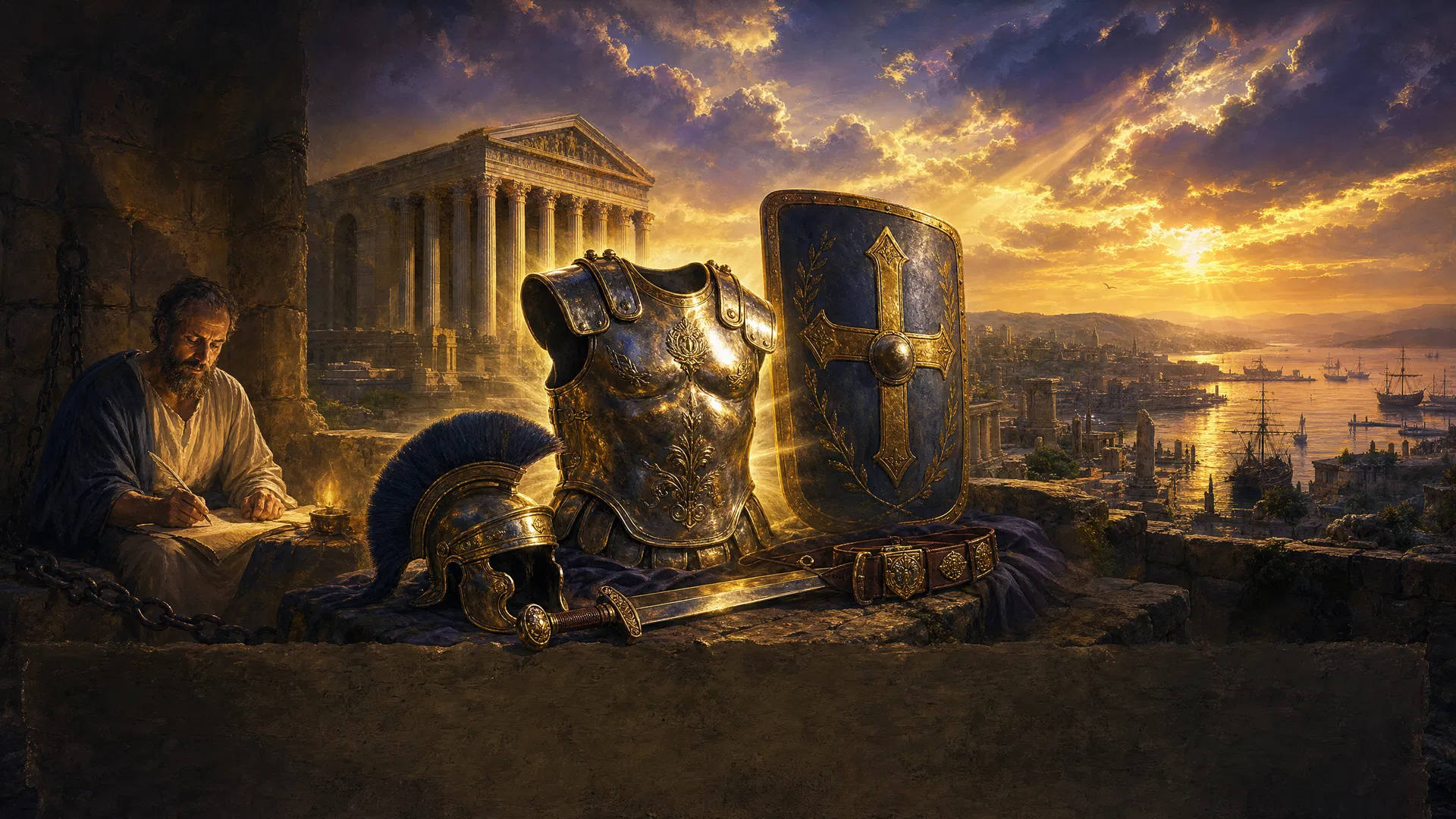
Ephesians Bible Study Guide Overview
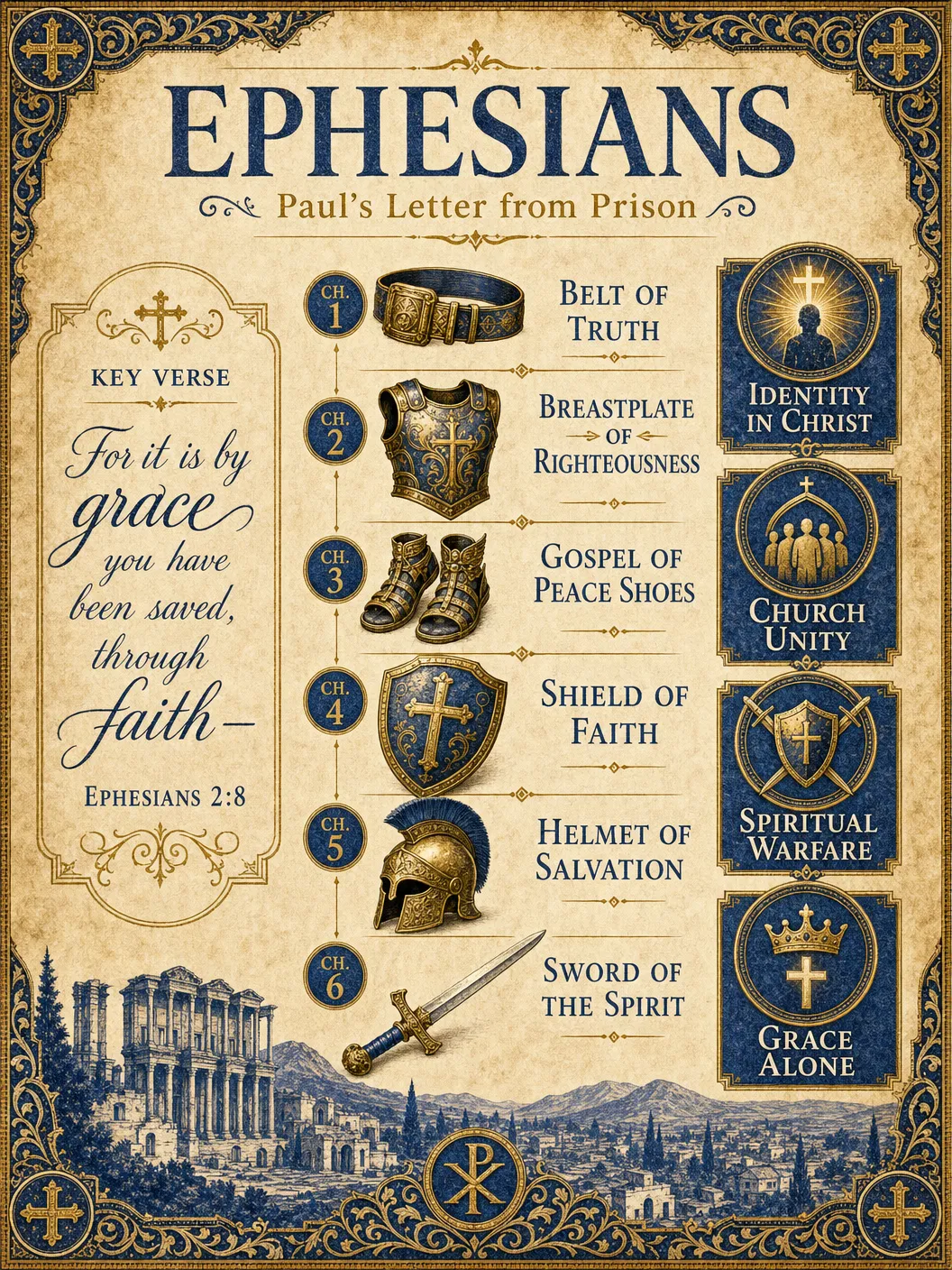
Full-page visual overview of The Letter to the Ephesians — key events, themes, and structure at a glance
How to Study the Letter to the Ephesians
To study Ephesians, read it as a letter in two movements. Chapters 1–3 are theological: Paul lays out what God has done in Christ — election, redemption, reconciliation, and the mystery of the church. Chapters 4–6 are practical: Paul shows what this theology looks like in everyday life. The hinge is Ephesians 4:1 — I urge you to walk worthy of the calling you have received. Everything before it is the calling; everything after it is the walk.
- 1 Read chapters 1–3 as one sustained argument: Paul is not writing disconnected theology but building a single case. God chose us in Christ, redeemed us through his blood, and is uniting all things under Christ. Read it in one sitting to feel the cumulative weight.
- 2 Slow down at Ephesians 1:3–14: this is one of the densest and most glorious passages in the New Testament. Paul piles up blessings — chosen, predestined, redeemed, sealed — all rooted in the phrase in Christ. Count how many times that phrase appears in the letter.
- 3 Read Ephesians 2:1–10 as the gospel in miniature: dead in sin, made alive in Christ, saved by grace through faith. Verse 10 — we are God's handiwork, created in Christ Jesus for good works — is the bridge to the practical section.
- 4 Understand the mystery in chapter 3: the mystery Paul reveals is that Gentiles are co-heirs with Israel in one body. This was hidden in previous ages and is now disclosed through the gospel. It is the theological foundation for everything Paul says about unity in chapters 4–6.
- 5 Study the household code in chapters 5–6 in its first-century context: Paul is not simply endorsing social structures but radically reframing them around mutual submission and the pattern of Christ's self-giving love.
- 6 Meditate on the armor of God in 6:10–20: each piece corresponds to a spiritual reality. The armor is not about individual spiritual discipline but about standing firm together as a community against spiritual opposition.
Ephesians is a letter about identity. Paul wants the church to know who they are before he tells them how to live. Read it slowly, and let the first three chapters settle into you before you move to the second three. The walk follows from the calling.
Ephesians Chapter-by-Chapter Summary
The Book of Ephesians is a foundational text of Scripture, rich with theological depth, historical narrative, and enduring spiritual insight.
Every Spiritual Blessing in Christ
- 1:1–3 Paul opens with a doxology: God has blessed believers "with every spiritual blessing in the heavenly realms in Christ." This is not a promise for the future but a present reality — the believer already possesses these blessings by virtue of being "in Christ."
- 1:4–14 Three stanzas, each ending with "to the praise of his glory": chosen by the Father before creation (vv. 4–6), redeemed by the Son’s blood (vv. 7–12), sealed by the Spirit as a deposit guaranteeing inheritance (vv. 13–14). The Trinity is fully engaged in salvation.
- 1:15–23 Paul’s first prayer: that the Ephesians would know the hope of their calling, the riches of their inheritance, and the surpassing greatness of God’s power — the same power that raised Christ and seated him "far above all rule and authority" at the Father’s right hand.
Dead in Sin, Alive in Grace — One New Humanity
- 2:1–9 The most concise summary of the gospel in Paul’s letters: humanity was dead in trespasses, following the world and the devil, deserving wrath. But God, rich in mercy, made us alive together with Christ. "For it is by grace you have been saved, through faith — and this is not from yourselves, it is the gift of God."
- 2:10 "We are God’s handiwork, created in Christ Jesus to do good works, which God prepared in advance for us to do." The Greek word is poiema — masterpiece. Salvation is not the end of the story but the beginning of a new one: a life of purposeful, Spirit-empowered good works.
- 2:11–22 The Gentiles, once excluded from Israel’s covenants, have been brought near by Christ’s blood. He has broken down "the dividing wall of hostility" between Jew and Gentile, creating "one new humanity." Together they form a holy temple in which God dwells by his Spirit.
The Mystery Revealed — The Church as God’s Masterpiece
- 3:1–13 Paul reveals the "mystery" hidden for ages: that Gentiles are fellow heirs, members of the same body, sharers in the promise in Christ Jesus. The church is the vehicle through which "the manifold wisdom of God" is made known — even to the rulers and authorities in the heavenly realms.
- 3:14–19 Paul’s second prayer: that the Ephesians would be strengthened in their inner being, that Christ would dwell in their hearts through faith, and that they would grasp the dimensions of Christ’s love — "wide and long and high and deep" — and be filled to the measure of all the fullness of God.
- 3:20–21 The doxology: "Now to him who is able to do immeasurably more than all we ask or imagine, according to his power that is at work within us, to him be glory in the church and in Christ Jesus throughout all generations." The church is the arena of God’s eternal glory.
Walk Worthy — Unity, Maturity, and the New Self
- 4:1–16 "Walk worthy of the calling you have received." Unity is not uniformity: there is one body, one Spirit, one hope, one Lord, one faith, one baptism, one God. Yet Christ gave diverse gifts — apostles, prophets, evangelists, pastors, teachers — to equip the saints for works of service until the body reaches maturity.
- 4:17–5:2 Put off the old self, be renewed in the mind, put on the new self. Practical ethics follow: speak truth, be angry without sinning, steal no more but work to give, let no corrupting talk come out of your mouth. "Be kind and compassionate to one another, forgiving each other, just as in Christ God forgave you."
- 5:3–33 Sexual immorality and greed have no place among God’s people. "Walk in the light." The mystery of marriage: husbands love as Christ loved the church; wives submit as the church to Christ. This is not a hierarchy of worth but a picture of the gospel — self-giving love and trusting response.
The Armor of God — Standing Firm in Spiritual Battle
- 6:1–9 Household codes: children obey parents; fathers do not exasperate children. Slaves serve as serving the Lord; masters treat slaves with respect, knowing both have the same Master in heaven. Every relationship is transformed when lived "as to the Lord."
- 6:10–17 The Armor of God: belt of truth, breastplate of righteousness, feet fitted with the gospel of peace, shield of faith, helmet of salvation, sword of the Spirit (the word of God). The armor is not for offense but for standing firm — the battle is already won; the Christian’s task is to hold the ground.
- 6:18–24 Prayer is the atmosphere in which the armor functions: "pray in the Spirit on all occasions." Paul closes with a request for boldness to make known the mystery of the gospel — even in chains. The letter ends with grace and peace to all who love the Lord Jesus with an undying love.
Key Themes in Ephesians
This book develops key theological themes that have shaped Christian thought across the centuries.
Identity in Christ
Ephesians uses the phrase "in Christ" or "in him" over 30 times. This is Paul’s master concept: the believer’s entire identity, status, and destiny are defined by union with Jesus. Chosen in him before creation, redeemed through his blood, sealed with his Spirit, raised and seated with him in the heavenly realms — these are not aspirations but present realities for every believer, regardless of background, status, or performance.
Read Ephesians 1:3 in your preferred translation.
Ephesians 1:3
Application: When you face failure, rejection, or shame, which aspect of your identity in Christ — chosen, redeemed, sealed, or seated — do you most need to remember? How would living from that identity rather than toward it change your daily experience?
Grace Alone
Ephesians 2:8–9 is the most precise statement of salvation by grace in the New Testament: saved by grace, through faith, not of yourselves, not of works. But Paul immediately adds verse 10: we are God’s poiema — masterpiece — created for good works. Grace does not eliminate works; it reframes them. Works are no longer the cause of salvation but its fruit, no longer the ladder we climb but the life we live from a place of already-received acceptance.
Read Ephesians 2:8 in your preferred translation.
Ephesians 2:8
Application: In what areas of your life do you still subtly try to earn God’s favor through performance? What would it look like to rest in grace and let good works flow from gratitude rather than anxiety?
The Unity of the Church
Ephesians 4:4–6 lists seven unities: one body, one Spirit, one hope, one Lord, one faith, one baptism, one God and Father. This is not an ideal to achieve but a reality to maintain — "active care for Spirit-shaped unity" The church’s unity is a cosmic statement: it demonstrates to the watching universe that God’s reconciling power is real, breaking down every wall that divides humanity.
Read Ephesians 4:4 in your preferred translation.
Ephesians 4:4
Application: What specific walls — racial, economic, political, generational — exist in your church community? What one concrete step could you take to actively pursue unity across one of those divides?
The Armor of God
The armor passage (6:10–18) is not primarily about individual spiritual disciplines but about corporate standing. The plural "you" throughout is addressed to the whole community. The armor is not for conquest but for holding ground: "stand firm" appears four times in six verses. The enemy is not flesh and blood but spiritual forces — meaning the real battle is fought in the realm of truth, righteousness, faith, and prayer, not through human strategies or power.
Read Ephesians 6:10–11 in your preferred translation.
Ephesians 6:10–11
Application: Which piece of the armor do you most neglect? The belt of truth (knowing what you believe), the shield of faith (trusting God in uncertainty), or the sword of the Spirit (engaging Scripture actively)? What would it look like to intentionally put on that piece this week?
Ephesians Symbols and Imagery
The Prisoner's Chains
Historical Context
Paul wrote Ephesians from prison (3:1; 4:1; 6:20), likely in Rome around AD 60–62. Roman prisoners were often chained to a guard, which meant Paul's captivity was literally physical — iron chains on his wrists. Yet he calls himself "a prisoner of Christ Jesus," not a prisoner of Rome. The chains were real, but his identity was defined by a higher authority.
Theological Meaning
The prisoner image reframes suffering: Paul's chains become a platform for the gospel rather than an obstacle to it. In Ephesians 6:20, he asks for prayer that he would "courage in sharing the gospel" even "as an ambassador in chains." The armor of God passage that follows is written by someone who knows what it means to stand firm under real pressure. The Christian's ultimate chains are not iron but spiritual — and Christ has already broken them (2:1–6).
The Temple / Holy Building
Historical Context
The Temple in Jerusalem was the center of Jewish worship — the place where God's presence dwelt among his people. It was divided into courts: Gentiles could enter the outer court but were forbidden, on pain of death, from entering the inner courts. A stone barrier (the "dividing wall") literally separated Jew and Gentile in the Temple complex.
Theological Meaning
Paul uses the Temple as a metaphor for the church: Christ has destroyed the "dividing wall of hostility" (2:14), and now Jew and Gentile together form "a holy temple in the Lord" (2:21). The church is not a building but a living structure — "built together to become a dwelling in which God lives by his Spirit" (2:22). Every believer is a living stone in this temple, and the whole structure is held together by Christ as the cornerstone.
The Armor of God
Historical Context
Paul's description of the armor mirrors the equipment of a Roman legionary: the leather belt (cingulum) that held everything together, the breastplate (lorica), the sandals with iron studs for grip in battle, the large rectangular shield (scutum) that could interlock with other soldiers' shields to form a wall, the helmet (galea), and the short sword (gladius). Paul was likely chained to a Roman soldier as he wrote, making the imagery vividly concrete.
Theological Meaning
Each piece of armor corresponds to a spiritual reality: truth, righteousness, the gospel of peace, faith, salvation, and the word of God. The armor is not for individual combat but for corporate standing — the plural "you" throughout the passage addresses the whole church. The interlocking shields of Roman legionaries become a picture of believers standing together in faith, protecting one another. The armor is not earned but received — it is the character of God himself that the believer puts on.
Marriage as Gospel Mystery
Historical Context
In the Greco-Roman world, marriage was primarily an economic and social contract. Paul's elevation of marriage to a "profound mystery" (5:32) representing Christ and the church was countercultural. The Greek word musterion (mystery) in Paul's letters refers not to something unknowable but to something previously hidden that has now been revealed.
Theological Meaning
Paul links Genesis 2:24 to Christ and the church. Marriage is a picture of the gospel: Christ's self-giving love for his bride and the church's trusting response. The husband's call to sacrificial love is not a call to authority; Christ's love was expressed through giving himself up. The mystery of marriage is that it is a living parable of the greatest love story in the universe.
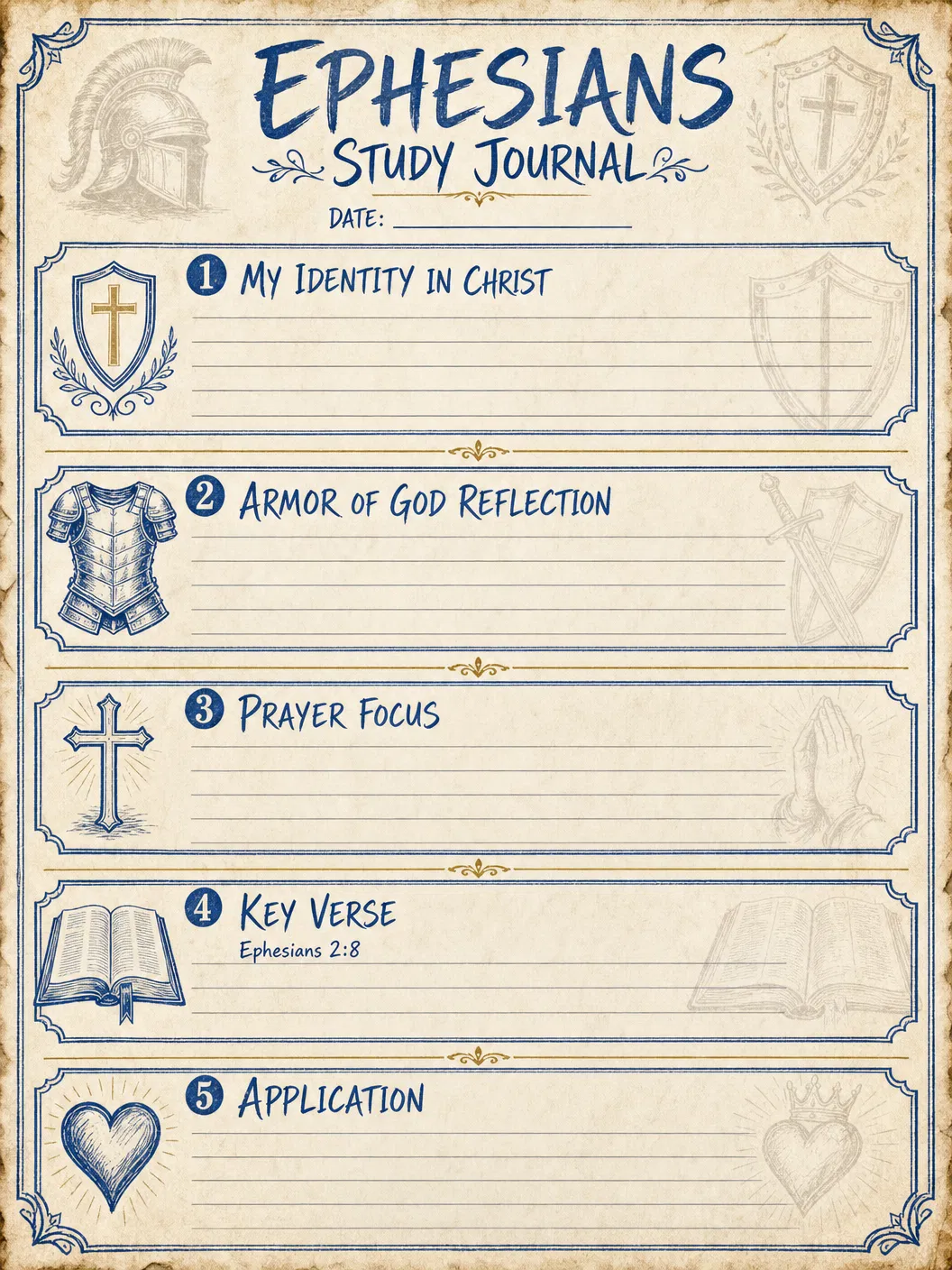
Ephesians Bible Study Journal and Reflection Questions
A printable journal template designed for verse-by-verse reflection, prayer, and personal response to Scripture.
Ephesians Bible Small Group Discussion Guide
These 8 questions are designed for a 60–90 minute small group session. Begin with the icebreaker, then work through observation, interpretation, and application questions. Close with the prayer prompt.
If you had to describe your identity in three words — not your job, family role, or nationality, but who you fundamentally are — what would they be? How do those words compare to how God describes you in Ephesians 1?
Read Ephesians 1:3–14 aloud. Notice the three stanzas, each ending with "to the praise of his glory." What does the Father do? What does the Son do? What does the Spirit do? What does this Trinitarian structure tell us about the nature of salvation?
The Father chooses and adopts (vv. 4–6), the Son redeems and reveals (vv. 7–12), the Spirit seals and guarantees (vv. 13–14). Salvation is a Trinitarian project from beginning to end.
Ephesians 2:1–10 moves from "dead" (v. 1) to "alive" (v. 5) to "seated in the heavenly realms" (v. 6). Trace this movement. What does it mean that believers are already seated with Christ? How should this present reality affect how we face today's challenges?
Paul says the church makes known "the manifold wisdom of God" to "rulers and authorities in the heavenly realms" (3:10). What does it mean that the church is a cosmic display of God's wisdom? How does this change the way you think about the importance of your local church?
The church is not just a human institution for mutual support — it is a cosmic announcement. Every time the church lives in genuine unity across human divides, it declares something to the watching universe about the power of the gospel.
The Armor of God passage (6:10–18) uses plural "you" throughout — it is addressed to the whole community, not just individuals. How does this change your understanding of spiritual warfare? What does it look like to "stand firm" together as a community rather than just as individuals?
Paul lists seven unities in 4:4–6 (one body, one Spirit, one hope, one Lord, one faith, one baptism, one God). Yet the church is visibly divided. What is one specific thing you could do this week to actively pursue unity — with someone in your church you find difficult, or across a divide in the broader church?
Ephesians 4:29 says: "speech that builds others up" Reflect on your conversations this past week. What would it look like to apply this standard to your words — at home, at work, online?
Close by reading Paul's second prayer (Ephesians 3:14–19) together. Invite each person to name a dimension of Christ's love they need to grasp and why. Then pray for one another using the themes of Paul's prayer.
Ephesians Bible Study Questions and Answers
Deeper questions, richer answers — exploring the historical, theological, and personal dimensions of Ephesians.
Day 132 · Blessed in Christ — Dead, Alive, and Seated
Paul wrote Ephesians from prison, yet chapter 1 is an unbroken doxology. What does this tell us about the relationship between circumstances and spiritual perspective in Paul's theology?
Paul's prison context makes the doxology of Ephesians 1 all the more striking. He is not writing from a mountain retreat but from chains. This reveals a core Pauline conviction: spiritual blessings are not dependent on physical circumstances. The phrase 'in the heavenly realms' (1:3) locates the believer's true reality in a dimension that transcends earthly conditions. Paul's theology of 'already/not yet' is key here. The believer is already chosen, already redeemed, already sealed with the Spirit (1:4-14) - these are present realities, not future hopes. This means that even in the worst earthly circumstances, the believer's fundamental status before God is unchanged. Paul is not performing positivity; he is operating from a different ontological reality. The doxology is not despite the chains but through them - because the chains cannot touch what matters most.
Read Ephesians 1:3 in your preferred translation.
Ephesians 2:10 calls believers God's 'handiwork' (poiema - masterpiece). How does this identity challenge the way most people derive their sense of worth from performance or achievement?
The word poiema (from which we get 'poem') means a crafted work of art. Paul places this identity after the declaration of grace (2:8-9), not before it. This sequencing is crucial: the masterpiece identity is not something we earn but something we receive. Most performance-based identity systems work like this: I do good things, therefore I am a good person. Paul reverses the order: I am God's masterpiece, therefore I do good works (which God prepared in advance). The practical difference is enormous. Performance-based identity is fragile - one failure can shatter it. Poiema identity is stable - it rests on the character of the Artist, not the quality of our output.
Read Ephesians 2:10 in your preferred translation.
How does BibleLum read the 'dividing wall' of Ephesians 2:14 in light of the current global church's divisions?
BibleLum reads Ephesians 2:14 as one of the most politically charged verses in the New Testament. The 'dividing wall of hostility' was not a metaphor for Paul's original readers - it was a literal stone barrier in the Jerusalem Temple, with inscriptions warning Gentiles that entry beyond it meant death. Christ's death demolished this wall - not just symbolically but structurally, creating 'one new humanity' (2:15). BibleLum observes that the church today has rebuilt many walls: racial segregation in worship, economic homogeneity, political tribalism, denominational hostility. Each of these walls is a theological contradiction - a denial of what Christ accomplished.
Read Ephesians 2:14 in your preferred translation.
Day 179 · The Mystery Revealed — The Church as Cosmic Display
Paul uses the word 'mystery' (musterion) six times in Ephesians. What did this word mean in the first century, and how does Paul redefine it compared to its use in Greek mystery religions?
In Greek mystery religions, musterion referred to secret knowledge revealed only to initiates through rituals. Paul radically democratizes the concept: the mystery of the gospel is now proclaimed openly to all nations. Paul's mystery is not esoteric knowledge for a spiritual elite but a previously hidden plan now fully disclosed: that Gentiles are 'fellow heirs, members of the same body, sharers in the promise in Christ Jesus' (3:6). The mystery is not about secret rituals but about the scope of God's redemptive plan - wider than anyone imagined, reaching every nation, tribe, and tongue.
Read Ephesians 3:6 in your preferred translation.
Paul prays that believers would 'grasp how wide and long and high and deep is the love of Christ' (3:18). Why does he use spatial dimensions to describe love?
Paul's use of four spatial dimensions (wide, long, high, deep) suggests that Christ's love is immeasurable in every direction - it cannot be contained by any single perspective or experience. The prayer is also paradoxical: Paul asks that they would 'know' a love that 'surpasses knowledge' (3:19). This is not anti-intellectual but trans-intellectual. The practical implication: our experience of God's love is always partial, always growing. There is always more to discover.
Read Ephesians 3:17-18 in your preferred translation.
Ephesians 3:10 says the church makes known God's wisdom to 'rulers and authorities in the heavenly realms.' How does BibleLum interpret this cosmic audience?
BibleLum reads this as one of the most expansive statements about the church's purpose in the entire New Testament. The church is not primarily a social service organization or a spiritual country club - it is a cosmic demonstration of God's wisdom to the entire spiritual order. The 'rulers and authorities in the heavenly realms' likely refers to spiritual powers - the same forces mentioned in 6:12. The church's very existence - Jews and Gentiles, slaves and free, men and women, living in genuine community - is a declaration to these powers that God's plan of reconciliation is succeeding.
Read Ephesians 3:10 in your preferred translation.
Day 180 · Walk Worthy — Unity, Gifts, and the New Self
Ephesians 4:11 lists five ministry gifts: apostles, prophets, evangelists, pastors, and teachers. How were these roles understood in the first-century church?
In the first-century context, these were not organizational titles but functional roles - ways that the risen Christ continued to build his church through gifted people. The purpose of these gifts is not to do ministry for the congregation but to 'equip his people for works of service' (4:12) - a crucial distinction. The goal is a mature body where every member is functioning, not a professional clergy doing ministry while the congregation watches.
Read Ephesians 4:11-12 in your preferred translation.
Paul commands believers to 'put off' the old self and 'put on' the new self (4:22-24). What does this language of clothing suggest about the nature of spiritual transformation?
The clothing metaphor suggests that transformation involves both divine gift and human deliberate choice. The new self is not something we manufacture but something we receive - yet putting it on requires intentional action. Paul's grammar is instructive: 'put off' (aorist - a decisive break) and 'put on' (aorist - a decisive action) frame a continuous process: 'be renewed in the attitude of your minds' (present passive - ongoing). The structure is: decisive break from the old, ongoing renewal of the mind, decisive adoption of the new.
Read Ephesians 4:22-24 in your preferred translation.
How does BibleLum connect Paul's command to 'speak the truth in love' (4:15) to the broader theme of unity in Ephesians?
BibleLum reads 4:15 as the synthesis of two forces that are often set in opposition: truth and love. In Paul's vision, they are not competing values but complementary ones - truth without love is harsh; love without truth is sentimental. The context of 4:15 is doctrinal stability: Paul has just warned against being 'tossed back and forth by the waves' of false teaching (4:14). Speaking truth in love is the antidote - not the avoidance of hard conversations but the conduct of them in a way that builds up rather than tears down.
Read Ephesians 4:15 in your preferred translation.
Day 226 · Walk in Love — Marriage, Light, and the Spirit-Filled Life
Ephesians 5:18 commands believers to 'be filled with the Spirit' rather than be drunk with wine. What is the significance of this contrast in the first-century Ephesian context?
Ephesus was a center of Dionysian worship - the Greek god of wine and ecstasy. Paul contrasts this with Spirit-filling, which produces not ecstasy but community: psalms, hymns, thanksgiving, and mutual submission (5:19-21). The grammar of 5:18 is significant: 'be filled' is a present passive imperative - continuous, ongoing, and received rather than self-generated. The results that follow (5:19-21) are all communal: singing together, giving thanks together, submitting to one another. The Spirit-filled life is not primarily about private ecstasy but about transformed relationships.
Read Ephesians 5:18 in your preferred translation.
Ephesians 5:25 commands husbands to love their wives 'as Christ loved the church and gave himself up for her.' What does this mean practically?
The standard for husbands is not cultural authority but cruciform self-sacrifice. Christ's love for the church was expressed through giving himself up - the ultimate act of self-emptying, not self-assertion. In the first-century Greco-Roman household, the husband had virtually unlimited authority. Paul's command to love 'as Christ loved' was countercultural in the extreme. The practical question is not 'who is in charge?' but 'who is serving?' A husband who loves as Christ loved will be the first to sacrifice his preferences and comfort for the flourishing of his wife.
Read Ephesians 5:25 in your preferred translation.
How does BibleLum interpret the 'mystery' of marriage in Ephesians 5:32 in relation to the broader narrative of Scripture?
BibleLum reads Ephesians 5:32 as the unveiling of a hidden meaning embedded in Genesis 2:24 from the very beginning. When God created marriage, he was encoding a picture of the gospel into the fabric of human experience. The mystery Paul reveals is this: the union of husband and wife has always been a parable of the union between Christ and the church. Marriage is not primarily a human institution that Paul is using as an illustration; it is a divine institution designed from the beginning to point beyond itself.
Read but I am talking about Christ and the church.” — Ephesians 5:32 in your preferred translation.
Day 228 · Household Codes and the Armor of God
Paul's household codes (6:1-9) address children, fathers, slaves, and masters. How do these codes both reflect and transform first-century social structures?
Household codes (Haustafeln) were a common literary form in the ancient world. Paul's codes are similar in structure but radically different in motivation: every relationship is reframed by the phrase 'as to the Lord.' In Aristotle's household code, the husband/father/master has absolute authority. Paul's code is bilateral: both parties have obligations. His instruction to masters (6:9) is revolutionary: 'treat your slaves in the same way' and 'do not threaten them, since you know that he who is both their Master and yours is in heaven, and there is no favoritism with him.'
Read Ephesians 6:5 in your preferred translation.
The Armor of God passage (6:10-18) commands believers to 'stand firm' four times in six verses. What does it mean to stand firm in spiritual warfare?
The repeated command to 'stand firm' reveals that the primary posture of spiritual warfare in Ephesians is defensive, not offensive. The battle has already been won by Christ; the believer's task is to hold the ground that has been secured. Much popular teaching on spiritual warfare emphasizes aggressive spiritual combat. Paul's emphasis is different: put on the armor, stand your ground, and pray. The armor is entirely defensive (belt, breastplate, shield, helmet) except for one offensive weapon: the sword of the Spirit. The victory has been won; the task is to remain in it.
Read Ephesians 6:13 in your preferred translation.
How does BibleLum connect the Armor of God to Paul's prison context and the broader theme of identity in Ephesians?
BibleLum observes that Paul wrote the Armor of God passage while chained to a Roman soldier - making the imagery not abstract but viscerally concrete. He could look at the soldier's equipment and see a spiritual reality. But there is a deeper irony: the prisoner is describing armor, and the armor belongs to God. The Roman soldier's armor represents earthly power - the power that imprisoned Paul. God's armor represents a different kind of power: truth, righteousness, the gospel, faith, salvation, the word of God. The prisoner is better equipped than his guard.
Read Ephesians 6:14 in your preferred translation.
Day 255 · Grace, Identity, and the Heavenly Realms
Ephesians uses the phrase 'in the heavenly realms' (en tois epouraniois) five times. What does this phrase mean, and how does it shape the letter's worldview?
The 'heavenly realms' in Ephesians is not a distant location but an overlapping dimension of reality that intersects with the earthly realm. It is where Christ is seated (1:20), where believers are seated with him (2:6), and where spiritual warfare takes place (6:12). This spatial language creates a two-level cosmology: the earthly realm (where Paul is imprisoned) and the heavenly realm (where the real action is). The letter's argument is that believers live simultaneously in both realms. They are physically in Ephesus but spiritually seated with Christ in the heavenly realms. Suffering is real but not ultimate; earthly powers are real but not supreme.
Read Ephesians 2:6 in your preferred translation.
Paul prays twice in Ephesians (1:15-23; 3:14-19). What do these two prayers reveal about what Paul considers most important for spiritual growth?
Paul's two prayers are striking for what they do not ask for: he does not pray for healing, prosperity, or safety. He prays for knowledge, power, and love - interior realities rather than exterior circumstances. The first prayer (1:15-23) asks for wisdom and revelation to know God better. The second prayer (3:14-19) asks for inner strength, Christ's indwelling, and rootedness in love. Both prayers are entirely focused on the interior life. Paul's conviction: if believers truly know who they are in Christ and experience his love, the exterior circumstances become secondary.
Read Ephesians 1:17 in your preferred translation.
How does BibleLum read the doxology of Ephesians 3:20-21 in relation to the letter's overall argument about the church's purpose?
BibleLum reads the doxology as the theological climax of the letter's first half. The phrase 'immeasurably more than all we ask or imagine' is a specific claim about the scope of God's power at work in the church, not a general promise about answered prayer. The doxology locates God's glory 'in the church and in Christ Jesus throughout all generations' (3:21). This is remarkable: the church is named alongside Christ as the arena of God's eternal glory. Not the temple, not the cosmos, not heaven - the church. The ordinary, imperfect, struggling church is the place where God's eternal glory is being displayed.
Read Ephesians 3:20-21 in your preferred translation.
Day 293 · Prayer, the Ambassador, and the Benediction
Paul calls himself 'an ambassador in chains' (6:20). What does the concept of ambassador mean in the Roman world, and how does this self-description reframe his imprisonment?
In the Roman world, an ambassador (presbeutes) was a representative of a sovereign power, protected by diplomatic immunity. Paul uses this title while in chains - a deliberate paradox. An ambassador in chains is a contradiction in Roman terms; in Paul's theology, it is a declaration of where ultimate authority lies. The paradox is intentional: Paul is physically imprisoned by Rome but spiritually commissioned by a higher sovereign. His chains do not negate his ambassadorial status; they demonstrate it. Paul's request is not for release but for boldness (6:19-20) - not that the chains would be removed but that he would speak fearlessly within them.
Read Ephesians 6:19-20 in your preferred translation.
The letter closes with 'Grace to all who love our Lord Jesus Christ with an undying love' (6:24). What does 'undying love' mean, and how does it summarize the letter's call?
The Greek phrase en aphtharsia (in incorruptibility/immortality) suggests a love that is imperishable, uncorrupted, and eternal - a love that does not fade with circumstances, is not corrupted by self-interest, and does not end with death. This closing benediction is a summary of the entire letter. Ephesians has been about identity in Christ - blessings that are imperishable (1:3-14), a new humanity that is incorruptible (2:15), a love that surpasses knowledge (3:19). The letter ends where it began: with grace. The grace that saves (2:8) is the grace that sustains (6:24).
Read Ephesians 6:24 in your preferred translation.
How does BibleLum read the arc of Ephesians - from 'dead in trespasses' (2:1) to 'love with an undying love' (6:24) - as a model for spiritual formation?
BibleLum reads Ephesians as a complete map of the spiritual journey: from death to life, from identity confusion to identity clarity, from fragmented community to unified body, from spiritual vulnerability to armored standing. The letter's structure is itself a model of spiritual formation: chapters 1-3 establish identity (who you are in Christ) before chapters 4-6 address behavior (how you live from that identity). This sequence is not accidental - it is Paul's fundamental conviction that transformation flows from identity, not toward it. You do not become who you are by behaving better; you behave differently because you have discovered who you already are.
Read and this is not from yourselves, it is the gift of God.” — Ephesians 2:8 in your preferred translation.
Ephesians Bible Study Key Characters
Meet the people whose faith, failure, and faithfulness shaped the story.
Paul
The imprisoned apostle who writes from chains yet overflows with praise, prayer, and theological vision for the church.
Tychicus
Paul's trusted messenger who carries the letter to Ephesus and will explain Paul's circumstances to the congregation.
Ephesians Bible Study Practical Application
Ancient wisdom, lived out today — practical steps rooted in Scripture.
Know Your Identity
Before changing your behavior, meditate on Ephesians 1:3-14. You are chosen, adopted, redeemed, and sealed. Let this reshape how you see yourself.
Pursue Unity
Ephesians 4:3 calls believers to 'make every effort' to maintain unity. This is not passive — it requires active pursuit across racial, economic, and cultural lines.
Put on the Armor Daily
Ephesians 6:10-18 is not a one-time prayer but a daily discipline. Each piece of armor corresponds to a spiritual practice: truth, righteousness, the gospel, faith, salvation, and prayer.
Related Study Packs
Common Questions About Studying the Letter to the Ephesians
How do I study the Letter to the Ephesians?
To study Ephesians, read it as a letter in two movements. Chapters 1–3 are theological — what God has done in Christ. Chapters 4–6 are practical — how to live in light of that. The hinge is Ephesians 4:1. Read chapters 1–3 in one sitting to feel the cumulative weight, then slow down at key passages: 1:3–14 (blessings in Christ), 2:1–10 (the gospel in miniature), and 3:14–21 (Paul's prayer). Count how many times the phrase in Christ appears throughout the letter.
What is the main message of the Letter to the Ephesians?
The main message of Ephesians is that God is uniting all things in Christ — Jew and Gentile, heaven and earth — and that the church is the visible expression of this cosmic reconciliation. Paul grounds everything in identity: who believers are in Christ (ch. 1–3) before telling them how to live (ch. 4–6). The letter is a sustained meditation on grace, identity, unity, and the call to walk worthy of the calling received.
What is the armor of God in Ephesians 6?
The armor of God in Ephesians 6:10–20 is Paul's metaphor for the spiritual resources available to believers in their struggle against spiritual opposition. Each piece — the belt of truth, breastplate of righteousness, shoes of the gospel, shield of faith, helmet of salvation, and sword of the Spirit — corresponds to a spiritual reality rooted in the gospel. Paul frames this not as individual spiritual discipline but as a community standing firm together. The passage ends with a call to prayer.
How does the Letter to the Ephesians connect to the rest of the Bible?
Ephesians is the fullest expression of Paul's theology of the church as the body of Christ. The mystery Paul reveals — that Gentiles are co-heirs with Israel in one body (3:6) — is the fulfillment of the promise to Abraham in Genesis 12 that all nations would be blessed. Ephesians 1:10 echoes the cosmic scope of Colossians 1:15–20. The household code in chapters 5–6 is paralleled in Colossians 3–4. Reading Ephesians alongside Romans 9–11 and Galatians deepens understanding of the Jewish-Gentile unity theme.
The Letter to the Ephesians
"Finally, be strong in the Lord and in his mighty power. Put on the full armor of God."
Ephesians 6:10–11
Start the 300-Day Bible Study Journey →