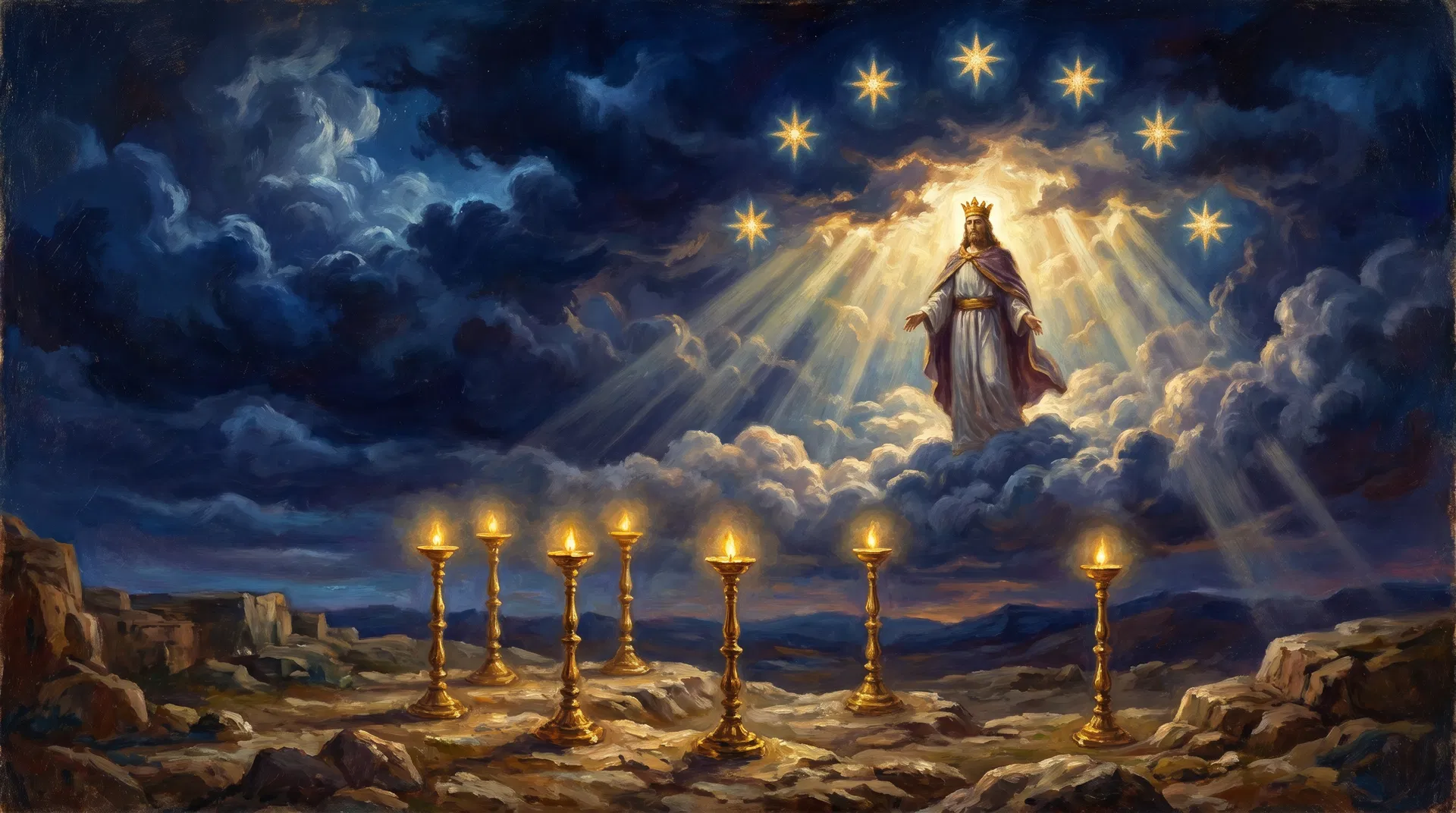
Revelation Bible Study Guide Overview
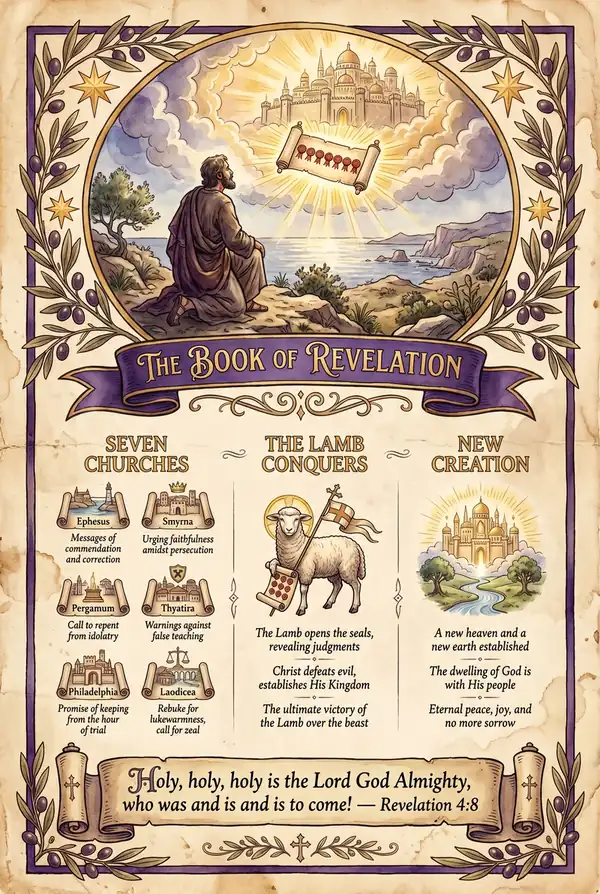
Full-page visual overview of The Book of Revelation — key events, themes, and structure at a glance
How to Study the Book of Revelation
To study Revelation, read it as a letter written to real churches under real pressure — not primarily as a prediction chart. It is a book of worship, warning, and hope, written in the language of Jewish apocalyptic imagery that its first readers would have recognized.
- 1 Read the letters to the seven churches first (chapters 2–3): they set the pastoral stakes of the whole book.
- 2 Learn the genre: apocalyptic literature uses symbols, numbers, and visions to convey theological truth, not newspaper headlines.
- 3 Notice the numbers: 7 (completeness), 12 (Israel/church), 1000 (fullness), 666 (falling short of perfection).
- 4 Follow the Lamb: Jesus appears as the slain-but-standing Lamb — the central image of the entire book.
- 5 Read the Old Testament background: Revelation quotes or alludes to Daniel, Ezekiel, Isaiah, and Zechariah on nearly every page.
- 6 End with the vision of the new creation (chapters 21–22): the book's goal is not fear but hope.
Revelation rewards patient, prayerful reading. The goal is not to decode a timeline but to encounter the risen Christ, who holds the seven stars, opens the sealed scroll, and makes all things new.
Revelation Chapter-by-Chapter Summary
The Book of Revelation is traditionally associated with John and is often dated near the end of the first century, during a time of pressure on churches in Asia Minor. Using the genre of Jewish apocalyptic literature, it addresses seven churches under Roman pressure — assuring them that the Lamb who was slain is Lord over all history, and that his victory is certain.
Letters to the Seven Churches
- 1:1–20 The risen Christ appears to John in overwhelming glory — eyes like blazing fire, feet like bronze, voice like rushing waters. "Do not be afraid. I am the First and the Last. I am the Living One; I was dead, and now look, I am alive for ever and ever!"
- 2:1–3:22 Seven letters to seven real churches in Asia Minor. Each follows a pattern: Christ's self-identification, commendation, rebuke, call to repentance, and promise to the overcomer. Ephesus lost its first love; Smyrna faces persecution; Laodicea is lukewarm. These letters speak to every generation of the church.
The Throne Room and the Sealed Scroll
- 4:1–11 John is caught up to heaven and sees the throne of God surrounded by 24 elders and four living creatures. Continuous worship: "Holy, holy, holy is the Lord God Almighty, who was, and is, and is to come." The vision establishes that God is sovereign over all history.
- 5:1–14 The sealed scroll of history can only be opened by the Lion of Judah — who appears as a slain Lamb. The paradox of power through sacrifice is the theological heart of Revelation. Heaven erupts in worship: "Worthy is the Lamb who was slain!"
- 6:1–7:17 The first six seals are opened: war, famine, death, cosmic upheaval. Yet between the sixth and seventh seals, 144,000 are sealed for protection, and a great multitude from every nation stands before the throne. God's judgment and God's mercy operate simultaneously.
Trumpets, Bowls, and the Dragon
- 8:1–11:19 Seven trumpets sound, bringing escalating judgments that echo the plagues of Egypt. The seventh trumpet announces: "The kingdom of the world has become the kingdom of our Lord and of his Messiah, and he will reign for ever and ever."
- 12:1–14:20 The great cosmic drama: the woman, the dragon (Satan), and the child (Christ). The beast from the sea (worldly power) and the beast from the earth (false religion) wage war against the saints. The number 666 represents the beast's claim to divine authority — always falling short of the perfect 7.
- 15:1–16:21 Seven bowls of God's wrath are poured out — the fullness of divine judgment. The song of Moses and the Lamb is sung before the bowls are released: God's judgments are just and true. Armageddon is the gathering of the nations for the final conflict.
Babylon Falls — The New Jerusalem Descends
- 17:1–18:24 The fall of Babylon the Great — the symbol of every worldly system that opposes God and seduces humanity. "Come out of her, my people" (18:4). The merchants of the earth mourn; heaven rejoices. Babylon's fall is certain because God's judgment is certain.
- 19:1–20:15 The marriage supper of the Lamb. Christ returns as the Word of God, riding a white horse. The beast and false prophet are thrown into the lake of fire. Satan is bound for a thousand years, then released, defeated, and cast into the lake of fire. The great white throne judgment.
- 21:1–22:21 The new heaven and new earth. The New Jerusalem descends — a city of breathtaking beauty where God dwells with His people. "He will wipe every tear from their eyes. There will be no more death or mourning or crying or pain." The river of life, the tree of life, and the final invitation: "Come!" The last prayer of Scripture: "Come, Lord Jesus."
Key Themes in Revelation
The Book of Revelation is structured around four theological visions that together form a unified declaration: the Lamb reigns, and his people will share in his victory.
The Sovereignty of God
Despite the chaos of persecution, cosmic warfare, and divine judgment that fills Revelation, the central message is that God is on the throne and history is moving toward His predetermined conclusion. The throne room vision of Revelation 4–5 establishes this before any of the judgments unfold: God is not reacting to events — He is directing them. The scroll of history is in His hands, and only the Lamb is worthy to open it.
Read Revelation 4:8 in your preferred translation.
Revelation 4:8
Application: When the world feels out of control, Revelation invites us to look up and see what John saw: a throne, and One seated on it. The chaos around us does not tell the whole story. God has written the last chapter.
The Lamb Who Conquers
The most stunning moment in Revelation is the introduction of the Lamb in chapter 5. John is told to look for the Lion of Judah — and sees a Lamb, looking as if it had been slain. This is the theological heart of the book: the Lamb conquers not through military might but through sacrificial death. The cross, which looked like defeat, was in fact the decisive victory over sin, death, and the powers of darkness.
Read Revelation 5:12 in your preferred translation.
Revelation 5:12
Application: The Lamb's victory redefines what power looks like. In a world that respects force, wealth, and status, Revelation calls us to follow the Lamb wherever He goes — even through suffering — trusting that the way of the cross is the way of ultimate victory.
Perseverance Under Persecution
Revelation was written to real churches facing real persecution under the Roman Empire. The seven letters (chapters 2–3) address specific failures and call for specific faithfulness. The promise to "the one who overcomes" is repeated seven times — not as a reward for the spiritually elite, but as an encouragement to every believer to hold on. Suffering is not a sign of God's absence; it is the context in which faithfulness is forged.
Read Revelation 2:10 in your preferred translation.
Revelation 2:10
Application: The call to persevere is not passive endurance but active faithfulness — continuing to worship, witness, and love even when it costs something. What does faithful endurance look like in your specific context?
New Creation
The ultimate hope of Revelation is not escape from earth but the renewal of all things. The final vision is not of souls floating in heaven but of a new heaven and new earth, with the New Jerusalem descending to a renewed creation. God's plan is not to abandon His creation but to redeem and restore it. "Behold, I am making all things new" (21:5) — not "all new things" but the renewal of all that exists.
Read Revelation 21:4 in your preferred translation.
Revelation 21:4
Application: The new creation hope transforms how we live now. If God is going to renew all things, then our work, relationships, and care for creation are not meaningless — they are seeds of the coming kingdom. How does the hope of new creation change how you approach your daily life?
Revelation Symbols and Imagery
The Lamb
Historical Context
The Passover lamb was central to Israel's identity — its blood on the doorposts protected the firstborn from the angel of death (Exodus 12). In the Temple, lambs were sacrificed daily. John the Baptist introduced Jesus as Read John 1:29 in your preferred translation, connecting Jesus to this entire sacrificial tradition.
Theological Meaning
In Revelation, the Lamb appears 28 times — far more than any other title for Jesus. The paradox is deliberate: the Lamb who was slain is the one who holds the scroll of history and executes judgment. Power flows not from military might but from sacrificial love. This inverts every worldly understanding of authority.
Babylon
Historical Context
Babylon was the empire that destroyed Jerusalem and the Temple in 586 BC, exiling the Jewish people. It was the supreme symbol of pagan power and idolatry in Jewish memory. In John's day, "Babylon" was widely understood as a code name for Rome — the empire that had destroyed Jerusalem again in AD 70 and was persecuting Christians.
Theological Meaning
Babylon represents any human system — political, economic, cultural — that demands ultimate allegiance and seduces people away from God. Every generation has its own Babylon. The call to "come out of her" (18:4) is not a call to physical withdrawal but to spiritual non-conformity — refusing to worship at the altar of worldly power.
The New Jerusalem
Historical Context
Jerusalem was the city of God's presence, the site of the Temple, the center of Jewish worship. Its destruction in AD 70 was a theological crisis for early Christians. John's vision of the New Jerusalem descending from heaven answers this crisis: God's presence is not destroyed — it is being renewed and perfected.
Theological Meaning
The New Jerusalem is not a place we go to but a reality that comes down to us — God dwelling with humanity. Notably, there is no temple in the New Jerusalem (21:22), because God Himself is its temple. The city's dimensions (a perfect cube, like the Holy of Holies) suggest the entire city is the dwelling place of God's presence. This is the ultimate fulfillment of the Exodus promise: "I will be your God and you will be my people."
The Number 7
Historical Context
Seven was the number of completeness and perfection in Hebrew thought, rooted in the seven days of creation. Revelation is structured around sevens: 7 churches, 7 seals, 7 trumpets, 7 bowls, 7 beatitudes. The number 666 (the mark of the beast) is deliberately one short of 777 — a triple imperfection, the ultimate counterfeit.
Theological Meaning
The sevenfold structure of Revelation is not accidental — it communicates that God's plan is complete and perfect. History is not random; it is moving toward a divinely ordained conclusion. The repeated sevens reassure persecuted believers that God is not surprised by events — He has written the last chapter.
Revelation Bible Study Journal and Reflection Questions
A printable journal template designed for verse-by-verse reflection, prayer, and personal response to Scripture.
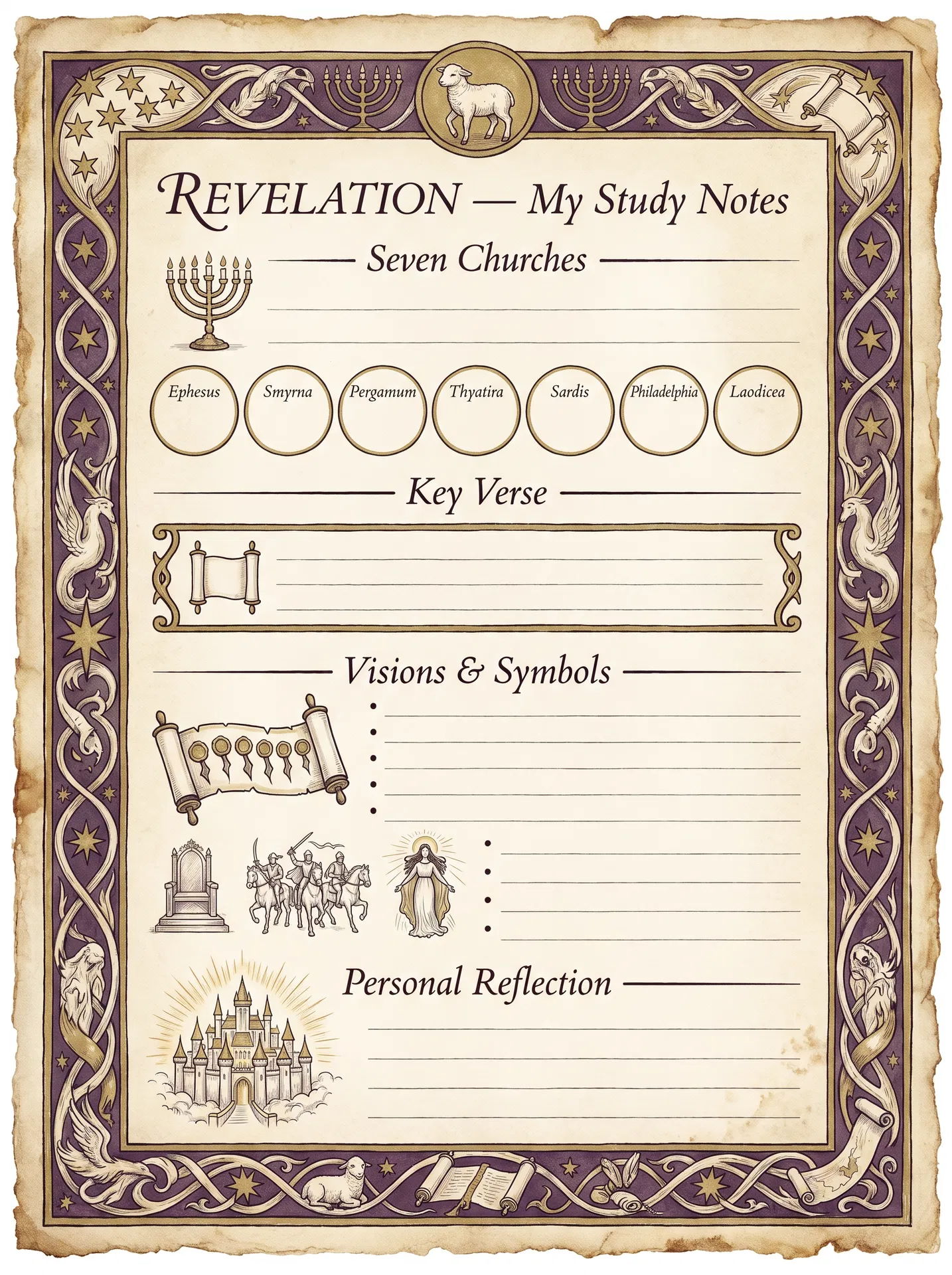
Revelation Bible Small Group Discussion Guide
These 8 questions are designed for a 60–90 minute small group session. Begin with the icebreaker, then work through observation, interpretation, and application questions. Close with the prayer prompt.
What image or scene from Revelation has stayed with you the most — whether it inspired, confused, or unsettled you? What drew you to that image?
Read Revelation 5:1–14. John weeps because no one is found worthy to open the scroll — and then the Lamb appears. What does this scene reveal about the nature of Christ's authority? Why is it significant that He appears as a Lamb rather than a warrior?
The Lamb has seven horns (perfect power) and seven eyes (perfect knowledge) — yet He is described as "looking as if it had been slain." The wounds of the cross are not erased in heaven; they are the basis of Christ's authority.
Read the letters to Ephesus (2:1–7) and Laodicea (3:14–22). What does Christ commend and rebuke in each church? Which letter speaks most directly to the condition of the church today? Which speaks most directly to your own spiritual condition?
Revelation 12 describes a cosmic battle between a dragon (Satan) and a woman (representing God's people). The dragon is defeated "by the blood of the Lamb and by the word of their testimony" (12:11). What does this tell us about how spiritual warfare is actually won?
The victory is not military but testimonial — faithful witness, even unto death, is the means by which the dragon is overcome. This radically redefines what "winning" looks like.
Revelation 21:4 promises that God will wipe every tear from their eyes. What does it mean to you that God does not simply erase suffering but personally wipes away the tears? How does this image shape your understanding of God's character?
The seven letters each end with a promise to "the one who overcomes." What does it mean to "overcome" in your current circumstances? What specific challenge are you facing where you need the endurance Revelation calls for?
Revelation is full of worship scenes — the four living creatures, the 24 elders, the great multitude. What does the centrality of worship in Revelation suggest about its role in the Christian life? How does your current practice of worship prepare you for eternity?
Close by reading Revelation 22:20 together: "Come, Lord Jesus." Have each person share one thing they are longing for God to make right — in their own life, in the world, or in the church. Then pray together using the words of Revelation: "Come, Lord Jesus. Make all things new."
Revelation Bible Study Questions and Answers
Deeper questions, richer answers — exploring the historical, theological, and personal dimensions of Revelation.
Day 145 · Letters to the Seven Churches — Revelation 1–5
Who wrote the Book of Revelation, when was it written, and what was the historical context?
The Book of Revelation is traditionally associated with John and is often dated near the end of the first century, during a time of pressure on churches in Asia Minor. The Roman Empire had intensified its demand for emperor worship, and Christians who refused faced persecution, economic exclusion, and execution. Revelation is written in a genre called apocalyptic literature — a coded symbolic language familiar to Jewish readers but opaque to Roman authorities. It is simultaneously a letter to seven real churches in Asia Minor, a prophetic vision of cosmic conflict, and a pastoral encouragement to persecuted believers. The seven churches (Ephesus, Smyrna, Pergamum, Thyatira, Sardis, Philadelphia, Laodicea) were real congregations facing real threats. Each letter diagnoses a specific spiritual condition: Ephesus has lost its first love; Smyrna faces poverty and persecution; Laodicea is lukewarm. These are not just ancient churches — they represent patterns of spiritual health and decline that recur throughout church history.
Read Revelation 1:11 in your preferred translation.
Revelation 3:16 says God will 'spit out' the lukewarm Laodicean church. What does it mean to be lukewarm, and how do Christians avoid it today?
The Laodicean church was neither hot (zealous, committed) nor cold (openly rejecting). It was comfortable, self-sufficient, and spiritually indifferent. Jesus's diagnosis is brutal: You say, 'I am rich; I have acquired wealth and do not need a thing.' But you do not realize that you are wretched, pitiful, poor, blind and naked (3:17). The lukewarm condition is not outright apostasy — it is the slow drift of a church that has replaced genuine encounter with God with the comfort of religious routine and material prosperity. Laodicea was famous for three things: its banking industry (wealth), its medical school (especially eye salve), and its textile industry (black wool). Jesus's counsel — buy gold refined in fire, white clothes, and eye salve — directly subverts each source of Laodicean pride. True wealth, purity, and spiritual sight cannot be purchased; they come from genuine repentance and intimacy with Christ.
Read neither hot nor cold — I am about to spit you out of my mouth. — Revelation 3:16 in your preferred translation.
Revelation 4-5 describes a throne room scene in heaven. What is the theological significance of the Lamb who was slain standing at the center of the throne?
Revelation 4-5 is the interpretive key to the entire book. John weeps because no one is worthy to open the scroll of history — until the Lion of Judah appears, and it is a Lamb, looking as if it had been slain (5:6). The paradox is deliberate: the Lion conquers as a Lamb. The wounds of the cross are not erased in heaven — they are the permanent marks of victory. The scroll of history can only be opened by the one who died to redeem it. This is Revelation's central claim: crucified weakness is the ultimate form of divine power. The 24 elders and four living creatures sing a new song: You are worthy to take the scroll and to open its seals, because you were slain, and with your blood you purchased for God persons from every tribe and language and people and nation (5:9). The diversity of the redeemed — every tribe, language, people, nation — is the fruit of the Lamb's sacrifice. Revelation's vision of heaven is radically multicultural.
Read Revelation 5:6 in your preferred translation.
Day 146 · The Seven Seals and Trumpets — Revelation 6–11
Who are the Four Horsemen of the Apocalypse, and what do they represent?
The Four Horsemen (Revelation 6:1-8) ride out as the first four seals are opened. The white horse rider carries a bow and a crown — representing conquest or false peace. The red horse brings war and bloodshed. The black horse carries scales, symbolizing economic scarcity and famine. The pale horse (chloros — sickly green) is ridden by Death, with Hades following close behind. Together they represent the recurring catastrophes of human history: military conquest, war, famine, and plague. They are not predictions of a single future event but a pattern of judgment that recurs throughout history. The imagery draws from Zechariah 1 and 6, where colored horses patrol the earth. In Zechariah's context, the horses report on the state of the nations. In Revelation, they are agents of judgment. The sobering message is that these four forces — conquest, war, famine, death — are not accidents of history but permitted by God as part of his sovereign governance of a rebellious world.
Read Revelation 6:8 in your preferred translation.
Revelation 7 describes 144,000 sealed servants. Who are they — a literal number, a specific group, or a symbol?
The 144,000 (12 x 12 x 1,000) is one of Revelation's most debated numbers. Jehovah's Witnesses teach it is a literal group of 144,000 who will rule in heaven. Most biblical scholars read it as a symbolic number representing the complete people of God — 12 tribes of Israel times 12 apostles times 1,000 (completeness). The same group appears in Revelation 14 as those who follow the Lamb wherever he goes, with no lie found in their mouths. The 'sealing' (7:3) echoes Ezekiel 9, where God marks his faithful before judgment falls. Immediately after the 144,000 are sealed, John sees a great multitude that no one could count, from every nation, tribe, people and language (7:9). The contrast is deliberate: the structured 144,000 (Israel-shaped) and the innumerable multitude (Gentile-inclusive) together represent the full scope of God's redeemed people. Revelation's vision of salvation is both ordered and boundless.
Read Revelation 7:9 in your preferred translation.
Revelation 11 introduces the two witnesses. Who are they, and what is their symbolic role in the narrative?
The two witnesses (Revelation 11:3-12) prophesy for 1,260 days, have power to shut up the sky and turn water to blood, are killed by the beast, lie unburied for three days, and are resurrected and taken to heaven. The imagery draws from Moses (plagues) and Elijah (drought), and from Zechariah's two olive trees (Zechariah 4). Interpretations range from two literal individuals (some identify them as Enoch and Elijah) to a symbol for the witnessing church. Their death and resurrection mirror Christ's pattern: faithful witness leads to death, which is followed by vindication. The city where they are killed is called Sodom, Egypt, and 'where their Lord was crucified' — a triple identification pointing to Jerusalem as the spiritual center of opposition to God's witnesses. BibleLum traces the witness theme from the two witnesses required by Mosaic law (Deuteronomy 19:15) through the disciples sent out two by two (Luke 10:1) to the two witnesses of Revelation 11.
Read Revelation 11:3 in your preferred translation.
Day 147 · The Dragon, the Beast and Babylon — Revelation 12–18
What is the mark of the beast 666 in Revelation 13, and should Christians be afraid of microchips or barcodes?
The mark of the beast (666) is one of the most searched topics in the Bible. In Revelation 13:16-18, the beast requires a mark on the right hand or forehead for all buying and selling. In the original context, this almost certainly refers to Roman imperial cult loyalty — the mark of allegiance to Caesar. The number 666 in Hebrew gematria (where letters have numerical values) most likely refers to Nero Caesar. The mark is the economic and social consequence of refusing to worship the beast — exclusion from commerce. Modern applications (microchips, barcodes, digital IDs) miss the original point: the mark is about worship and allegiance, not technology. The mark of the beast is deliberately contrasted with the seal of God on the 144,000 (7:3) and the name of the Lamb on their foreheads (14:1). The forehead and hand symbolism echoes Deuteronomy 6:8, where God's commands are to be bound on hands and foreheads. Revelation is asking: whose mark do you bear? Whose commands shape your actions (hand) and your thinking (forehead)?
Read Revelation 13:16 in your preferred translation.
Revelation 12 describes a woman, a dragon, and a male child. Who are these figures, and what does this cosmic battle mean for ordinary Christians?
Revelation 12 is the theological center of the book. The woman clothed with the sun represents Israel / the people of God who give birth to the Messiah. The dragon is explicitly identified as the devil or Satan (12:9). The male child is Christ, who is caught up to God's throne (resurrection and ascension). The dragon's war against the woman's offspring (12:17) — those who keep God's commands and hold to the testimony of Jesus — is the cosmic explanation for why Christians face persecution. The battle is not random; it is the continuation of the ancient enmity between the serpent and the woman's seed (Genesis 3:15). Revelation 12:11 gives the victory formula: They triumphed over him by the blood of the Lamb and by the word of their testimony; they did not love their lives so much as to shrink from death. Three weapons: the atoning work of Christ, faithful witness, and willingness to die. This is not passive endurance — it is active, costly, world-overcoming faith.
Read Revelation 12:11 in your preferred translation.
What is Babylon the Great in Revelation 17-18, and is it a literal city or a symbol?
Babylon the Great — the great prostitute who sits on many waters — is one of Revelation's most vivid images. In the original context, Babylon was Rome: the city on seven hills (17:9) that ruled over the kings of the earth. The imagery draws from the Old Testament Babylon — the empire that destroyed Jerusalem and enslaved Israel — and applies it to Rome. But Babylon functions as a type: any empire that seduces nations with luxury, demands worship, and persecutes God's people is 'Babylon.' The call to 'Come out of her, my people' (18:4) is not a call to geographic relocation but to spiritual non-conformity. Revelation 18 describes Babylon's fall in the language of a funeral lament. The merchants weep because no one buys their cargo anymore — a list that ends with 'human beings sold as slaves' (18:13). Babylon's economy is built on exploitation. The contrast with the New Jerusalem is total: Babylon is built on commerce and coercion; the New Jerusalem is built on the glory of God and the Lamb.
Read Revelation 18:2 in your preferred translation.
Day 148 · The New Jerusalem — Come, Lord Jesus — Revelation 19–22
What is the millennium in Revelation 20, and what are the main views (premillennialism, amillennialism, postmillennialism)?
Revelation 20:1-6 describes Satan being bound for 1,000 years while the martyrs reign with Christ. This passage has generated three major interpretive traditions. Premillennialism holds that Christ returns before a literal 1,000-year reign on earth. Amillennialism reads the millennium as the current church age, with Christ reigning spiritually. Postmillennialism expects the gospel to transform the world before Christ returns. Each view has serious scholars and deep scriptural roots. The millennium debate should not divide Christians — all three views agree on the final resurrection, judgment, and new creation. The binding of Satan (20:2-3) echoes Jesus's words in Matthew 12:29 — the strong man must be bound before his house can be plundered. The first resurrection (20:5-6) is interpreted as spiritual new birth (amillennialism) or physical resurrection of martyrs (premillennialism). BibleLum traces the 1,000-year reign theme from Psalm 90:4 (a thousand years are like a day) through 2 Peter 3:8 to Revelation 20.
Read Revelation 20:2 in your preferred translation.
Revelation 21 describes the New Jerusalem coming down from heaven. Is heaven a physical place, and what will eternal life actually be like?
Revelation 21-22 is the Bible's most detailed description of the eternal state, and it subverts popular ideas about heaven. The New Jerusalem does not float in the clouds — it comes down out of heaven from God to a renewed earth (21:2). The final state is not disembodied souls in a spiritual realm but resurrected people in a physical new creation. The city is described in architectural detail: 12 foundations, 12 gates, streets of gold, a river of life, the tree of life. This is not metaphor for nothingness — it is the restoration of Eden, expanded to city scale. Revelation 21:3-4 contains the most comforting promise in Scripture: God's dwelling place is now among the people, and he will dwell with them. He will wipe every tear from their eyes. There will be no more death or mourning or crying or pain. The new creation is not the absence of the old but its healing. Every grief, every loss, every injustice will be addressed — not forgotten but redeemed.
Read Revelation 21:4 in your preferred translation.
How does Revelation 22 connect back to Genesis 1-3, and why does the Bible end with 'Come, Lord Jesus'?
Revelation 22 is a deliberate mirror of Genesis 1-3. In Genesis: a garden, a tree of life, a river, God walking with humans, then exile. In Revelation 22: a garden-city, the tree of life bearing twelve crops, a river of life, God dwelling with his people, and no more curse (22:3). What was lost in Genesis 3 is restored in Revelation 22 — not merely returned to its original state but elevated: a garden becomes a city, a couple becomes a multitude from every nation, a local presence becomes God's permanent dwelling. The Bible is a single story with a coherent ending. The final words of Scripture — Come, Lord Jesus (22:20) — are the Aramaic prayer Maranatha (1 Corinthians 16:22), the oldest prayer of the Christian church. It is not a passive wish but an active longing: the church's posture toward history is expectant waiting, not anxious grasping. The last book of the Bible ends not with a doctrine but with a prayer — the most honest expression of Christian hope.
Read Revelation 22:20 in your preferred translation.
Day 99 · Come, Lord Jesus — Revelation 22
What is the rapture, and is it actually taught in the Book of Revelation?
The rapture — the sudden removal of Christians from earth before a period of tribulation — is one of the most popular end-times concepts in American Christianity, largely due to the Left Behind series. Surprisingly, the word 'rapture' never appears in Revelation. The doctrine is primarily derived from 1 Thessalonians 4:17 (caught up together to meet the Lord in the air) and 1 Corinthians 15:51-52. Revelation scholars debate whether the rapture is a separate event from Christ's second coming (pretribulationism) or the same event (posttribulationism). Revelation itself focuses on endurance through tribulation, not escape from it. The pretribulation rapture view was popularized by John Nelson Darby in the 19th century and is relatively recent in church history. The early church fathers expected to endure tribulation, not be removed from it. Revelation's consistent message to persecuted churches is not 'you will be taken out' but 'hold on, the Lamb has already won.' The comfort of Revelation is not escape but victory.
Read Revelation 1:3 in your preferred translation.
Revelation 22:18-19 warns against adding to or taking away from the book. Does this apply to the entire Bible, and what does it mean for biblical interpretation?
Revelation 22:18-19 — If anyone adds anything to them, God will add to that person the plagues described in this scroll — is a warning formula common in ancient literature (cf. Deuteronomy 4:2; 12:32). In its original context, it applies specifically to the prophecy of Revelation, not the entire Bible (the New Testament canon was not yet fixed when John wrote). However, the principle — do not distort God's word for your own purposes — applies to all Scripture. The warning is against false prophecy and deliberate misrepresentation, not against careful scholarly interpretation. The history of Revelation interpretation is filled with examples of adding to the text: identifying specific historical figures as the Antichrist, setting dates for Christ's return, building entire theological systems on symbolic numbers. Jesus's own warning in Matthew 24:36 — no one knows the day or hour — is the best commentary on Revelation 22:18-19: hold the text with humility.
Read Revelation 22:18 in your preferred translation.
Is Revelation primarily about the future, or is it primarily about the first century? How should we read it today?
Revelation has been read through four main lenses: Preterism (it was all fulfilled in the first century), Historicism (it maps church history from apostolic times to the end), Futurism (most of it is still future), and Idealism (it is timeless symbolism of the cosmic conflict between good and evil). The most historically grounded reading recognizes that Revelation was written to address a real first-century crisis — Roman persecution — using symbolic language that had immediate meaning for its original audience. But its patterns of judgment, redemption, and new creation have continuing relevance for every generation that faces imperial power claiming ultimate allegiance. BibleLum's approach to Revelation: read it first as a letter to seven real churches under Roman persecution. Then ask: what does this pattern of cosmic conflict, faithful witness, and ultimate vindication mean for my context? The book is not a newspaper of future events — it is a vision of reality that gives persecuted believers the courage to endure. Its relevance is not diminished by not knowing the exact timeline.
Read Revelation 1:1 in your preferred translation.
Day 186 · All Things New — Revelation 21–22
What is the Great White Throne Judgment in Revelation 20:11-15, and what determines who is judged?
The Great White Throne Judgment (Revelation 20:11-15) is the final judgment of all the dead. The dead are judged according to what they had done as recorded in the books. Then another book is opened — the Book of Life. Anyone whose name was not found written in the Book of Life was thrown into the lake of fire. The judgment is both by works and by the Book of Life. This is not a contradiction: works reveal the true orientation of a life, but ultimate salvation depends on whether one's name is in the Book of Life — which throughout Revelation is associated with belonging to the Lamb (13:8; 21:27). The lake of fire is called the second death (20:14) — a permanent state of separation from God. Death and Hades themselves are thrown into the lake of fire (20:14), signaling the end of death as a power. The first death (physical) ends; the second death is the final verdict on those who rejected the Lamb. Revelation does not speculate about the mechanics of eternal punishment — it focuses on the urgency of the present choice.
Read Revelation 20:15 in your preferred translation.
Revelation 21:5 says 'I am making everything new.' How does this promise of renewal apply to grief, loss, and broken things in our lives now?
I am making everything new (21:5) is spoken from the throne — the present tense is significant. The renewal is not only future; it is already underway in the resurrection of Jesus. Paul calls Jesus the firstfruits of the new creation (1 Corinthians 15:20). Every act of healing, reconciliation, and restoration in the present is a foretaste of the final renewal. For those carrying grief and loss, Revelation 21 is not escapism — it is the assurance that nothing good will ultimately be lost, and nothing broken will remain unhealed. The New Jerusalem's dimensions (12,000 stadia in each direction — a perfect cube) echo the Holy of Holies in Solomon's Temple (1 Kings 6:20), which was also a perfect cube. The entire city is the Holy of Holies — the place of God's immediate presence. In the new creation, there is no temple (21:22) because the entire city is the temple. Access to God is no longer mediated; it is immediate and universal.
Read Revelation 21:5 in your preferred translation.
Revelation 22:2 says the tree of life bears fruit every month and its leaves are for the healing of the nations. What does this image mean?
The tree of life in Revelation 22 directly echoes Genesis 2-3, where access to the tree was blocked after the fall. In the new creation, the tree is restored — but now it is accessible to all and bears twelve kinds of fruit, one for each month. The leaves for the healing of the nations draws from Ezekiel 47:12, where trees along the river of life have leaves for healing. The image suggests that the new creation is not static perfection but dynamic flourishing — ongoing abundance, ongoing healing, ongoing life. The nations (ethnoi) who were once enemies of God are now healed and welcomed. BibleLum traces the tree of life from Genesis 2:9 (planted in the garden) through Proverbs 3:18 (wisdom is a tree of life) through Ezekiel 47 (trees along the river) to Revelation 22:2 (the tree of life in the new creation). The tree is a symbol of God's life-giving presence — wherever God dwells, the tree of life grows. The new creation is the final, permanent dwelling of God with his people.
Read Revelation 22:2 in your preferred translation.
Day 285 · Revelation 1–11 — The Seven Churches and Seals
What does the number 7 mean in Revelation, and why does it appear so frequently (7 churches, 7 seals, 7 trumpets, 7 bowls)?
The number 7 in Revelation is not coincidental — it is the most theologically loaded number in Jewish and Christian tradition, representing completeness and divine perfection (rooted in the seven days of creation). Seven churches = the complete church. Seven seals = the complete unfolding of history. Seven trumpets = complete divine warning. Seven bowls = complete divine judgment. The repetition of sevens is Revelation's way of saying: what is happening is not partial or incomplete — it is the full, sovereign, purposeful action of God bringing history to its intended conclusion. Other significant numbers in Revelation: 12 (the people of God — 12 tribes, 12 apostles, 12 gates, 12 foundations), 4 (the created world — four living creatures, four corners of the earth), 1,000 (vast completeness), 144,000 (12 x 12 x 1,000 = the complete people of God). Understanding these symbolic numbers transforms Revelation from a confusing code into a coherent theological vision.
Read Revelation 1:19 in your preferred translation.
Revelation 2:10 says 'Be faithful, even to the point of death, and I will give you life as your victor's crown.' How does this promise sustain Christians under persecution?
The letter to Smyrna (2:8-11) is addressed to a church facing poverty, slander, and imminent imprisonment. Jesus offers no promise of deliverance from suffering — only the promise of the crown of life for those who are faithful to death. The crown (stephanos) was the victor's wreath given to athletes and military heroes. Jesus is saying: the arena of faithful suffering is the arena of true victory. This is not a comfortable promise — it is a call to costly faithfulness with the assurance that death is not the end. The church at Smyrna is one of only two churches (with Philadelphia) that receives no rebuke from Jesus. It is also the poorest and most persecuted. The pattern is consistent throughout Scripture: the suffering church is often the faithful church. Revelation's pastoral genius is that it gives persecuted believers a cosmic perspective — they are not victims of random violence but participants in the Lamb's victory.
Read Revelation 2:10 in your preferred translation.
Revelation 8-9 describes terrifying trumpet judgments. Are these literal events or symbolic warnings, and how should we read apocalyptic imagery?
The trumpet judgments (hail and fire mixed with blood, a burning mountain thrown into the sea, a star called Wormwood poisoning the waters, a darkened sun) draw heavily from the plagues of Egypt in Exodus 7-12. This is the key to reading apocalyptic imagery: it is not a literal prediction of future events but a typological recasting of past events. Just as God judged Egypt through plagues, he will judge the world that oppresses his people. The imagery is designed to evoke recognition, not provide a scientific forecast. Reading it literally misses the point; reading it as pure metaphor with no historical referent also misses the point. BibleLum helps beginners connect the trumpet judgments with the Exodus plagues: hail and fire echo the seventh plague (Exodus 9:24), the sea turning to blood echoes the first plague (Exodus 7:20), and the locusts echo the eighth plague (Exodus 10:12). The message: the God who delivered Israel from Egypt will deliver his church from Rome — and from every empire that follows.
Read Revelation 8:7 in your preferred translation.
Day 286 · Revelation 12–22 — The Dragon Falls, All Things New
Who is the Antichrist in Revelation, and is there a single future individual or a recurring pattern?
The word 'Antichrist' never appears in Revelation — it appears only in 1 John 2:18-22 and 2 John 7. Revelation uses the term 'the beast' (13:1-18). In the original context, the beast almost certainly represents the Roman Empire and its emperors, particularly Nero (whose name in Hebrew gematria equals 666). But Revelation's beast is also a type — a pattern of anti-God power that recurs throughout history. Paul's 'man of lawlessness' (2 Thessalonians 2:3-4) and John's beast share the same profile: claims divine authority, demands worship, persecutes believers. Whether there is a single future individual who fulfills this pattern is debated; that the pattern recurs is not. The beast from the sea (political power) and the beast from the earth (religious/propaganda power, later called the false prophet) work together to enforce the dragon's agenda. This two-beast system — coercive political power backed by religious legitimation — is a recurring pattern in history: Pharaoh and his magicians, Nebuchadnezzar and his astrologers, Rome and its imperial cult. Revelation gives believers a framework to recognize and resist this pattern in every age.
Read Revelation 13:18 in your preferred translation.
Revelation 19:11-16 describes Jesus returning as a warrior on a white horse. How does this image of Christ as a conquering king relate to the gentle Jesus of the Gospels?
Revelation 19:11-16 presents the most militaristic image of Jesus in the New Testament: eyes like blazing fire, a sharp sword coming from his mouth, robe dipped in blood, treading the winepress of God's wrath. This is not a different Jesus from the Gospels — it is the same Jesus, now fully revealed in his divine authority. The Gospels show Jesus as the suffering servant who absorbs violence; Revelation shows the same Jesus as the risen King who ends violence. The sword from his mouth is the Word of God — his weapon is not military force but divine judgment through truth. The name on his robe and thigh — King of Kings and Lord of Lords (19:16) — directly challenges Caesar's title. In the Roman world, emperors claimed to be lord of lords. Revelation's response is not political revolution but cosmic reorientation: there is a King above all kings, and his kingdom will outlast every empire. The church's posture is not to seize power but to bear witness to the true King.
Read Revelation 19:16 in your preferred translation.
How does Revelation use Old Testament imagery, and what does this tell us about how to read the Bible as a unified story?
Revelation contains more Old Testament allusions than any other New Testament book — over 500 references to the Hebrew Scriptures, yet it never directly quotes them. It weaves together imagery from Genesis, Exodus, Isaiah, Ezekiel, Daniel, and Zechariah into a new tapestry. The New Jerusalem draws from Ezekiel 40-48. The river of life comes from Ezekiel 47. The tree of life returns from Genesis 2. The throne room echoes Isaiah 6 and Ezekiel 1. Revelation is the Bible reading itself — the final book that gathers all the threads of the entire story and weaves them into a single, coherent ending. BibleLum helps beginners notice how Revelation gathers imagery from Genesis, Exodus, Isaiah, Ezekiel, Daniel, and Zechariah into one final vision. Reading Revelation without knowing the Old Testament is like watching the final episode of a series without having seen the previous seasons. The images make sense only in the context of the whole story. This is why BibleLum's 300-day journey reads the entire Bible before returning to Revelation in Phase 3.
Read Revelation 22:13 in your preferred translation.
Revelation Bible Study Key Characters
Meet the people whose faith, failure, and faithfulness shaped the story.
Jesus Christ (The Lamb)
The central figure — both the slain Lamb and the conquering Lion of Judah who holds the scroll of history.
John
The apostle who received the vision while exiled on the island of Patmos.
The Seven Churches
Real congregations in Asia Minor, each receiving a specific message of commendation, correction, and promise.
Revelation Bible Study Practical Application
Ancient wisdom, lived out today — practical steps rooted in Scripture.
Hold On — The End Is Written
Revelation was written to persecuted believers to assure them that God wins. The same assurance applies today.
Worship Reorients Everything
The heavenly worship scenes remind us that God's worthiness, not our circumstances, is the foundation of praise.
Come, Lord Jesus
The closing prayer of Scripture — "Maranatha" — invites believers to live with an eternal perspective and eager hope.
Related Study Packs
Common Questions About Studying the Book of Revelation
How do I study the Book of Revelation?
For beginners, the best way to study Revelation is to read it as a symbolic, pastoral letter about Christ's victory, not as a codebook for predicting current events. Begin by reading it as a letter written to seven real churches in first-century Asia Minor facing real pressures — persecution, compromise, and spiritual complacency. Read Revelation 1:1–3 carefully: the book describes itself as apocalypse (unveiling), prophecy, and letter. Read it in one sitting to feel its dramatic arc. Then study the Old Testament background — especially Daniel, Ezekiel, Isaiah, and Zechariah — since Revelation draws on these books constantly. Let the imagery point you to theological realities rather than newspaper headlines.
What is the main message of the Book of Revelation?
The main message of Revelation is that Jesus Christ is Lord over all history, and that God will ultimately defeat evil and renew all things. Written to churches under pressure, Revelation calls its readers to faithful endurance by giving them a heavenly perspective on earthly events. The Lamb who was slain (ch. 5) is also the Lion of Judah who holds the scroll of history. The book ends not with escape from the world but with the new creation — God dwelling with his people in a renewed heaven and earth (ch. 21–22).
What is the genre of Revelation and how does it affect interpretation?
Revelation belongs to the genre of apocalyptic literature — a form of writing common in Jewish and early Christian contexts that uses vivid symbolic imagery to communicate theological truth about the conflict between good and evil, the sovereignty of God, and the ultimate vindication of the righteous. This means the numbers, colors, beasts, and visions in Revelation are primarily symbolic rather than literal. The number 7 signifies completeness; 666 represents human fallenness; Babylon is a symbol for any empire that opposes God. Reading Revelation as symbolic does not make it less true — it makes it more powerful.
How does the Book of Revelation connect to the rest of the Bible?
Revelation is the climax of the entire biblical story. It draws on nearly every major theme and image from the Old Testament: the garden of Eden (the tree of life returns in ch. 22), the exodus (plagues and the song of Moses in ch. 15), the tabernacle and temple (the heavenly sanctuary throughout), the prophets (Babylon from Jeremiah, the dry bones from Ezekiel, the Son of Man from Daniel). The new Jerusalem in Revelation 21–22 is the fulfillment of every covenant promise — God with his people, in a renewed creation, forever.
The Book of Revelation
"He will wipe every tear from their eyes. There will be no more death or mourning or crying or pain, for the old order of things has passed away."
Revelation 21:4
Start the 300-Day Bible Study Journey →