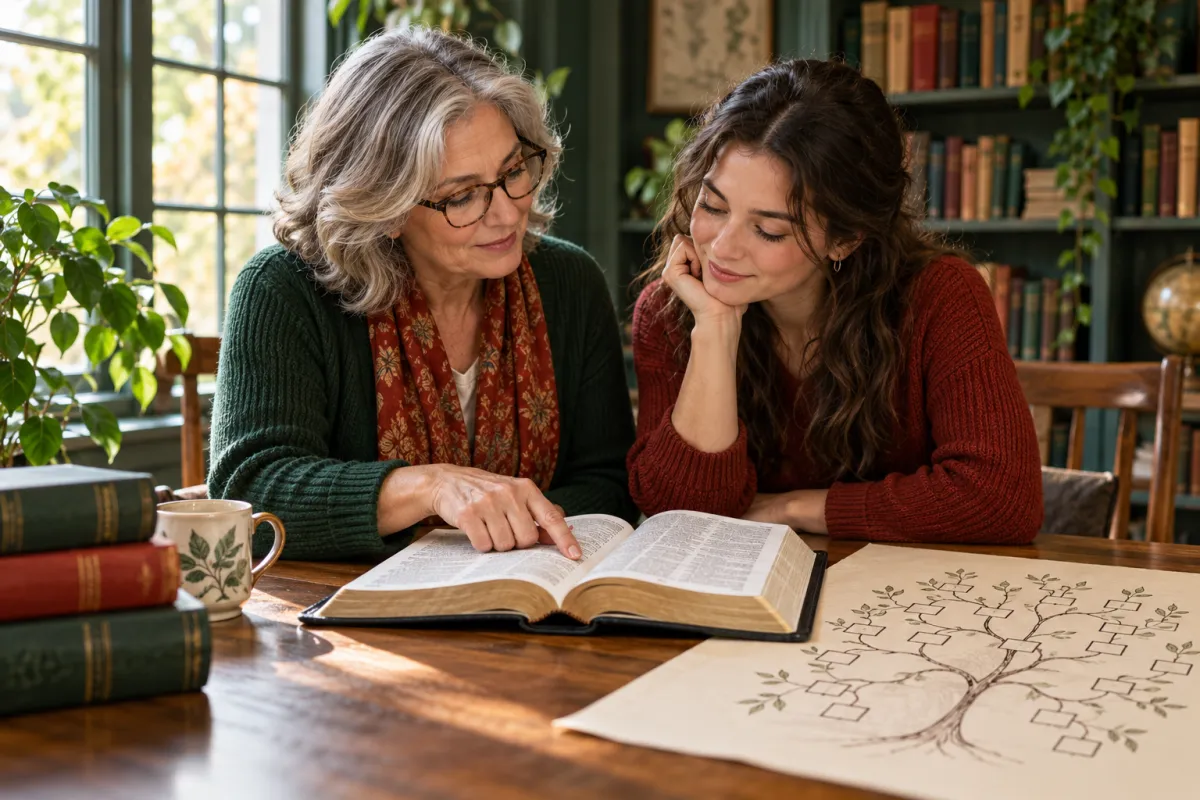
A page of unfamiliar names can feel like a wall in a whole-Bible plan. Skipping every list, however, can hide why a book moves from one generation to another. Genesis 5 joins Adam’s descendants to the next part of the story; Genesis 11:10–32 narrows that story toward Abram. You do not need to pronounce every name perfectly to see that movement.
Three questions for any list of names
- Where am I in the book? In Genesis, a genealogy often bridges episodes. At the opening of Chronicles, lists orient a people looking back over their history.
- What repeats, and what interrupts the pattern? The repeated generations in Genesis 5 frame the narrative; a changed phrase may deserve a closer look.
- Where does the list lead? Matthew 1:1–17 introduces Jesus by locating him within Israel’s story; the names serve the Gospel’s opening claim.
Worked example: trace the shape of Matthew 1
Open Matthew 1:1–17 and read the opening and verse 17 before trying to remember the names between them. The opening names Abraham, David, and Jesus; verse 17 groups the list around Abraham, David, the exile, and Christ. Now return to the middle: notice the repeated family-line formula and the places where the writer names women, including Ruth. You can describe the list’s movement without claiming to know every person’s private story.
| On this first pass | Write down |
|---|---|
| Opening and ending | The named starting points and the three groups in verse 17. |
| Repeated pattern | Which names or events interrupt the formula? |
| Question to leave open | Why does Matthew arrange this history this way? |
Are genealogies complete modern family trees?
Do not assume every biblical list aims to record every intervening generation in a modern archival format. Read the list’s own wording and purpose. The Yale Bible Study guide to Matthew’s ancestry is a scholarly companion for examining the literary arrangement; it is not a substitute for reading Matthew 1 yourself. If Matthew and Luke present genealogies differently, first identify each author’s setting and claims rather than trying to solve every historical question with a single diagram. It is fine to hold some questions open.
| Passage | Helpful first observation |
|---|---|
| Genesis 5 | How the story moves from Adam toward Noah |
| 1 Chronicles 1–9 | How names and tribal lines orient a community |
| Matthew 1:1–17 | How the Gospel begins with Israel’s history and Jesus |
What to do on a reading-plan day
Read the assigned list once without pausing at every name. Note one line of continuity and one question, then continue to the next chapter. If your plan includes many chapters, this is still reading the text; it is not the same as ignoring it. The Bible Reading Plan for Women keeps a route through all 66 books. The Leviticus guide uses a similar map-first approach for another type of passage people often avoid.