The Problem: You Have a Bible, But No Map
You open Philippians. You know it is a letter from Paul. You know it contains the famous line about rejoicing always and the one about doing all things through Christ. But you do not know who the Philippians were, why Paul was writing to them, what the letter is actually arguing, or how its four chapters fit together. You read a passage and it is moving — but it floats free of context, disconnected from the larger story it was written to serve.
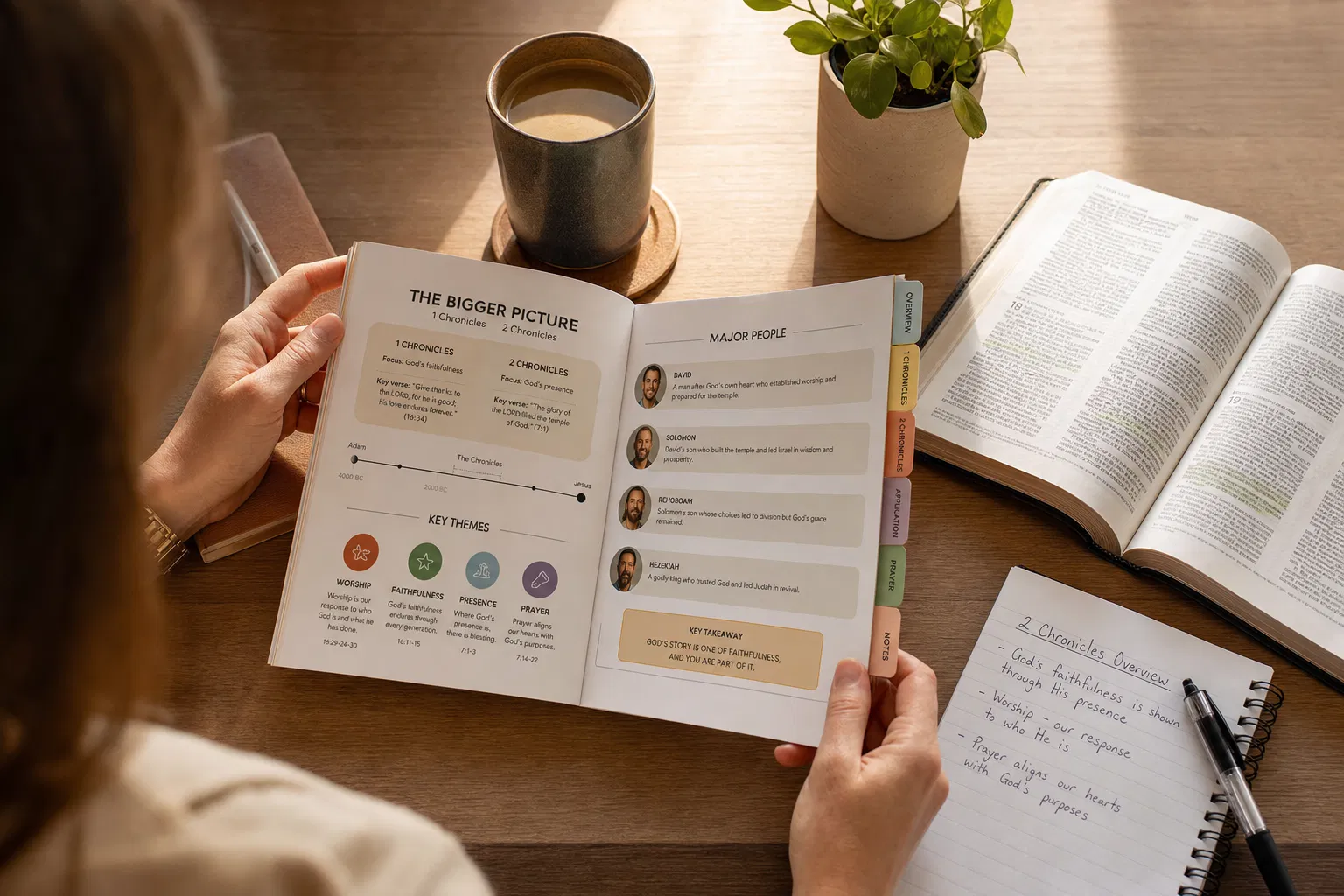
This is the experience of most Bible readers, most of the time. It is not a failure of devotion. It is a failure of orientation. Before you can read a biblical book well, you need a map — a sense of the terrain, the major landmarks, the direction of travel. That is precisely what a Study Pack[1] provides.
This article walks through the five sections of a BibleLum Study Pack in sequence, using Philippians as the working example, and shows exactly how each section builds on the previous one to give you confident comprehension of a biblical book — even if you have never studied it before, and even if you only have 45 to 60 minutes.
The Five-Section Reading Sequence
A BibleLum Study Pack is not a collection of independent resources to be consulted in any order. It is a structured sequence. Each section answers a different question, and the questions are ordered from the most foundational to the most personal. Reading them in order is not a rule — it is a strategy.
Section 1: Visual Overview — Answer the Question "What Is This Book About?"
The Visual Overview is a single-page infographic that maps the entire book's structure at a glance. For Philippians, it shows four chapters organized around four movements: joy in chains (chapter 1), the mind of Christ (chapter 2), knowing Christ above all (chapter 3), and the peace that passes understanding (chapter 4). Each chapter is color-coded and labeled with its central theme.
Spend three to five minutes here. You are not trying to memorize the structure — you are trying to build a mental scaffold. When you later encounter Philippians 2:5–11 (the Christ Hymn), you will already know it belongs to the chapter about the mind of Christ, which is the theological summit of the letter. Context is not a luxury; it is the difference between reading a passage and understanding it.
The Visual Overview answers the question every first-time reader needs answered before they can read a single verse with comprehension: What kind of book is this, and where am I in it?
Section 2: Chapter-by-Chapter Overview — Answer the Question "What Happens, and in What Order?"
The Chapter Overview walks through the book passage by passage, providing a brief summary of each section's content and its key verses. For Philippians, this means learning that chapter 1 opens with Paul's thanksgiving for the Philippians' partnership in the gospel, moves to his famous "to live is Christ, to die is gain" reflection on his imprisonment, and closes with a call to live worthy of the gospel regardless of suffering.
This section is the most efficient investment of reading time in the entire Study Pack. In ten to fifteen minutes, you gain a working knowledge of the book's narrative flow that would otherwise require reading the entire text twice. You learn, for example, that Philippians 4:13 — "I can do all this through him who gives me strength" — is not a general promise of divine empowerment for any goal, but the conclusion of Paul's reflection on contentment[2] in the face of material deprivation. The context transforms the meaning.
Section 3: Key Themes — Answer the Question "What Is This Book Arguing?"
Every biblical book makes a theological argument. The Key Themes section identifies the four major arguments a book is making and traces each one through the text with specific verse references and historical context. For Philippians, the four themes are: Joy as a Settled Orientation, the Kenosis[3] (Christ's self-emptying), Contentment as a Learned Art, and Heavenly Citizenship.
Consider the theme of Heavenly Citizenship. Philippi was a Roman colony — its citizens were immensely proud of their Roman citizenship, which brought legal privileges and a distinct social identity. Paul uses this civic pride as a theological lever: "But our citizenship is in heaven" (Philippians 3:20). The Study Pack explains that this is not escapism but a reorientation of ultimate loyalty. Believers live as resident aliens in this world — fully engaged, but not ultimately defined by earthly categories of status, nationality, or achievement.
Without this historical context, the verse is a pleasant sentiment. With it, the verse is a subversive declaration that would have landed with force on its original readers. The Key Themes section is where Study Pack reading moves from information to interpretation.
Section 4: Symbolism & Imagery — Answer the Question "What Does This Image Mean?"
Biblical writers communicate through images as much as through propositions. The Symbolism section unpacks the major images and metaphors in a book, tracing their historical background and theological significance. For Philippians, the central image is Chains.
Paul wrote Philippians from prison. Roman prisoners awaiting trial were often chained to a guard — a practice called custodia militaris. Paul was likely chained to a rotating series of Praetorian guards, the elite imperial soldiers stationed at the emperor's palace. This meant the gospel was literally being heard by the most powerful military force in the world, one guard at a time. When Paul writes that his chains have "served to advance the gospel" (1:12), he is not being optimistic — he is reporting a strategic reality.
The Symbolism section also traces the image of the Athletic Race in Philippians 3:12–14 — "forgetting what is behind and straining toward what is ahead, I press on toward the goal." The Greek athletic games were a central feature of Philippian civic life. Paul's readers would have immediately pictured a runner in the stadium, not a vague spiritual striving. The image is concrete, competitive, and demanding — and it reframes the Christian life as one of active, disciplined pursuit rather than passive waiting.
Section 5: Practical Application — Answer the Question "What Does This Mean for My Life?"
The final section of the Study Pack bridges the ancient text to contemporary life. For Philippians, the application steps are organized around the book's four major themes. Under Joy, the application asks: Paul's joy in chains is not denial of difficulty but evidence that something deeper than circumstances is sustaining him. What would it look like to cultivate this kind of joy in your current season?
Under Contentment, the application notes that Paul says he has "learned" contentment — which means it did not come naturally and it took time. The application question is not abstract: What circumstances in your life are currently the most difficult to accept? What would it look like to begin learning contentment in that specific area? This is the movement from exegesis[4] to formation — from understanding what the text meant to allowing it to change how you live.
A Worked Example: Reading Philippians in 55 Minutes
The following sequence shows how a reader with 55 minutes can move through the Philippians Study Pack from zero context to confident comprehension, with approximate time allocations for each section.
- Minutes 0–5: Visual Overview — scan the four-chapter structure, note the color-coded themes, identify the theological summit (the Christ Hymn in chapter 2).
- Minutes 5–20: Chapter Overview — read the passage summaries for all four chapters, paying attention to the flow of argument and the key verses in each section.
- Minutes 20–35: Key Themes — read two of the four themes in depth (Joy and Kenosis are the most foundational; Contentment and Heavenly Citizenship can be read later).
- Minutes 35–45: Symbolism — read the entry on Chains and the Athletic Race; these two images unlock the emotional register of the letter.
- Minutes 45–55: Practical Application — read the application questions for Joy and Contentment; choose one to sit with for the rest of the day.
At the end of 55 minutes, you will not have read every word of Philippians — but you will understand what it is arguing, why it was written, what its central images mean, and how it applies to your life. You will be able to read any passage in the letter and place it in its context. You will have the map.
Why This Sequence Works: The Principle of Contextual Loading
The five-section sequence is designed around a principle that cognitive scientists call contextual loading — the process of building background knowledge before engaging with primary material. Research in reading comprehension consistently shows that readers who possess prior knowledge of a text's domain understand and retain significantly more than readers who approach the same text cold, even when the cold readers spend more total time reading.
This is why the Study Pack begins with the Visual Overview rather than the text itself. The overview does not replace reading the Bible — it prepares you to read it. When you subsequently open Philippians 2:5 and read "Have this mind among yourselves, which is yours in Christ Jesus," you already know that this verse introduces the Christ Hymn, that the Hymn is the theological summit of the letter, and that Paul is using it as the basis for his appeal to humility and unity. You are not encountering the verse for the first time — you are recognizing it.
The goal of the Study Pack is not to replace the Bible. It is to make every minute you spend reading the Bible more productive by ensuring you arrive at the text with the context you need to understand it.
Applying the Same Method to Other Books
The five-section sequence works for any biblical book, though the time investment scales with the book's length and complexity. A short letter like Philippians (4 chapters) can be covered in 55 minutes. A longer narrative like Genesis (50 chapters) benefits from a longer initial investment — perhaps 90 minutes for the first pass through the Study Pack — before beginning to read the text itself.
For prophetic books like Isaiah or Jeremiah, the Symbolism section becomes especially important, as prophetic literature is saturated with images whose meaning is not self-evident to modern readers. For wisdom literature like Proverbs or Ecclesiastes, the Key Themes section is the most critical entry point, as these books make their arguments through accumulation rather than narrative. The sequence adapts to the genre.
The consistent principle across all books is this: begin with the map, then read the territory. The Study Pack is the map. The Bible is the territory. Used together, they make every reading session more productive — whether you have 55 minutes or five.
A Second Worked Example: Reading Genesis in 90 Minutes
Genesis is the longest and most structurally complex of the books currently available in BibleLum Study Packs. It spans 50 chapters, four distinct narrative arcs (Creation, the Fall, the Patriarchs, and the Joseph story), and roughly 2,000 years of history. A reader approaching it cold faces a genuine orientation problem: the book contains everything from cosmic origins to family drama to political intrigue, and it is not always obvious how the pieces relate to one another. The 90-minute Study Pack sequence solves this problem before you open the text.
- Minutes 0–8: Visual Overview — identify the four narrative arcs and their approximate chapter ranges: Primeval History (1–11), Abraham (12–25), Isaac and Jacob (25–36), and Joseph (37–50). Note that the book divides almost exactly in half between universal history and family history.
- Minutes 8–30: Chapter Overview — read the passage summaries for all four arcs. Pay particular attention to Genesis 12:1–3 (the Abrahamic call), Genesis 22 (the binding of Isaac), Genesis 32 (Jacob's wrestling match), and Genesis 50:20 (Joseph's declaration of providence). These four passages are the theological load-bearing walls of the entire book.
- Minutes 30–50: Key Themes — read all four themes: the Goodness of Creation and the Image of God (imago Dei[5]); the Reality and Reach of Sin; God's Covenant Faithfulness; and Providence — God's Hidden Hand. The fourth theme (Providence) is the interpretive key to the Joseph narrative and the most immediately applicable to contemporary readers.
- Minutes 50–68: Symbolism — read all five symbol entries: the Rainbow (God's covenant restraint), the Tree of Life (the bookend connecting Eden to the New Jerusalem), the Ram at Moriah (the most powerful type of Christ in Genesis), Joseph's Coat (the beloved son rejected and glorified), and Pharaoh's Seven Years (God's sovereignty over history and empires). The Ram at Moriah entry alone repays careful reading — it places Genesis 22 in its full canonical context.
- Minutes 68–80: Practical Application — read the application questions for Covenant Faithfulness and Providence. The Providence application asks: Joseph's story invites us to trust that God is working in our darkest chapters — not just despite them, but through them — toward purposes we cannot yet see. What chapter of your own story currently feels most opaque? What would it look like to hold that chapter with Joseph's trust?
- Minutes 80–90: Integration — return to the Visual Overview and read it again. The second reading is qualitatively different from the first: you now know what each section contains, what the major themes argue, and what the key symbols mean. The map has become familiar. You are ready to read the territory.
After 90 minutes with the Genesis Study Pack, a reader will understand why the book begins with "In the beginning, God" rather than "In the beginning, humans" — a deliberate theological statement that everything which follows is God's story, not ours. They will know that Genesis 3:15 (the proto-evangelium[6], God's first promise of a redeemer) is the seed from which the entire biblical narrative grows. And they will be able to read the Joseph story not as an isolated tale of resilience but as the climactic illustration of a theme that runs through all 50 chapters: God's faithfulness is not defeated by human failure. It works through it.