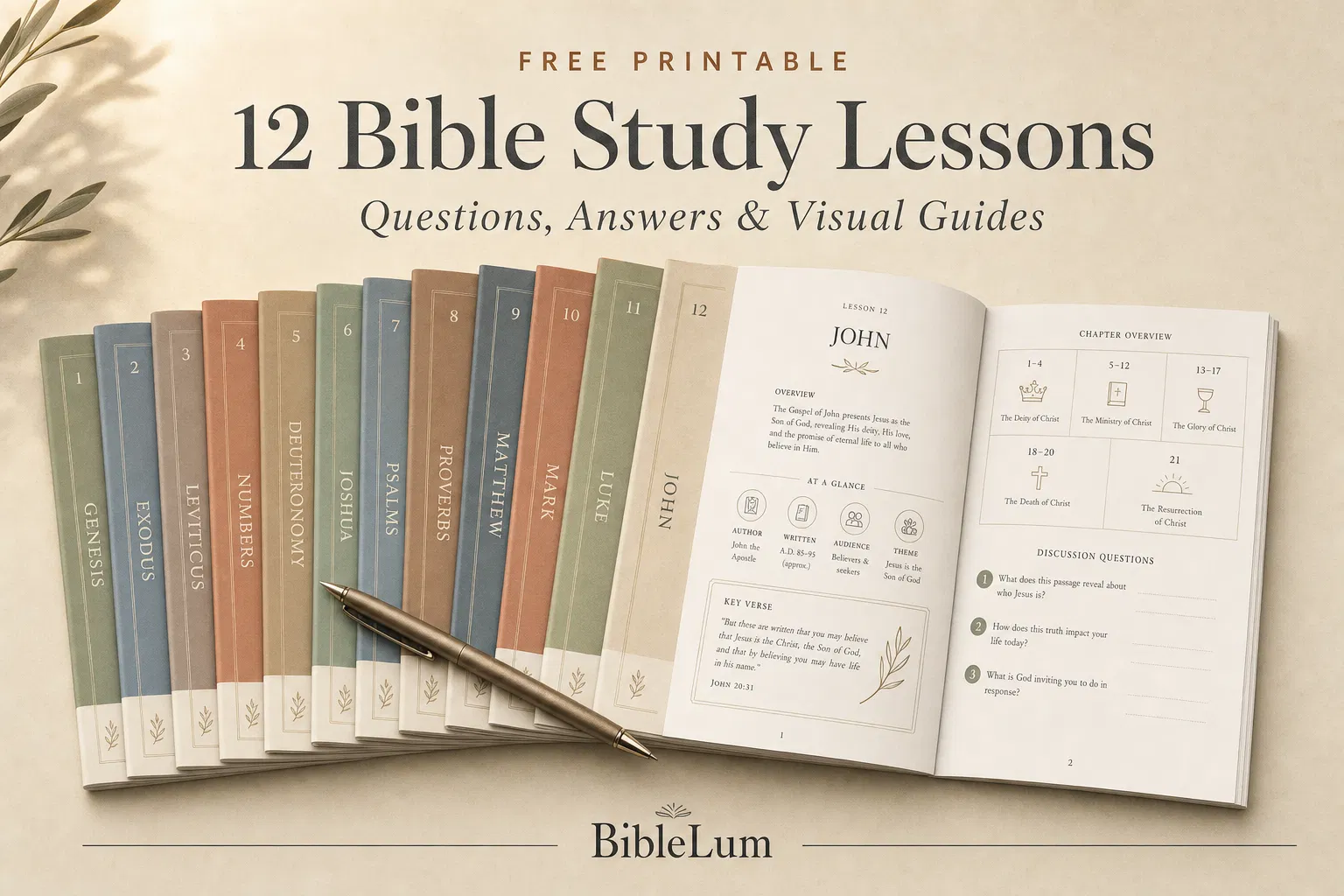
Finding Bible study material that is simultaneously theologically substantive, visually engaging, and ready to print without a design degree is harder than it should be. Most free resources online fall into one of two failure modes: they are either thin devotional content dressed up in attractive typography, or they are dense academic outlines that require significant preparation time before they can be used in a group setting. The twelve study guides collected here are designed to solve both problems at once.
Each lesson in this collection is a complete, self-contained study pack — not a worksheet, not a reading plan, but a structured guide that takes a group from the opening paragraph of a biblical book to its closing verse, with visual scaffolding, theological depth, and ready-to-use discussion questions at every stage. Every pack offers two free A4 downloads: an 11-page content Study Guide and a separate one-page Journal image PDF. Together they are designed to work equally well for individual devotional use and facilitated small group discussion.
What Makes a Bible Study Lesson Worth Printing?
The proliferation of free Bible study content online has not solved the quality problem — it has intensified it. A search for "free printable Bible study lessons" returns thousands of results, but the vast majority share the same structural weakness: they are organized around isolated verses rather than the literary and theological arc of a complete book. A lesson built on Jeremiah 29:11 in isolation, for example, tells a group almost nothing about the covenant theology[1] that gives the verse its meaning, the historical context of the Babylonian exile that makes it urgent, or the canonical trajectory that connects it to the New Testament promises it anticipates.
A study lesson worth printing does four things well. It provides enough historical and literary context that participants can read the passage with understanding rather than projection. It identifies the theological themes that give the passage its weight within the larger biblical narrative. It supplies discussion questions that move from observation to interpretation to application — the three movements of inductive Bible study[2] — without collapsing all three into a single vague prompt. And it includes visual aids that help participants who are not yet fluent in biblical geography, chronology, or genre to orient themselves before the discussion begins.
The best printable Bible study lesson is one that a group leader can hand out five minutes before the session begins and trust that every participant — regardless of background — will be able to engage meaningfully with the text.
What Each Study Pack Contains: 9 Core Sections
Every guide in this collection follows the same nine-section structure, ensuring that groups who work through multiple books encounter a consistent learning framework while engaging with entirely different biblical content. The table below summarizes what each section provides and why it matters for group discussion.
- Visual Overview Infographic — A full-page poster mapping the book's chapter structure, key events, and theological arc. Designed to be displayed or distributed at the start of a study series.
- Chapter-by-Chapter Overview — The entire book divided into 3–4 thematic sections, with each passage summarized in one sentence and its canonical significance noted.
- Key Themes Deep Dive (4 themes) — Each theme includes a biblical anchor text, a historical background note, and a theological interpretation connecting the theme to the broader canon.
- Symbolism & Imagery Guide (4 symbols) — Each symbol is analyzed from two angles: its historical meaning in its original cultural context, and its theological meaning within the redemptive narrative.
- Discussion Guide (8 questions) — Eight questions organized across three levels: observation (what does the text say?), interpretation (what does it mean?), and application (how does it change how we live?).
- Key Characters — Brief profiles of 3–4 central figures, including their role in the narrative, their theological significance, and the questions their lives raise for contemporary readers.
- Practical Application — Four concrete, actionable responses to the book's central message, written for individuals and small groups.
- Personal Journal Template — A structured reflection page with space for passage meditation, prayer notes, and a 30-day reading plan.
- Visual Closing Page — A closing verse, thematic summary, and BibleLum branding for groups who want to continue their study digitally.
Old Testament: 6 Books
The Old Testament guides in this collection span the Torah[3], the historical books, and the wisdom literature — covering the foundational narratives, the covenant history, and the poetic theology that the New Testament writers assume their readers know.
Genesis — Creation, Fall, and the Covenant Promise
A 13-page visual journey through the primeval history (chapters 1–11) and the patriarchal narratives (chapters 12–50). The Genesis Study Pack traces the theological arc from creation to covenant, showing how the promises made to Abraham, Isaac, and Jacob establish the framework within which the entire biblical story unfolds. The discussion questions are particularly strong on the themes of image-bearing, human vocation, and the nature of faith as trust in a promise not yet fulfilled.
Exodus — Liberation, Law, and the Dwelling of God
The Exodus Study Pack covers the two great movements of the book: the liberation from Egypt (chapters 1–18) and the giving of the law and the construction of the tabernacle (chapters 19–40). The visual infographic maps the ten plagues, the Sinai covenant, and the tabernacle design in a single poster. Discussion questions explore the relationship between redemption and law — why the Ten Commandments follow the exodus rather than precede it — and the theological significance of God choosing to dwell among His people.
Joshua — Conquest, Covenant Renewal, and the Promised Land
The Joshua Study Pack addresses one of the most theologically demanding books in the Old Testament: the conquest narratives. The guide provides the historical and canonical context necessary for groups to engage honestly with the violence of the text without either dismissing it or defending it uncritically. The discussion questions on Joshua 24 — the covenant renewal at Shechem — are among the strongest in the collection for generating genuine group reflection on the nature of commitment and the cost of faithfulness.
Psalms — Israel's Prayer Book and the Vocabulary of Worship
Rather than attempting to cover all 150 psalms, the Psalms Study Pack organizes the collection by genre — lament, praise, royal, wisdom, and pilgrimage psalms — and provides representative examples of each. The visual infographic maps the five books of the Psalter[4] and their editorial logic. Discussion questions focus on the practice of lament: how the psalms give language to suffering that contemporary Christian worship often suppresses, and what it means to bring honest complaint before God.
Proverbs — Wisdom, Work, and the Fear of the Lord
The Proverbs Study Pack addresses the genre of wisdom literature and its relationship to the rest of the canon. The guide explains why Proverbs is not a collection of guarantees but a description of how the world generally works under God's providential order — a distinction that matters enormously for groups who have encountered the book's promises in contexts of suffering or injustice. Discussion questions on Proverbs 31 are designed to move beyond the surface-level application and engage the poem's literary structure and theological argument.
Revelation — The Unveiling of Christ and the New Creation
The Revelation Study Pack is designed for groups who want to engage the book seriously without getting lost in speculative chronology. The visual infographic maps the seven churches, the seven seals, and the structural logic of the book as a whole. The guide explains the genre of apocalyptic literature[5] and why reading Revelation as a newspaper prediction misses its pastoral purpose. Discussion questions focus on the book's central claim: that the Lamb who was slain is the Lord of history, and that this claim has concrete implications for how communities of faith live under pressure.
New Testament: 6 Books
The New Testament guides cover the four major literary categories of the New Testament: Gospel, Acts, Epistle, and Apocalypse. Together they trace the story of Jesus, the birth of the church, and the theological reflection that the apostolic community produced as it worked out the implications of the resurrection.
Matthew — The Promised Messiah and the Kingdom of Heaven
The Matthew Study Pack traces the Gospel's sustained argument that Jesus is the fulfillment of Israel's story — the new Moses, the true Israel, the Son of David who establishes the Kingdom of Heaven. The visual infographic maps the five great discourses of Matthew (including the Sermon on the Mount) and their relationship to the five books of the Torah. Discussion questions on the Beatitudes and the Great Commission are designed for groups who want to move beyond familiarity with the text to genuine engagement with its demands.
John — The Word Made Flesh and the Signs of Eternal Life
The John Study Pack focuses on the Gospel's distinctive theological architecture: the seven signs, the seven I AM statements, and the prologue's identification of Jesus with the divine Word (Logos[6]). The guide is particularly useful for groups who have read the Synoptic Gospels and want to understand what John adds — and why. Discussion questions on John 17 (the High Priestly Prayer) are among the most theologically rich in the collection.
Acts — Pentecost, the Early Church, and the Gospel to the Ends of the Earth
The Acts Study Pack traces the geographic and theological expansion of the early church from Jerusalem to Rome. The visual infographic maps Paul's three missionary journeys and the key cities of the early Christian movement. Discussion questions focus on the role of the Holy Spirit in Acts — not as a source of individual spiritual experience but as the power that drives the church's mission — and on the relationship between Jewish and Gentile believers in the emerging Christian community.
Romans — Justification by Faith and the Righteousness of God
The Romans Study Pack is designed for groups who want to engage Paul's most systematic theological argument without requiring a seminary background. The guide divides the letter into its four major movements: the universal problem of sin (1–3), the solution of justification by faith (3–5), the life of the Spirit (6–8), and the mystery of Israel's place in God's plan (9–11). Discussion questions on Romans 8 are consistently the most generative in the collection for groups dealing with suffering, hope, and the nature of Christian identity.
Philippians — Joy, Unity, and the Mind of Christ
The Philippians Study Pack is the shortest guide in the collection — matching the brevity of the letter itself — but it is among the most practically useful for groups dealing with conflict, anxiety, or discouragement. The guide centers on the Christ-hymn of Philippians 2:5–11 as the theological foundation for Paul's ethical instructions. Discussion questions on contentment (4:11–13) are designed to challenge the prosperity-gospel reading of the passage and recover its original meaning in the context of imprisonment and uncertainty.
Ephesians — Identity in Christ, the Church, and the Armor of God
The Ephesians Study Pack traces the letter's movement from theological declaration (chapters 1–3) to ethical instruction (chapters 4–6), showing how Paul's vision of the church as the body of Christ grounds every practical command that follows. The visual infographic maps the six pieces of the armor of God and their Old Testament background in Isaiah. Discussion questions on Ephesians 2:8–10 — grace, faith, and works — are designed to help groups hold together what is often separated in popular Christian teaching.
How to Use These Guides in a Small Group Setting
Each study pack is designed to support a group study of 4–8 weeks, depending on how much time the group devotes to each section. A typical session structure might allocate 10 minutes to reviewing the visual infographic together, 20 minutes to reading and discussing the chapter overview, and 30 minutes to working through 3–4 of the discussion questions. The journal template is designed for individual use between sessions.
For groups who want to extend their study beyond the printed guide, BibleLum's interactive Study Packs provide the same nine-section framework in a digital format, with AI-assisted reflection, daily reading plans, and progress tracking. The printed guide and the digital experience are designed to complement each other: the print version provides a tangible, shareable artifact for group discussion, while the digital version extends the depth and flexibility of individual study. Both are free to access.
The most effective small group practice combines the accountability of a shared printed guide with the depth of a digital library. These twelve study packs are designed to serve as the foundation for both.