
Editorial Review Scores
These ratings are BibleLum editorial scores, not user aggregate ratings. They compare each free resource by theological usefulness, learning structure, depth, accessibility, and how well it serves independent Bible study.
| Resource | Editorial Score | Best For | Why It Scores Well |
|---|---|---|---|
| Blue Letter Bible | 4.8 / 5 | Original-language study | Strong's Concordance, interlinear texts, morphology, and classic commentaries without a paid subscription. |
| The Bible Project | 4.7 / 5 | Visual biblical theology | Animated book and theme overviews, study guides, and podcasts that help readers see Scripture as one story. |
| BibleLum | 4.6 / 5 | Guided beginner study | Short structured lessons, book-level context, reflection, and a sustainable path through all 66 books. |
| Bible Gateway | 4.4 / 5 | Translation reference | Fast passage lookup, many translations, language breadth, and simple comparison for everyday study. |
| OpenBible.info | 4.3 / 5 | Cross-reference exploration | Data-driven cross-reference mapping for tracing connections and themes across the canon. |
The proliferation of free online Bible study resources has democratized access to theological education in ways that would have been unimaginable a generation ago. A student in rural Kenya, a commuter in Seoul, and a retiree in rural Nebraska can all access the same commentaries, study guides, and video lectures that were previously available only to seminary students. This democratization is genuinely significant — but it also creates a discernment challenge: not all free resources are equally reliable, and the absence of institutional accountability means that theological errors can circulate widely without correction.
Criteria for Evaluating Free Resources
Evaluating free Bible study resources requires the same criteria as evaluating paid resources, with the additional question of sustainability: how is the resource funded, and does the funding model create incentives that might compromise theological integrity? Resources funded by advertising may prioritize engagement metrics over accuracy; resources funded by a specific denomination may reflect that tradition's theological commitments without acknowledging them.
- Theological accuracy: Does the resource accurately represent the biblical text and the mainstream of Christian theological tradition?
- Pedagogical structure: Is the content organized in a way that supports genuine learning rather than passive consumption?
- Original-language engagement: Does the resource help users engage with the Hebrew and Greek texts, even at a basic level?
- Attribution and accountability: Is the resource produced by identifiable authors with verifiable credentials?
- Sustainability: Is the resource likely to remain available and updated over time?
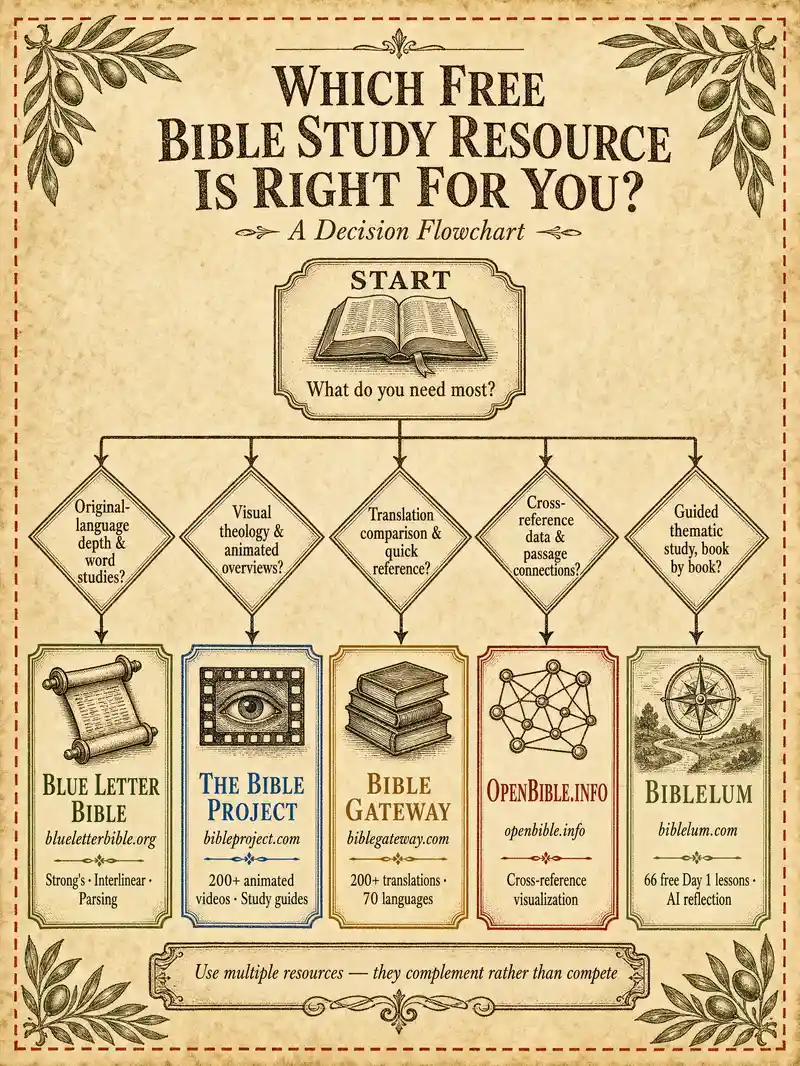
Best Free Bible Study Resource by Need
The phrase "best free Bible study" can mean very different things. A pastor preparing a word study, a beginner trying to understand Genesis, and a small group leader looking for a visual overview are not asking for the same tool. The strongest free resource is the one that matches the kind of study you are actually doing.
| If You Need | Start With | Why |
|---|---|---|
| Original-language depth | Blue Letter Bible | It gives free access to Strong's numbers, interlinear tools, Greek and Hebrew parsing, and classic commentaries. |
| A visual overview of a book or theme | The Bible Project | Its animated videos and study notes make big biblical themes easier to see before you move into close reading. |
| Fast passage lookup and translation comparison | Bible Gateway | It is still one of the quickest ways to compare multiple English translations and search specific passages. |
| Cross-references and thematic connections | OpenBible.info | Its data-driven cross-reference tools help you trace how passages echo and interpret one another. |
| A guided path for beginners | BibleLum | It gives short, structured lessons with context, reflection, and a clear route through the whole Bible. |
For most readers, the best answer is not one platform but a small stack: use The Bible Project to understand the big picture, Bible Gateway to compare translations, Blue Letter Bible to investigate words or commentaries, OpenBible.info to trace cross-references, and BibleLum to keep the learning rhythm guided and sustainable.
Head-to-Head: 5 Free Resources Across 5 Dimensions
A by-need recommendation answers "which one to pick first." A head-to-head comparison answers a different question: where each platform has real depth and where it stops. The five dimensions below are the ones that most determine whether a resource is genuinely useful for sustained study, not whether it looks good in a screenshot.
| Dimension | Blue Letter Bible | The Bible Project | Bible Gateway | OpenBible.info | BibleLum |
|---|---|---|---|---|---|
| Original-language access | Strong's, interlinear, parsing — full | None — English only | Greek/Hebrew word display via tagged translations | None — focuses on cross-reference data | Term glosses inline; no parsing tools |
| Translation breadth | Limited (mostly KJV/public-domain) | Quotes ESV/NIV in materials, no comparison view | 200+ translations, 70+ languages | Limited (uses ESV/KJV for citations) | User-selectable translation; no built-in comparison view |
| Cross-reference depth | Treasury of Scripture Knowledge built in | Thematic connections in study guides only | Per-verse cross-refs (limited density) | Largest free dataset (340,000+ links, ranked) | Cross-refs surfaced inside guided lessons |
| Pedagogical structure | Reference tool, not curriculum | Strong — videos + reading plans + guides | Reference tool only | Reference/visualization tool only | Curriculum — 66-book guided path |
| Mobile experience | Functional but dense interface | Polished mobile + dedicated app | Polished mobile + dedicated app | Functional, not optimized | Mobile-first design |
Three patterns worth naming. First, no single free platform is strong on all five dimensions — every one of them has at least one weak axis. Second, the strongest dimensions are reliably the ones that platform was built around: Blue Letter Bible was built for word study, The Bible Project for visual theology, Bible Gateway for translation lookup. Third, the dimensions where free resources collectively struggle most are pedagogical structure and cross-reference depth — which is why combining them matters.
Blue Letter Bible: The Free Standard
Blue Letter Bible remains the most comprehensive free Bible study platform available. Its core features — Strong's Concordance[1], interlinear[2] texts, morphological parsing, and a curated selection of commentaries — are genuinely useful for serious study. The platform is funded by donations and has maintained consistent quality since its 1996 launch.
The primary limitation of BLB is its interface: the site has been incrementally updated but retains a utilitarian aesthetic that can be disorienting for new users. The mobile app is functional but not optimized for extended study sessions. For users who can navigate the interface, BLB offers more depth than most paid apps at the free tier.
The Bible Project: Visual Theology at No Cost
The Bible Project has produced over 200 animated videos on biblical themes, books, and theological concepts, all available free on YouTube and their website. The quality of the content is consistently high: the videos are theologically sophisticated, visually compelling, and pedagogically[3] well-structured. The accompanying study guides and podcast episodes add depth for users who want to go beyond the videos.
The Bible Project's thematic approach — tracing concepts like "the image of God," "covenant," and "the temple" across the entire canon — is particularly valuable for readers who want to understand the Bible as a unified theological argument. The content is broadly evangelical and ecumenical, avoiding denominational distinctives in favor of widely shared theological commitments.
The Bible Project has done more to raise the theological literacy of lay Bible readers than any other free resource in the past decade. Its combination of visual accessibility and genuine scholarly depth is genuinely unusual.
Bible Gateway: The Reference Standard
Bible Gateway is the most widely used online Bible platform, with access to over 200 translations in 70 languages. Its primary value is as a reference tool: users can quickly compare translations, search for specific passages, and access a curated selection of devotional and study content. The free tier is genuinely useful; the premium subscription adds audio Bibles, ad-free access, and additional study tools.
Bible Gateway's weakness is depth: it is an excellent reference tool but not a study environment. Users who want to engage seriously with the text will quickly exhaust its analytical resources and need to supplement with BLB, Logos, or a dedicated commentary.
OpenBible.info: Data-Driven Cross-References
OpenBible.info is a lesser-known resource that offers one of the most comprehensive cross-reference databases available online. The site's cross-reference visualization tool maps the connections between passages across the entire Bible, allowing users to see at a glance which passages are most frequently cross-referenced and how different parts of the canon relate to each other. This is particularly valuable for thematic study and for understanding how New Testament authors use Old Testament texts.
BibleLum: Free Entry to Thematic Study
BibleLum's free tier offers Day 1 of every Study Pack — 66 free lessons, one for each book of the Bible. This is a genuinely generous free offering: each Day 1 lesson provides a complete introduction to the book's theological contribution, key themes, and narrative structure. For users who want to survey the entire Bible before committing to deeper study of specific books, this free tier provides more canonical breadth than any other free resource.
The AI-assisted reflection feature is available in the free tier, allowing users to ask questions about the Day 1 content and receive contextually grounded responses. This is particularly valuable for independent learners who lack access to a teacher or study group.
Which Free Tool Should You Open First?
If you are a beginner, start with structure before depth. A common mistake is opening five tabs at once — one for Greek, one for commentary, one for cross-references, one for videos, and one for translations — before you have even understood the passage in front of you. Better Bible study usually begins with a simple sequence.
- Read the passage in a clear translation first, using Bible Gateway if you want to compare wording.
- Watch or read a short overview from The Bible Project when you need book-level context.
- Use Blue Letter Bible only after you have a real question about a word, phrase, or commentary issue.
- Use OpenBible.info when you want to see how the passage connects to other parts of Scripture.
- Use BibleLum when you want the whole process organized into a guided lesson with reflection and continuity.
This order keeps free tools from becoming a distraction. Bible study is not improved by opening more resources; it is improved by asking better questions in the right order. The best free platforms should help you move from text, to context, to understanding, to response.
How to Evaluate Any Free Bible Study Resource
New free resources appear constantly — YouTube channels, blogs, apps, podcasts. Most are unevaluated, and many that look professional are theologically thin or eccentric. A short evaluation framework keeps you from defaulting to whichever resource happens to be loudest in algorithm-driven feeds.
- Who funds it? Donation-funded (Blue Letter Bible, The Bible Project) and confessional/denominational sites tend toward stability. Single-creator monetized channels (ad-driven YouTube, Patreon-supported solo voices) can be excellent but are more vulnerable to drift. Look for an "About" page that names the leadership and theological commitments.
- Is the content tested against the broader tradition? A resource that engages historic Christian voices (Augustine, Calvin, Luther, modern confessions) signals intellectual humility. A resource that frames every doctrine as a fresh discovery, with no acknowledgment of how the church has historically read the same passages, is a warning sign.
- Does it cite primary sources? Resources that quote Greek and Hebrew, reference manuscripts, and link to original-language tools (BLB, BibleHub, Logos) operate at a different depth than ones that quote only English translations. Both can be useful; the difference matters when you assess weight.
- Does it distinguish opinion from exegesis? Trustworthy free resources mark when they are interpreting (e.g., "I take this to mean…") versus when they are reporting consensus (e.g., "most scholars agree…"). Resources that present every reading as the obvious one are doing you a disservice.
- Does it acknowledge limits? A resource that says "this passage is genuinely contested" or "we don't fully know what this means" is more trustworthy than one with confident answers to every question.
No free resource will score perfectly on all five. The point is not to find a flawless source but to know what each one is trading off — depth for accessibility, confessional clarity for breadth, original-language rigor for visual appeal.
Common Pitfalls of Free Online Bible Study
Free does not mean unbiased, comprehensive, or careful. The most common pitfalls are not about content quality directly — they are about how readers use free resources without knowing what to watch for.
The algorithmic-curation pitfall. YouTube and TikTok recommendation systems optimize for engagement, not theological depth. The most viewed Bible content on these platforms is rarely the most carefully argued. Readers who learn from algorithm-curated feeds often inherit a skewed picture of mainstream Christian thought, dominated by whichever creators have figured out the engagement game.
The "free" framing pitfall. Some sites are free to access but are essentially marketing funnels for paid courses, pastor personalities, or denominational membership. The free content is curated to draw users into a paid relationship. This is not necessarily bad — many great teachers fund their work this way — but readers should know when the front-door content is shaped by a back-door business model.
The translation-blindness pitfall. Many free resources work exclusively in English without ever flagging how a translation choice shapes interpretation. A reader who only encounters Romans 3:25 in the NIV ("a sacrifice of atonement") and never sees the ESV's "propitiation" or NRSV's "place of atonement" may miss the entire scholarly debate behind the verse.
The depth-substitution pitfall. Watching a 15-minute Bible Project video on Romans is excellent — but it is not a substitute for reading Romans. Free video content is a doorway, not a destination. Readers who treat the doorway as the room itself stop short of the actual study.
Free vs Paid: Where the Real Trade-offs Are
The honest answer to "do I need to pay for Bible study tools?" is: it depends on what you are trying to do. Marketing copy on both sides distorts the picture. Free advocates undersell how much paid tools actually accelerate certain workflows; paid advocates oversell how often most readers actually need that acceleration. The real question is which trade-offs apply to your study, not which side wins in the abstract.
Where free is genuinely competitive
For everyday study — reading a passage, comparing two or three translations, looking up a Greek or Hebrew word, tracing a cross-reference, watching a book overview — the free stack covers more than 90% of what most lay readers need. Blue Letter Bible alone gives you Strong's numbers, parsing, and several public-domain commentaries. Bible Gateway gives you over 200 translations. The Bible Project gives you book-level theology. None of this requires payment.
Where paid tools meaningfully outperform
The gap opens at scale and depth. If you need to search across hundreds of academic commentaries simultaneously (Logos), if you need full Hebrew/Greek syntax search and morphology (Accordance), if you want a unified library where notes, original-language tools, and journals connect to the verse you are reading — these are real capabilities that free tools do not match. The same goes for sustained sermon preparation, graduate-level research, or original-language exegesis at speed.
Concrete benchmarks that matter
- Search latency on a 200,000-word commentary set: free tools usually cannot do this at all; paid platforms answer in seconds.
- Number of cross-references per verse: OpenBible.info's free dataset is around 340,000 links across the canon; Logos cross-reference layers can add another 200,000+ from licensed datasets.
- Available critical apparatus: free tools rarely include the NA28 / UBS5 apparatus or BHS textual notes; paid platforms ship them.
- Note-taking integration: free tools do not link your notes to a specific morphology tag or commentary section the way paid libraries do.
- Offline access: most free platforms degrade significantly offline; paid desktop libraries do not.
For an in-depth comparison of paid platforms, see our best Bible study software in 2026 guide. The short answer: most readers should start with the free stack and only consider paid when a specific workflow is genuinely blocked.
A 7-Day Bible Study Rhythm Using Only Free Tools
A reliable rhythm matters more than any single tool. The plan below rotates the five free resources across a week so you build context, depth, and reflection without overloading any one session. It assumes 20–30 minutes a day on a single book of the Bible — adjust the duration as needed.
- Day 1 — Big picture (The Bible Project): Watch the book overview video and read its accompanying summary. The goal is to understand the book's argument before reading a single verse.
- Day 2 — First reading (Bible Gateway): Read chapters 1–2 of the book in two translations side by side. Note any wording differences that change the meaning.
- Day 3 — Guided lesson (BibleLum): Open the Day 1 Study Pack lesson for the same book to absorb the structured context — historical setting, key themes, narrative arc.
- Day 4 — Word study (Blue Letter Bible): Pick one repeated or theologically loaded word from your reading and trace its Strong's entry, parsing, and usage elsewhere in the canon.
- Day 5 — Cross-reference exploration (OpenBible.info): Take one verse that puzzled you and follow its top three cross-references. See how the rest of Scripture amplifies, qualifies, or contrasts with it.
- Day 6 — Second reading + reflection (Bible Gateway + journaling): Re-read the same chapters from Day 2. Write down two questions and one observation that has shifted since Day 1.
- Day 7 — Synthesize (BibleLum): Use the AI-assisted reflection prompt to articulate, in your own words, what the book is teaching and how it connects to the rest of Scripture.
This rhythm is sustainable, costs nothing, and avoids the most common free-resource failure mode: opening five tabs at once and finishing none. Run it once on a short book like Ruth or Philemon before scaling to longer books — the muscle memory transfers, but the time investment will not.
Building a Free Study Stack
The most effective free Bible study practice combines resources with complementary strengths: The Bible Project for thematic comprehension and canonical overview, Blue Letter Bible for original-language access and word studies, Bible Gateway for translation comparison and quick reference, and BibleLum for structured thematic engagement with individual books. Together, these four free resources provide a study environment that rivals many paid platforms in depth and breadth. When you are ready to invest in paid resources, see our guide to the best Bible study books for beginners.
- The Bible Project (free): Thematic videos and study guides for canonical comprehension.
- Blue Letter Bible (free): Original-language access, Strong's Concordance, and classic commentaries.
- Bible Gateway (free): Translation comparison and passage search.
- BibleLum (free tier): Day 1 of all 66 Study Packs with AI-assisted reflection.
- OpenBible.info (free): Cross-reference visualization and data-driven biblical connections.
The democratization of Bible study resources is one of the most significant developments in theological education in the past two decades. The challenge is no longer access — it is discernment: knowing which resources to trust, how to use them effectively, and how to integrate them into a sustainable study practice. The resources listed above represent the best of what is freely available; the question is whether users will invest the time to use them well.