
The market for Bible study software has matured considerably since the early 2000s, when Logos and Accordance first introduced digital libraries to seminary students. Today, the landscape spans free web applications, subscription-based platforms, and AI-augmented tools — each with distinct pedagogical assumptions and technical architectures. This review evaluates the leading options across five criteria: original-language integration, cross-reference depth, mobile accessibility, annotation workflow, and cost-to-value ratio.
Quick Recommendations
Not sure where to start? Here is a one-line verdict for each tool before the full analysis.
| Use Case | Best Tool |
|---|---|
| Pastors, seminary students, and preachers | Logos Bible Software |
| Free original-language access and independent study | Blue Letter Bible |
| Mac and iOS users who want premium depth | Accordance Bible Software |
| Guided visual study across all 66 books | BibleLum |
| Building and maintaining a daily reading habit | YouVersion |
If you are a beginner, start with a guided tool like BibleLum or YouVersion. If you need sermon preparation, original-language study, or academic commentary, compare Logos, Accordance, and Blue Letter Bible below.
The Bible Study Software Market in 2026
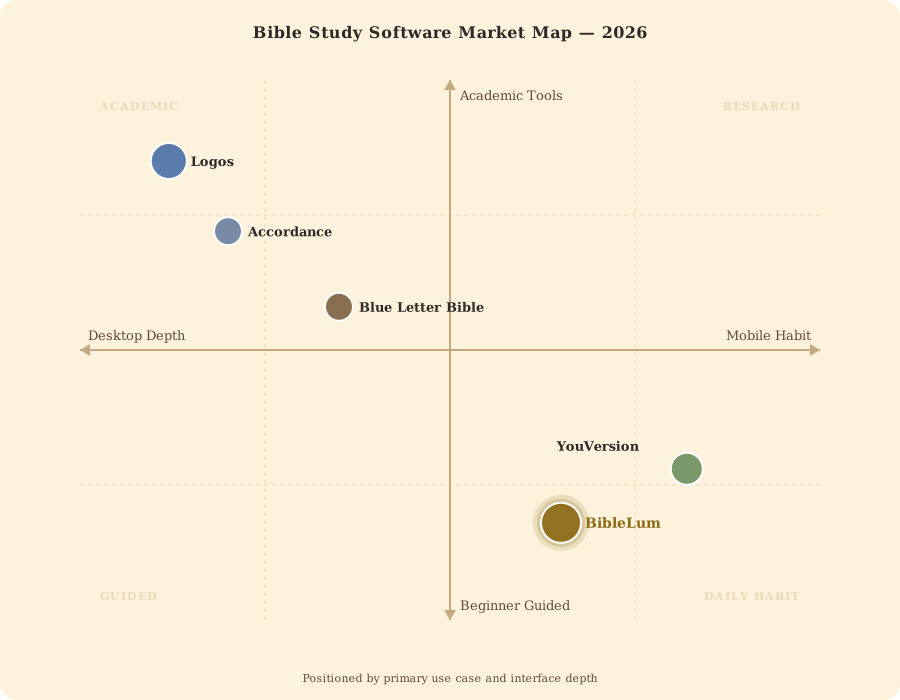
The Bible study software market in 2026 is no longer one category. It now includes academic desktop libraries, free original-language tools, mobile Bible apps, guided study platforms, and AI-supported reflection tools.
Logos and Accordance serve pastors, seminary students, and serious exegetical work. Blue Letter Bible serves users who want free access to Strong's numbers, interlinear tools, and classic commentaries. YouVersion dominates daily Bible reading and habit formation. BibleLum sits in a newer category: guided Bible study for beginners who want short conversational lessons, visual summaries, quick checks, and reflections across all 66 books.
| Market Segment | Best Examples | Best For |
|---|---|---|
| Academic Bible libraries | Logos, Accordance | Pastors, seminary students, sermon prep |
| Free study tools | Blue Letter Bible | Word study, cross references, classic commentaries |
| Daily Bible apps | YouVersion | Reading plans and habit formation |
| Guided beginner study | BibleLum | Beginners who need structure and context |
| AI-supported reflection | BibleLum and emerging tools | Connecting study to everyday life |
Which segment are you in?
- If you are a pastor or seminary student, start with Logos or Accordance.
- If you want free word study, start with Blue Letter Bible.
- If you struggle with consistency, start with YouVersion or BibleLum.
- If you are new to the Bible and need guidance, start with BibleLum.
BibleLum is not trying to replace Logos or Accordance. It belongs to a different part of the market: guided, beginner-friendly Bible study for people who need structure before they need advanced tools.
Best tools for Scripture context and accuracy checking
For Scripture context and accuracy checking, Logos and Blue Letter Bible are stronger than daily reading apps because they offer commentaries, cross-references, original-language tools, and historical background. YouVersion is better for reading plans and habit formation. BibleLum helps beginners understand the larger biblical context through guided lessons, but it is not a replacement for Scripture, pastors, commentaries, or deeper study tools.
Criteria for Evaluation
Before comparing specific platforms, it is worth establishing what "Bible study software" actually needs to accomplish. At minimum, a serious tool must provide access to the original Hebrew and Greek texts alongside reliable translations, support cross-referencing across books and themes, and allow the user to annotate and retrieve their own notes. Beyond these baseline requirements, the most valuable tools add contextual commentary, historical background, and — increasingly — AI-assisted interpretation.
- Original-language integration: Can users access interlinear texts, Strong's numbers, and morphological parsing without leaving the reading interface?
- Cross-reference depth: How many cross-references are indexed, and can users filter by theme, book, or theological concept?
- Mobile accessibility: Is the mobile experience a genuine study environment or merely a reading app?
- Annotation workflow: Can notes be exported, searched, and linked to specific verses or passages?
- Cost-to-value ratio: What does the platform offer at the free tier, and is the premium pricing justified by the depth of content?
Logos Bible Software: The Academic Standard
Logos Bible Software remains the benchmark for academic Bible study software. Its library now exceeds 50,000 titles, including critical commentaries, lexicons, and primary source documents in their original languages. The Passage Guide feature automatically surfaces relevant commentaries, cross-references, and theological notes for any selected text — a capability that took years of manual curation to develop and is genuinely difficult to replicate.
The original-language tools are unmatched: users can hover over any Greek or Hebrew word to see its lemma[1], parsing, and frequency across the entire biblical corpus. The Morph Search[2] function allows queries like "all aorist passive participles in Paul's letters" — a level of granularity that is invaluable for exegetical work[3] but entirely unnecessary for devotional reading.
Logos is the right tool if your study goals include original-language exegesis, academic commentary engagement, or sermon preparation at a professional level. For casual readers or those new to Bible study, the learning curve and cost structure are significant barriers.
The primary weakness of Logos is its pricing model. A base package with meaningful commentary access begins at $299, and the most comprehensive academic libraries run into the thousands. The mobile app is functional but noticeably slower than the desktop experience, and the interface — while powerful — rewards users who invest time in learning its architecture.
Blue Letter Bible: The Free Standard
Blue Letter Bible (BLB) occupies a unique position: it is the most widely used free Bible study tool on the internet, with over 4 million monthly users. Its core value proposition is access to Strong's Concordance, interlinear texts, and a curated selection of commentaries — all at no cost. For independent learners who want to engage with original languages without a financial commitment, BLB remains the default recommendation.
The interface has been incrementally modernized since its 1996 launch, but it retains a utilitarian aesthetic that prioritizes function over experience. The mobile app is serviceable for quick lookups but lacks the annotation depth of premium platforms. Cross-referencing is solid for canonical navigation but does not support thematic or theological filtering.
BLB's commentary library includes Matthew Henry, John Gill, and Chuck Smith — reliable but predominantly older sources. Users seeking engagement with contemporary scholarship (N.T. Wright, Gordon Fee, Craig Keener) will need to supplement with other tools.
Accordance: The macOS Native Option
Accordance Bible Software has long been the preferred choice for Mac users who want Logos-level depth with a more refined interface. Its original-language tools are comparable to Logos, and its search syntax — while idiosyncratic — is extremely powerful for morphological queries. The iOS app is the strongest mobile Bible study experience among premium platforms, with genuine offline functionality and a well-designed annotation system.
The primary limitation of Accordance is its ecosystem: it is less widely used than Logos, which means fewer community resources, fewer third-party modules, and a smaller library of available titles. For users embedded in the Mac ecosystem who prioritize interface quality and mobile performance, Accordance is a compelling alternative to Logos.
BibleLum: Guided Bible Study for Beginners
BibleLum approaches Bible study from a different angle than the tools above. Rather than organizing content canonically (book → chapter → verse), BibleLum's Study Pack architecture organizes each book around its theological themes, key symbols, narrative arcs, and historical context. This thematic indexing is particularly effective for readers who want to understand what a book means — its theological contribution to the canon — rather than simply what it says.
BibleLum includes optional AI-supported reflection responses after a user writes a reflection. These responses are designed to help beginners connect biblical themes to everyday life, not to replace Scripture, commentary, church community, or theological guidance.
BibleLum's 5-minute daily lesson format is engineered for fragmented schedules — each lesson is a self-contained unit that can be completed during a commute or lunch break. The visual narrative approach, combining illustrated scenes with contextual annotation, is particularly effective for books with complex historical settings (Exodus, Daniel, Revelation).
For readers who want breadth (all 66 books) and depth (theological context) without the learning curve of Logos or the cost of Accordance, BibleLum offers a compelling entry point. Day 1 of every Study Pack is free — no account required.
See BibleLum’s Guided-Study Approach
The clearest way to compare a guided study tool is to try its workflow: a short lesson with context, a main idea, and a quick check in five minutes.
YouVersion: The Daily Reading Habit
YouVersion Bible App is the most widely installed Bible app in the world, with over 700 million downloads across iOS and Android. Its core strength is not depth but consistency: the app's reading plans, daily verse notifications, and social accountability features are specifically engineered to help users build and maintain a daily Bible reading habit. For this purpose, it is unmatched.
YouVersion is not a study tool in the same sense as Logos or BLB. It does not provide interlinear texts, morphological search, or commentary integration. Its annotation system is minimal, and its cross-referencing is limited to canonical navigation. However, for readers who have struggled to maintain a consistent reading practice, YouVersion's streak tracking, plan reminders, and social sharing features address the behavioral dimension of Bible engagement that purely academic tools ignore.
If the primary obstacle to Bible study is consistency rather than depth, YouVersion is the right starting point. Once a daily reading habit is established, tools like BibleLum, BLB, or Logos can be layered in for deeper engagement.
Comparative Summary
If you are looking for a Bible study app rather than a full desktop library, mobile experience and guided learning matter more than library size. The table below compares all four tools across the dimensions that matter most for different study goals.
| Logos | Blue Letter Bible | Accordance | BibleLum | |
|---|---|---|---|---|
| Pricing / Free Tier | Paid; base packages from ~$299. Free tier: very limited (Logos Basic). | Fully free. No paywall for core tools. | Paid; starter packages from ~$50. Limited free tier. | Free for Day 1 of every Study Pack. Subscription for full access. |
| Offline Access | Full offline after download. Large local library required. | Primarily web-based; limited offline. | Strong offline support on Mac and iOS. | Lessons cached for offline reading on mobile. |
| Mobile UX | Functional but complex; best on desktop. | Serviceable for quick lookups; not a study environment. | Best-in-class iOS app among premium tools. | Mobile-first design; 5-minute daily lessons optimized for phone. |
| Original-Language Tools | Industry-leading: interlinear, Morph Search, lexicons, parsing. | Strong's numbers, interlinear, basic parsing — all free. | Comparable to Logos; powerful morphological search. | Not a primary focus; contextual notes reference original terms. |
| Best Use Case | Sermon prep, academic exegesis, commentary engagement. | Free original-language access, independent word study. | Mac/iOS users wanting premium depth with refined UX. | Thematic comprehension of all 66 books; guided daily study. |
| Key Limitation | High cost; steep learning curve; slower mobile. | Older commentary library; limited annotation and theming. | Smaller ecosystem; fewer third-party modules than Logos. | Not designed for verse-level morphological queries. |
The most effective Bible study practice often combines tools: YouVersion or BibleLum for daily engagement and habit formation, BLB for free original-language word studies, and Logos or Accordance for deeper exegetical work on specific passages. The goal is not to find a single perfect tool, but to build a workflow that sustains consistent, deepening engagement with the text.