
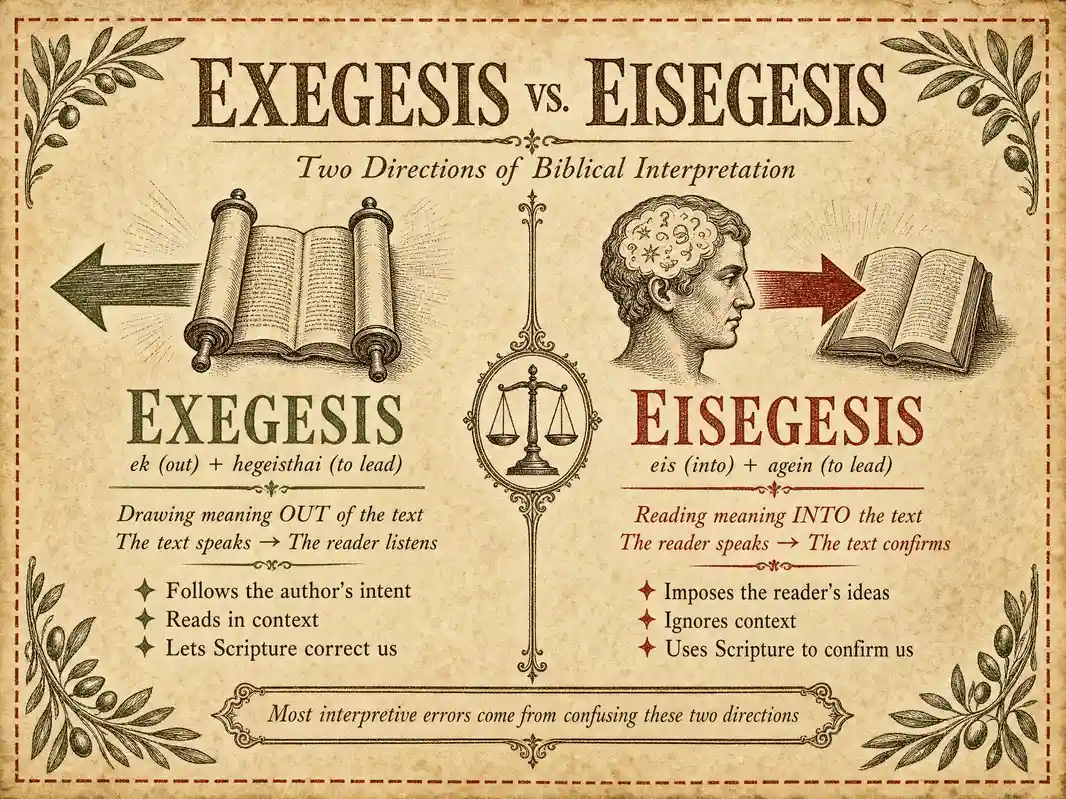
Every reader of the Bible brings something to the text: assumptions, questions, prior experiences, theological commitments, and cultural frameworks. This is unavoidable and, in itself, not a problem. The problem arises when those prior commitments are allowed to determine what the text says, rather than the other way around. That practice has a name: eisegesis[1].
Eisegesis is the opposite of exegesis[2]. Where exegesis draws meaning out of the text, eisegesis reads meaning into it. The distinction sounds simple, but its practical implications are far-reaching. Some of the most significant theological errors in church history — and some of the most common mistakes in personal Bible study — are the direct result of eisegetical reading. (For a broader scholarly overview, see the Wikipedia entry on exegesis which surveys the term across religious traditions.)
The Word and Its History
The term eisegesis comes from the Greek eisagein — eis (into) + agein (to lead). It entered theological vocabulary in the nineteenth century as a technical counterpart to exegesis, and it was used to describe the interpretive error of projecting one's own ideas onto the biblical text. The term is almost always pejorative: to accuse a reading of being eisegetical is to say that it has substituted the interpreter's voice for the author's.
It is worth noting that the line between exegesis and eisegesis is not always sharp. All interpretation involves the interpreter, and the history of hermeneutics[3] has grappled seriously with the question of how much the reader inevitably shapes what is read. The philosopher Hans-Georg Gadamer argued that understanding always involves a "fusion of horizons" — the horizon of the text and the horizon of the reader. This does not mean that eisegesis is inevitable, but it does mean that the discipline of avoiding it requires ongoing self-awareness, not a one-time methodological commitment.
Five Common Forms of Eisegesis
Eisegesis takes many forms, some obvious and some subtle. The following five are the most frequently encountered in both popular Bible study and formal theological writing.
| Form | Description | Example |
|---|---|---|
| Proof-texting[4] | Citing isolated verses to support a predetermined conclusion, without regard for context | Using Jer. 29:11 ("plans to prosper you") as a promise of personal financial success |
| Allegorizing | Finding hidden spiritual meanings not warranted by the text or its genre | Reading the Song of Solomon exclusively as an allegory of Christ and the church, ignoring its literal dimension |
| Contemporizing | Assuming that the text directly addresses modern situations it was not written to address | Reading Revelation's imagery as a coded description of twenty-first-century geopolitics |
| Reader-response eisegesis | Treating the reader's emotional or spiritual experience as the primary determinant of meaning | "This verse means whatever it means to me personally" |
| Theological grid reading | Forcing every passage through a pre-existing theological system, regardless of the passage's own emphasis | Reading every OT narrative primarily as a type of Christ, even where the text gives no such warrant |
None of these forms is entirely without legitimate application. Typological reading, for example, is a recognized and valuable hermeneutical method — but it becomes eisegetical when it is imposed on texts that do not invite it. The difference lies in whether the interpretive move is warranted by the text itself or imported from outside it.
Why Eisegesis Is Dangerous
The stakes of eisegesis are not merely academic. When a reader consistently reads their own meaning into Scripture, several things follow. First, the text loses its capacity to challenge and correct the reader. The Bible becomes a mirror that reflects the reader's existing beliefs rather than a window onto a reality that transcends them. Second, eisegetical readings are almost impossible to falsify: because the meaning is generated by the reader, no textual evidence can dislodge it. Third, eisegesis tends to produce theological fragmentation, as each reader's private interpretation becomes authoritative for themselves, making shared understanding and accountability difficult.
The text must be allowed to say what it says, not what we want it to say. The discipline of exegesis is, at its core, the discipline of listening. — Gordon Fee & Douglas Stuart, How to Read the Bible for All Its Worth
At the community level, eisegesis has historically been used to justify positions that the broader church has recognized as errors — from prosperity theology to various forms of legalism and antinomianism. The common thread is that a small number of texts, read in isolation and filtered through a particular cultural or ideological lens, are allowed to override the plain teaching of the canon as a whole.
How to Recognize Eisegesis in Your Own Reading
Self-diagnosis is the hardest part of avoiding eisegesis, because eisegetical readers are typically unaware that they are doing it. The following questions can serve as diagnostic tools when you are studying a passage.
- Am I reading this passage in its literary context, or have I isolated a verse or phrase from its surrounding argument?
- Do I know the historical and cultural situation of the original audience? Does my interpretation make sense in that context?
- Would the original author recognize my interpretation as a fair representation of what they wrote?
- Is my interpretation consistent with the teaching of the passage's canonical context — the book, the Testament, the Bible as a whole?
- Am I willing to be corrected by this text, or have I already decided what it must say?
A particularly useful practice is to read a passage in a translation you are unfamiliar with, or to read a commentary written from a theological tradition different from your own. Both practices disrupt the automatic confirmation of your existing views and force genuine engagement with the text.
Eisegesis vs. Application: A Necessary Distinction
A common misconception is that avoiding eisegesis means refusing to apply the text to contemporary life. This is not the case. Application — the movement from what the text meant to what it means for us today — is a legitimate and necessary part of biblical interpretation. The key is that application must follow exegesis, not replace it.
The sequence matters: first, determine what the text said to its original audience (exegesis); then, identify the theological principle that transcends the original situation; finally, determine how that principle applies in your contemporary context (application). When application precedes exegesis — when you begin with "what does this mean for me?" before asking "what did this mean?" — eisegesis is almost inevitable.
The Analogy of Faith as a Guardrail
One of the most effective guardrails against eisegesis is the classical hermeneutical principle known as the analogia fidei[5] — the analogy of faith. This principle holds that Scripture interprets Scripture: unclear or disputed passages should be read in light of clearer ones, and no interpretation of a single text should contradict the plain teaching of the canon as a whole.
The analogy of faith does not eliminate interpretive disagreement, but it does provide a check against readings that are idiosyncratic or self-serving. If your interpretation of a passage requires you to dismiss or reinterpret a large body of contrary evidence elsewhere in Scripture, that is a strong signal that eisegesis may be at work.
How BibleLum Helps You Read Exegetically
BibleLum's Study Packs are designed to build exegetical habits from the ground up. Each pack begins with the historical and literary context of the book — the information you need to read the text as its original audience would have heard it. The thematic overviews and cross-reference maps help you situate individual passages within the canonical whole, reducing the risk of proof-texting. The AI-assisted reflection prompts are designed to move from observation (what does the text say?) to interpretation (what does it mean?) to application (what does it require of me?) — the sequence that keeps application accountable to exegesis.
If you are working through Romans, the Study Pack's chapter-by-chapter structure follows Paul's own argument rather than imposing a thematic grid on it. This is a small but significant design choice: it trains readers to follow the text's logic rather than their own. The companion articles on biblical hermeneutics and biblical exegesis provide the theoretical framework that underlies this approach.