
Among the principles that have governed Protestant biblical interpretation since the Reformation, few are more foundational — or more frequently misunderstood — than the analogia fidei[1], the analogy of faith. The principle holds that Scripture is its own best interpreter: when a passage is obscure, ambiguous, or disputed, the interpreter should seek clarification from clearer passages on the same subject rather than importing meaning from outside the text. This is not merely a methodological preference; it is a theological claim about the coherence and unity of Scripture as a single divine communication.
The analogy of faith stands at the intersection of hermeneutics[2] and systematic theology. It presupposes that the Bible, despite its diversity of human authors, genres, historical settings, and literary forms, ultimately speaks with a unified voice on matters of doctrine and practice. This presupposition is not self-evident; it is a confessional commitment that shapes the entire interpretive enterprise. Understanding what the analogy of faith is — and what it is not — is essential for anyone who wants to read Scripture with both theological seriousness and exegetical[3] integrity.
The Biblical Basis: Romans 12:6
The classical locus for the analogy of faith is Romans 12:6, where Paul instructs that prophecy should be exercised "according to the proportion of faith" (Greek: kata ten analogian tes pisteos). The phrase is grammatically dense and has generated significant debate about whether Paul is referring to the objective content of the faith (the body of Christian doctrine) or the subjective faith of the individual prophet. The Reformers, and the confessional tradition that followed them, generally read it as referring to the former: the standard of sound doctrine against which all prophetic utterance — and by extension, all biblical interpretation — must be measured.
The analogy of faith is not a license to flatten Scripture into a doctrinal grid, but a safeguard against readings that pit one part of the canon against another. It assumes coherence without imposing uniformity. — Herman Bavinck, Reformed Dogmatics
Additional biblical support is found in 2 Peter 1:20–21, which states that "no prophecy of Scripture comes from someone's own interpretation" — a text that the Reformed tradition has read as prohibiting private, idiosyncratic readings that isolate a passage from the broader canonical witness. The principle is also implicit in Jesus's own interpretive practice: in Matthew 22:29, he rebukes the Sadducees for not knowing "the Scriptures or the power of God," implying that a correct understanding of one passage (resurrection) requires familiarity with the whole.
Historical Development: From the Reformation to Westminster
The formal articulation of the analogy of faith as a hermeneutical principle belongs to the Reformation era, though its roots extend to patristic exegesis. Augustine's rule that obscure passages should be interpreted in light of clear ones anticipates the later Reformed formulation. Martin Luther applied the principle polemically against allegorical readings that he believed obscured the plain sense of Scripture; for Luther, the analogia fidei served as a corrective to the speculative exegesis of medieval scholasticism.
John Calvin developed the principle more systematically in his Institutes and commentaries. For Calvin, the analogy of faith meant that the interpreter must always ask whether a proposed reading of a passage coheres with the central message of the gospel as attested throughout Scripture. A reading that contradicts the plain teaching of Romans on justification, for example, cannot be correct — regardless of how grammatically plausible it might appear in isolation.
The Westminster Confession of Faith (1647) gave the analogy of faith its most influential confessional formulation: "The infallible rule of interpretation of Scripture is the Scripture itself; and therefore, when there is a question about the true and full sense of any Scripture (which is not manifold, but one), it must be searched and known by other places that speak more clearly." This statement has shaped Protestant hermeneutics for nearly four centuries and remains the standard reference point for discussions of the principle.
| Theologian | Period | Key Contribution |
|---|---|---|
| Augustine | 354–430 | Rule of charity: obscure passages interpreted by clear ones; love of God and neighbor as the interpretive goal |
| Martin Luther | 1483–1546 | Applied analogia fidei against medieval allegory; Scripture as its own interpreter (Scriptura sui ipsius interpres) |
| John Calvin | 1509–1564 | Systematic integration with gospel coherence; the plain sense of Scripture governs theological conclusions |
| Westminster Assembly | 1643–1649 | Confessional formulation: "the infallible rule of interpretation of Scripture is the Scripture itself" |
| Herman Bavinck | 1854–1921 | Distinguished analogia fidei from analogia scripturae; emphasized canonical unity without doctrinal flattening |
Analogia Fidei vs. Analogia Scripturae
A distinction that is often overlooked in popular treatments of the analogy of faith is the difference between the analogia fidei (analogy of faith) and the analogia scripturae[4] (analogy of Scripture). The two principles are related but not identical. The analogy of Scripture is a narrower, more purely exegetical principle: it holds that Scripture should be used to interpret Scripture, and that parallel passages on the same subject should be consulted before drawing doctrinal conclusions. The analogy of faith is broader: it holds that any interpretation must cohere with the established body of Christian doctrine — the "rule of faith" — as attested by the whole of Scripture.
In practice, the two principles work together. The analogy of Scripture provides the method (consult parallel passages); the analogy of faith provides the standard (cohere with the whole). A reading that passes the first test (it is grammatically plausible and supported by parallel texts) but fails the second (it contradicts the plain teaching of the canon on a central doctrine) must be revisited. This two-stage check is what distinguishes careful exegesis from both proof-texting and theological speculation.
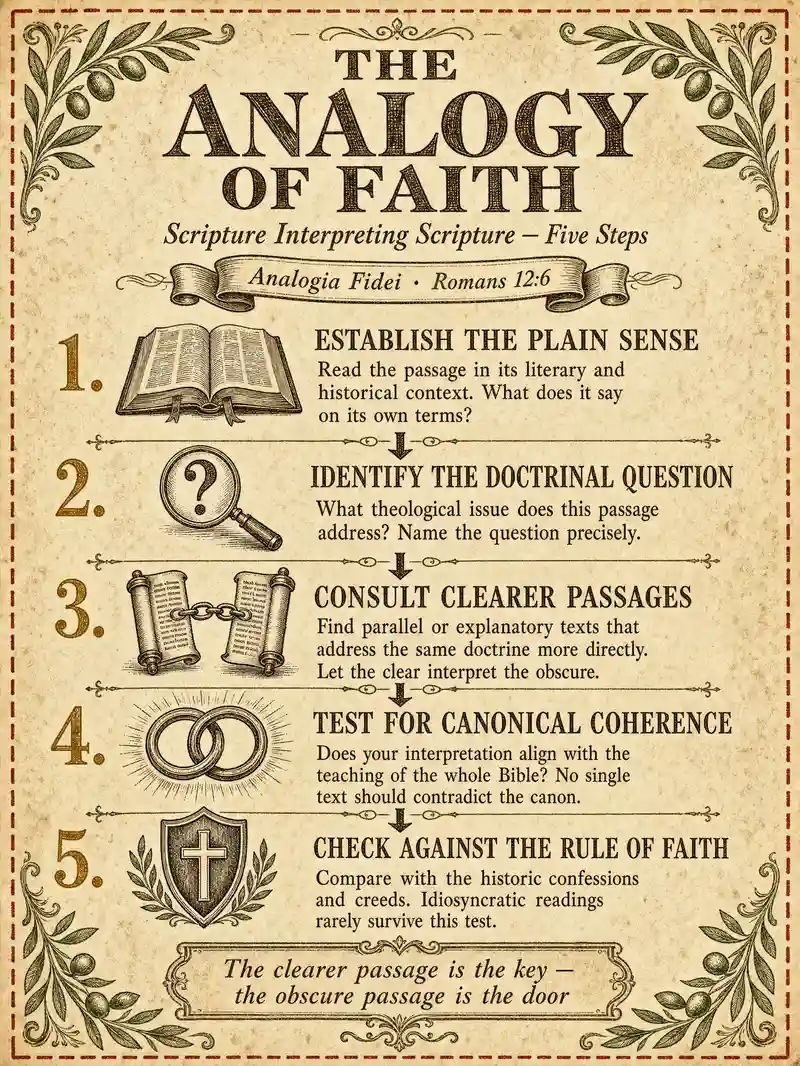
Practical Application: Five Steps
Applying the analogy of faith in personal Bible study does not require a seminary degree. The following five-step framework makes the principle accessible to any serious reader.
- Establish the plain sense of the passage. Before consulting any parallel texts, determine what the passage says in its immediate literary and historical context. This is the exegetical foundation that the analogy of faith builds on, not replaces.
- Identify the doctrinal question the passage raises. What theological claim does this text appear to make? Is it about salvation, the nature of God, ethics, eschatology, or something else? Naming the question precisely prevents the next step from becoming a fishing expedition.
- Consult clearer passages on the same subject. Use a concordance, cross-reference system, or a tool like BibleLum to find passages that address the same doctrinal question more directly. (For a step-by-step method, see What Is Biblical Exegesis?.) Prioritize passages that are didactic (teaching passages) over narrative or poetic ones.
- Test your interpretation for canonical coherence. Does your reading of the original passage cohere with the clearer passages you have found? If there is a contradiction, the problem almost certainly lies with your interpretation of the less clear passage, not with the clearer ones.
- Check against the rule of faith. Does your interpretation cohere with the central message of the gospel — the death and resurrection of Christ for the justification of sinners — as attested throughout Scripture? This is the final and most important test.
Common Misapplications
The analogy of faith is a powerful safeguard, but it can itself be misapplied in ways that undermine careful exegesis. Three misapplications are particularly common.
The first is using the analogy of faith to suppress the genuine diversity of Scripture. The Bible contains real tensions — between the wisdom literature's this-worldly focus and the apocalyptic literature's eschatological urgency, between Paul's emphasis on grace and James's emphasis on works, between the imprecatory psalms and Jesus's command to love enemies. The analogy of faith does not resolve these tensions by flattening them; it holds them together within a larger canonical unity that the interpreter must learn to inhabit.
The second misapplication is treating the analogy of faith as a license to import systematic theology into exegesis prematurely. The principle is a check on interpretation, not a replacement for it. The interpreter must still do the grammatical-historical work before appealing to the analogy of faith; the principle governs the final stage of interpretation, not the first.
The analogy of faith is a guardrail, not a shortcut. It prevents the interpreter from going off the road; it does not tell them where the road goes.
The third misapplication is confusing the analogy of faith with confessional authority. The Westminster Confession's formulation of the principle is not itself the rule of faith; it is a human document that attempts to articulate what Scripture teaches. The analogy of faith ultimately appeals to Scripture itself, not to any creed, confession, or theological tradition — however valuable those traditions may be as guides to interpretation.
The Analogy of Faith and the Sensus Plenior
One area where the analogy of faith has particular relevance is the interpretation of Old Testament texts in light of their New Testament fulfillment — what theologians call the sensus plenior[5], or "fuller sense." When Matthew quotes Isaiah 7:14 as a prophecy of the virgin birth, or when the author of Hebrews reads Psalm 110 as a description of Christ's high priesthood, they are applying something like the analogy of faith: the fuller canonical context illuminates a meaning that was present in the original text but not fully visible to the original audience.
This does not mean that the original historical meaning is irrelevant or that the New Testament authors were reading meanings into the text that were not there. It means that the full meaning of the Old Testament is only visible from the vantage point of its New Testament fulfillment — and that the analogy of faith, applied canonically, is the hermeneutical principle that makes this kind of reading possible without collapsing into allegory or eisegesis. For a practical guide to this kind of reading, see How to Interpret Old Testament Prophecy.
How BibleLum Embodies the Analogy of Faith
BibleLum's Study Pack architecture is designed to model the analogy of faith in practice. Each pack begins with the historical and literary context of the book — the grammatical-historical foundation — and then situates the book within the broader canonical narrative through thematic overviews and cross-reference maps. The Key Themes section of each pack explicitly traces how the book's central themes connect to the rest of Scripture, embodying the analogia scripturae at the level of book-by-book study.
The AI-assisted reflection prompts are designed to move from observation to interpretation to application — a sequence that keeps application accountable to exegesis and exegesis accountable to the canonical whole. If you are working through Romans, the Study Pack's chapter-by-chapter structure follows Paul's own argument, and the cross-reference maps show how that argument connects to Genesis, Psalms, Isaiah, and the Gospels — the canonical web that the analogy of faith requires the interpreter to navigate.