
If you have spent any time in a Bible study group, you have probably heard someone say that a particular Old Testament story "points to Jesus." The Passover lamb points to Christ. The bronze serpent in the wilderness points to the crucifixion. The Davidic king points to the Messiah. These connections are not accidental or fanciful — they reflect a specific interpretive method called typology, and understanding it is one of the most rewarding skills a Bible reader can develop.
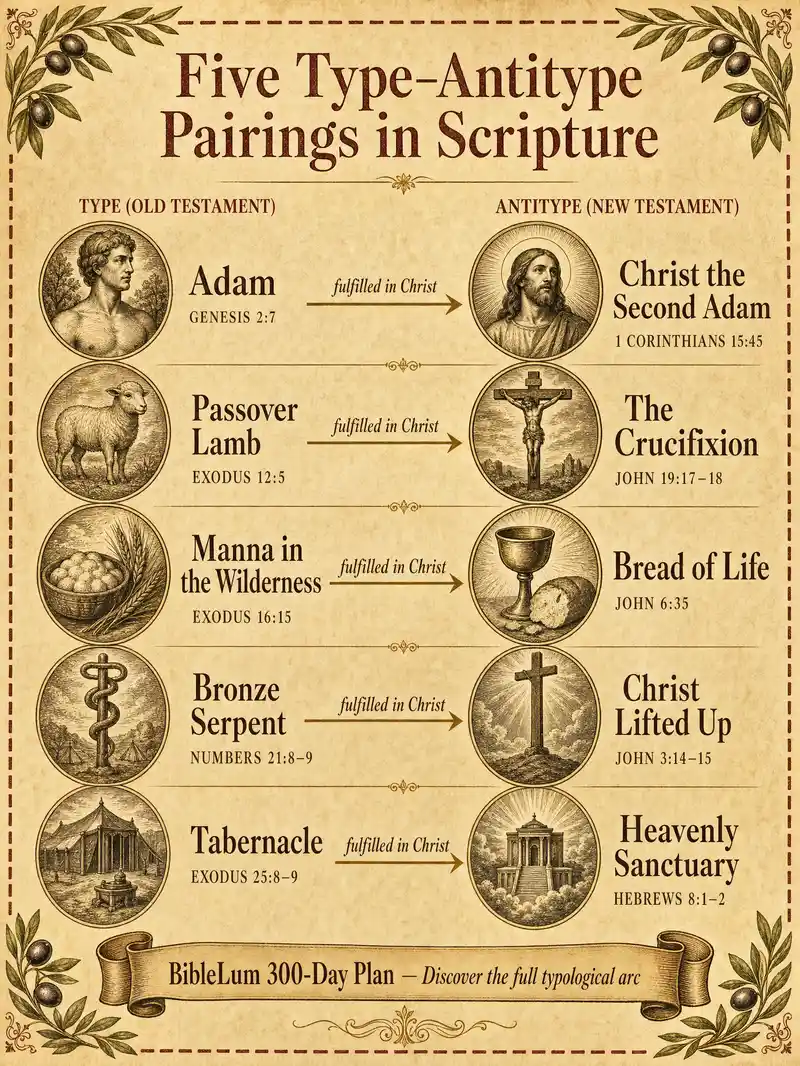
Typology is the study of types and antitypes in Scripture. A type[1] is a person, event, institution, or object in the Old Testament that God designed to prefigure a greater reality — the antitype — which is typically revealed in the New Testament. The word comes from the Greek typos (τύπος), meaning a pattern, impression, or mold. The antitype is the reality that the mold was shaped to receive. Understanding this relationship is essential for reading both Testaments well. (For broader background on typology as an interpretive method, see the Wikipedia overview of typology in theology.)
Typology Is Not Allegory
The most important distinction to make at the outset is between typology and allegory. Allegory treats a narrative as a symbolic code in which each element stands for a hidden spiritual meaning that is unrelated to the literal story — a tendency closely related to eisegesis, or reading meaning into a text from outside. The second-century theologian Origen, for example, interpreted the binding of Rahab's scarlet cord in Joshua 2 as an allegory of the blood of Christ — a connection he derived from the color of the cord, not from the narrative logic of the text.
Typology, by contrast, is grounded in historical events. The type has its own genuine historical meaning and integrity — it is not merely a symbol. The Passover lamb was a real lamb, slaughtered in a real historical event, that delivered real Israelites from real death in Egypt. Its typological significance does not replace or negate this historical reality; it builds on it. The New Testament authors who identify Christ as the Passover lamb (1 Corinthians 5:7; John 1:29) are making a claim about the historical pattern God embedded in Israel's history, not decoding a symbolic cipher.
This distinction matters practically: typological interpretation is constrained by the text in ways that allegorical interpretation is not. A valid type must be grounded in genuine structural correspondence between the type and antitype, and ideally confirmed by the New Testament authors themselves. Identifying types without these constraints produces creative readings that may be spiritually stimulating but are not exegetically[2] sound.
Three Categories of Biblical Types
Biblical scholars typically identify three broad categories of types — persons, events, and institutions — each carrying typological weight in distinct ways.
Personal Types
The first category is personal types — individuals whose lives, roles, or experiences prefigure Christ or the people of God. Adam is the most explicit: Paul calls him 'a type of the one who was to come' (Romans 5:14), because as Adam's disobedience brought condemnation to all, Christ's obedience brings justification to all. Melchizedek, the priest-king of Salem who blesses Abraham in Genesis 14, is identified in Hebrews 7 as a type of Christ's eternal priesthood. Moses, as the mediator of the covenant and the deliverer of Israel, prefigures Christ as the mediator of the new covenant.
Event Types
The second category is event types — historical events that prefigure redemptive realities. The Exodus is the paradigmatic event type of the entire Old Testament: God's deliverance of Israel from slavery in Egypt becomes the template for understanding every subsequent act of divine rescue, culminating in the new exodus accomplished in the death and resurrection of Christ. The wilderness wandering prefigures the church's journey through the present age (1 Corinthians 10:1–11). The conquest of Canaan prefigures the eschatological[3] inheritance of the new creation.
Institutional Types
The third category is institutional types — the laws, rituals, and structures of Israel's covenant life that prefigure the realities of the new covenant. The sacrificial system as a whole prefigures Christ's atoning death. The Levitical priesthood prefigures Christ's high priesthood. The tabernacle and temple prefigure Christ as the true dwelling place of God among his people (John 1:14; 2:21). The Sabbath prefigures the eschatological rest that remains for the people of God (Hebrews 4:9–11).
How to Identify a Valid Type
Not every parallel between the Old and New Testaments constitutes a genuine type. The history of biblical interpretation is littered with fanciful connections that reflect the interpreter's creativity more than the text's intention. The following criteria help distinguish valid types from speculative parallels.
The first criterion is structural correspondence: the type and antitype must share a genuine pattern of meaning, not merely a superficial resemblance. The bronze serpent lifted up in the wilderness (Numbers 21:8-9) is a valid type of the crucifixion because Jesus himself identifies the structural correspondence: 'As Moses lifted up the serpent in the wilderness, so must the Son of Man be lifted up, that whoever believes in him may have eternal life' (John 3:14-15). The correspondence is not the serpent's appearance but the pattern of lifting up as the means of salvation for those who look in faith.
The second criterion is escalation: the antitype is always greater than the type. Christ is greater than the Passover lamb, greater than the Levitical priests, greater than the temple, greater than Moses. This escalation is not incidental — it is the theological point. The type is a shadow; the antitype is the substance (Colossians 2:17; Hebrews 10:1). If your proposed type-antitype connection does not involve escalation — if the antitype is merely equivalent to or smaller than the type — the connection is probably not genuine typology.
The third criterion is New Testament confirmation: the most secure types are those explicitly identified by the New Testament authors. Paul, the author of Hebrews, and John are the most prolific typologists in the New Testament, and their identifications provide the clearest warrant for typological reading. Types that lack New Testament confirmation can still be valid — the structural logic of the canon supports some connections that are not made explicit — but they require greater caution and humility.
A Worked Example: Genesis and the New Creation
Genesis is the richest source of typological material in the entire Old Testament, which is one reason BibleLum's Genesis Study Pack organizes its content around the book's theological arcs rather than a verse-by-verse commentary. The creation narrative of Genesis 1–2 functions as the typological foundation for the entire biblical story: the new creation of Revelation 21–22 is structured as a deliberate echo and escalation of the original creation, with the tree of life, the river of water, and the unmediated presence of God restored and surpassed.
Adam's role as the image-bearer and vice-regent of God in the garden prefigures Christ as the true image of God (Colossians 1:15) and the last Adam (1 Corinthians 15:45) who accomplishes what the first Adam failed to do. The garden itself — a sacred space where God and humanity dwell together — prefigures the tabernacle, the temple, and ultimately the new Jerusalem. Even the cherubim who guard the entrance to Eden after the fall (Genesis 3:24) reappear as guardians of the ark of the covenant in the tabernacle, marking the holy of holies as the restored garden-presence of God.
Reading Genesis with this typological awareness does not mean reading it as allegory — the historical events are real and matter as history. It means reading it as the beginning of a story whose ending has already been revealed, and allowing that ending to illuminate the beginning. This is precisely the kind of canonical reading[4] that BibleLum's thematic approach is designed to facilitate: the Key Themes and Symbols sections of each Study Pack map these structural patterns across the whole canon, giving you the framework to see how each book participates in the larger typological argument of Scripture.
Common Pitfalls to Avoid
The most common pitfall in typological reading is over-typologizing: finding a type in every detail of every Old Testament narrative. Not every element of the tabernacle is a type of Christ. Not every character in Genesis is a personal type of the Messiah. The acacia wood of the ark of the covenant is not a type of the cross simply because both are made of wood. This kind of hyper-typology, while popular in some devotional traditions, undermines the interpretive discipline that makes genuine typology meaningful.
A related pitfall is using typology to evacuate the Old Testament of its own historical and theological meaning. If the Exodus is 'really' about the cross, then its significance for Israel's actual history is diminished. The correct understanding is that the Exodus has both its own historical meaning — God's covenant faithfulness to Israel — and a typological dimension that points forward to a greater deliverance. Both meanings are real and both matter. The New Testament fulfillment does not cancel the Old Testament meaning; it completes and surpasses it.
For readers who want to develop their typological reading skills, the most practical starting point is to follow the New Testament authors' own typological connections and work backward to understand why they made them. When Paul says that the rock that followed Israel in the wilderness 'was Christ' (1 Corinthians 10:4), the question to ask is not whether this is literally true but what structural correspondence Paul is identifying and what theological claim he is making through it. This kind of close reading, practiced consistently, builds the interpretive instincts that make typology a tool for illumination rather than a license for speculation.
Biblical Typology Examples
The following examples illustrate the three categories of types across the canon. In each case, the antitype escalates and fulfills the type without canceling its original historical meaning.
- Passover lamb → Christ: The lamb slaughtered at the first Passover (Exodus 12) is explicitly identified as a type of Christ by Paul: "Christ, our Passover lamb, has been sacrificed" (1 Corinthians 5:7). The structural correspondence is substitutionary death that delivers God's people from judgment.
- Adam → Christ: Paul calls Adam "a type of the one who was to come" (Romans 5:14). As Adam's one act of disobedience brought condemnation to all, Christ's one act of obedience brings justification to all. The escalation is from a type who failed to an antitype who succeeds perfectly.
- Exodus → Salvation: The Exodus — God's deliverance of Israel from slavery in Egypt — is the paradigmatic event type of the Old Testament. The New Testament presents Christ's death and resurrection as a new and greater Exodus: liberation not from political slavery but from sin, death, and the power of the devil (Luke 9:31, where "departure" translates the Greek exodos).
- Davidic king → Messiah: The Davidic covenant (2 Samuel 7) promises an eternal king from David's line. The New Testament identifies Jesus as the fulfillment: "He will be great and will be called the Son of the Most High. The Lord God will give him the throne of his father David" (Luke 1:32). The escalation is from a mortal king whose kingdom was eventually lost to an eternal king whose kingdom has no end.
- Temple → Christ, Church, New Creation: The Temple as the dwelling place of God among his people functions as a multi-layered type. Jesus identifies his own body as the temple (John 2:19–21). Paul identifies the church as the temple of the Holy Spirit (Ephesians 2:21–22). Revelation 21:22 reveals the ultimate antitype: in the new creation, "I did not see a temple in the city, because the Lord God Almighty and the Lamb are its temple."