
What Does Exegesis Mean?
In simple words, exegesis is careful explanation. An interpreter pays attention to what a text actually says, how its words work together, and the setting in which it was written before drawing conclusions from it. The term can describe the interpretation of many kinds of texts, but it is especially common in biblical studies.
| Term | Plain meaning |
|---|---|
| Exegesis | Drawing a text's intended meaning out of its language and context |
| Exegetical | Describing work that carefully explains a text |
| Eisegesis | Reading a conclusion or assumption into a text |
Exegesis in a sentence: A careful exegesis of Romans 5:1–5 follows Paul's argument about justification, peace, suffering, and hope before making an application for readers today.
The word exegesis[1] comes from the Greek exegeisthai — to lead out, to explain. In biblical study, it refers to the disciplined practice of drawing out the meaning that is already present in the text, as opposed to reading meaning into it. This distinction matters enormously. Every reader brings assumptions, questions, and prior beliefs to the Bible. Exegesis is the set of habits and methods that prevent those assumptions from overriding what the text actually says.
This guide walks through exegesis as a step-by-step process. It is written for readers who want to move beyond surface-level Bible reading without enrolling in a seminary course. Each step is practical and immediately applicable to your next study session.
Exegesis vs. Eisegesis: The Foundational Distinction
Before describing what exegesis is, it helps to name what it resists. Eisegesis[2] — from the Greek eis (into) — is the practice of reading one's own meaning into a text. It happens when a reader selects a verse to support a conclusion already reached, ignores context that complicates the preferred reading, or treats the Bible as a collection of quotable fragments rather than a unified argument.
Exegesis draws out what the text says. Eisegesis reads into the text what the interpreter wants it to say.
The distinction is not merely academic. Proof-texting[3] — the practice of citing isolated verses without regard for their context — is one of the most common forms of eisegesis, and it has produced some of the most damaging misreadings in the history of biblical interpretation. Exegesis is the corrective: a commitment to let the text speak on its own terms before asking what it means for us.
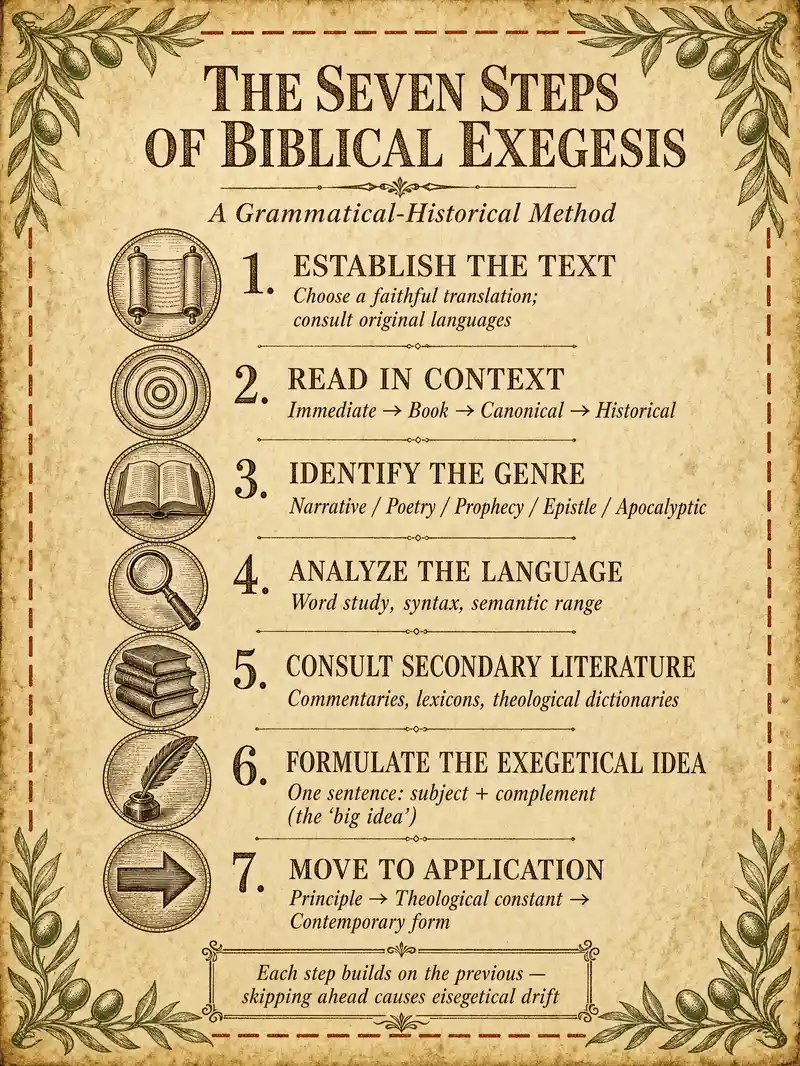
Step 1: Establish the Text
Before interpreting a passage, you need to be confident you are working with a reliable text. For most readers, this means choosing a translation that prioritizes formal equivalence — a word-for-word rendering that preserves the structure of the original — rather than a paraphrase. The ESV, NASB, and NRSV are widely used for exegetical work. The NIV occupies a middle position. Paraphrases like The Message are useful for devotional reading but are not suitable as the primary text for exegesis, since they already embed the translator's interpretive decisions.
If you have access to the original languages, working from the Hebrew (Old Testament) or Greek (New Testament) text is always preferable. Interlinear Bibles and tools like Blue Letter Bible or BibleHub provide access to Strong's numbers and morphological parsing[4] without requiring fluency in the original languages. Even a basic familiarity with how these tools work will improve the quality of your exegesis significantly.
Step 2: Read in Context
Context is the most important single factor in determining the meaning of a biblical text. Every passage exists within at least four concentric circles of context, each of which constrains and illuminates the meaning of the words on the page.
| Context Level | What to Ask | Example |
|---|---|---|
| Immediate | What comes directly before and after this passage? | Romans 8:28 is part of an argument about suffering and hope that runs from 8:18 to 8:39 |
| Book | What is the overall argument or narrative of this book? | Galatians is a defense of justification by faith; every passage must be read in light of that argument |
| Canonical | How does this passage relate to the rest of Scripture? | Psalm 22 is a lament that is quoted by Jesus on the cross (Matthew 27:46) |
| Historical | What was the situation of the original author and audience? | Philippians was written from prison; the call to rejoice carries a different weight in that context |
A common exegetical error is to read a passage as if it were a standalone unit. Most biblical texts are embedded in larger arguments, narratives, or poetic sequences. Reading Romans 3:23 without Romans 3:21–26 produces a truncated understanding of what Paul is saying about sin and justification. Reading John 3:16 without John 3:14–15 misses the typological connection to Numbers 21 that Jesus himself draws.
Step 3: Identify the Genre
Genre determines the rules of interpretation. The Bible contains narrative, poetry, wisdom literature, prophecy, epistle, and apocalyptic writing. Each genre makes different kinds of claims and requires different interpretive strategies. Applying the interpretive rules of one genre to another produces systematic misreadings.
- Narrative: Ask what theological point the narrator is making through the selection and arrangement of events. Not every character in a biblical narrative is a moral exemplar; the narrator's evaluative comments are the key to interpretation.
- Poetry: Attend to parallelism, imagery, and emotional register. Hebrew poetry works through the juxtaposition of lines that restate, contrast, or develop each other. Do not over-literalize metaphors.
- Prophecy: Distinguish between the immediate historical address (the covenant lawsuit or oracle of judgment directed at a specific audience) and any typological or eschatological extension. Prophecy is not primarily prediction; it is covenant enforcement.
- Epistle: Reconstruct the situation being addressed. Paul's letters are occasional documents — written to specific communities facing specific problems. The principle embedded in the instruction may be universal; the culturally specific form of its application may not be.
- Apocalyptic: Interpret symbols in light of their Old Testament background. The imagery of Revelation is drawn almost entirely from Daniel, Ezekiel, Isaiah, and Zechariah. Resist the temptation to map symbols onto contemporary events without exegetical warrant.
Step 4: Analyze the Language
Word studies are one of the most rewarding — and most misused — tools in biblical exegesis. The misuse typically takes the form of the etymological fallacy[5]: assuming that the meaning of a word is determined by its historical origin rather than its usage in context. The Greek word dynamis, for example, is related to the English word dynamite, but this does not mean that every occurrence of dynamis in the New Testament carries explosive connotations. Words mean what they mean in their context of use, not what their etymology suggests.
Productive word study asks: How is this word used elsewhere in the same author's writings? How is it used in the broader Greek or Hebrew literature of the period? Are there synonyms or antonyms that help define its semantic range? What is the significance of this particular word choice in this particular sentence? These questions require access to a concordance and, ideally, a lexicon — but both are freely available online.
Step 5: Consult the Secondary Literature
Exegesis is not a solitary exercise. The church has been reading and interpreting Scripture for two thousand years, and that accumulated wisdom is available in commentaries, theological dictionaries, and study Bibles. Consulting secondary literature is not a sign of weakness; it is a sign of intellectual humility and historical awareness.
A practical approach is to do your own exegesis first — working through the text with the steps above before consulting any commentary — and then check your conclusions against the secondary literature. This sequence prevents the commentary from doing your thinking for you while still benefiting from the expertise it represents. When your reading agrees with the consensus of careful interpreters, you can hold it with greater confidence. When it diverges, you have a specific question to investigate.
Step 6: Formulate the Exegetical Idea
After working through the previous steps, the goal is to formulate a single sentence that captures the main point of the passage — what Haddon Robinson called the "big idea." This sentence should express the subject of the passage (what the author is talking about) and the complement (what the author is saying about it). For example: "Paul argues in Romans 5:1–5 that justification by faith produces peace with God, which in turn enables believers to rejoice in suffering as the pathway to hope."
The exegetical idea is the anchor of interpretation. Everything else — application, illustration, theological reflection — should be tethered to it. If you cannot state the main point of a passage in a single sentence, you have not yet finished your exegesis.
Step 7: Move from Meaning to Application
Exegesis is not complete until it produces application — but application must be grounded in the exegetical idea, not imposed on the text from outside. The question is not "What does this verse mean to me?" but "What does this verse mean, and what does that meaning require of me?" The distinction is subtle but important. The first question makes the reader the arbiter of meaning; the second keeps the text in that role.
Application typically moves through three stages: identifying the principle embedded in the text (what was true for the original audience), determining its theological constant (what remains true across all times and cultures), and specifying its contemporary form (how that constant expresses itself in your particular situation). This movement from ancient text to contemporary life is the final act of exegesis, and it requires both careful interpretation and honest self-examination.
How BibleLum Supports Exegetical Practice
BibleLum's Study Packs are structured to walk readers through the exegetical process without requiring formal training. Each pack begins with historical and literary context (Steps 1–2), identifies the genre and key themes of the book (Step 3), and provides discussion questions that move from observation to interpretation to application (Steps 4–7). The AI-assisted chat feature allows readers to ask specific questions about word meanings, cross-references, and theological connections — the kind of secondary consultation that Step 5 recommends.
If you are new to exegesis, the Romans Study Pack is an ideal starting point. Romans is Paul's most sustained exegetical argument, and working through it with the Study Pack will give you a practical introduction to the method that no abstract guide can fully replicate. The companion article on biblical hermeneutics provides the theoretical framework that underlies the steps described here.