
Why Translation Choice Matters for First-Time Readers
The Bible was not written in English. The Old Testament was written in Hebrew (with small portions in Aramaic) between roughly 1400 and 400 BC. The New Testament was written in Koine Greek between roughly AD 50 and 100. Every English Bible you can read today is a translation — and translations involve thousands of small choices about how to render ancient words, idioms, and sentence structures into modern English.
For a beginner, the translation you start with shapes whether the Bible feels accessible or impossible. A translation that is too literal can feel wooden and confusing — sentences that follow Hebrew or Greek word order without smoothing it out for English readers. A translation that is too loose can lose precision — paraphrasing the original in ways that reflect the translator's interpretation more than the text itself. The right beginner translation strikes a balance: faithful to the original but readable in modern English.
According to the 2022 American Bible Society State of the Bible report[4], around 18 percent of US adults read the Bible most days. The most-cited reason for not reading among those who want to is not theological — it is that they "don't know where to start" or find the language difficult. Translation choice is a major part of that difficulty, and it is solvable in five minutes. If you want to skip the analysis and just begin, the BibleLum 300-day journey is designed to work well with the NIV and other modern translations, with passage-level notes that work in any translation.
The Three Translation Philosophies
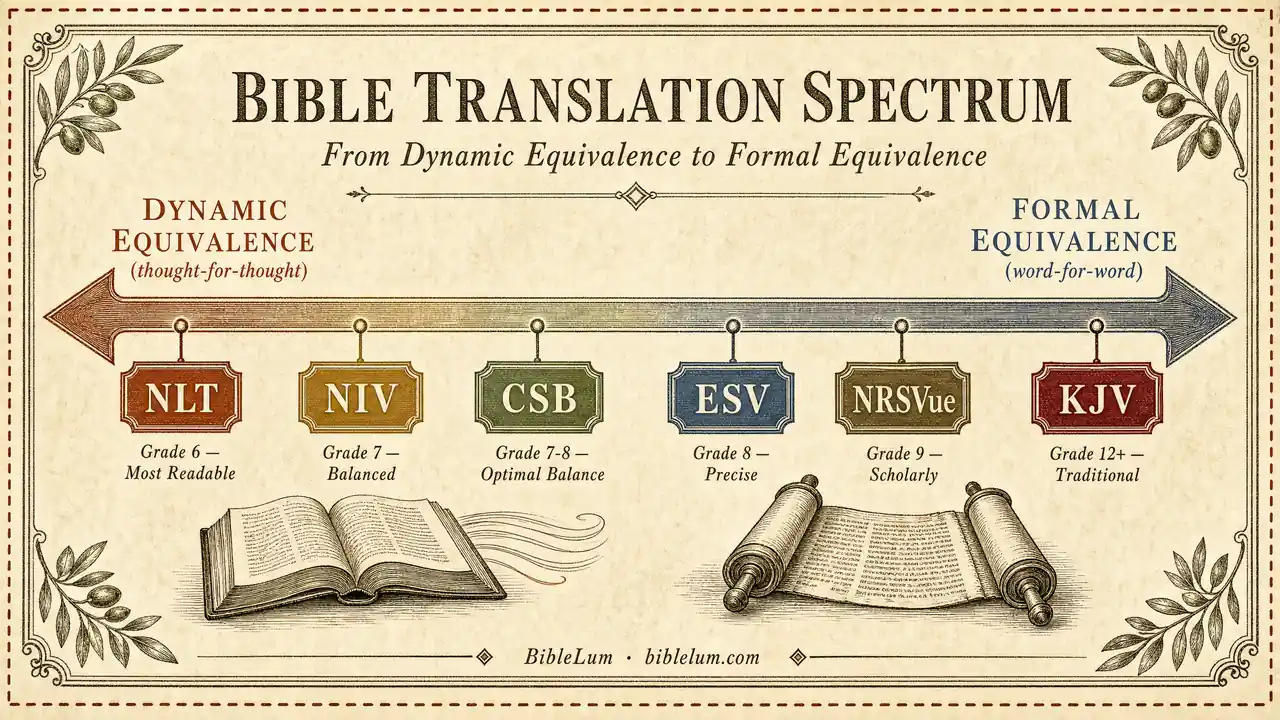
Every modern Bible translation lands somewhere on a spectrum between two competing goals: staying as close as possible to the original Hebrew or Greek words (formal equivalence) or rendering the meaning of the original in natural contemporary English (dynamic equivalence). A third category, paraphrase, takes greater liberties with the text in exchange for accessibility.
- Formal equivalence (word-for-word) — Translates each word and grammatical structure as literally as English allows. Strengths: precision, useful for word-by-word study, preserves original imagery. Trade-off: can feel stiff or archaic. Examples: ESV, NASB, NRSVue, KJV.
- Dynamic equivalence (thought-for-thought) — Translates the meaning of phrases and sentences rather than individual words. Strengths: reads smoothly, easier for first-time readers, captures idioms naturally. Trade-off: more interpretive choices baked in. Examples: NLT, NIV (leans dynamic).
- Paraphrase — Re-expresses the original in completely contemporary language, sometimes even rephrasing entire sentences. Strengths: very accessible, can refresh familiar passages. Trade-off: paraphrases reflect the paraphraser's interpretation strongly. Examples: The Message, J.B. Phillips New Testament.
The formal vs. dynamic distinction was made famous by linguist Eugene Nida in the 1960s[2], whose work shaped nearly every modern translation. Nida argued that the goal of translation is not to reproduce the form of the original but to produce the same effect on the modern reader that the original had on its first audience. Almost every translation since has had to decide where on this spectrum it sits.
| Philosophy | Approach | Best For | Example Translations |
|---|---|---|---|
| Formal equivalence | Word-for-word — preserves original structure | Word-by-word study, preaching, careful theological reading | ESV, NASB, NRSVue, KJV |
| Dynamic equivalence | Thought-for-thought — preserves meaning | First reading, narrative books, devotional reading | NIV, NLT, CSB |
| Paraphrase | Idiomatic re-expression — reflects paraphraser's reading | Re-reading familiar passages with fresh eyes | The Message, J.B. Phillips |
For a beginner, the practical implication is this: start with a translation that leans dynamic (NIV or NLT) for your first reading, because momentum matters more than literalism when you are still building familiarity. Add a more formal translation (ESV or NRSVue) later, once you have the big story in your head and want to study specific passages closely.
Reading Level Comparison: Which Translations Are Easiest?
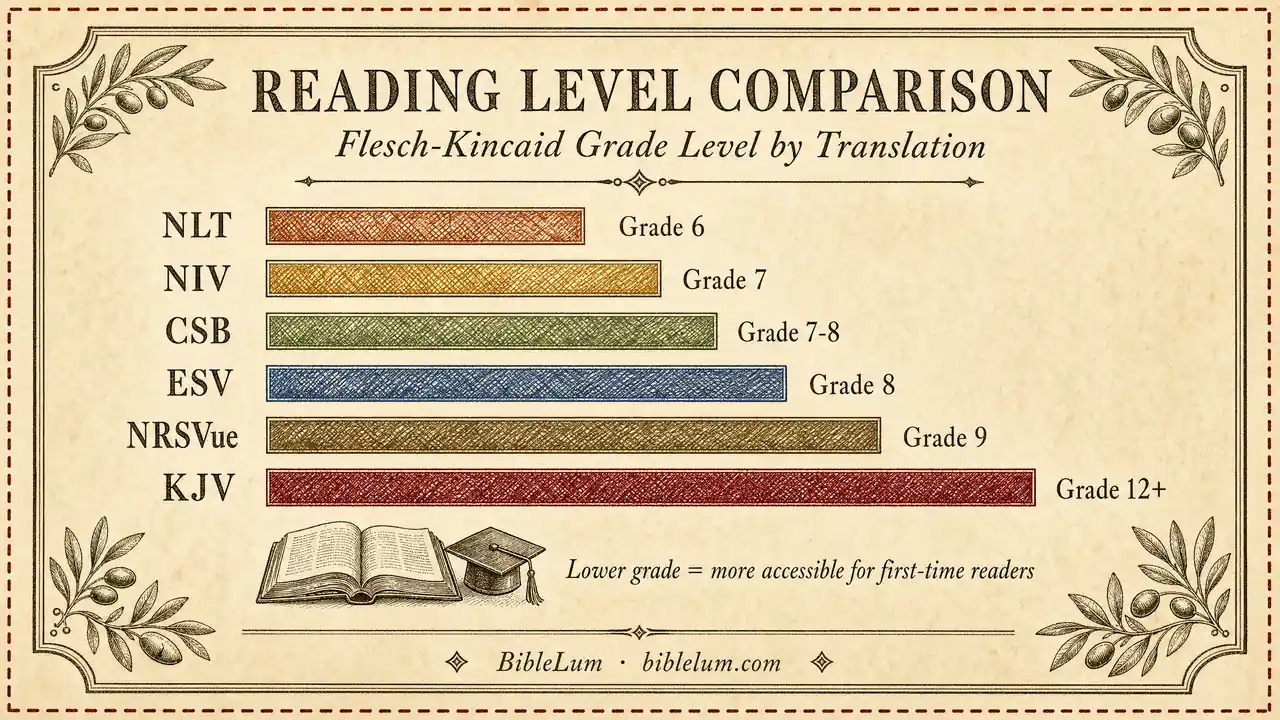
Reading level is the single most useful filter when choosing a beginner translation. The Flesch-Kincaid grade level[1] is the standard measure: it estimates the US school grade a reader would need to comprehend a text on first reading. Lower numbers mean easier reading.
| Translation | Approx. reading level | Year completed | Tradition |
|---|---|---|---|
| NLT (New Living Translation) | 6th grade | 1996 (rev. 2015) | Evangelical, ecumenical |
| CSB (Christian Standard Bible) | 7th grade | 2017 | Southern Baptist origin, broad evangelical use |
| NIV (New International Version) | 7th–8th grade | 1978 (rev. 2011) | Mainstream evangelical |
| ESV (English Standard Version) | 8th–10th grade | 2001 (rev. 2016) | Conservative evangelical, RSV lineage |
| NRSVue (NRSV updated edition) | 10th–11th grade | 2022 | Mainline Protestant, Catholic, Orthodox, academic |
| KJV (King James Version) | 12th grade+ | 1611 (Authorized 1769) | Historic Anglican, broad Protestant |
These are approximations — reading level varies passage by passage. A psalm written in Hebrew poetry will score differently from a Pauline argument or a narrative chapter. But as a general guide, the table above tells you which translations to expect to find easier on first reading and which to approach later.
Five Beginner-Friendly English Translations Compared
These five are the most commonly recommended translations for first-time English Bible readers. Each has a clear identity. The right one for you depends on your goal, your tradition, and how literal you want the reading to feel. The KJV is covered in its own section below as a sixth option — historically important and literarily beautiful, but generally not the right place for a first-time reader to begin.
NIV — The Most Popular Beginner Choice
The New International Version is the best-selling English Bible in the world and the most likely to be quoted in sermons, devotionals, and popular Christian writing. It sits intentionally in the middle of the formal-vs-dynamic spectrum, leaning slightly dynamic. The 2011 revision modernized inclusive language and updated archaic phrasing. Its 7th–8th grade reading level keeps it accessible for first-time readers, while its precision is sufficient for group study and small-group discussion and most personal study tasks. If you are unsure where to start, the NIV is rarely the wrong answer.
NLT — The Most Accessible Modern Translation
The New Living Translation is the most readable mainstream English Bible. It traces back to Kenneth Taylor's Living Bible paraphrase but was rebuilt by a team of 90 scholars working from the original Hebrew and Greek, so it is now a genuine translation rather than a paraphrase. Reading level around 6th grade. The NLT is the strongest first-read choice for readers who have stalled in denser translations or who are reading the Bible primarily for narrative comprehension — Genesis, the Gospels, and Acts. Its trade-off is that it makes more interpretive choices than the NIV — you are reading the translators' interpretation alongside the text.
ESV — Beginner-Friendly Formal Equivalence
The English Standard Version is the most popular formal-equivalence translation among English-speaking evangelicals. It is a 2001 revision of the 1971 Revised Standard Version (RSV), itself a descendant of the King James line. The ESV stays close to the original word order and grammar where English allows, producing a text that rewards careful reading but reads slightly denser than the NIV. Reading level around 8th–10th grade. The ESV is the best beginner choice if you want a more literal translation now rather than later, and a strong fit for readers from Reformed, Presbyterian, Baptist, and broadly conservative-evangelical traditions. It pairs especially well with the four-step Bible study method for beginners when you want to do close word-level study.
CSB — A Modern Hybrid Worth Considering
The Christian Standard Bible is the newest of the mainstream beginner translations (completed 2017). It uses what its translators call "optimal equivalence" — leaning formal where the original is clear, and dynamic where formal renderings would mislead a modern reader. The result is a translation that reads as smoothly as the NIV in most narrative passages but holds onto more of the original's literary structure than the NLT. Reading level around 7th grade. The CSB is gaining adoption in Southern Baptist contexts and increasingly in broader evangelical settings. It is a legitimate contender for first-read among beginners who want a balanced modern feel.
NRSVue — The Academic and Mainline Choice
The New Revised Standard Version Updated Edition (2022) is the standard for academic biblical scholarship and the most widely used translation in mainline Protestant, Catholic, and Orthodox contexts. It is more literal than the NIV but uses gender-inclusive language for human references where the original Hebrew or Greek is itself inclusive. Reading level around 10th–11th grade. The NRSVue is the right beginner translation if you come from a mainline Protestant, Episcopal, Catholic, or academic tradition, or if you want the most up-to-date textual scholarship reflected in your reading. It is denser than the NIV or NLT, so consider pairing it with one of those for your first sweep.
KJV and NKJV: Beautiful but Challenging for First-Time Readers
The King James Version, completed in 1611, is one of the most important works of English literature ever produced. Its rhythms have shaped English prose for four centuries. But it is a 17th-century translation of ancient texts, and its 1611 vocabulary, syntax, and verb forms make it significantly harder to follow as a first read. Words like "thee," "thou," "shalt," "saith," "verily," "behooveth," and "peradventure" appear constantly. Reading level scores around 12th grade and above on Flesch-Kincaid measures.
There is also a textual issue. The KJV was translated from the Greek manuscripts available in 1611 — a manuscript family known as the Textus Receptus[3]. Modern translations use the Critical Text, which incorporates older and more numerous Greek manuscripts discovered since the 19th century. The differences between the two are usually small, but they exist, and most contemporary scholars consider the Critical Text closer to the original.
The New King James Version (1982) updates the 1611 vocabulary while retaining the Textus Receptus base. It is more readable than the KJV but still translates from the older manuscript tradition. If you love the KJV style and want a smoother modern read, the NKJV is the natural step. But for a true first-time reader with no prior attachment to the King James tradition, an NIV or NLT will serve you better.
Paraphrases (The Message, Amplified): When to Use, When to Avoid
A paraphrase is not a translation in the strict sense. It is one author's re-expression of the original in contemporary language, with much greater interpretive freedom than even a dynamic-equivalence translation allows. The two most popular English paraphrases are The Message (Eugene Peterson) and the Amplified Bible.
The Message is one pastor's rendering of the Bible into idiomatic American English. It can be refreshingly clarifying for familiar passages — Romans 8 or the Sermon on the Mount, for example, take on new force when the formal phrasing is stripped away. But because it is one person's interpretation, The Message is a poor primary Bible. Read it alongside a real translation, never instead of one.
The Amplified Bible takes the opposite approach: it inserts multiple possible English meanings for each original word in brackets and parentheses, producing a text that looks like a translator's working notes. The Amplified can be useful for readers who want to see the range of meaning a Hebrew or Greek word carries — but for first-time reading, it is overwhelming. The constant brackets break narrative flow and create a sense that the text is unstable, when in fact most translation choices are settled.
For beginners, the practical rule is simple: use paraphrases as occasional companions, not as primary Bibles. Read a real translation (NIV, NLT, ESV, CSB, NRSVue) for daily reading and study. Reach for The Message or Amplified when you want a fresh angle on a passage you already know.
All Six Translations at a Glance
The table below summarizes the six translations covered in this guide. Use it as a quick reference when you are choosing — and remember that the best beginner translation is the one you will actually read consistently.
| Translation | Reading level | Philosophy | Best for | First published |
|---|---|---|---|---|
| NIV | 7th–8th grade | Mediating (slight dynamic lean) | General first reading, group study, mainstream evangelical use | 1978 |
| NLT | 6th grade | Dynamic equivalence | First reading, narrative books, readers who have stalled before | 1996 |
| ESV | 8th–10th grade | Formal equivalence | Word-by-word study, conservative evangelical and Reformed contexts | 2001 |
| CSB | 7th grade | "Optimal equivalence" (balanced) | A modern alternative to NIV with smoother readability than ESV | 2017 |
| NRSVue | 10th–11th grade | Formal equivalence with inclusive language | Mainline Protestant, Catholic, academic, ecumenical reading | 2022 |
| KJV | 12th grade+ | Formal equivalence, 1611 English | Literary appreciation, congregations with KJV tradition | 1611 |
John 3:16 in Four Translations
Abstract comparisons help, but translation differences become clearest when you read the same passage in several Bible apps or printed editions. John 3:16 is a useful test case because every translation team has had to make careful choices about how to render it.
| Translation | What to notice when you read John 3:16 |
|---|---|
| KJV (1611) | Its historic diction and cadence; compare its vocabulary with a contemporary translation. |
| ESV (2001) | A more formal approach to sentence structure and theological terms. |
| NIV (2011) | A contemporary, balanced rendering designed for clarity and public reading. |
| NLT (2015) | A more dynamically phrased rendering that emphasizes natural contemporary English. |
For a word-for-word comparison, read John 3:16 in the official app, website, or printed edition for each translation. Translation copyrights belong to their respective publishers.
Several differences are visible at a glance. The KJV uses "begotten" (a word with specific theological weight in 17th-century English that few modern readers would recognize) and "everlasting" rather than "eternal." The ESV preserves the KJV's sentence structure ("For God so loved the world, that...") but updates the vocabulary. The NIV moves to "one and only Son" — a phrase that captures the sense of the Greek monogenes more directly than "begotten." The NLT goes further: it restructures the sentence entirely ("For this is how God loved the world:") to make the logical flow easier for a modern English reader to follow on first reading.
None of these renderings is "wrong" — they reflect different choices about what to optimize for. The KJV preserves a specific tradition of English-language religious diction. The ESV stays close to the Greek word order. The NIV smooths the syntax while keeping the literary feel. The NLT prioritizes a first-time reader's comprehension above all. For a beginner, the NIV or NLT will usually feel the clearest on first reading; the ESV becomes valuable later when you want to study the passage more closely; and the KJV is best appreciated alongside one of the modern translations rather than instead of one.
This single-verse exercise is also a useful habit to build. When a passage feels confusing in your primary translation, looking it up in one or two others often clarifies the meaning faster than any commentary. The differences between translations are not bugs in the system — they are a feature that gives you multiple windows into the same text.
How to Choose: A Simple Decision Path
If you are still undecided after reading the comparisons, the following decision path will get you to a translation in under a minute. Each step narrows the field.
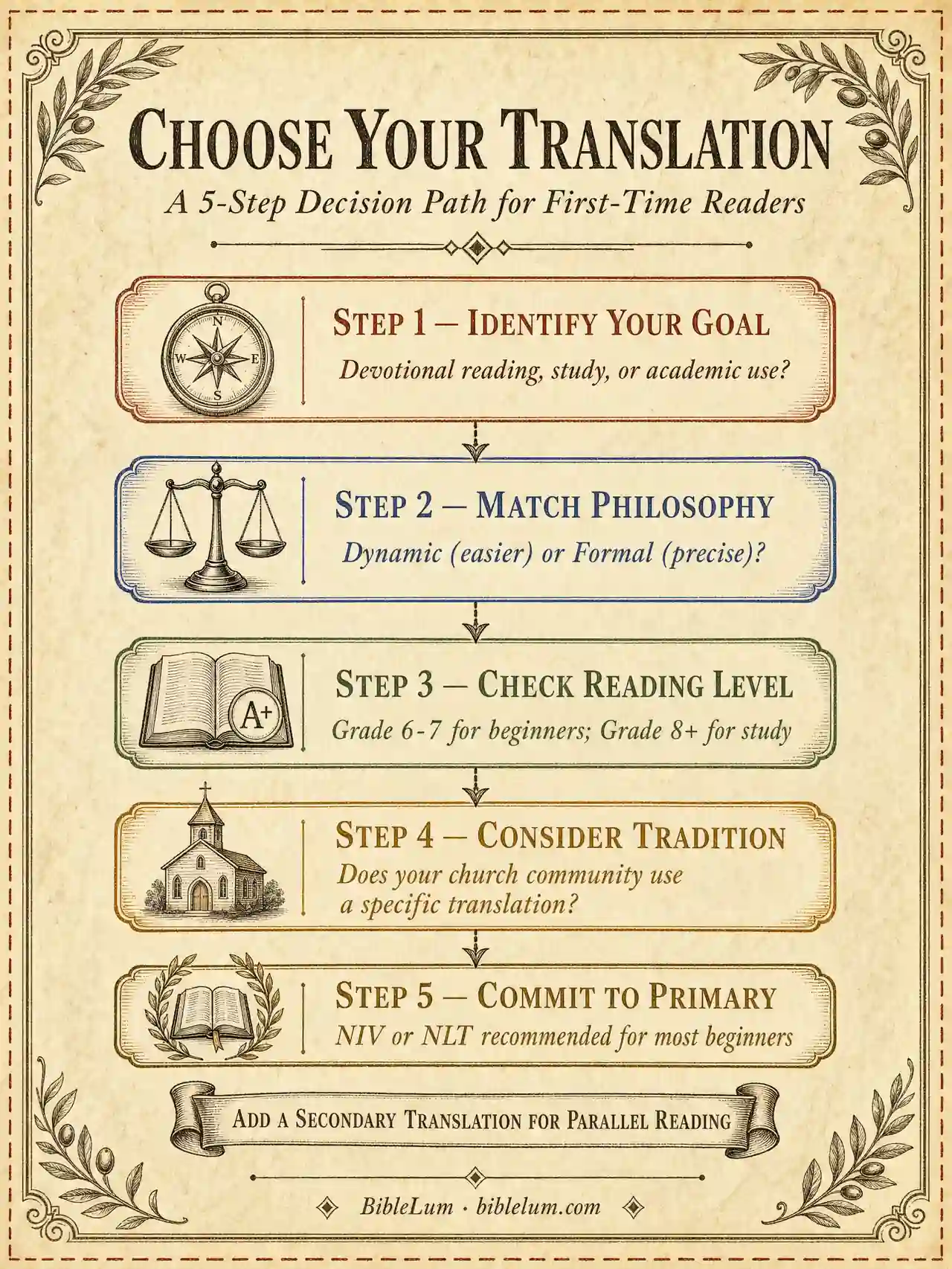
- Identify your primary goal. If it is "read the Bible all the way through," prioritize readability — go to step 2. If it is "study individual passages closely," prioritize literalism — go to step 3. If it is "use what my church or small group uses," ask before reading further.
- For readability-first reading: pick NLT if you have stalled in denser translations, or NIV if you want the most widely shared evangelical translation.
- For literal study reading: pick ESV if you come from a conservative evangelical tradition, or NRSVue if you come from a mainline, Catholic, or academic background.
- Consider your tradition. Reformed, Baptist, broadly evangelical → ESV or CSB. Mainline Protestant, Episcopal, Catholic, Orthodox → NRSVue. Charismatic or Pentecostal → NIV or NLT (rarely a denominational signal). KJV-tradition congregation → NKJV.
- Pick a primary translation and start. Optionally add a secondary translation for parallel reading later — see the next section. The goal is consistency: a translation you will actually read every day beats a "more accurate" one that sits on the shelf. Once your translation is chosen, the Bible Reading Plan for Beginners gives you a 30-day starter sequence.
A good rule of thumb: choose your primary translation in five minutes, start reading today, and revisit the choice in three months once you have actual reading experience to inform it. Most beginners switch translations once or twice in the first year, and that is fine — each switch is a sign of growing literacy.
Should You Read Multiple Translations Together?
Reading multiple translations in parallel is one of the most underrated practices for both beginners and serious students. Each translation makes interpretive choices, and the choices are visible only when you compare them. A passage that feels flat in one translation can come alive in another. A word that seemed obvious in the NLT may turn out to carry weight you missed when you check the ESV.
For beginners, the most effective parallel pairing is one dynamic translation (NLT or NIV) for first reading and one formal translation (ESV or NRSVue) for closer review. Read the dynamic version first to get the meaning and momentum, then re-read the same passage in the formal version to see the literary structure that the dynamic version smoothed. Apps like BibleLum, BibleGateway, and YouVersion make parallel reading easy — you can compare verses across translations in seconds.
You do not need to do this every day. Save parallel reading for passages where the meaning matters most — the parables, key theological arguments, narrative climaxes. For most chapters, your primary translation alone is enough. The goal is to read the Bible consistently, not to optimize every verse.
Once you have chosen a translation, the next question is where to start reading. The Where to Start in the Bible for Beginners guide compares the five most-recommended starting points. If you want a structured path through all 66 books, the Bible Reading Plan for Beginners outlines a 30-day starter and the BibleLum 300-day journey. And if you want the full beginner overview, start with the Bible Study for Beginners guide.