
Why the Distinction Matters
Most beginners conflate reading and study, then quit when neither produces what they hoped for. They open the Bible expecting depth from the first page, get frustrated when Genesis 5's genealogies feel meaningless, and conclude they "just don't understand the Bible." The 2023 Barna State of the Bible report documents the accessibility side of this — the most-cited barrier among interested adults is not theological but practical ("I don't know where to start"). Our reading: that accessibility gap is partly about which practice the reader is using, not just whether they're reading. The problem is rarely the reader and almost never the text. The problem is using the wrong practice for the moment.
Reading and study are different practices because they answer different questions. Reading answers "What is this Bible saying as a whole?" Study answers "What does this passage mean, and what does it require of me?" The first is necessary before the second is possible — you cannot meaningfully study Romans 8 without first having read enough of the Old Testament to know what "righteousness" and "covenant" mean in the canon. But the second is necessary for transformation — reading without study eventually plateaus into mere familiarity.
Recognizing the distinction is the most useful single move a beginner can make. It frees the daily reading session from the pressure to produce theological insight, and it frees the study session from the pressure to be sustained day after day. You read every day. You study some days. Both are real engagement with Scripture; neither is the inferior version of the other.
What Bible Reading Is
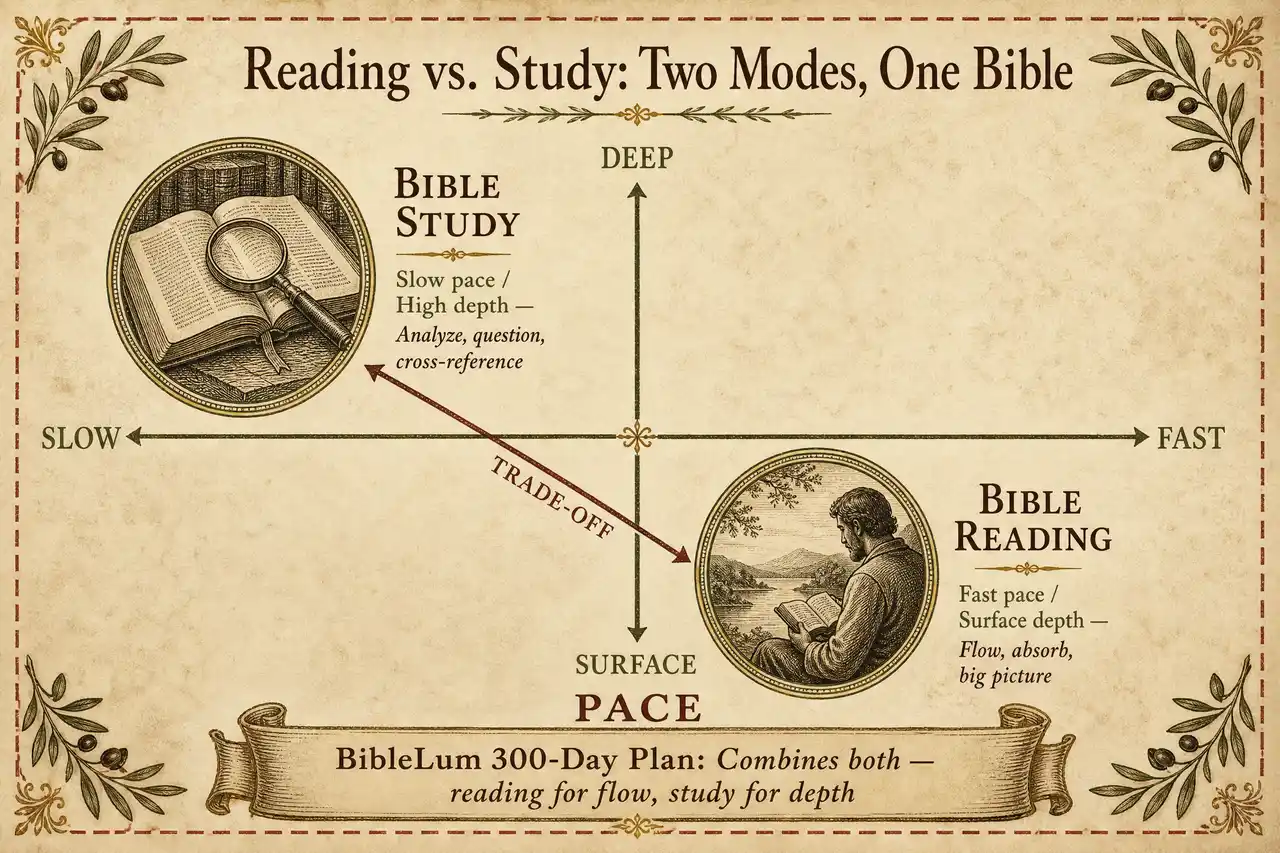
Bible reading is the practice of taking in Scripture at the pace of ordinary reading — usually one to three chapters at a sitting, in a translation comfortable enough that you don't stop every other verse to look something up. It is closer to reading a novel than to reading a textbook. The goal is not analysis. The goal is encounter: to let the text's own voice, its narrative arcs, its repeating images, and its overall shape settle into you over time.
Reading does most of its work cumulatively rather than in any single session. After thirty days of daily reading, you have a feel for the Bible's big story — creation, fall, covenant, exodus, kingdom, exile, Christ, church, new creation — that no amount of in-depth study on a single chapter can give you. This canonical map[3] is what makes individual passages interpretable when you do later sit down to study them. Reading first, study second is not a shortcut; it is the right order.
For most beginners, daily reading sessions of 10–15 minutes are the sustainable rhythm. Less than that and the canonical sweep stays out of reach. More than that, day after day, and most readers cannot maintain the pace. The BibleLum 300-day journey is built around this length: roughly fifteen minutes a day, organized to introduce the big story's key books in a sequence designed to keep momentum.
What Bible Study Is
Bible study is the practice of analyzing Scripture — slowing down to ask what a passage is actually doing, what it would have meant to its first audience, and what it requires of you now. The classical method has three movements: observation (what does the text say?), interpretation (what does it mean in its context?), and application (what does it require of me?). This three-step structure is sometimes called the OIA method[1] or, in slightly different form, inductive Bible study.
Study works on smaller portions than reading does. Where reading takes a chapter at a time, study takes a paragraph or even a single verse and stays with it long enough to see what is there. A typical study session works through a passage of 5–20 verses in 30–60 minutes, slowly enough to notice repeated words, structural shifts, and the argument the author is making. This is the practice that builds doctrinal depth and personal application — the place where reading's familiarity converts into transformation.
Study benefits from tools that reading does not require. A study Bible with cross-references and historical introductions, a basic concordance for tracing themes, and at least one trusted commentary on the book you are studying — these are not strictly necessary to start, but they multiply the depth you can reach. The four-step beginner method described in How to Study the Bible for Beginners adapts the classical OIA framework into a structure first-time readers can use without any commentary at all.
Reading vs Study: A Side-by-Side Comparison
The clearest way to see the distinction is to put both practices in the same frame. The differences are not about which is "real" Bible engagement. They are about which question each practice answers, and how each one builds the other.
| Dimension | Bible Reading | Bible Study |
|---|---|---|
| Goal | Encounter — let Scripture's own voice and shape settle in | Understanding — analyze a passage on its own terms |
| Pace | Normal reading speed; 1–3 chapters per sitting | Slow; 5–20 verses per session |
| Time per session | 10–15 minutes | 30–60 minutes |
| Frequency | Daily | Some days (often weekly), in addition to reading |
| Tools needed | A readable translation | Study Bible, concordance, commentary, original-language helps (optional) |
| Primary question | "What is this Bible saying as a whole?" | "What does this passage mean, and what does it require?" |
| Output | Cumulative familiarity with the canonical sweep | Specific interpretive and applicational insight on a passage |
| Best for | Building the map; daily devotional rhythm; first 30 days | Filling in detail; group discussion; deeper formation after the map exists |
Four Modes of Engaging Scripture
Inside the broader reading vs study distinction, there are four common modes of engaging the Bible. Knowing which one you are in helps you pick the right method, time, and tools — and prevents the frustration of trying to do, say, devotional reading when the moment actually calls for inductive study.
Devotional Reading
Devotional reading is a slow, prayer-shaped reading of a short passage with the goal of personal encounter. It is closer to lectio divina[2] than to academic study: read the passage, then read it again more slowly, then sit with one phrase that catches your attention and let it shape your prayer. Devotional reading does not require commentary, a study Bible, or original-language tools. A typical session is 5–15 minutes and works on whatever the daily reading plan or your own intuition surfaces.
Inductive Bible Study
Inductive study is the rigorous, three-step practice of letting the text speak on its own terms before applying it. Observation: what does the text actually say — who, what, when, where, how? Interpretation: what does it mean, given its original context, genre, and place in the biblical story? Application: what does it require of me, here? This is the method most useful for serious study, group discussion, and avoiding the common error of reading your assumptions into the text (eisegesis). A typical inductive session takes 30–60 minutes and works through a single passage of 5–20 verses.
Topical Bible Study
Topical study traces a theme — covenant, suffering, the Holy Spirit, identity in Christ — across multiple passages and books, often guided by a concordance or topical index. The goal is canonical understanding: what does the whole Bible say about this subject? Topical study is especially useful for answering life-stage questions ("What does the Bible teach about marriage?" or "How does Scripture frame suffering?") and for building doctrinal depth on a single concept. A typical session takes 45–90 minutes and may continue across multiple sessions on the same topic.
Word / Original-Language Study
Word study is the practice of examining a key Greek or Hebrew word's full range of meaning across its biblical occurrences — using a concordance[4], lexicon, or interlinear. The goal is to recover nuance that English translation, however faithful, smooths out. For example, the Greek word "δικαιοσύνη" (dikaiosunē) is translated "righteousness" but carries connotations of both moral rightness and covenant faithfulness — distinctions that affect how Romans 1–4 should be read. Free tools like Blue Letter Bible make Strong's Concordance and interlinear texts available without language training. Word study is best reserved for passages where the meaning hinges on a specific term, and it pairs naturally with inductive study rather than replacing it.
The Common Mistake: Skipping Reading and Jumping to Study
The most common pattern of frustration among new Bible readers is to skip the reading phase and try to do inductive study immediately. They open Romans, hit "the righteousness of God is revealed from faith for faith" in chapter 1, and stall — because they don't yet have the canonical context that makes that phrase meaningful. The phrase assumes you know who Israel was, what the covenant promised, why faithfulness mattered to Abraham, and how the prophets framed the failure of national righteousness. None of that is content you can absorb by analyzing Romans 1 alone.
The fix is sequencing. Read first to build the canonical map. Then study to fill in the detail. The first thirty days of the Bible Reading Plan for Beginners is designed exactly for this — a guided path through Genesis, Exodus, Psalms, and the opening of Mark, so you have the framework that makes any later study session productive.
The Sustainable Pattern: Daily Reading + Weekly Study
For most beginners, the sustainable long-term pattern is daily reading plus weekly study — not daily study, not reading without study. Daily reading at 10–15 minutes builds and maintains the canonical map. Weekly study at 45–60 minutes goes deep on a chosen passage, often one of the verses or paragraphs that surfaced during the week's reading. This rhythm is realistic for working adults, reinforces both practices, and prevents the burnout that follows from trying to do study-level work every day.
A simple weekly cadence: Monday through Saturday, read the day's assigned chapters at normal pace; on Saturday or Sunday, pick the passage that struck you most deeply and study it inductively for an hour. Many serious readers add a second study session midweek if a small group meeting requires preparation. The point is not the specific schedule. The point is the disproportion: most engagement is reading, occasional engagement is study.
Beginner Sequence: When to Add Each
A first-time Bible reader doesn't need to start both practices on day one. Adding study too early produces frustration; adding it too late lets reading plateau into mere familiarity without depth. The sequence below has worked for many beginners.
- Days 1–14: Reading only. Read 10–15 minutes daily. Don't stop to look things up. Use a readable translation (NLT or NIV). Goal: build comfort with daily Bible engagement and start the canonical map. Skip nothing; trust that confusing passages will resolve later.
- Days 15–30: Reading + curious questions. Continue daily reading, but start jotting questions in a notebook as they surface — "Why did God command this?" "How does this story connect to Jesus?" Don't answer the questions yet. Just collect them. This habit primes you for study later.
- Days 31–60: Add light study once a week. Pick one passage from the week's reading that produced your strongest question. Spend 30 minutes on it: re-read slowly, write what you observe, then write what you think it means and why. Don't worry about getting it right — the practice itself builds the muscle.
- Day 61 onward: Daily reading + weekly inductive study. Now you're in the sustainable rhythm. Daily reading continues; weekly study sessions extend to 45–60 minutes and use the full OIA framework. At this point, adding a study Bible (e.g., the ESV or NIV Study Bible) starts to pay off.
This is not a strict timeline — many readers compress the early phases or extend them. The principle is sequencing: reading first to build the map, then study added in increasing depth as the map becomes familiar. Trying to do both at full intensity from day one is the single most common cause of beginner Bible-study burnout.
Tools You Need (and Don't Need)
One of the most useful side effects of distinguishing reading from study is that it clarifies what tools each one actually requires. Reading needs almost nothing. Study benefits from a small, well-chosen set of resources. Buying a study Bible before you have read for thirty days is a common purchase regret; not buying one when you have read for six months and want to go deeper is a different kind of regret.
| Resource | For Reading | For Study |
|---|---|---|
| Readable translation (NIV / NLT) | Required | Optional secondary |
| Formal translation (ESV / NRSVue) | Optional | Recommended for inductive work |
| Study Bible with cross-references | Not needed | Highly useful |
| Concordance (e.g., Strong's) | Not needed | Useful for word study and topical study |
| Single-volume commentary (e.g., New Bible Commentary) | Not needed | Useful for confirming interpretations |
| Original-language tools (interlinear, lexicon) | Not needed | Optional, for word study |
| Notebook or journal | Useful for collecting questions | Essential — observation/interpretation/application notes |
| Reading plan | Strongly recommended | Less critical (you choose the passage) |
For first-time readers, the entire toolkit for the first month is a readable translation and a notebook. That's it. The rest of the table is what you add as study sessions become a regular part of your rhythm.
Putting It Together
Bible reading and Bible study are not competitors and not interchangeable. Reading is the canonical sweep. Study is the deep dive. For sustainable Bible engagement over months and years, you need both — but in different proportions and at different paces. Daily reading at 10–15 minutes; weekly study at 45–60. Reading first to build the map, then study added once the map is familiar.
A practical way to combine the two practices in a single sitting: read a chapter at normal pace (5–10 minutes), then pick one or two verses that stood out and stay with them more closely (10–15 minutes) — observation, interpretation, application. The combined session captures both the canonical sweep and the focused depth without requiring two separate disciplines. Most beginners find this rhythm sustainable for months, and several BibleLum resources support it: How to Start Reading the Bible covers the reading side, How to Study the Bible for Beginners explains the four-step study method, and the 300-day journey structures the same pattern day by day for readers who want a guided path (Day 1 is free, no signup required).