This page gives any new reader a 30-day starter schedule. If you are looking for a personal reading rhythm that explicitly connects a path through all 66 books with questions from everyday life, see the Bible Reading Plan for Women. Both paths begin in Scripture; choose the one that answers your next question.
Why a Schedule Alone Is Not Enough
Many beginners search for a beginner plan because they want to start but do not know where. That is a good instinct. A plan gives you direction. But a schedule alone is not always enough. A good guided path for beginners should do more than tell you what chapters to read. It should help you understand where you are in the story, why the passage matters, and how to keep going when the Bible feels unfamiliar.
Why Many Reading Plans Fail Beginners
Most reading plans are built around a simple idea: read a certain number of chapters each day, and you will finish the Bible in a year. That structure works for experienced readers who already know the big story. For beginners, it often leads to frustration and giving up.
Five Common Failure Modes
- Too much reading too soon — Starting with three or four chapters a day can feel overwhelming before you have any sense of the overall story.
- No explanation — A plan tells you what to read, but not what it means or why it matters.
- Getting stuck in Leviticus and Numbers — These books are full of laws and lists that are hard to follow without background context.
- No sense of progress — Reading chapters in isolation makes it hard to feel like you are moving forward.
- No reflection — Without a moment to pause and respond, the reading can feel like a task rather than a conversation.
None of this means you are bad at reading the Bible. It means most beginner plans were not designed with beginners in mind.
What Makes a Good Reading Plan for Beginners?
A good beginner plan does more than fill a calendar. It builds momentum, gives context, and respects the limits of attention.
Five Markers of a Beginner-Friendly Plan
- Short daily sessions — Ten to fifteen minutes a day is enough to build a habit. Long sessions can feel like homework. Research on spaced reading[4] shows that distributing engagement across daily short sessions produces better retention than infrequent long ones.
- Clear context before each reading — A short summary or introduction helps you understand what you are about to read and why it matters.
- A path through the Bible's big story — The Bible is not one book. It is a library of 66 books that tell one connected story. A good plan helps you see that connection.
- Variety — Moving between narrative, poetry, gospel, and letters keeps the reading fresh and shows you the different ways the Bible communicates.
- Reflection — A question or prompt at the end of each session helps you respond personally, not just read passively.
When a plan has these elements, it stops feeling like a checklist and starts feeling like a journey.
Should Beginners Start at the Beginning and Read All the Way Through?
This is one of the most common questions beginners ask. The short answer is: the opening book of the Bible is a great place to start, but reading straight through (a practice known as lectio continua[2], following the canonical order[3] of the printed Bible) can become difficult.
The opening chapters of Scripture give you the foundation of the entire Bible's story — creation, the fall, the first covenant, and the promise that runs through everything that follows.
The challenge comes around Exodus chapter 20, when the narrative slows down and gives way to long sections of law. Leviticus and Numbers can feel like walls for a new reader who does not yet have the context to understand why these laws exist.
A guided sequence solves this. Instead of reading every chapter in order, a thoughtful plan moves you through the big story while mixing in psalms, proverbs, and gospel passages to keep the reading varied and meaningful. If you want a fuller explanation of where to begin, our guide on how to start reading the Bible walks through the reasoning in detail.
A 7-Day Starter: Try the Rhythm Before Committing
Before committing to thirty or three hundred days, try one week. A 7-day starter plan lets you test whether daily Bible reading fits your schedule, your attention, and your life — without locking you into a longer commitment. Most beginners who quit a long plan would have benefited from this one-week test first.
A reasonable 7-day starter looks like this:
| Day | Passage | Why this passage |
|---|---|---|
| Day 1 | Genesis 1–2 | Creation as the foundation of the Bible's story |
| Day 2 | Genesis 3 | The fall — the problem the rest of Scripture addresses |
| Day 3 | Genesis 12:1–9 | The covenant with Abraham — the promise that runs through everything |
| Day 4 | Psalm 1 | Two ways of life, in compact poetic form |
| Day 5 | Mark 1 | The opening of Jesus's ministry, in the shortest Gospel |
| Day 6 | Mark 4:1–34 | The parables of the kingdom — Jesus's primary teaching method |
| Day 7 | Mark 14–15 | The crucifixion narrative — the climax of the Gospel story |
Each session is 10–15 minutes. Read the passage once at normal pace; if a phrase catches you, re-read it slowly. Don't look anything up unless you want to. The goal of week one is not understanding everything — it is finding out whether daily Bible reading fits your life. If yes, continue with the 30-day plan below. If not, the seven days were still worthwhile: you have begun to notice what kind of pace and support helps you stay present with Scripture.
Want to experience the guided format with a little more context? A five-minute lesson gives you a passage, its main idea, and a quick check. No preparation is required.
A Simple 30-Day Bible Reading Plan for Beginners
If you want to try a beginner reading path before committing to a longer journey, here is a simple 30-day starter. It follows the actual opening sequence of the BibleLum 300-day journey, so you can pick up where you left off.
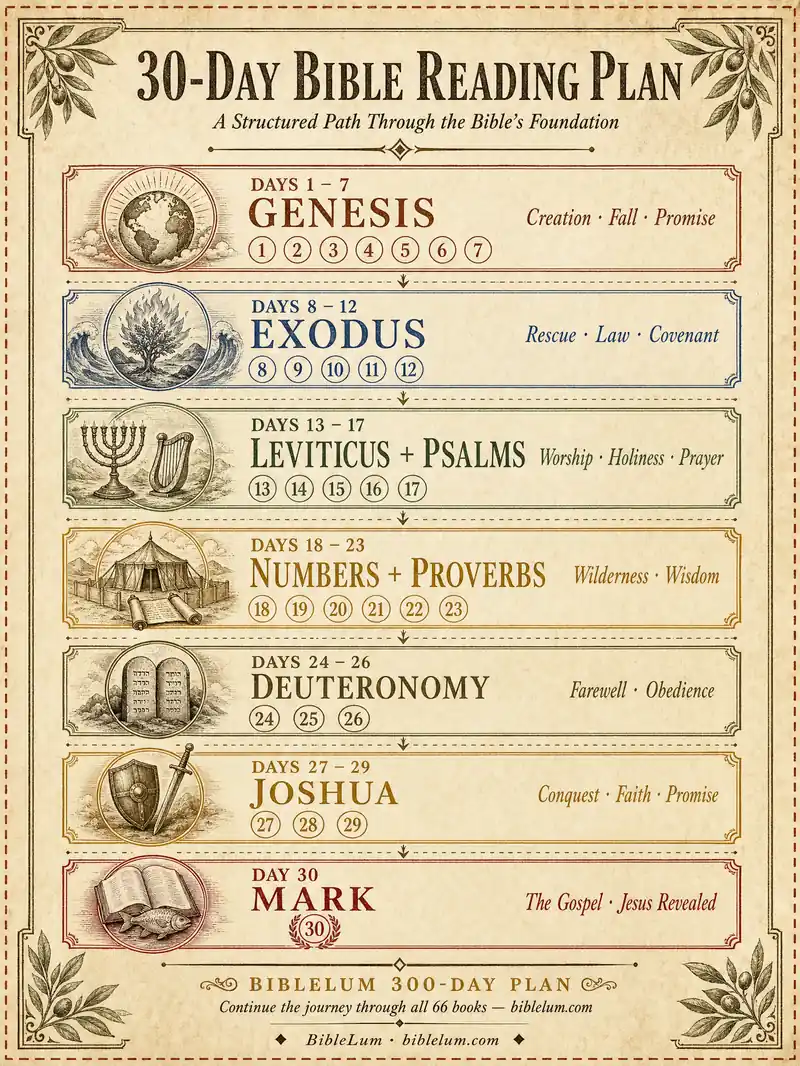
- Days 1–7: The First Book — Creation, the fall, Noah, Abraham, and the covenant promise.
- Days 8–12: Exodus — The rescue from Egypt, the Passover, the Ten Commandments, and the tabernacle.
- Days 13–17: Leviticus and Psalms — Holiness and prayer, read together so the laws are balanced by worship.
- Days 18–23: Numbers and Proverbs — The wilderness journey and practical wisdom for daily life.
- Days 24–26: Deuteronomy — Covenant renewal and Moses' final words to Israel.
- Days 27–29: Joshua — Entering the promised land and the faithfulness of God.
- Day 30: Mark begins — The opening of Jesus' ministry in the New Testament.
This 30-day plan gives you a real taste of the Bible's big story — from creation to the beginning of the New Testament. Each section builds on the one before it, so you are not reading in isolation.
A Bible reading plan tells you what to read and helps you build familiarity with Scripture. A Bible study plan slows down over a smaller passage to ask what it means in context. Start here when you need a daily sequence; when you are ready to look more closely at a passage, use the 4-step beginner Bible study method.
The BibleLum 300-Day Bible Reading Plan
BibleLum's 300-day journey is designed for beginners who need more than a checklist. It covers all 66 books of the Bible across 300 days, with short conversational lessons that give you context, a clear main idea, a quick check, and a reflection prompt for each session.
Each day is designed to take about ten to fifteen minutes. You are not left alone with a long chapter and no guidance.
The first three days are free, so you can try the experience before committing. There is no prior Bible knowledge required, and no theology background needed. You just need an open mind and a few minutes each day. You can start the journey here.
How the 300-Day Plan Is Structured
The 300-day journey is organized into three phases, each building on the last.
Three Phases of the 300-Day Journey
- Phase 1: Foundations (Days 1–100) — The Old Testament narrative from the first book through the prophets, giving you the foundation of the whole story.
- Phase 2: Depth (Days 101–200) — The wisdom books, the minor prophets, and the Gospels, showing you how the story deepens and points forward.
- Phase 3: Completion (Days 201–300) — Acts, the letters, and Revelation, completing the story from the early church to the end of Scripture.
Each phase is designed so that you always know where you are in the big story. If you want to understand how the lessons are built, how BibleLum works explains the structure in more detail.
How to Recover After Missing Days
The single most common reason beginners abandon a Bible reading plan is not loss of interest. It is missed days. The reader skips one day, then two, then opens the plan a week later and discovers they are seven readings behind. Faced with the gap, most readers do nothing — and the plan ends.
There are three sustainable ways to handle missed days. Each one preserves the plan; the worst response is the one most beginners default to (trying to catch up by doubling and tripling readings until the plan feels punitive).
- Skip the missed days and resume on today's date. This is the most sustainable response for most readers. The plan is a guide, not a contract. If today is Day 12 of the calendar, read today's passage today. The earlier passages are not lost — they're still there if you choose to come back.
- Spread the catch-up across a week. If you missed three days and want to recover, add a 5–10 minute supplementary reading to your normal session for a week. This works only when the gap is small (under five days) and only when you commit to the supplement before resuming.
- Restart the plan from where you stalled. If you missed two weeks or more, the gap is wide enough that restarting is more honest than catching up. Restart on the day you stalled — not Day 1 — and continue forward. Restarts are not failures; they're what serious readers do regularly.
A useful mental model: a Bible reading plan is more like a fitness routine than a deadline. Missing a day in the gym does not mean you have failed at fitness; it means you take the next day. The same is true for a reading plan. Consistency over months matters far more than perfection in any single week.
Chronological, Canonical, or Thematic? Which Plan Format Fits You
Bible reading plans come in three main formats, and beginners often pick whichever one their pastor or app recommends without realizing the formats are designed for different goals. Choosing the format that fits your goal — rather than the most popular one — significantly improves the odds you finish.
| Format | Order | Best for | Trade-off |
|---|---|---|---|
| Canonical | Genesis to Revelation in printed Bible order | Beginners learning the standard structure of the Bible; readers who want to understand how the canon was assembled | Hits Leviticus and Numbers within weeks; many beginners stall here |
| Chronological | Events arranged in approximate historical order (Job inserted into Genesis era, Psalms grouped with David, etc.) | Readers who want to follow the unfolding storyline as it happened; useful for visualizing biblical history | Some books get split across the year; you lose the literary unity of individual books |
| Thematic / Guided | Sequence designed to introduce key books and themes early, varying genre to maintain engagement | First-time readers who need momentum more than completeness; readers who quit canonical plans before | Doesn't cover every chapter; you read parts of all 66 books rather than every verse |
For first-time readers, the thematic / guided format almost always works best. The canonical format works better in year two, once the canonical map is familiar enough that Leviticus is not a wall but a chapter you can navigate with context. Chronological plans are interesting but rarely the right starting point — they're better as a year-three challenge once the story is internalized.
The 30-day starter and 300-day journey above are thematic / guided plans for exactly this reason. They prioritize building the canonical map and finishing the path over covering every chapter in printed order.
Can I Download a Bible Reading Plan PDF?
If you are looking for a free Bible reading plan PDF to print and follow, you are not alone. Many beginners prefer a physical copy they can mark up and carry with them.
BibleLum's full 300-day journey is interactive inside the app, which means the lessons, checks, and reflections are built into each day's experience rather than a static document. However, if you want a printable starting point, the Genesis Study Pack includes printable study notes and journal templates for the first book of the Bible.
For a broader overview of free printable resources, 12 free printable Bible study lessons is a good place to explore.
Starting Is Simpler Than You Think
The most important thing about any beginner plan is that it helps you start and keep going. You do not need to understand everything. You do not need to read fast. You just need a daily rhythm that makes sense and a little guidance along the way.
If you are not sure where to begin, start with the beginner Bible study guide for an overview of how BibleLum approaches the Bible for first-time readers. Or jump straight into Day 1 of the 300-day journey — the first three days are free, and no preparation is needed.