
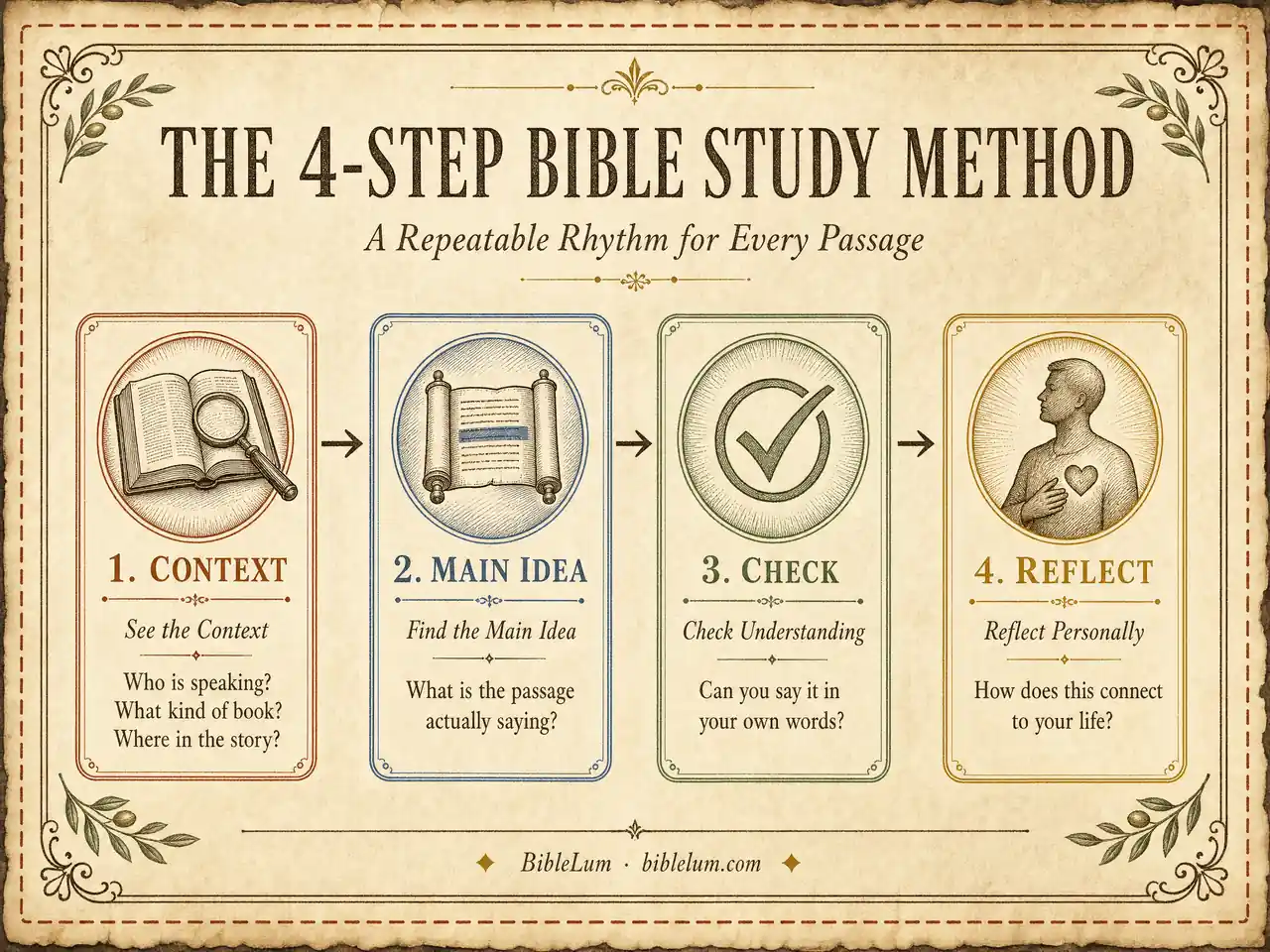
Many beginners want to study the Bible but are not sure what "study" actually means. They may read a chapter, recognize a few familiar verses, and still finish with the uneasy feeling that they missed the point. That feeling is common. The Bible is a library of ancient books, written across many centuries, in several genres[1], with one connected canonical[2] story running through it. A beginner does not need to solve all of that on day one. But a beginner does need a method simple enough to repeat.
This guide focuses on how to study the Bible for beginners, not where to start reading or which long-term plan to follow. If you need help choosing a starting point, see How to Start Reading the Bible. If you want a daily schedule, see Bible Reading Plan for Beginners. Here, the goal is narrower and more practical: a four-step rhythm you can use with a Psalm, a Gospel paragraph, a proverb, or a longer narrative passage.
Bible Reading vs. Bible Study
Bible reading and Bible study belong together, but they are not the same activity. Reading builds familiarity. Study builds understanding. Reading asks, "What did I read?" Study asks, "What does this passage mean in context[3], why does it matter, and how should I respond?"
| Bible Reading | Bible Study |
|---|---|
| Follows a passage | Asks what the passage means |
| Builds familiarity | Builds understanding |
| Can be passive | Requires attention and response |
| Answers "what did I read?" | Answers "what is God showing here?" |
Reading helps you become familiar with Scripture. Study helps you understand what Scripture is saying and why it matters.
This distinction matters because many beginners assume they are failing if they do not understand every detail during ordinary reading. You are not failing. You are simply noticing that reading and studying require different kinds of attention. Reading can be broad and steady. Study is slower, more curious, and more responsive.
The 4-Step Beginner Bible Study Method
A beginner method should be memorable enough to use without a worksheet in front of you. These four steps work because they move in a natural order: before you apply a passage, you need to know where it fits; before you explain it, you need to identify its main idea; before you move on, you need to check whether you actually understood it.
1. See the Context
Start by asking where the passage sits. Who is speaking? Who is being addressed? What kind of book is this: narrative, poetry, wisdom, prophecy, Gospel, or letter? Where does this moment fit in the Bible's larger story? Context does not answer every question, but it prevents the most common mistake: treating a verse as if it dropped out of the sky.
- Who is speaking or writing?
- Who is the original audience?
- What kind of literature am I reading?
- What happened before and after this passage?
- Where does this fit in the larger story of Scripture?
2. Find the Main Idea
After context, look for the passage's center of gravity. What is the passage mainly saying? What does it reveal about God, people, sin, grace, wisdom, faith, or obedience? Try to state the main idea in one sentence. If the sentence is too vague, return to the passage and look for repeated words, contrasts, commands, images, or turning points.
3. Check Your Understanding
A simple check keeps Bible study from becoming guesswork. Can you summarize the passage without copying a verse word for word? Can you explain how your main idea comes from the text itself? What question would you ask yourself after reading? This step is not about taking a test. It is about making sure your interpretation[4] is anchored in the passage.
4. Reflect and Respond
Finally, ask how the passage invites a response. Does it call you to trust, confess, practice, remember, notice, or wait? Reflection is not the same as forcing an immediate life lesson out of every verse. It is the patient work of letting the passage address you. Christian study aims at formation[5], not merely information.
A good beginner method does not rush from reading to application. It moves from context to meaning to understanding to response.
A Simple Example: Psalm 1
Psalm 1 is a good practice passage because it is short, vivid, and placed intentionally at the opening of the Psalms. Read the whole psalm once. Then walk through the four steps slowly.
| Step | Psalm 1 Example |
|---|---|
| Context | Psalm 1 opens the Psalter and introduces two ways of life: the way of the righteous and the way of the wicked. |
| Main Idea | The blessed person is rooted in God's instruction, while the wicked are unstable and passing away. |
| Check | What image describes the blessed person? A tree planted by streams of water. |
| Reflect | Where do I need to become more rooted instead of reactive? What voices are shaping my attention? |
Notice how the method keeps the study grounded. You do not need to know every scholarly debate about the Psalms. You do need to see that this psalm is not merely giving generic advice about being good. It is setting up a contrast between two ways of life and inviting the reader to delight in the Lord's instruction.
The same method works with a Gospel passage such as John 3:16. You would ask where the verse appears in Jesus's conversation with Nicodemus, what the main claim is about God's love and the giving of the Son, how the surrounding verses clarify belief and life, and what response the passage invites. Familiar verses often become clearer when studied in context.
A Worked Example: Romans 12:1–2
Walking the four steps end-to-end on a single passage is the fastest way to feel how the method actually works. Romans 12:1–2 is a useful example because it sits at a hinge in Paul's letter and rewards careful attention without requiring expert tools.
Step 1 — See the Context. Romans 12 is the first chapter of the letter's practical section. Chapters 1–11 build a long argument about God's righteousness, human sin, and the gospel's power. The word "therefore" in 12:1 explicitly connects what follows to what came before. Paul is writing to a mixed Jewish-Gentile church in Rome around AD 57. The passage is a hortatory section in a letter (not narrative or poetry), which means we should expect commands grounded in prior argument.
Step 2 — Find the Main Idea. Two verbs anchor the passage: "present" (your bodies as a living sacrifice) and "be transformed" (by the renewing of your mind). The main idea: in light of God's mercy, Christian formation involves both the body (worship offered as life) and the mind (ongoing renewal). It is not enough to summarize the passage as "be a good Christian" — the passage links worship and thinking, and grounds both in God's prior mercy.
Step 3 — Check Your Understanding. A simple test: can you explain why "therefore" is doing important work? If you can — connecting the practical commands to the theological argument that precedes them — your reading is anchored. If "therefore" feels arbitrary, return to chapters 9–11 (the immediate precedent) to see what mercy Paul is referencing. Another check: do "living sacrifice" and "renewing of your mind" feel like one idea or two unrelated commands? In Paul's argument, they are two facets of the same response.
Step 4 — Reflect and Respond. Where does this passage press on your life? Does it call you to offer something specific as worship — a body, a calendar, a vocation? Does it reveal a place where your mind is conformed to the surrounding culture rather than transformed? Reflection here is not generic. It asks for one specific response anchored in this passage, not in general Christian advice.
Notice what the method does and does not require. It does not require Greek, a commentary, or a study Bible. It does require slowing down to ask context, main idea, check, and response. Most beginners can do this in 30–45 minutes per passage. After a few weeks of practice, the four steps become automatic — not a worksheet but a habit of attention.
Common Beginner Mistakes
Beginners usually do not struggle because they lack sincerity. They struggle because they try to do too much without enough structure. Watch for these common mistakes.
- Trying to understand every detail immediately — Some questions can wait. Start with the main idea before chasing every cross-reference.
- Reading without context — A verse can be true and still be misunderstood when detached from its paragraph, book, or genre.
- Skipping reflection — If you never pause to respond, study remains information only.
- Treating Proverbs like absolute promises — Proverbs gives wisdom principles for ordinary life, not mechanical guarantees that remove complexity.
- Reading difficult passages alone without guidance — Some passages require historical background, a trusted teacher, a study Bible, or a commentary.
- Confusing information with formation — Knowing more facts is valuable, but Scripture also trains attention, desire, wisdom, and trust.
Tools That Help (and Tools You Don't Need)
One reason beginners stall is that they assume they need an expensive software package or a wall of commentaries before they can study. They do not. The four-step method works with a readable translation and a notebook. Tools become useful only when they answer questions the method has already surfaced — not before.
For most beginners, three free tools are enough for the first six months. A study Bible (NIV, ESV, or NLT editions all have inexpensive paperback options) supplies introductory notes and cross-references. A free site like Blue Letter Bible gives you Strong's Concordance and parallel translations without a paid account. A simple notebook captures observations and questions across sessions so the method has memory beyond a single sitting.
Tools you can postpone: an interlinear (helpful only after you know what you're looking for), a Greek or Hebrew lexicon (useful in year two, not month one), and Logos or Accordance (powerful but overwhelming for a first-time study habit). The 2023 Barna State of the Bible report documents that "I don't know where to start" and "language is hard" are the top two barriers to Scripture engagement. Our reading: those barriers are addressed far more by repeated use of a simple method than by buying the next tool.
Best Books to Practice Bible Study as a Beginner
You can use the four-step method anywhere, but some books are especially helpful for practice because their themes are clear and their passages are manageable.
| Book | Why It Helps Beginners |
|---|---|
| John Bible study guide | A clear portrait of who Jesus is, with signs, conversations, and repeated themes such as life, light, belief, and witness. |
| Genesis Bible study guide | The foundation of the Bible's story: creation, the fall, covenant, promise, family, blessing, and exile. |
| Psalms Bible study guide | A training ground for prayer, emotion, lament, praise, trust, and honest speech before God. |
| Proverbs Bible study guide | Short wisdom sayings that help beginners practice context, pattern recognition, and careful application. |
| Romans Bible study guide | A structured letter about sin, grace, faith, righteousness, and life in Christ. |
Do not try to study all five at once. Choose one book, use the method consistently, and let repetition do some of the work. A simple method practiced ten times will teach you more than a complicated method abandoned after two days. That quiet consistency is where confidence begins to grow.
How Long Until Bible Study Feels Natural?
A reasonable expectation: the four-step method feels deliberate for the first ten sessions, becomes a recognizable rhythm by the twentieth, and starts to feel automatic somewhere around the fortieth. Most beginners notice the shift around the second month — not because they've learned more facts, but because they've learned to ask the four questions without thinking about them.
A few things accelerate the transition. Studying the same biblical book for several weeks (rather than jumping between books each session) lets context build cumulatively, so each new passage starts with the previous chapters' insights already in mind. Studying the same passage twice with a few days between sessions almost always reveals something the first reading missed. Writing your one-sentence main idea before consulting any commentary forces the method to do its work — when you check a commentary later, the comparison teaches more than the commentary alone would.
A few things slow it down. Switching translations every session interrupts familiarity with phrasing. Treating every difficult question as something to solve immediately turns study into research. Studying without a notebook means each session starts from scratch instead of building on prior observations.
The honest answer is that Bible study never stops feeling rewarding to attentive readers — but it does stop feeling foreign. By the third month, most beginners describe the four steps as "how I read now," not as a method they're consciously following. That is the goal: not technique, but habit.
How BibleLum Helps Beginners Study
BibleLum follows this same rhythm through short conversational lessons: context, main idea, quick check, and reflection. Instead of leaving beginners alone with long chapters, it guides them through all 66 books in a 300-day journey, reducing overwhelm without reducing depth.
That does not replace your own reading, a church community, a good study Bible, or trusted teachers. It simply gives beginners a repeatable path: learn enough context to begin, check whether the main idea is clear, and reflect on how the passage connects to life. When you are ready, you can start the 300-day Bible study journey.