| Your Goal | Start With | Why | Chapters |
|---|---|---|---|
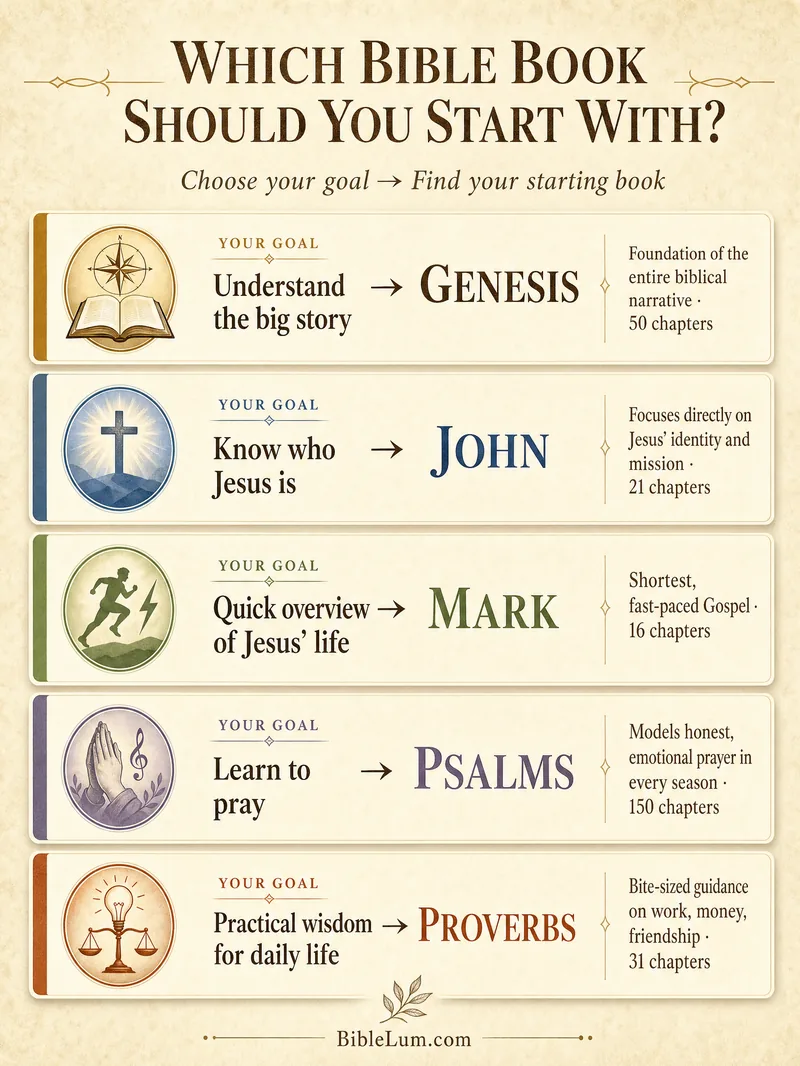
| Understand the big story | Genesis | Foundation of the entire biblical narrative | 50 chapters |
| Know who Jesus is | John | Focuses directly on Jesus' identity and mission | 21 chapters |
| Quick overview of Jesus' life | Mark | Shortest, fast-paced Gospel | 16 chapters |
| Learn to pray | Psalms | Models honest, emotional prayer in every season | 150 chapters |
| Practical wisdom for daily life | Proverbs | Bite-sized guidance on work, money, friendship | 31 chapters |
Genesis vs John: Which Should Most Beginners Choose?
Genesis and John are the two most-recommended starting points, and each fits a different first goal. Use the side-by-side below to decide which one matches what you actually want from your first reading.
| Compare on | Genesis | John |
|---|---|---|
| First scene | "In the beginning God created..." (Genesis 1:1) — creation | "In the beginning was the Word..." (John 1:1) — Jesus |
| Length | 50 chapters | 21 chapters |
| What it teaches you | How the world began, why humans rebel, why God makes promises | Who Jesus is, what he taught, why he died and rose |
| Where it fits | First book of the Old Testament — sets up the whole Bible | Fourth Gospel of the New Testament — focused theological portrait |
| Reading difficulty | Narrative is accessible; later genealogies need patience | Narrative is clear; some discourses are abstract |
| Best if you want | Foundation before encounter | Encounter before foundation |
A useful rule of thumb: if you would rather understand the question the Bible is answering, start with Genesis. If you would rather meet the person the Bible is centered on, start with John. Either is a defensible choice; many readers eventually do both.
Why the Starting Point Matters
The Bible is not a single book you read from beginning to end. It is a library of 66 books that together tell one connected story. But those books were written at different times, in different genres, by different authors, for different audiences — and they were not written to be read in isolation. A reader who opens to Leviticus or Romans without any preparation is like a viewer who walks into a movie halfway through: the events are happening on screen, but the meaning is lost.
This is a pattern most beginner-Bible-reading guides flag: a reader who opens to the wrong book first is more likely to feel overwhelmed and stop within a few weeks, while a reader who chooses a book that fits their goal is more likely to keep going. A bad starting point can make the Bible feel impenetrable; a good one makes it feel like a story you are entering.
The Bible is not a puzzle to be solved by guessing the right piece. It is a story to be entered at the beginning — or at least at a point where you can follow what is happening.
Books to Avoid as Your First Bible Read
Some books of the Bible are essential, but make poor starting points because they assume context you do not yet have. Three are commonly miscast as "first reads" and almost always end the reading habit before it begins:
- Leviticus. A book of priestly laws and ritual instructions written for Israel after the Exodus. Without Genesis and Exodus as backstory, the rules feel arbitrary; with them, the same chapters reveal a vision of holiness. Read it after Genesis–Numbers in sequence, not first.
- Numbers. Long stretches of census data and travel itineraries that only make sense once you understand the Exodus generation and the wilderness narrative. Read after Genesis and Exodus.
- Revelation. A symbolic vision densely woven from Old Testament imagery (Daniel, Ezekiel, Psalms, Isaiah). Without that background, almost every symbol gets misread. Save it for after the Old Testament prophets and at least one Gospel.
Starting in any of these is not wrong — but it usually leads to the kind of confusion that ends the reading habit. The five books recommended in this guide give you a foundation that lets you return to the harder ones later with the context they require.
Genesis: The Foundation of the Entire Story
Genesis is the first book of the Bible, and for most beginners who want to understand the big picture, it is the strongest starting point. Genesis introduces every major theme that the rest of the Bible will develop: creation, the image of God, human rebellion, covenant, promise, and the family line through which God will eventually bring salvation. The Bible Project's free book overview is a useful supplement for first-time readers.
Why Genesis Works for Beginners
- It sets up the whole story. Without Genesis, the rest of the Bible feels like a sequel to a story you have never seen. You read about God's covenant with Abraham (Genesis 12:1–3; 15:18–21) in later books without knowing who Abraham is or why a covenant matters. You read about the Promised Land without knowing why it was promised. Genesis gives you that foundation.
- It is narrative, not legislation. The first 11 chapters are some of the most compelling storytelling in all of Scripture. The stories of creation (Genesis 1–2), the fall (Genesis 3), Noah (Genesis 6–9), and the tower of Babel (Genesis 11) are accessible to anyone, regardless of prior knowledge.
- It asks the big questions. Why are we here? What went wrong? What will God do about it? Genesis does not answer every question, but it frames the questions the rest of the Bible will answer.
The Challenge of Genesis
Genesis is not without difficulty. The later chapters are full of names, genealogies, and family dynamics that can feel confusing without context. The story moves slowly in places. But these are the same reasons why a guided approach helps — and why many beginners find that short, contextualized lessons make Genesis accessible where a cold reading would not.
Best For...
Choose Genesis if your goal is to understand the big story of the Bible from the beginning. It is the right choice for anyone who wants to know how the whole narrative hangs together. For themes, symbols, and study notes, see the Genesis Study Pack.
John: Who Is Jesus?
The Gospel of John is one of the most frequently recommended starting points for beginners, and the reason is simple: it focuses directly on the central figure of Christianity. John does not begin with Jesus' birth or a detailed account of his life in chronological order. It begins with a theological statement — "In the beginning was the Word" (John 1:1) — and then unfolds who Jesus is and why he matters. The Bible Project's John guide walks through the book section by section if you want a structured supplement.
Why John Works for Beginners
- It is thematically focused. Unlike the other Gospels, which move quickly through events, John pauses on fewer incidents and explores them more deeply. The result is a book that feels more reflective and meditative.
- The "I am" statements are memorable. Jesus says "I am the bread of life" (John 6:35), "I am the light of the world" (John 8:12), "I am the good shepherd" (John 10:11). These statements become anchors that a beginner can hold onto.
- It assumes no prior knowledge of the Old Testament. While John references Old Testament themes, it does not require you to have read the Old Testament first. The narrative can stand on its own.
The Challenge of John
John's theological depth can be challenging. Some of Jesus' discourses are long and abstract, and the symbolism requires patience. A reader who is new to Christian language may find phrases like "born again" or "eternal life" unfamiliar. But these are also reasons why a guided reading, with explanations of key terms, can make John accessible.
Best For...
Choose John if your goal is to encounter Jesus directly and understand who he is. It is the right choice for anyone whose primary question is "Who is this Jesus people keep talking about?"
Mark: The Fastest Path Through Jesus' Life
Mark is the shortest Gospel and the most action-packed. It moves quickly from one scene to the next, often using the word "immediately" to transition (for example, Mark 1:18, 1:21, 1:29). For a beginner who wants a quick overview of who Jesus was and what he did, Mark is an efficient choice.
Why Mark Works for Beginners
- It is short. At 16 chapters, Mark can be read in a few focused sessions.
- The narrative is clear. Unlike John, which lingers on theological reflection, Mark tells the story of Jesus' ministry, death, and resurrection in a straightforward way.
- It emphasizes action. Miracles, confrontations, teachings, parables — Mark keeps the story moving.
The Challenge of Mark
Mark's brevity is also its limitation. It provides less depth than the other Gospels and less explicit theological explanation. A beginner who reads Mark will understand what Jesus did but may still wonder what it means. That is not a problem — it just means Mark is often best as a starting point that leads into deeper reading.
Best For...
Choose Mark if you want a quick, clear overview of Jesus' life and ministry. It is the right choice for anyone who is short on time but wants to understand the basic story.
Psalms: Learning the Language of Prayer
Psalms is not a narrative. It is a collection of 150 prayers, songs, and poems that together form the prayer book of ancient Israel. For a beginner who wants to learn how to talk to God, or who is processing emotions like grief, doubt, joy, or anger, Psalms is an immediate entry point. For a deeper study, see the Psalms Study Pack.
Why Psalms Works for Beginners
- Each chapter stands alone. You do not need to read Psalms from beginning to end. You can open to Psalm 23, Psalm 51, or any psalm and read it in isolation.
- It models honest prayer. The psalmists express joy, gratitude, doubt, anger, grief, and hope. A beginner who thinks prayer must always be polite or cheerful will find Psalms liberating.
- It is poetic and memorable. Many verses from Psalms are widely known, even outside the church. "The Lord is my shepherd" (Psalm 23:1), "Create in me a clean heart" (Psalm 51:10), "Be still and know that I am God" (Psalm 46:10).
The Challenge of Psalms
Because Psalms is not narrative, it does not provide a framework for understanding the big story of the Bible. A beginner who reads only Psalms will learn to pray but may not grasp the underlying story of creation, fall, covenant, and redemption. Psalms is best as a supplement to narrative reading, not a substitute for it.
Best For...
Choose Psalms if your goal is to learn the language of prayer or process emotions before God. It is the right choice for anyone who wants to develop a personal prayer life.
Proverbs: Practical Wisdom for Daily Life
Proverbs is a collection of wisdom sayings — short, memorable statements about how life works. For a beginner who wants practical guidance on topics like work, money, friendship, speech, and family, Proverbs is immediately applicable. For themes and study notes, see the Proverbs Study Pack.
Why Proverbs Works for Beginners
- The format is bite-sized. Each proverb is a short saying you can reflect on in a moment.
- The topics are universal. Work, money, parenting, friendship — Proverbs speaks to everyday concerns.
- It encourages slow reading. Proverbs is not meant to be read in one sitting. One or two proverbs a day is a good rhythm.
The Challenge of Proverbs
Proverbs is not promises, but principles. A reader who treats every proverb as a guaranteed promise will eventually find exceptions. For example, "Train up a child in the way he should go" (Proverbs 22:6) is a wise principle, not an absolute promise that every child will follow the path they were taught. Understanding this distinction requires guidance.
Best For...
Choose Proverbs if your goal is practical wisdom for daily decisions. It is the right choice for anyone who wants bite-sized guidance that applies to life right now.
Choosing Your Starting Point: A Decision Guide
No single starting point is right for everyone. The best choice depends on what you are looking for. If you also need help with the how — daily rhythm, length, and consistency — see How to Start Reading the Bible before choosing a book.
- I want to understand the big story. Start with Genesis. It gives you the foundation everything else builds on.
- I want to know who Jesus is. Start with John. It focuses directly on Jesus' identity and mission.
- I want a quick overview of Jesus' life. Start with Mark. It is the shortest Gospel and moves quickly through events.
- I want to learn to pray. Start with Psalms. It models honest, emotional prayer in every season of life.
- I want practical wisdom for daily life. Start with Proverbs. It offers bite-sized guidance on work, money, friendship, and family.
Which Bible Translation Should Beginners Use?
For most English-speaking beginners, three translations strike the right balance between readability and accuracy: the NIV (New International Version) is the most widely read; the CSB (Christian Standard Bible) is balanced and very readable; the ESV (English Standard Version) is more literal and preferred for study. Any of the three works well for a first read.
Translations to skip as your first Bible: the KJV (1611 English is unnecessarily hard for first-time readers) and paraphrases like The Message (good for devotional flavor, less reliable for grasping what the original actually says). If you want to compare versions side by side, Bible Gateway hosts most major translations for free.
What to Do After Your First Book
Your first book is just that — the first. The question of where to go next is as important as the question of where to begin. A haphazard path through the Bible can feel like wandering. A structured plan, like the Bible Reading Plan for Beginners, helps you see connections and build understanding.
If you started with Genesis, the natural next step is to continue through the opening books of the Bible — Exodus, Leviticus, Numbers, Deuteronomy — to follow the story of Israel. If you started with John, you might read another Gospel (Mark or Luke) to see different perspectives on Jesus. If you started with Psalms or Proverbs, you might add a narrative book to balance poetry with story.
A guided path does not replace your own reading. It gives you a map so you do not get lost.
Common Reader Patterns: Which Goal Maps to Which Book
When beginners describe what they got out of their first book, five patterns recur. Each pattern tracks closely with one of the five starting points above.
- "I needed a framework, not a verse." Readers who started with Genesis often report that the rest of the Bible only made sense once they understood why Abraham, the Promised Land, and the covenant matter. The pattern is foundation-first.
- "I wanted to meet a person, not learn a system." Readers who started with John often report being struck by Jesus' "I am" statements as anchors they could return to. The pattern is encounter-first.
- "I needed momentum more than depth." Readers who started with Mark often report finishing in days and being pulled into the other Gospels. The pattern is finishability-first.
- "I needed permission to be honest, not polite." Readers who started with Psalms often report that the lament psalms freed them to bring doubt and frustration to God, not just gratitude. The pattern is honesty-first.
- "I needed practical wisdom for everyday decisions." Readers who started with Proverbs often report returning to one or two sayings a day for guidance on work, money, speech, or relationships. The pattern is application-first.
Beyond the Starting Point
Choosing a starting point is an important decision, but it is only the beginning of a longer journey. The Bible is too large to be understood in a single book or a single reading. What matters more than your starting point is that you keep going — that you move from your first book into a structured path that helps you see connections, understand context, and build understanding over time. Once you have a starting point, the 4-step study method gives you a way to engage each passage with care.
Disclosure: BibleLum is the publisher of this guide. The recommendations above are book-level, not platform-level — Genesis, John, Mark, Psalms, and Proverbs are widely recommended starting points across beginner Bible-reading literature, not unique to BibleLum.
BibleLum's 300-day journey is designed for exactly this: a guided path through all 66 books, with short lessons that provide context, a clear main idea, a quick check, and a reflection prompt for each day. If you want the full beginner overview first, read the Bible Study for Beginners guide. If you are ready to begin, you can start the journey here.