
Why Beginners Need a Clear Bible Reading Path
Most people who decide to read the Bible do not finish it. According to Barna Research, even among Americans who describe the Bible as sacred, fewer than one in five reads it on a daily basis — and the most commonly cited reason is not lack of interest but a sense of not knowing where to start, or of having started and become lost. The Bible is not a difficult book in the way that a legal contract or a technical manual is difficult. It is difficult in the way that a great city is difficult: vast, layered, internally coherent, and impossible to navigate without a map.
This guide is for anyone who wants to start a Bible study for beginners — whether you have tried before and stopped, or have not yet tried because the task feels too large. It draws on what cognitive science and learning research tell us about how the brain actually acquires and retains complex knowledge — and applies those principles directly to the question of how to begin a beginner Bible study in a way that builds lasting understanding rather than producing a sense of failure. If you are wondering where to start reading the Bible, begin with the big story before trying to master every detail.
Where Should a Beginner Start Reading the Bible?
Start with Genesis if You Want the Foundation
For most beginners, Genesis is the strongest starting point if you want the foundation of the whole story. It introduces creation, the image of God, sin, covenant, promise, and the family line through which the rest of the Bible unfolds. Without Genesis, many later books can feel like isolated fragments instead of parts of one connected story.
Start with John if You Want to Meet Jesus First
John is also a meaningful place to begin because it focuses directly on who Jesus is and why he matters. Psalms can help beginners learn the language of prayer, emotion, grief, trust, and worship. A guided path can combine these starting points so you do not have to choose between foundation, Jesus, and daily spiritual formation. For a deeper comparison of starting points, see Where to Start in the Bible for Beginners.
Why Reading Cover-to-Cover Fails: The Cognitive Load Problem
The most common advice given to new Bible readers is to start at Genesis 1 and read straight through. This advice is well-intentioned but psychologically naive. Cognitive Load Theory[1], developed by educational psychologist John Sweller in 1988 and now one of the most empirically robust frameworks in learning science, explains why. Working memory — the mental workspace where we process new information — has a strictly limited capacity. When a learner encounters too much unfamiliar material at once, the system becomes overloaded, comprehension collapses, and the learner disengages. In simpler terms: beginners need a map before they need more information.
The Bible read cover-to-cover presents exactly this kind of overload. By the time a new reader reaches Leviticus — the third book, still in the first of sixty-six — they are encountering detailed sacrificial legislation written for a priestly culture three thousand years removed from their own, with no narrative momentum to carry them forward. The cognitive cost is high; the perceived reward is low. The brain, which is fundamentally a prediction and reward machine, concludes that the effort is not worth sustaining.
Cognitive Load Theory tells us that effective learning requires managing the amount of new information presented at any one time. The goal is not to simplify the material but to sequence it so that each new piece builds on what the learner already knows.
The solution is not to read less of the Bible but to read it differently — in a sequence that respects the architecture of the brain's learning system rather than the physical order of the printed page.
The Narrative Brain: Why Story Is the Right Format for Scripture
A second insight from neuroscience is directly relevant to how the Bible should be approached. Research on narrative transportation[2] — the psychological state of being absorbed in a story — consistently shows that narrative is the format in which the human brain most efficiently encodes and retains complex information. When we read a story, the brain does not merely process words; it simulates the events, activates the same neural circuits that would fire if we were experiencing those events directly, and integrates the new information into existing memory structures with far greater efficiency than when processing abstract propositions. In simpler terms: stories stick in a way that lists of rules simply do not.
This has a direct implication for Bible reading. The Bible is, at its structural core, a narrative — a single story that runs from creation to new creation, with a coherent plot, recurring characters, and a central dramatic arc. But this narrative structure is not always visible to a reader who approaches the Bible as a collection of separate books, each to be read in isolation. The beginner who reads the Gospel of John without understanding its relationship to Genesis, or who reads Paul's letter to the Romans without understanding its relationship to the story of Israel, is reading fragments of a story rather than the story itself. The brain's narrative processing system cannot engage fully with fragments.
Neuroscientist Uri Hasson's research at Princeton demonstrated that when a speaker tells a story, the listener's brain activity begins to mirror the speaker's — a phenomenon called neural coupling. The more complete and coherent the narrative, the stronger the coupling. Fragmented or decontextualized information produces no such effect.
The practical implication is that beginners should be introduced to the Bible's overarching narrative before they are asked to read individual books in depth. Understanding the big story — creation, fall, covenant, law, kingdom, exile, return, and fulfillment — provides the cognitive scaffolding[3] that makes each individual book comprehensible rather than bewildering. In simpler terms: you need the big picture before the details make sense.
Spaced Repetition and the Forgetting Curve: Why Daily Short Sessions Beat Weekly Long Ones
The third relevant finding from learning science concerns the optimal distribution of study time. German psychologist Hermann Ebbinghaus's research on the forgetting curve — first published in 1885 and extensively replicated since — demonstrated that memory decays exponentially after initial learning, with the steepest drop occurring in the first twenty-four hours. The practical implication, confirmed by over a century of subsequent research, is that spaced repetition[4] — distributing study sessions over time rather than concentrating them — produces dramatically better long-term retention than massed practice.
A 2016 review in Policy Insights from the Behavioral and Brain Sciences found that spaced practice produced retention advantages of 10–30 percentage points over massed practice across a wide range of learning tasks and populations. A 2019 study in the Journal of Neuroscience demonstrated that spaced learning literally builds stronger and more stable memory traces in the brain. In simpler terms: fifteen minutes every day beats two hours once a week — not just for your schedule, but for your brain.
What This Means for Daily Bible Reading
For Bible study, this means that reading for fifteen minutes every day is not merely more sustainable than reading for two hours once a week — it is neurologically more effective. The brain consolidates new information during sleep; a daily reading practice gives the brain a new piece of information to consolidate each night, building a cumulative understanding that a weekly binge-reading session cannot replicate.
Chunking: How to Make the Bible's Complexity Manageable
A fourth principle from cognitive science is chunking[5] — the process of grouping individual pieces of information into larger meaningful units that can be held in working memory as a single item. Expert chess players do not memorize the positions of individual pieces; they recognize patterns — configurations of pieces that have meaning in the context of the game. Expert readers of the Bible do not read individual verses in isolation; they recognize literary patterns, theological themes, and narrative structures that give individual passages their meaning.
For beginners, the challenge is that they have not yet developed the pattern-recognition capacity that makes chunking possible. They read verse by verse, without the larger structures that would allow them to group those verses into meaningful units. The result is a kind of comprehension that is technically accurate at the sentence level but meaningless at the level of argument or narrative.
The solution is to provide beginners with explicit structural scaffolding — summaries of the book's argument, maps of its narrative structure, identification of its key themes — before they begin reading the text itself. This is not a shortcut or a substitute for reading; it is the cognitive preparation that makes reading comprehensible. A reader who knows that the book of Romans is structured as a sustained argument about the righteousness of God, moving from condemnation to justification to sanctification to glorification, will read chapter 1 differently — and more accurately — than a reader who encounters it cold.
A Practical Starting Point: The 300-Day Approach
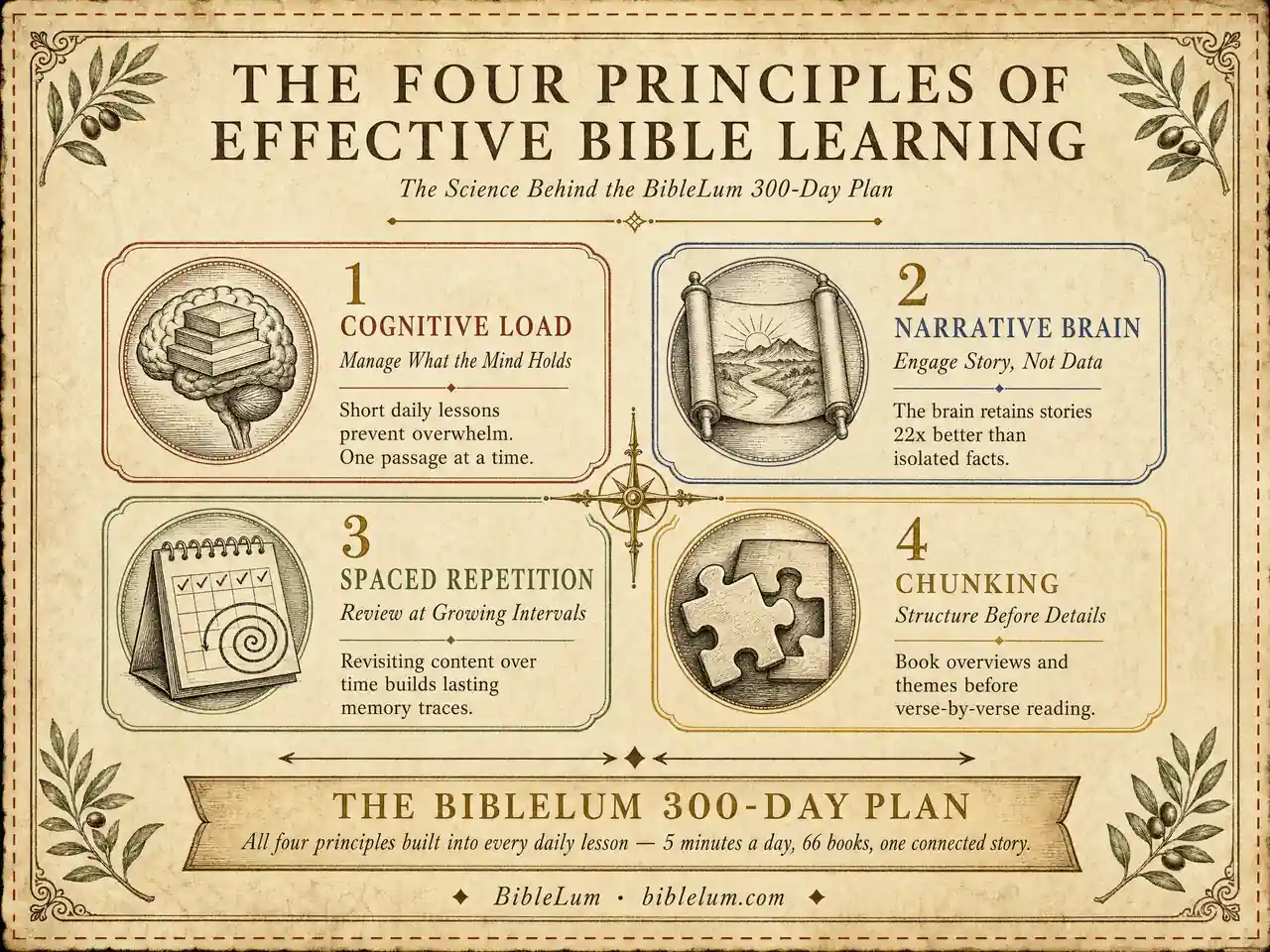
Applying these four principles — managing cognitive load, engaging the narrative brain, using spaced repetition, and providing structural scaffolding — produces a specific recommendation for how to begin reading the Bible. The recommendation is not to start at Genesis 1 and read straight through. It is to begin with a guided, sequenced journey through the Bible's overarching narrative, broken into short daily sessions, with each session providing the contextual scaffolding that makes the day's reading comprehensible.
This is the design philosophy behind BibleLum's 300-day journey through all 66 books. Rather than presenting the Bible as a reading challenge to be completed, it presents it as a story to be understood — one conversation at a time, one day at a time, across a sequence carefully designed to build cumulative understanding rather than to produce a sense of failure. Each daily lesson is short enough to fit into a busy schedule, structured to minimize cognitive load, and designed to connect the day's content to the larger narrative arc that gives it meaning.
If you are new to the Bible and want to understand the big story before diving into individual books, the best place to start is the Beginner's Guide to Bible Study — a structured introduction to the Bible's narrative, designed specifically for readers who have never studied Scripture before.
What to Expect in the First 30 Days
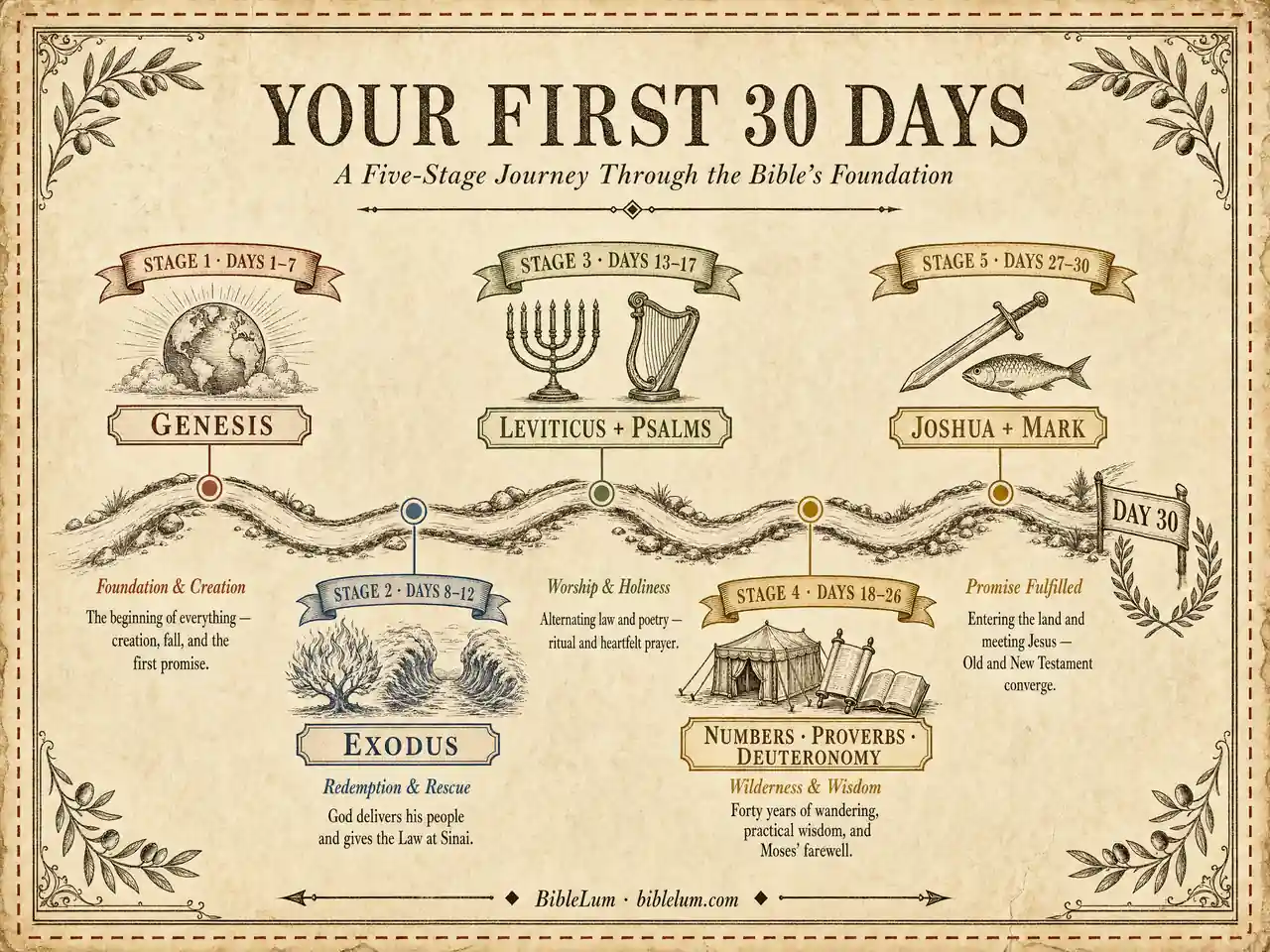
The first thirty days of a structured beginner Bible study are the most critical — and the most likely to produce either the habit that sustains long-term engagement or the discouragement that ends it. In BibleLum, the journey begins with Genesis, because Genesis gives the foundation for the whole Bible's story. The early days then move through Exodus, Leviticus, Psalms, Proverbs, and other books in a guided sequence, so beginners are never left alone in dense sections.
The 30-Day Sequence at a Glance
- Days 1–7: Genesis (Chapters 1–50). The journey opens with the book that introduces every major theme — creation, image, fall, covenant, promise, and redemption. Understanding Genesis is not optional for understanding the Bible; it is the prerequisite for everything that follows.
- Days 8–12: Exodus. Moses, the burning bush, the ten plagues, the Passover, the Ten Commandments, and the Tabernacle. Exodus is where the story of Israel — and the story of rescue — begins to take shape.
- Days 13–17: Leviticus and Psalms (alternating). Rather than reading Leviticus straight through, BibleLum alternates it with Psalms — so dense priestly legislation is balanced with poetry and prayer. This genre alternation is intentional: it keeps engagement high and prevents the cognitive fatigue that causes most readers to quit.
- Days 18–26: Numbers, Proverbs, and Deuteronomy. The wilderness years, wisdom literature, and Moses' farewell address. By this point, the reader has the narrative scaffolding to understand why these books matter.
- Days 27–30: Joshua and the Gospel of Mark. The conquest of Canaan and the opening of Mark's fast-paced Gospel — the first New Testament pivot in the journey. The contrast between Old and New Testament is now visible, not abstract.
This sequence is not arbitrary. It is designed around the learning principles reviewed above: managing cognitive load, engaging the narrative brain, using spaced repetition, and providing structural scaffolding in the order that the brain needs it. The variety of genres — narrative, law, poetry, gospel — maintains engagement by preventing the monotony that causes readers to disengage.
The Role of Reflection and Conversation in Deep Learning
Learning science consistently shows that passive reading — even attentive, careful reading — produces shallower retention than active processing. The most effective learning involves retrieval practice[6] (recalling information from memory rather than re-reading it), elaborative interrogation (asking why and how questions about the material), and self-explanation (articulating in one's own words what the text means and how it connects to what one already knows).
For Bible study, this means that reading alone is not enough. The reader who reads a passage and immediately moves on retains far less than the reader who pauses to ask: What did I just read? What does it mean? How does it connect to what I read yesterday? What does it mean for how I live? These are not merely devotional questions; they are the cognitive operations that convert short-term comprehension into long-term understanding.
This is why BibleLum's lesson structure includes reflection prompts and conversational AI responses — not as a substitute for the text but as a mechanism for the active processing that deep learning requires. The AI does not interpret the Bible for you; it asks the questions that prompt you to interpret it yourself, and responds to your reflections in ways that deepen rather than replace your own engagement with the text. To see how this works in practice, explore How BibleLum Works.
How to Start Your Bible Study for Beginners
The question of how to start reading the Bible has a simple answer and a complex one. The simple answer is: start today, start small, and start with a guide. The complex answer is everything in this article — the cognitive science behind why certain approaches work and others fail, the principles that should govern the sequencing and pacing of a Bible reading plan, and the specific design choices that make a structured journey more effective than an unguided one.
If you are new to the Bible and want to understand the big story before diving into individual books, begin with the Beginner's Bible Study Guide — a structured introduction to the Bible's narrative, designed specifically for readers who have never studied Scripture before.
When you are ready to go deeper, the 300-day journey through all 66 books puts these learning principles into practice from day one. Each lesson is short, structured, and connected to the larger narrative that gives it meaning. There are no prerequisites and no prior knowledge required. The goal is not to complete a Bible reading plan; it is to understand a story — and to let that story change the way you see everything else.