Most people who want to study the Bible more seriously eventually ask the same question: what should my notes actually look like? They open a blank notebook, write a verse at the top, and then stare at the page. The problem is not motivation — it is structure. A Bible study notebook without a clear template is like a kitchen without a recipe: you have all the ingredients but no idea what to make.
This guide answers the question directly. It describes what a well-designed Bible study notes template contains, why each component matters, and how BibleLum's two free notebook resources — the generic Bible Study Notebook Templates PDF (linked at the end of this guide) and the book-specific Personal Journal Template (available with every Study Pack) — both implement these elements in a format you can print at home and use immediately.
What's Included in the Free Notebook Templates
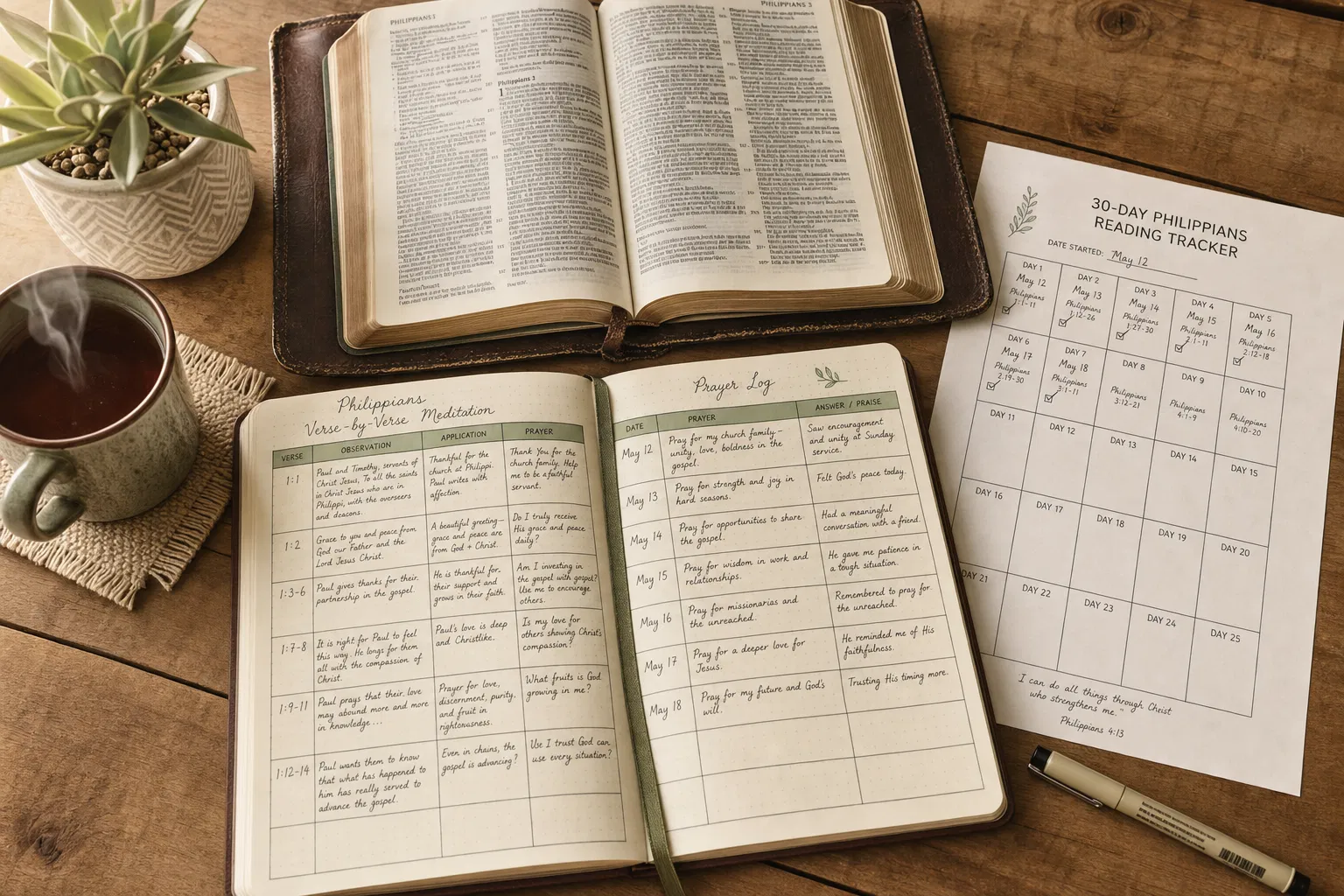
- Generic Bible Study Notebook Templates PDF (download from this guide's CTA) — A4 printable spread (US Letter compatible) with the verse-by-verse meditation grid, passage-anchored prayer log, and 30-day reading tracker. Works for any book of the Bible.
- Book-specific Personal Journal Template (download from any Study Pack page) — the same three-component framework tailored to each book's key verse and chapter count. Available as a separate PDF for Genesis, Philippians, John, Romans, Psalms, and other Study Pack books.
- Print-optimized layout — 11pt body text, generous margins for marginal notes, and a color palette that prints cleanly in both color and black-and-white modes.
- Free, no account required — download either PDF directly; print at home in under five minutes or take to a local print shop for a bound copy.
What Should Ideal Bible Study Notes Look Like?
Research on retention and reflective learning consistently shows that handwritten notes outperform typed notes for conceptual material — not because typing is slower, but because handwriting forces the writer to process and summarize rather than transcribe verbatim.[1] For Bible study, this means the best notes are not a transcript of what you read; they are a record of what you understood, what you questioned, and what you intend to do differently.
A well-designed Bible study notes template has three structural components, each serving a distinct cognitive function:
- A Meditation Grid — a structured space for verse-by-verse observation and reflection, designed to slow the reader down and surface meaning that a fast reading misses.
- A Prayer Log — a dedicated section for recording prayers that arise from the text, linking the intellectual work of study to the devotional practice of prayer.
- A Reading Tracker — a visual record of daily reading progress that provides accountability, builds momentum, and reveals patterns in consistency over time.
These three components correspond to three distinct modes of engagement with Scripture: observation (what does the text say?), response (how do I respond to what it says?), and habit (am I actually reading consistently?). A notebook that addresses all three is qualitatively different from one that only captures observations.
Component 1: The Meditation Grid (Verse-by-Verse Observation)
The meditation grid is the core of any serious Bible study notes template. Its purpose is to create a structured encounter with the text at the verse level — moving slowly enough to notice details that a chapter-level reading would skip.
The Four-Column Structure
A well-designed meditation grid contains four columns for each verse or passage segment: the verse reference, a space to write the verse in your own words (paraphrase), a space to record what the verse reveals about God or the human condition (observation), and a space to note one personal application (response). This four-column structure is based on the classical lectio divina[2] tradition, adapted for systematic verse-by-verse study.
How BibleLum's Templates Implement the Grid
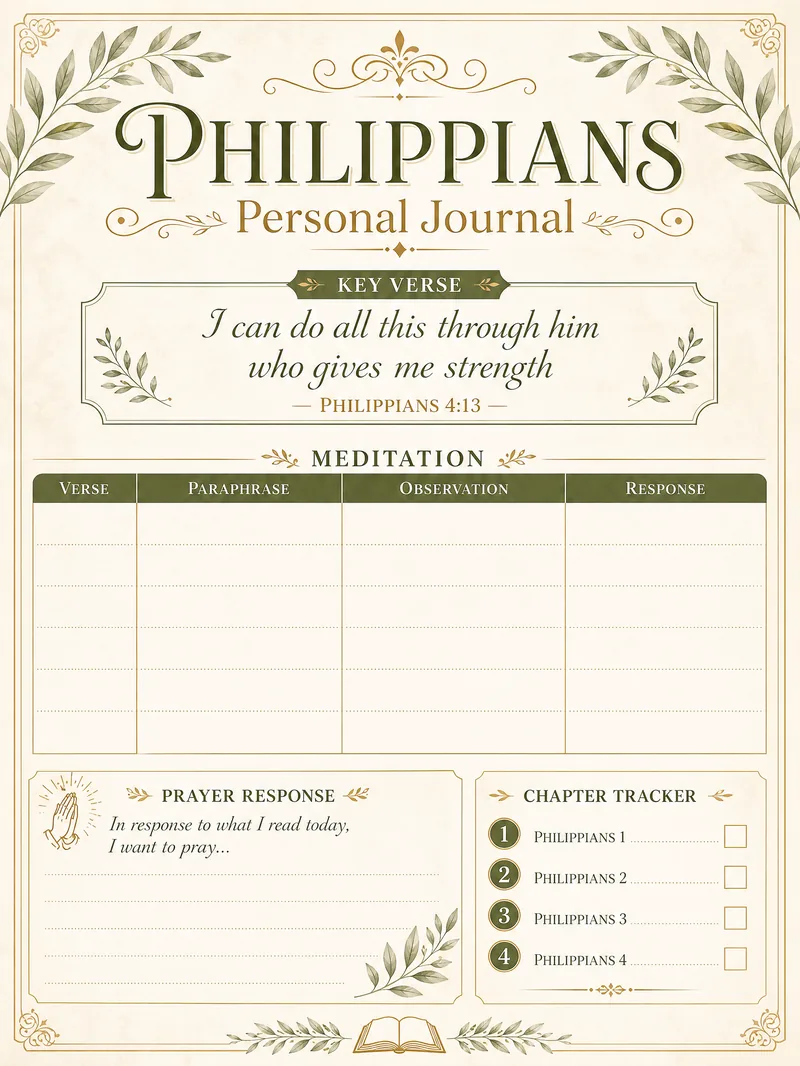
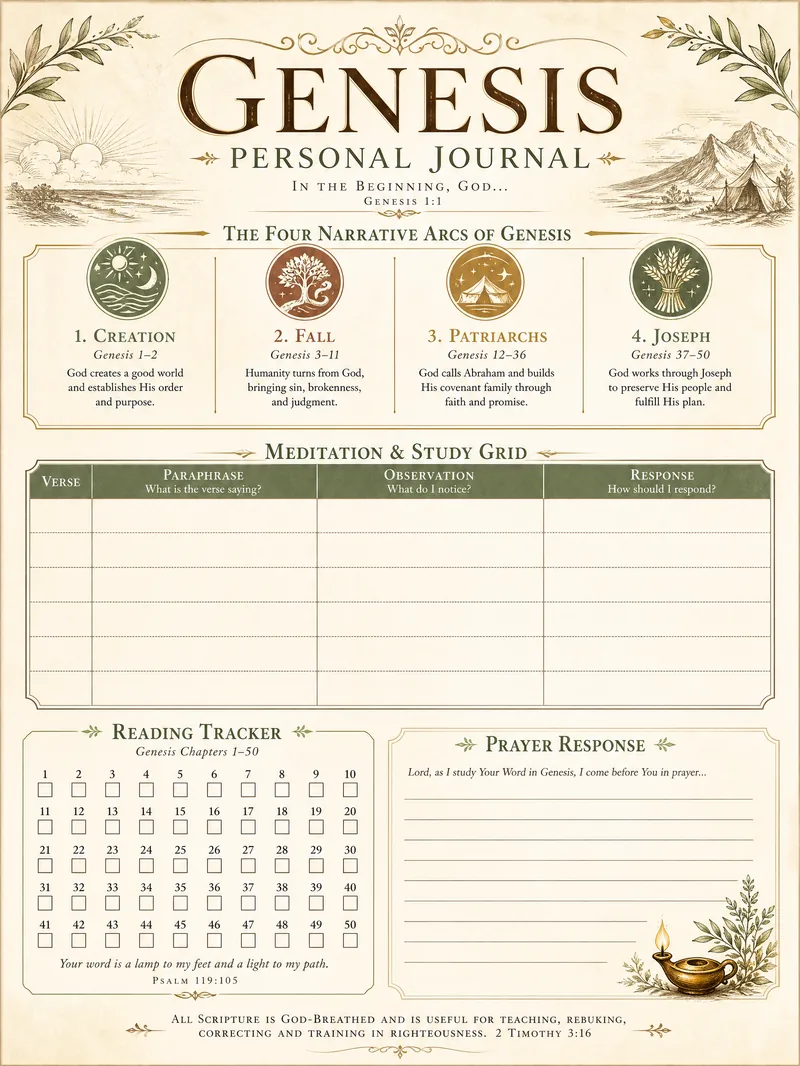
The book-specific Personal Journal Template (downloadable from each Study Pack page) implements this structure with a warm parchment background and Playfair Display typography that makes the page feel like a genuine journal rather than a worksheet. Each book's template is tailored individually: the Philippians journal opens with the key verse — “I can do all this through him who gives me strength” (Philippians 4:13) — and includes a chapter-by-chapter structure that mirrors the Study Pack's Chapter Overview section. The Genesis journal opens with the book's four narrative arcs already mapped, so the reader can see at a glance which section of the book they are journaling through.
Component 2: The Prayer Log
The most common failure mode of Bible study is the gap between intellectual understanding and personal transformation. A reader can correctly identify that Romans 8:28 teaches divine providence and still respond to adversity with anxiety rather than trust. The gap is not theological — it is devotional. The prayer log is the structural bridge between the two.
The Format: Anchored to a Specific Passage
A prayer log in a Bible study notebook is not a general prayer journal. It is passage-specific: each entry is anchored to a verse or theme from the day's reading. The format is simple — date, passage reference, a one-sentence summary of what the passage revealed, and a written prayer that responds directly to that revelation. This format prevents the common drift where prayer becomes disconnected from Scripture and reverts to a list of personal requests.
How BibleLum's Templates Implement the Prayer Log
Both BibleLum templates include a dedicated Prayer Response section at the bottom of each study page. The section is pre-formatted with a prompt: “In response to what I read today, I want to pray…” This prompt is deliberately open-ended — it can accommodate a sentence or a paragraph, a confession or a petition, a lament or a doxology. The goal is to make the transition from observation to prayer as frictionless as possible.
Component 3: The Reading Tracker
Consistency is the most underrated variable in Bible study. A reader who spends 15 minutes with Scripture every day for 30 days will develop a deeper familiarity with a book than a reader who spends three hours on a single Sunday and then does not return for two weeks. The reading tracker is the accountability mechanism that makes daily consistency visible.
The 30-Day Grid and the "Don't Break the Chain" Effect
A reading tracker in a Bible study notebook is a simple grid: 30 or 31 boxes, one for each day of the month, with a space to record the passage read and a checkbox to mark completion. The visual effect of a completed row of checkboxes is a powerful motivator — behavioral researchers call this the “don't break the chain” effect, first popularized by Jerry Seinfeld's productivity method.[3] The tracker makes the streak visible, which makes it worth protecting.
How BibleLum's Templates Implement the Tracker
Both BibleLum templates include a 30-day Reading Tracker. In the book-specific Personal Journal Template, it sits on the inside front cover and is organized by chapter: each row corresponds to a chapter of the book, with daily check-in boxes running across the page. The grid fits on a single printable page even for longer books like Genesis, doubling as a chapter completion record — a visual map of progress through the entire book. The generic Notebook Templates PDF includes a universal 30-day grid that works for any book.
Why Printable Matters: The Case for Paper
Digital note-taking apps offer convenience, but they also introduce friction of a different kind: the same device used for Bible study is also used for email, social media, and news. Research on digital distraction consistently shows that the mere presence of a smartphone — even face-down and silent — reduces available cognitive capacity.[4] A printed journal eliminates this friction entirely. The page has one purpose. There are no notifications.
The BibleLum Journal Templates are designed for print from the ground up. Each template is formatted as a high-quality PDF sized for A4 and compatible with US Letter printing, optimized for home printing on standard 80gsm paper. The layout uses generous margins (allowing for underlining and marginal notes), a font size of 11pt for body text (legible without magnification), and a color palette that prints cleanly in both color and black-and-white modes. You can print the entire journal at home in under five minutes, or take the PDF to a local print shop for a bound copy.
How to Set Up Your Bible Study Notebook: A Step-by-Step Guide
- Step 1: Choose your book. Select a biblical book from the BibleLum Study Pack library. If you are new to Bible study, Philippians (4 chapters, 15 minutes to read) or John (21 chapters, 90 minutes to read) are ideal starting points. If you are returning to a book you have read before, Genesis or Romans will reward the deeper engagement that a journal enables.
- Step 2: Download a notebook template. You have two options: (a) the generic Bible Study Notebook Templates PDF — get it from the download button at the end of this guide; or (b) the book-specific Personal Journal Template — open the matching Study Pack page (Genesis, Philippians, John, Romans, Psalms, etc.) and click the second download button. Both PDFs are A4 printable (US Letter compatible) and use the same three-component framework.
- Step 3: Read the Visual Overview first. Before you begin journaling, spend 10 minutes with the Visual Overview infographic — it lives inside the Study Pack PDF (the first download button on each Study Pack page). The map of the book — its structure, major themes, and key passages — orients your verse-by-verse notes inside the larger narrative.
- Step 4: Set a daily session length. Fifteen minutes is sufficient for a single chapter of a short letter. Thirty minutes is appropriate for a narrative chapter of Genesis or Acts. The key is consistency, not duration: a 15-minute daily session for 30 days produces more retention than a 3-hour session once a week.
- Step 5: Use the meditation grid for every session. For each passage, complete all four columns: verse reference, paraphrase, observation, and personal response. Do not skip the paraphrase column — the act of restating the verse in your own words is the single most effective comprehension technique available.
- Step 6: Close each session with the prayer log. Write one sentence that summarizes what the passage revealed, then write a prayer that responds directly to that revelation. The prayer does not need to be long — a single sentence is sufficient. The goal is to close the gap between observation and response.
- Step 7: Mark the Reading Tracker. Check the box for the day and the chapter you completed. If you miss a day, do not try to catch up by doubling the next session — simply resume where you left off. The tracker is a record, not a punishment.
Common Pitfalls in Notebook-Based Bible Study
A template is only as useful as the discipline of using it well. Four mistakes recur often enough that they are worth naming — each one undoes the structural advantage a good template gives you.
- Treating the meditation grid as a fill-in-the-blank quiz. The four columns are not boxes to be checked off as fast as possible. A single verse paraphrased carefully is worth more than a chapter of rushed entries. If you find yourself writing one-word answers to finish the page, slow down.
- Skipping the paraphrase column. This is the most common shortcut and the most damaging. Paraphrasing forces the kind of generative processing that handwriting research shows produces understanding — copy-paste of the verse text bypasses the entire mechanism.
- Switching templates every week. A template only compounds value if you use it long enough to internalize its rhythm. Pick one structure, commit to it for at least 30 days, and resist the temptation to redesign mid-stream.
- Letting a missed day end the streak permanently. The reading tracker is a record of consistency, not a punishment for perfection. If you miss Tuesday, do not skip Wednesday to "even things out" — just resume. The chain that matters is the one you continue, not the one you started.
A Comparison: Generic Notebook vs. BibleLum Journal Template
Disclosure: BibleLum is the publisher of this guide. The comparison below is included because the BibleLum Journal Template is one of the templates this article describes, and a side-by-side helps readers understand what a purpose-built template offers that a blank notebook does not. The trade-offs are real either way.
Both tools have a place, and the right choice depends on what kind of work you want the notebook to do. A blank notebook is the better fit if you prefer free-form journaling, want to develop your own structure over time, or are doing topical study where a fixed template would be too rigid. A printable template fits better if you are studying one book at a time, want consistency across reading sessions, or have ever opened a blank page and stalled. Neither is universally better — they answer different reading goals.
Last updated June 2026 — the comparison below reflects the current BibleLum 2026 template revisions (verse-by-verse meditation grid, prayer log, 30-day reading tracker; A4 + US Letter PDF).
| Feature | Generic Notebook | BibleLum Templates |
|---|---|---|
| Structure | Blank pages — requires self-design | Pre-formatted meditation grid, prayer log, and reading tracker |
| Book specificity | Generic — same for every book | Generic Notebook Templates PDF works for any book; per-book Personal Journal Templates available for Genesis, Philippians, John, Romans, Psalms, and others |
| Companion resources | Not included | Visual Overview infographic and Discussion Guide available as a separate Study Pack PDF download from each Study Pack page |
| Print quality | Depends on notebook brand | A4 PDF (US Letter compatible) optimized for home printing, color and B&W compatible |
| Cost | Varies ($5–$30 for a study journal) | Free — Notebook Templates PDF from this guide; book-specific Personal Journal Templates from each Study Pack page |
The table above is not a criticism of generic notebooks — a blank Moleskine is a perfectly good tool for free-form journaling. The point is that Bible study is a specific task with specific structural requirements, and a purpose-built template serves those requirements better than a blank page. The BibleLum templates are free, printable, and either generic or book-specific depending on which fits your goal.